OCR · GCSE · English Language
Interpreting Implicit Information
This guide focuses on the crucial skill of interpreting implicit information (AO1) for OCR GCSE English Language. You will learn to move beyond surface-level reading to decode subtext, tone, and unstated ideas, a skill essential for earning top marks across the reading papers."
- 8 min read
- 3 worked examples
- 5 practice questions
Study Notes

Overview
Welcome to your deep dive into one of the most fundamental skills for GCSE English Language: Interpreting Implicit Information. This skill, assessed under Assessment Objective 1 (AO1), is all about reading between the lines. While AO1 also covers explicit information (what the text directly states), the real challenge and the key to higher marks lies in understanding what a writer suggests or implies.
This guide will equip you with the techniques to dissect unseen 19th, 20th, and 21st-century texts, identify subtle clues, and articulate your inferences with the precision of a top-band candidate. Mastering this is not just about a few short-answer questions; it is the bedrock for your analysis of language and structure (AO2) and your evaluation of a writer's methods (AO4).
Reading Skills
Identifying Information & Ideas
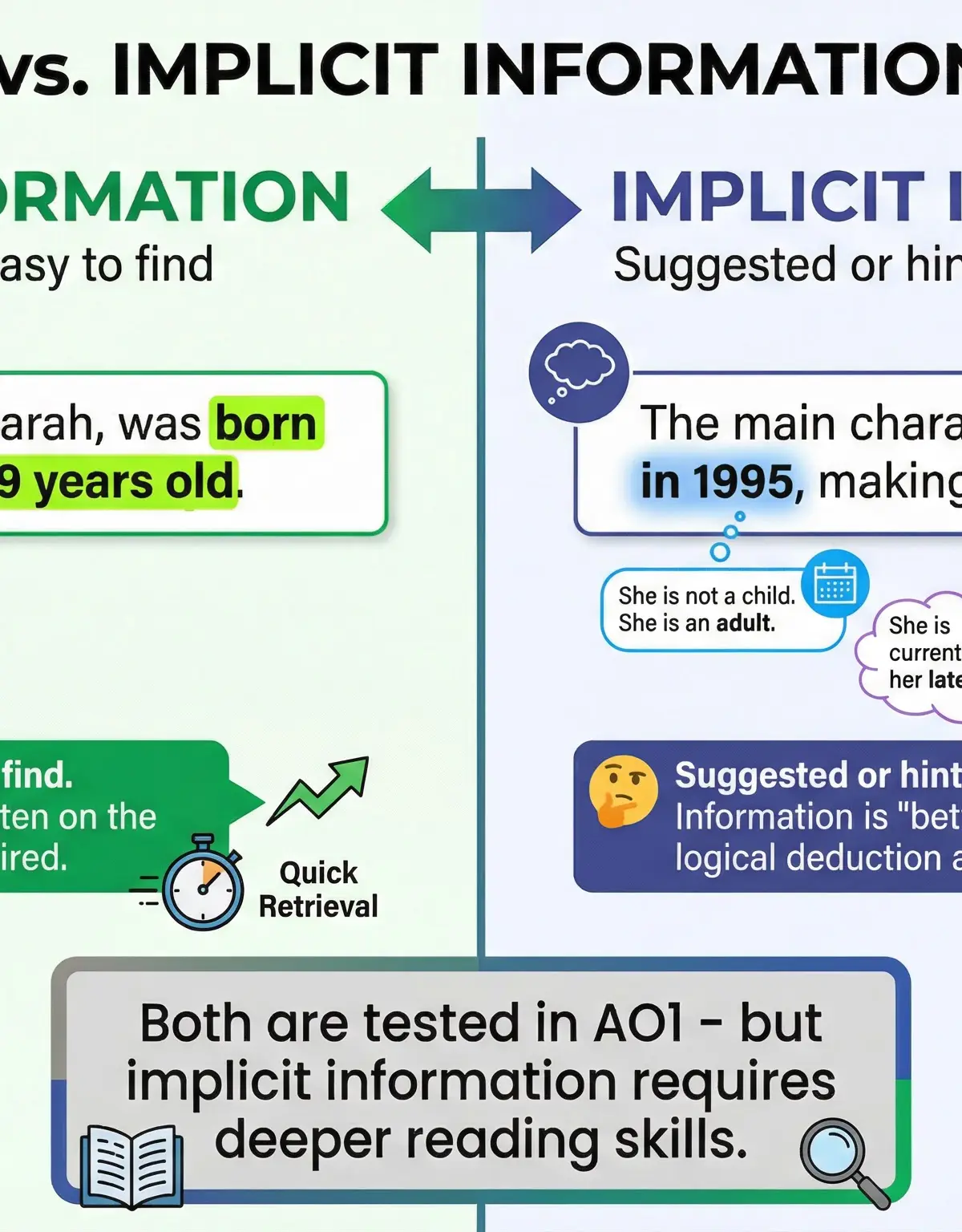
At its core, reading comprehension is a two-part skill: retrieving what is explicitly stated and inferring what is implicitly suggested.
- Explicit Information: This is the surface-level detail. If a text says, "The sky was grey," the explicit information is that the sky was grey. It requires no interpretation.
- Implicit Information: This is the subtext. A grey sky might imply a gloomy atmosphere, pathetic fallacy reflecting a character's mood, or foreshadowing an unhappy event. To access this, you must be a reading detective, looking for clues in the writer's choices.
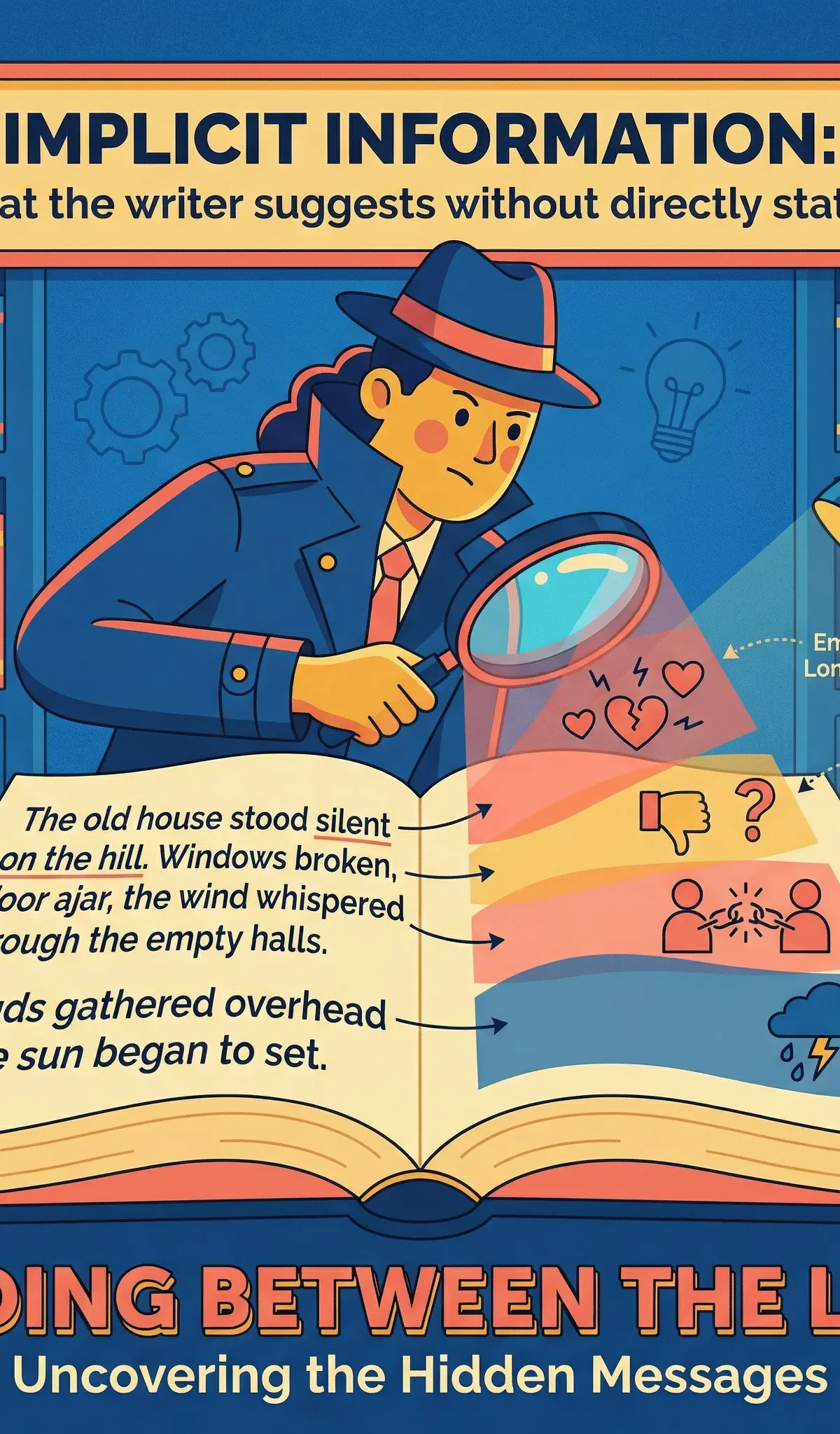
To make a valid inference, you must root your idea in the text. Ask yourself: What specific words or phrases led me to this conclusion? This is the difference between a valid inference and simple speculation.
Analysing Language
Language analysis (AO2) is where you explain how a writer uses words and phrases to create meaning and effects. This builds directly on your ability to infer. You identify a technique, but the credit comes from explaining the implicit effect it has on the reader.
Key Language Features to Identify
| Feature | Definition | Effect on Reader | Example |
|---|---|---|---|
| Metaphor | A figure of speech where a word or phrase is applied to an object or action to which it is not literally applicable. | Creates a powerful, often complex image in the reader's mind, layering meanings. | "The classroom was a zoo." (Suggests chaos, noise, lack of control). |
| Simile | A comparison of one thing with another thing of a different kind, using 'as' or 'like'. | Makes a description more vivid and relatable by linking it to a familiar image. | "He was as brave as a lion." (Emphasises his courage). |
| Pathetic Fallacy | The attribution of human feelings and responses to inanimate things or animals, especially the weather. | Creates a specific atmosphere that often reflects the mood of a character or the tone of the narrative. | "The miserable rain wept down the windowpane." (Projects a feeling of sadness onto the scene). |
| Personification | Giving human qualities or abilities to something that is not human. | Brings an object or concept to life, allowing the reader to connect with it on an emotional level. | "The wind whispered through the trees." (Creates a sense of gentle, secret communication). |
| Alliteration | The occurrence of the same letter or sound at the beginning of adjacent or closely connected words. | Can create a specific soundscape, affecting the pace and mood of the text. Can be harsh (plosive) or soft (sibilant). | "The snake slithered silently." (The 's' sound mimics the noise of a snake, creating a sinister feel). |
| Sibilance | A specific type of alliteration focusing on the repetition of soft consonant sounds, typically 's'. | Often creates a hissing, sinister, or soothing sound, depending on the context. | "The sea sighed sadly on the shore." (Creates a soft, melancholic sound). |
| Juxtaposition | Placing two contrasting ideas, characters, or descriptions close together. | Highlights the differences between them, often to create a dramatic or ironic effect. | "The pristine new houses were built next to the crumbling, ancient slum." (Emphasises the gap between rich and poor). |
Analysing Structure
Structure (also AO2) is about how a writer organises a text to guide the reader from beginning to end. It’s the narrative architecture. Key features include:
- Openings: How does the writer hook the reader in? In media res? A description? Dialogue?
- Shifts in Focus: Where does the narrative perspective change? From a wide view to a close-up? From one character to another?
- Narrative Perspective: First person (I), third person limited (he/she knows their own thoughts), or third person omniscient (he/she knows everyone's thoughts)? How does this affect what we know?
- Sentence and Paragraph Structure: Are sentences long and complex, or short and punchy? Why? Do paragraphs focus on a single idea? Are they long or short?
- Cyclical Structure: Does the text end where it began? What does this imply?
- Flashback/Foreshadowing: Does the writer play with time to reveal information or build suspense?
Evaluating Critically
Evaluation (AO4) asks for your informed, personal judgement on a text. You must assess how effectively a writer has achieved their purpose. This is not just saying "I liked it." It requires a structured argument.
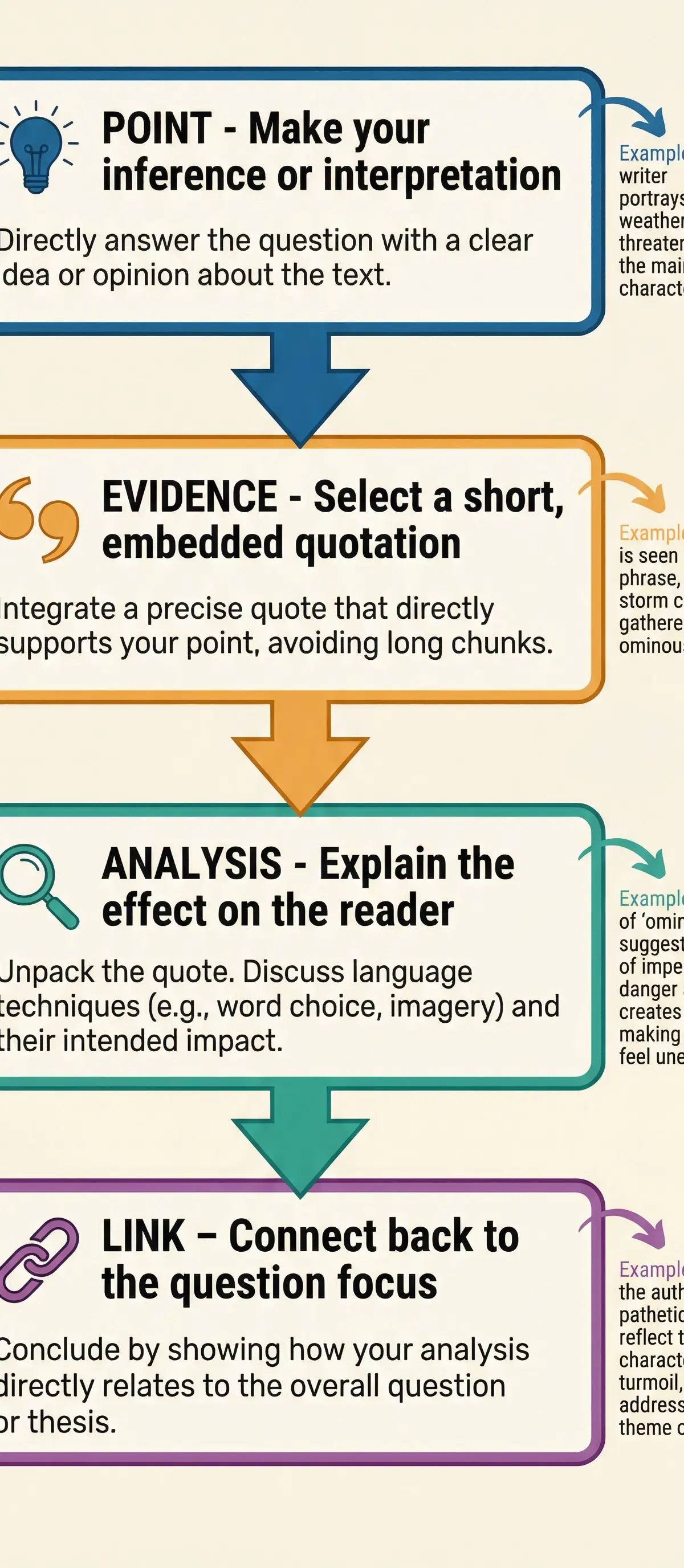
Use the Point-Evidence-Analysis-Link structure, but with an evaluative edge. Start with a clear judgement: "To a large extent, the writer successfully creates a tense atmosphere..." Then, prove it, using the same analysis skills but always linking back to how effective the chosen method is.
Comparing Writers' Viewpoints
For the comparison question, you must synthesise your understanding of two texts. A good framework is:
- Identify Viewpoints: What is the core attitude or opinion of each writer towards the topic?
- Compare Methods: How do they use language and structure to convey these viewpoints? Compare their choices directly.
- Evaluate Effectiveness: Which writer do you find more convincing or powerful, and why?
Writing Skills
Creative Writing (Narrative/Descriptive)
This is your chance to show, not just tell. Examiners are looking for control, creativity, and technical accuracy.
- Show, Don't Tell: Instead of saying "He was angry," describe it: "He clenched his fists, his jaw tight, a muscle twitching in his cheek."
- Sensory Description: Engage all five senses. What can be seen, heard, smelled, tasted, and touched?
- Varied Sentence Structures: Mix simple, compound, and complex sentences to control pace and rhythm.
- Engaging Openings: Start with action, dialogue, or a mystery to hook the reader.
- Satisfying Endings: A good ending provides a sense of closure, perhaps by linking back to the opening (cyclical structure).
Transactional/Non-Fiction Writing
This is about writing for a specific purpose, audience, and form (e.g., a letter, article, speech).
- Purpose-Audience-Form (PAF): Always keep these three in mind. A letter to your headteacher will have a different tone and structure to a speech for your peers.
- AFOREST: Use this acronym to remember key persuasive techniques: Alliteration, Facts, Opinions, Rhetorical questions, Emotive language, Statistics, Three (rule of).
Technical Accuracy (SPaG)
Spelling, Punctuation, and Grammar (SPaG) are critical. They account for a significant portion of the marks in the writing tasks.
- Ambitious Punctuation: Correctly using semicolons, colons, dashes, and parenthetical commas will impress examiners.
- Paragraph Cohesion: Use discourse markers (e.g., Furthermore, In contrast, Consequently) to link your ideas logically.
Worked Examples
3 worked examples — open one to explore the question and available guidance.
Practice Questions
Test your understanding — click to reveal model answers
From the sentence, 'He didn't smile, but a flicker of warmth entered his eyes,' what can you infer about the character's feelings?
Hint: Focus on the contrast between the lack of a smile and the 'flicker of warmth'. What does this subtle detail suggest?
Read the sentence: 'The city was a jungle, and he was just another predator on the prowl.' Identify the language feature used and explain its effect.
Hint: Identify the metaphor first. Then, think about the connotations of 'jungle' and 'predator'. What does this comparison suggest about the city and the character?
Write the opening to a story where the weather reflects a character's inner turmoil. You should write about 150 words.
Hint: Use pathetic fallacy. Think about what kind of weather would mirror turmoil - a storm? A thick fog? How can you describe the weather using emotive language?
Analyse how the writer uses structural features in the opening of a story to build suspense.
Hint: Look for shifts in focus, sentence length variation, and the withholding of information. How does the writer control what the reader knows and when?
Write a speech for your school assembly arguing that mobile phones should be allowed in school.
Hint: Remember PAF! Your purpose is to persuade, your audience is teachers and students, and your form is a speech. Use AFOREST techniques and a clear, confident tone.
Test your understanding of Interpreting Implicit Information
Active recall beats re-reading. Take an instant quiz now to test what you’ve learned and lock it into long-term memory.
7 days Premium · Then free forever · No card, no charge