Wuthering Heights (Emily Brontë)
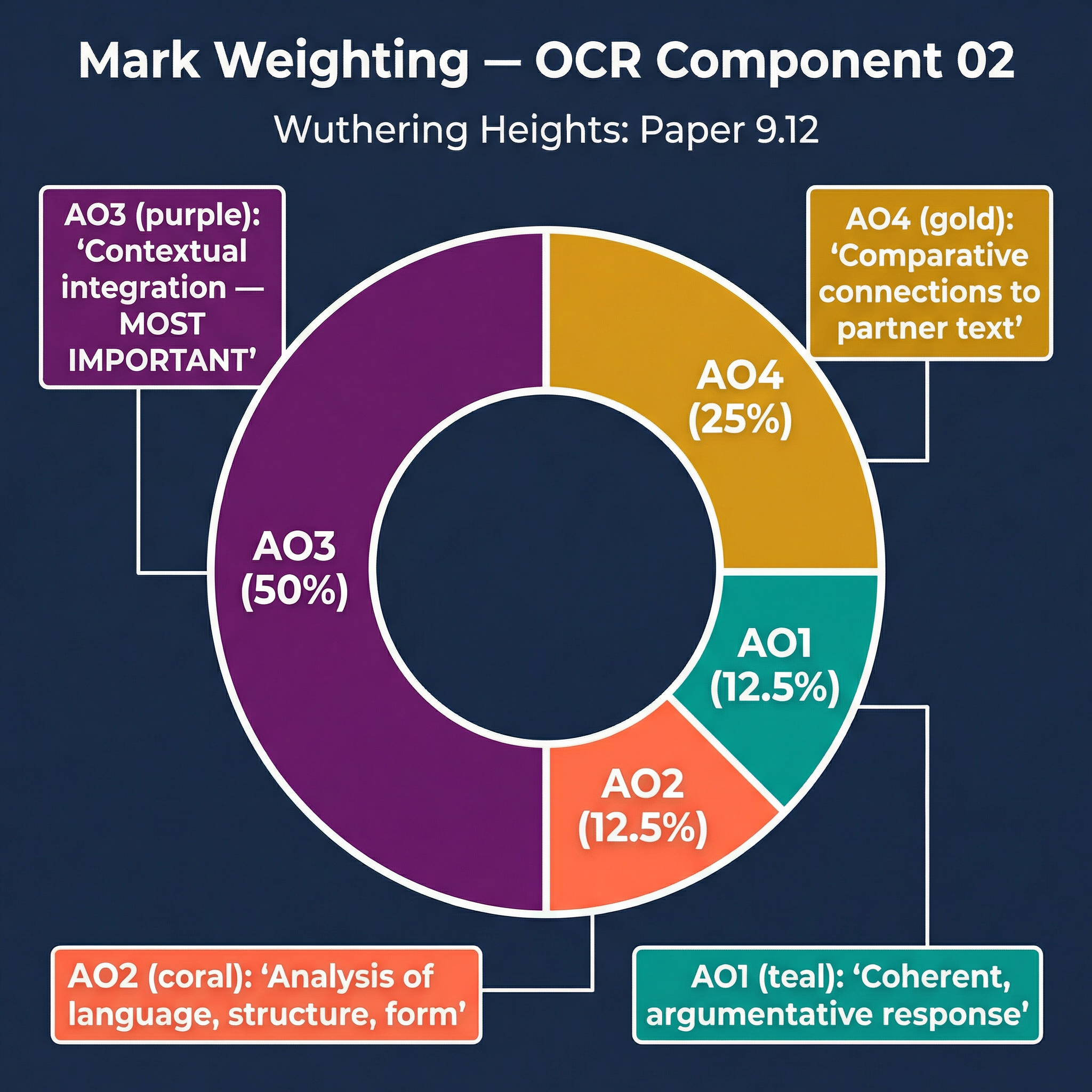
Unlock a top grade in Wuthering Heights with this guide, designed to show you how to analyse the novel as a Gothic text. We focus on the key assessment objectives, helping you to integrate context and comparison for maximum marks.
Study Notes
Overview
Wuthering Heights is a radical and transgressive novel that pushes the boundaries of the Gothic genre. For the OCR A-Level, candidates must move beyond seeing it as a simple romance and instead analyse it as a complex critique of Victorian society, exploring themes of obsession, revenge, and the supernatural. Examiners are looking for a conceptualised argument that engages with Brontë’s structural and linguistic choices, integrating contextual factors as the driving force of meaning. A high-level response will deconstruct the novel’s nested narrative, analyse the symbolic settings of the Heights and the Grange, and evaluate the motivations of its unreliable narrators. The key to success is to treat this as a comparative and contextual study, weaving in your partner text and the socio-historical landscape of the 1840s throughout your analysis.
Plot/Content Overview
The novel is structured in a non-linear fashion, framed by the narrative of Lockwood, a tenant at Thrushcross Grange in 1801. The main story is recounted to him by the servant, Nelly Dean.
- Chapters 1-3: Lockwood visits his landlord, Heathcliff, at Wuthering Heights and has a terrifying supernatural experience, dreaming of Catherine Earnshaw’s ghost.
- Chapters 4-9: Nelly begins her story, describing Heathcliff’s mysterious arrival as a child, his intense bond with Catherine Earnshaw, and the cruel treatment he suffers from Catherine’s brother, Hindley. Catherine’s fateful decision to marry Edgar Linton for social status causes Heathcliff to flee.
- Chapters 10-17: Heathcliff returns three years later, wealthy and determined to enact revenge. He marries Edgar’s sister, Isabella, treating her cruelly. Catherine becomes mentally and physically ill, eventually dying after giving birth to a daughter, also named Catherine. Heathcliff is devastated and begs her spirit to haunt him.
- Chapters 18-24: The narrative moves to the second generation. Nelly recounts the childhood of the younger Catherine (Cathy), her sheltered life at the Grange, and her encounters with Heathcliff’s son, Linton, and Hindley’s son, Hareton.
- Chapters 25-31: Heathcliff manipulates and forces Cathy to marry his sickly son, Linton, to secure the Linton property. After Linton’s death, Heathcliff’s revenge is complete, but he grows weary of it.
- Chapters 32-34: Lockwood returns a year later to find that Heathcliff has died. The narrative concludes with the impending marriage of Cathy and Hareton, representing a resolution and a union of the two houses. Heathcliff is buried next to Catherine, and local legend claims their ghosts roam the moors together.
Themes
Theme 1: Transgression and Social Order
The novel is built on the violation of social norms. Heathcliff, as a racial and social ‘other’, transgresses boundaries of class, property, and even the line between life and death. His revenge is a systematic dismantling of the patriarchal and class-based structures that excluded him. Catherine also transgresses Victorian ideals of femininity through her wildness and her declaration, ‘I am Heathcliff!’. Brontë uses this to critique the repressive nature of society.
Key Quotes:
- ‘I am Heathcliff! He’s always, always in my mind: not as a pleasure, any more than I am always a pleasure to myself, but as my own being.’ (Chapter 9) - This is a radical statement of identity that transcends social and gender norms, suggesting a pre-social, almost supernatural connection.
- ‘I have no pity! I have no pity! The more the worms writhe, the more I yearn to crush out their entrails!’ (Chapter 14) - Heathcliff’s violent rejection of Christian compassion, aligning him with a demonic, anti-social force.
Theme 2: The Gothic and the Supernatural
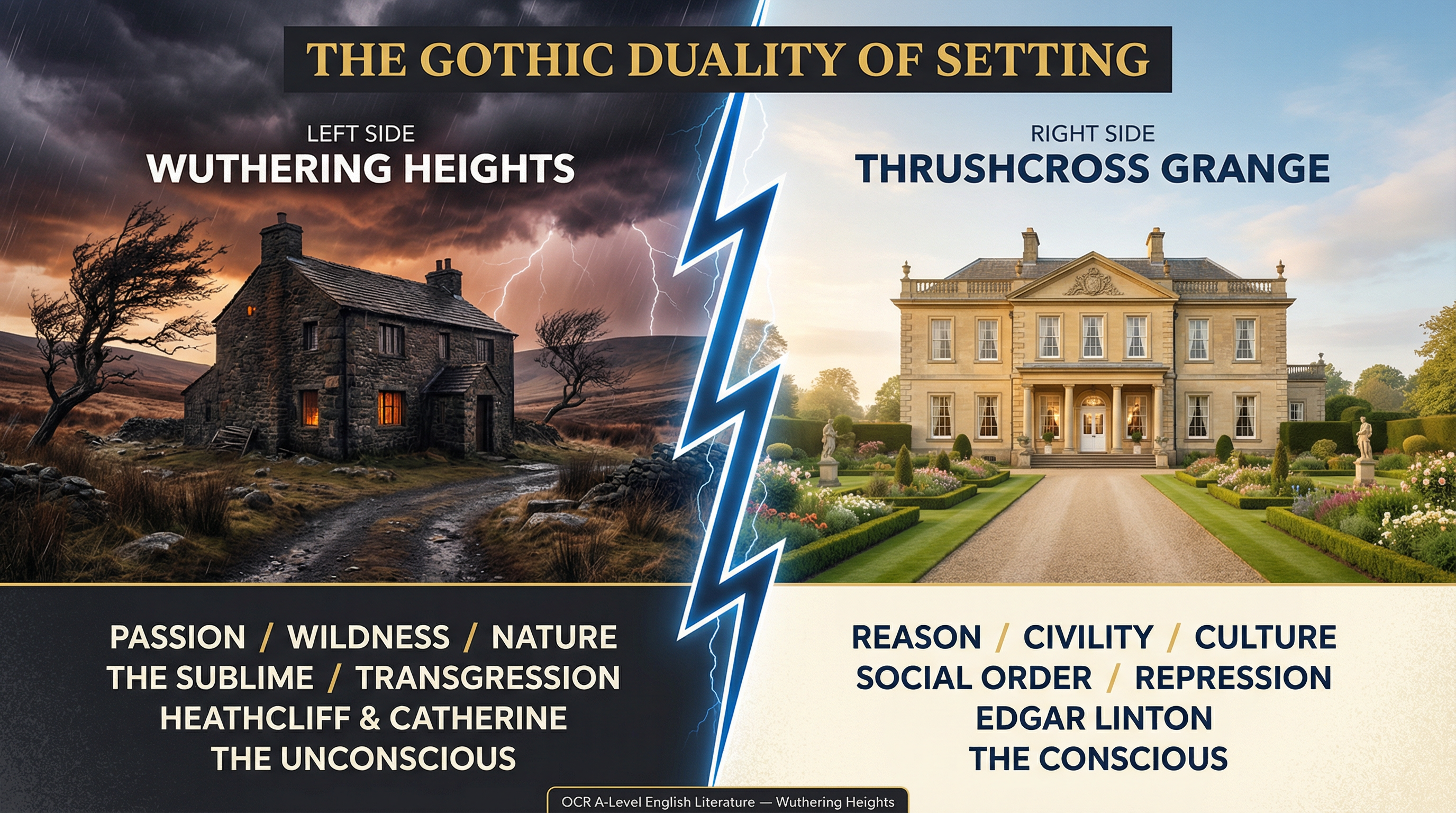
Brontë uses Gothic conventions not just for atmosphere, but to explore psychological states. The revenant (returning spirit) is central, with Catherine’s ghost haunting both Lockwood and Heathcliff. This supernatural element represents the inescapable power of the past and of passionate, obsessive love that cannot be contained by death. The sublime landscape of the moors reflects the characters’ inner turmoil.
Key Quotes:
- ‘“Let me in — let me in!”... “Catherine Linton, I’m come home: I’d lost my way on the moor!”’ (Chapter 3) - Lockwood’s dream of the ghost-child is a terrifying manifestation of the past’s intrusion into the present.
- ‘I cannot live without my life! I cannot live without my soul!’ (Chapter 16) - Heathcliff’s cry after Catherine’s death blurs the line between the self and the other, suggesting a love so absolute that separation is a form of living death.
Character Analysis
Heathcliff
Role: The novel’s protagonist-antagonist, a Byronic hero whose quest for revenge drives the plot.
Key Traits: Passionate, vengeful, cruel, mysterious, and deeply tormented. He is both a victim of social prejudice and a perpetrator of horrific abuse.
Character Arc: Heathcliff begins as a brutalised and dehumanised child. He transforms himself into a wealthy gentleman to enact a systematic revenge on the Earnshaw and Linton families. His arc culminates in a strange, spiritual reunion with Catherine in death, as he loses the will to continue his revenge.
Essential Quotes:
- ‘a dirty, ragged, black-haired child’ (Chapter 4)
- ‘Is Mr. Heathcliff a man? If so, is he mad? And if not, is he a devil?’ (Chapter 13)
- ‘My soul’s bliss kills my body, but does not satisfy itself.’ (Chapter 34)
Catherine Earnshaw
Role: The tragic heroine whose choice between passion (Heathcliff) and social status (Edgar) precipitates the central conflict.
Key Traits: Wild, passionate, selfish, and spirited. She is torn between her authentic self, which is aligned with Heathcliff and the moors, and her desire for social refinement.
Character Arc: Catherine’s arc is one of self-betrayal. Her decision to marry Edgar is a social elevation but a spiritual death. She descends into madness and dies, but her spirit endures as a haunting presence, embodying the novel’s central theme of love beyond the grave.
Essential Quotes:
- ‘It would degrade me to marry Heathcliff now; so he shall never know how I love him’ (Chapter 9)
- ‘My love for Linton is like the foliage in the woods: time will change it... My love for Heathcliff resembles the eternal rocks beneath’ (Chapter 9)
Writer’s Methods
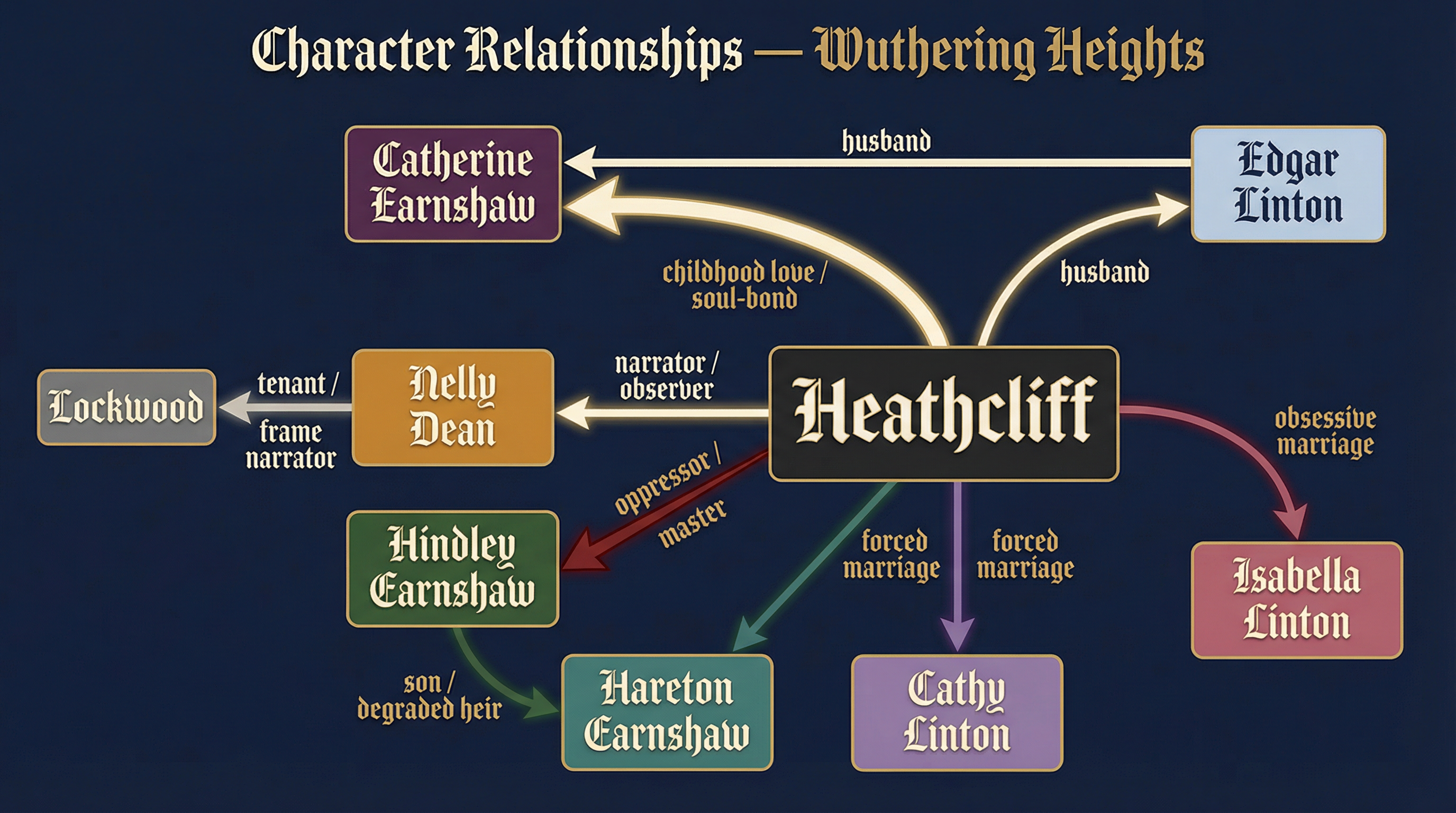
- Nested Narrative: The use of Lockwood and Nelly Dean as frame narrators is a key structural device. It creates distance and forces the reader to question the reliability of the story. For AO2, you must analyse why Brontë uses this structure. It destabilises the truth and highlights how stories are constructed, not just told. Nelly, in particular, is not a neutral observer; she is a key player whose choices and biases shape the events she describes. Credit is given for candidates who critically evaluate her narration.
- Symbolic Settings: The contrast between Wuthering Heights (storm, passion, nature) and Thrushcross Grange (calm, culture, society) is a central symbolic method. Characters’ movements between these two locations signify their internal struggles and changing values.
- Pathetic Fallacy: The weather, particularly the wind and snow on the moors, constantly reflects the characters’ violent emotions and the raw, sublime power of nature.
Context
- The Gothic Tradition: Brontë was writing in the mid-19th century, engaging with and subverting earlier Gothic conventions. Unlike earlier Gothic novels, the horror in Wuthering Heights is psychological and domestic, not located in a distant, Catholic past.
- Victorian Class System: Heathcliff’s story is a powerful critique of the rigid class hierarchy. His dispossession and subsequent revenge challenge the idea of natural inheritance and social stability. His ambiguous racial identity makes him a profound threat to the Victorian social order.
- Inheritance Laws: The novel is deeply concerned with property and inheritance. Heathcliff uses the law (specifically, laws of entail and property ownership through marriage) as a weapon to dispossess the families who wronged him. This is a key contextual point for AO3.
- Romanticism: The novel is heavily influenced by Romantic ideals, particularly the emphasis on intense emotion, the sublime power of nature, and the figure of the passionate, outcast individual (the Byronic hero).
Visual Resources
3 diagrams and illustrations
Interactive Diagrams
1 interactive diagram to visualise key concepts
Conceptual Flow Outline
Thematic development of Nature vs. Culture across the two generations.
Worked Examples
2 detailed examples with solutions and examiner commentary
Practice Questions
Test your understanding — click to reveal model answers
‘The presentation of childhood in Wuthering Heights is relentlessly bleak.’ To what extent do you agree with this view?
Hint: Consider the childhoods of Heathcliff, Catherine, Hindley, Hareton, and the younger Cathy. Is there any joy or innocence, or is it purely a story of abuse and neglect?
‘In Wuthering Heights, settings are more important than characters.’ To what extent do you agree with this view?
Hint: Think about the symbolic dualism of the Heights and the Grange. Are the characters defined by their settings, or do they define them?
Explore how Brontë presents the theme of revenge in Wuthering Heights.
Hint: Focus on Heathcliff. How does his quest for revenge begin, how does he enact it, and what is the ultimate result?
‘Nelly Dean is the true villain of Wuthering Heights.’ Evaluate this view.
Hint: This is a critical interpretation question. Analyse Nelly’s actions and omissions. Is she a harmless storyteller or a manipulative figure?