OCR · GCSE · English Literature
Remember (Christina Rossetti)
Christina Rossetti's 'Remember' is a masterful Petrarchan sonnet that moves from a desperate plea to be remembered after death to a profound, selfless act of love, urging the beloved to forget rather than grieve. This guide will unpack how Rossetti uses form, tone, and imagery to explore the complex relationship between memory, love, and mortality, giving you the tools to ace your OCR exam."
- 6 min read
- 2 worked examples
- 4 practice questions
Study Notes

Overview
"Remember" is one of Christina Rossetti's most famous poems, written in 1849 and published in her 1862 collection, Goblin Market and Other Poems. For the OCR GCSE (J352/02), it is a cornerstone of the 'Love and Relationships' poetry cluster. Examiners look for candidates who can move beyond a surface-level reading of a simple love poem. They expect a sophisticated analysis of its form as a Petrarchan sonnet, a precise tracking of the dramatic shift in tone at the volta (line 9), and an integrated understanding of Victorian mourning culture and Rossetti's own religious context. The poem charts a complex emotional journey: it begins with an almost selfish, imperative command for the speaker's beloved to remember her after she has died, but concludes with a remarkably selfless reversal, where the speaker prioritizes her beloved's happiness over her own legacy. Credit is given for analysing how this tension between control and release is managed through structural and linguistic choices.
Plot/Content Overview
The poem is a direct address from a speaker who is contemplating her own death. It can be broken down into two distinct parts, following the structure of the Petrarchan sonnet.
-
The Octave (Lines 1-8): The speaker issues a series of firm commands to her beloved. She insists, three times, "Remember me". She describes her death euphemistically as going "far away into the silent land" and acknowledges that her beloved will no longer be able to hold her hand or plan their future. The tone is insistent, anxious, and focused on ensuring her memory endures.
-
The Sestet (Lines 9-14): A dramatic shift, or volta, occurs. The speaker considers the possibility that her beloved might forget her, and urges them not to feel grief. This leads to the poem's ultimate, selfless conclusion: it is "Better by far" for the beloved to "forget and smile" than to "remember and be sad." The focus moves from the speaker's own desire for remembrance to her concern for the beloved's emotional well-being.
Themes
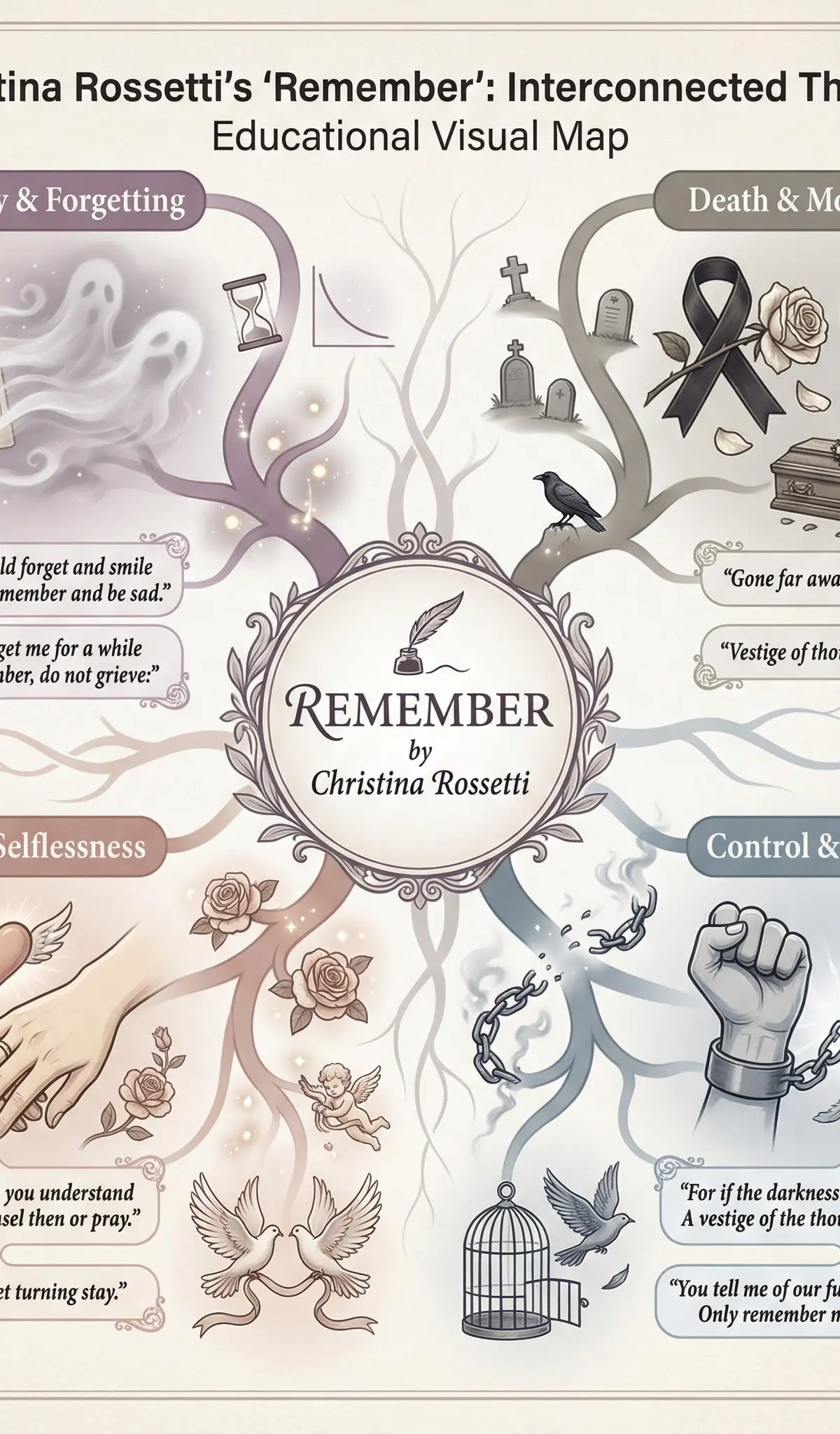
Theme 1: Memory and Forgetting
This is the central theme, evolving from a command to remember into a permission to forget. The poem explores the human anxiety of being forgotten after death, but ultimately suggests that true love means wanting happiness for the living, even at the cost of one's own legacy.
Key Quotes:
- "Remember me when I am gone away" - The opening imperative establishes the initial, controlling desire.
- "Better by far you should forget and smile / Than that you should remember and be sad." - The concluding couplet provides the selfless resolution, prioritizing the beloved's happiness.
Theme 2: Death and Mortality
Rossetti approaches the theme of death with a typically Victorian blend of euphemism and stark reality. The speaker confronts her own mortality, not with terror, but with a practical, albeit emotional, consideration of its consequences for the one she leaves behind.
Key Quotes:
- "Gone far away into the silent land" - A euphemism for death that softens its finality, presenting it as a journey to a quiet, unknown place.
- "For if the darkness and corruption leave / A vestige of the thoughts that once I had" - A more direct and visceral acknowledgement of the physical decay of death, contrasting with the earlier euphemisms.
Theme 3: Love and Selflessness
The poem presents a mature and evolving form of love. It begins with what could be seen as a selfish form of love—one that demands to be remembered—but transforms into a profoundly selfless love that prioritizes the beloved's emotional state above all else.
Key Quotes:
- "Only remember me; you understand" - The possessive, almost pleading tone of the octave.
- "do not grieve" - A simple but powerful command that signals the shift towards selfless concern.
Writer's Methods
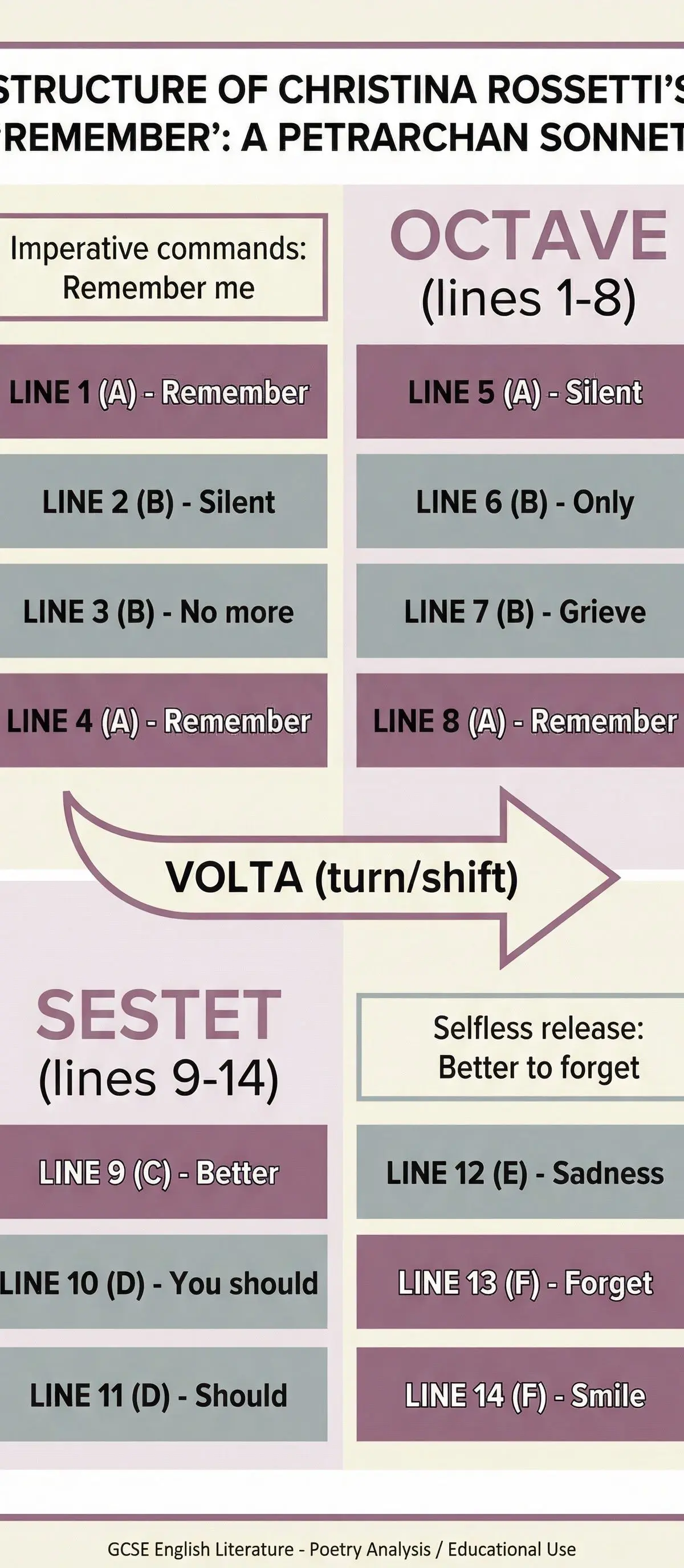
Form and Structure: The poem is a Petrarchan sonnet, a form traditionally used for love poetry. Rossetti subverts this by making the poem about death and letting go. The structure is crucial:
- The Octave (ABBA ABBA rhyme scheme): Presents the problem—the speaker's desperate need to be remembered. The enclosed rhyme scheme creates a feeling of claustrophobia and entrapment, mirroring the speaker's obsessive focus.
- The Volta (Line 9): The turn in thought, marked by the word "Yet". This is the pivot on which the entire poem's meaning rests.
- The Sestet (CDDECE rhyme scheme): Offers the resolution. The more varied rhyme scheme feels more open and liberating, reflecting the speaker's emotional release.
Language: Rossetti uses simple, direct language, but it is laden with emotional weight. The repetition of "Remember me" acts as a powerful refrain in the octave. The use of euphemisms like "silent land" contrasts with the bluntness of "darkness and corruption", showing the speaker grappling with the reality of death.
Tone: The tone undergoes a dramatic shift. It begins as insistent, anxious, and commanding. After the volta, it becomes gentle, reassuring, and ultimately, selfless and liberating.
Context
- Victorian Mourning Culture: The Victorian era had elaborate and often performative rituals around death and mourning. The speaker's initial anxiety about being remembered reflects a society obsessed with legacy and remembrance. Her final, selfless act of release can be seen as a quiet rebellion against this pressure.
- Christina Rossetti's Life and Beliefs: Rossetti was a devout High-Anglican and her faith was central to her life and work. Her belief in an afterlife and the soul's salvation may inform the speaker's ultimate peace with being forgotten on Earth. The idea that earthly concerns are secondary to spiritual salvation is a key tenet of her faith. She also suffered from chronic illness for much of her life, including Graves' disease, which would have made themes of mortality particularly immediate and personal.
- The Role of Women: In the 19th century, women were often idealized as selfless and sacrificing. A feminist reading might see the speaker's final act as conforming to this societal expectation. Alternatively, it could be read as an act of profound personal agency—the speaker taking control of her own death and legacy in the only way she can."
Worked Examples
2 worked examples — open one to explore the question and available guidance.
Practice Questions
Test your understanding — click to reveal model answers
How does Rossetti use language and structure in 'Remember' to present the speaker's changing attitude to love?
Hint: Focus on the shift from the octave to the sestet. How does the rhyme scheme and the change in tone reflect the speaker's evolving feelings?
Compare how the speakers in 'Remember' and 'When We Two Parted' by Lord Byron present the pain of separation.
Hint: Consider the cause of the separation (death vs. the end of an affair) and the speaker's emotional response (selflessness vs. bitterness).
Explore the significance of the shift in tone in 'Remember'.
Hint: This question is all about the volta. What is the tone in the octave, what is it in the sestet, and why is the change so important to the poem's message?
To what extent can the speaker in 'Remember' be seen as controlling?
Hint: This is an 'evaluate' style question. You need to argue both sides. How is she controlling in the octave? How does she relinquish control in the sestet? Which is more powerful?
Test your understanding of Remember (Christina Rossetti)
Active recall beats re-reading. Take an instant quiz now to test what you’ve learned and lock it into long-term memory.
7 days Premium · Then free forever · No card, no charge