Inferring meaning from context
Mastering the art of inferring meaning is the single most critical skill for the OCR GCSE French reading exam. This guide provides the specific techniques, vocabulary, and grammatical knowledge needed to decode implicit meaning and secure top marks.
Study Notes
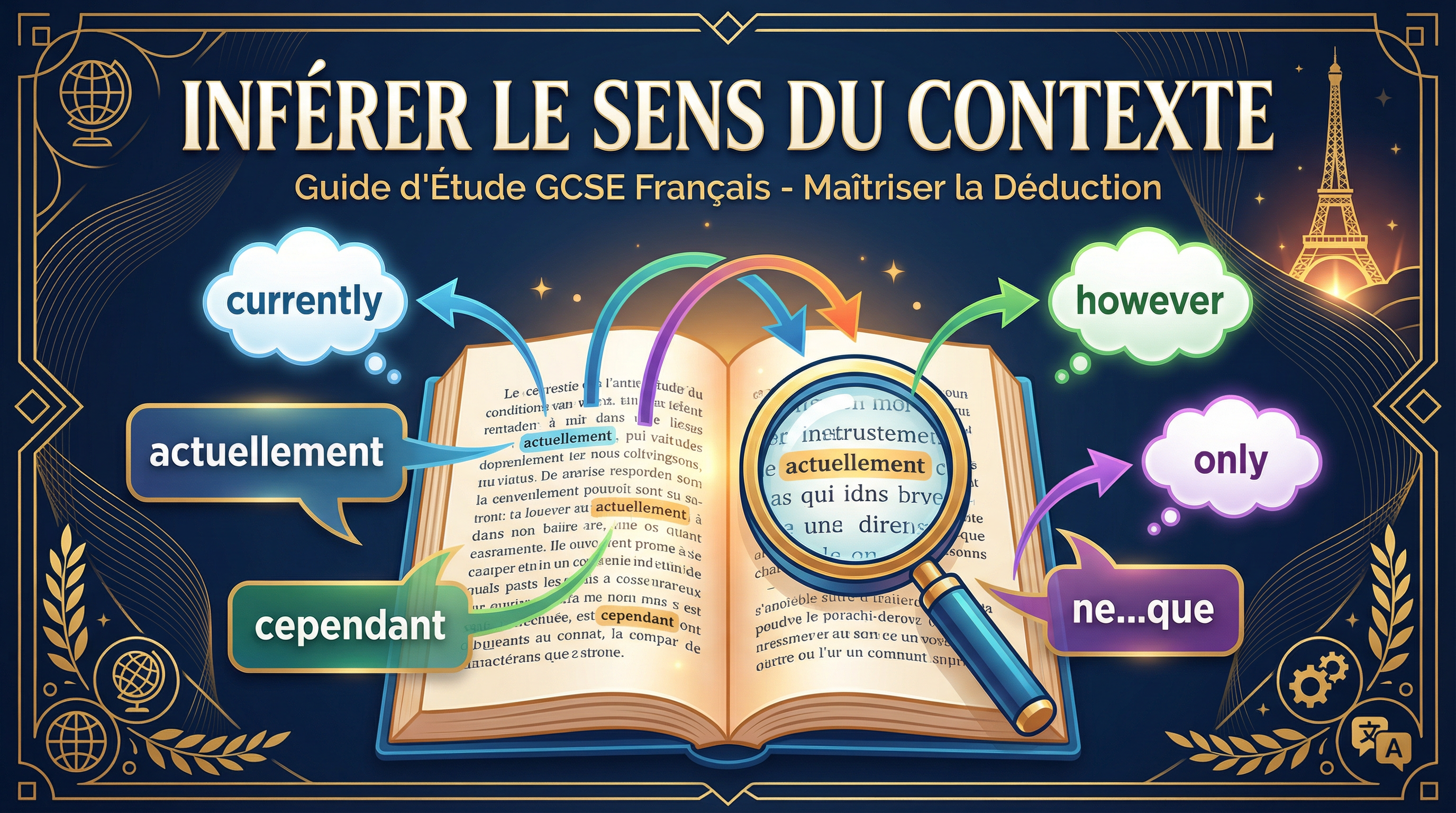
Overview
Inferring meaning from context is the cornerstone of the OCR GCSE French reading and listening exams, falling under Assessment Objective 3 (AO3), which accounts for a significant 55% of the marks. This skill requires candidates to move beyond literal, word-for-word translation and instead act as detectives, using grammatical clues, discourse markers, and wider context to deduce the writer's or speaker's true message, attitude, and opinions. Examiners are not testing your ability to be a human dictionary; they are assessing your ability to comprehend authentic French as it is actually used. This involves recognising time frames, understanding nuanced negation, identifying 'faux amis' (false friends), and synthesising information from across a text. Success in this area is what separates candidates who achieve a passing grade from those who excel, as it demonstrates a deeper, more holistic understanding of the language.
Key Skills for Inferring Meaning
1. Decoding Tense & Time Markers
What it is: Identifying when events are happening (past, present, future) is fundamental. Examiners will deliberately test your ability to distinguish between what has happened, what is happening, and what someone wishes would happen.
Why it matters: Confusing tenses leads to fundamental misinterpretations. For example, mistaking the conditional ('je voudrais' - I would like) for the present tense ('je veux' - I want) can completely change the meaning of a sentence from a desire to a current reality.
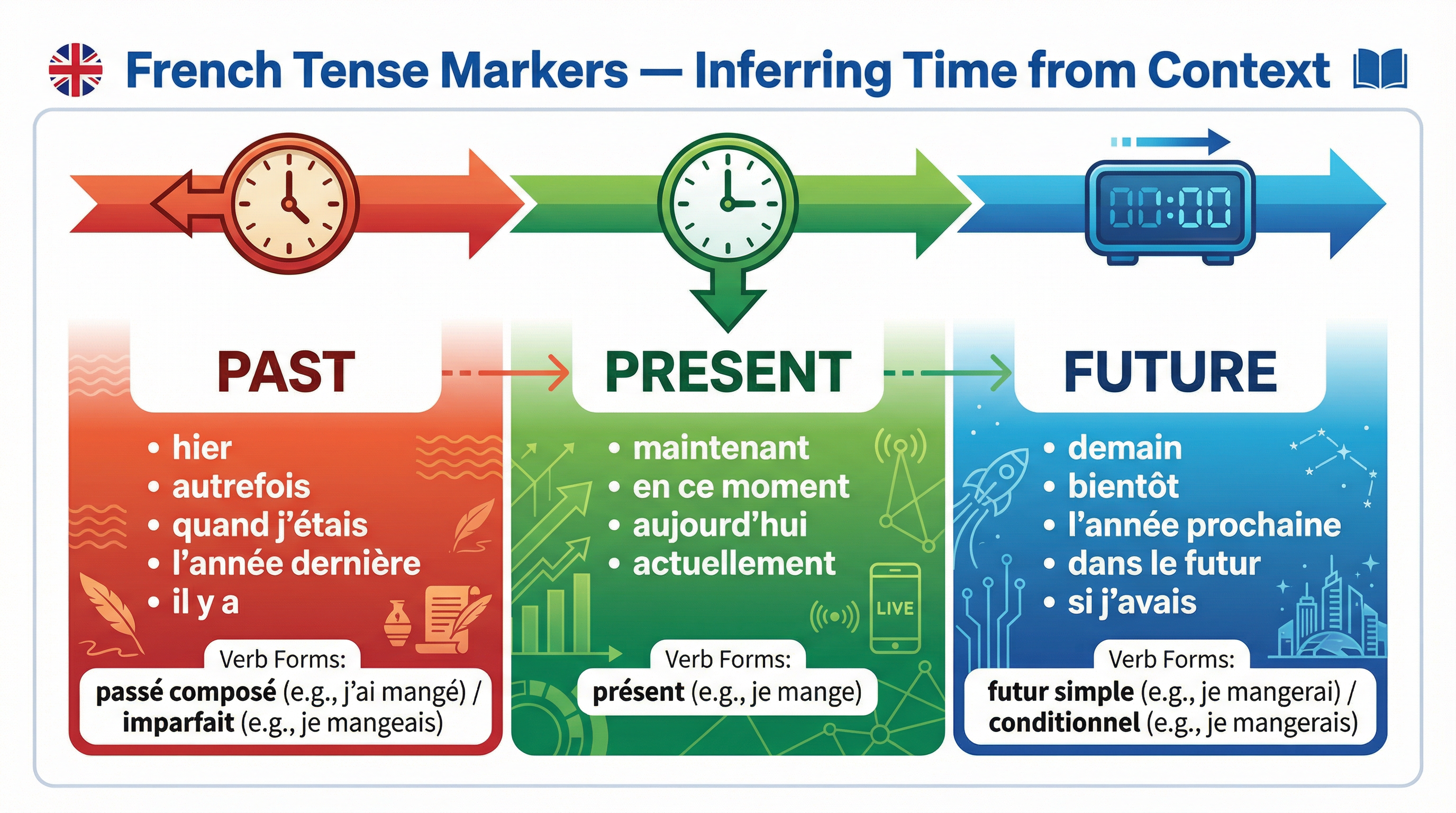
Specific Knowledge: You must be able to recognise key time-telling phrases and verb endings.
- Past: hier, l'année dernière, quand j'étais jeune, il y a deux ans. Look for verbs in the passé composé (e.g., j'ai mangé) and the imparfait (e.g., il faisait).
- Present: maintenant, aujourd'hui, en ce moment, actuellement. Look for verbs in the present tense (e.g., je suis, elle regarde).
- Future: demain, le week-end prochain, dans le futur. Look for verbs in the futur simple (e.g., nous irons) and the conditionnel (e.g., il aimerait).
2. Navigating Negation & Restriction
What it is: Understanding that French negation is more complex than just 'ne... pas'. Certain negative structures fundamentally alter the meaning of a sentence.
Why it matters: Misinterpreting a negative can lead you to choose the exact opposite of the correct answer. The most commonly tested is 'ne... que'.
Specific Knowledge: Memorise these key negative and restrictive structures:
- ne... pas: not (Je ne suis pas d'accord - I do not agree)
- ne... jamais: never (Elle ne mange jamais de viande - She never eats meat)
- ne... plus: no longer / not anymore (Il ne fume plus - He no longer smokes)
- ne... rien: nothing (Nous n'avons rien vu - We saw nothing)
- ne... que: ONLY (Je n'ai que cinq euros - I ONLY have five euros. Crucially, this does NOT mean 'I don't have five euros').
3. Spotting 'Faux Amis' (False Friends)
What it is: These are words that look like English words but have a different meaning. Examiners use them as distractors to catch out candidates who are translating too literally.
Why it matters: Relying on visual similarity instead of actual meaning is a classic exam trap. It shows the examiner you are guessing rather than comprehending.
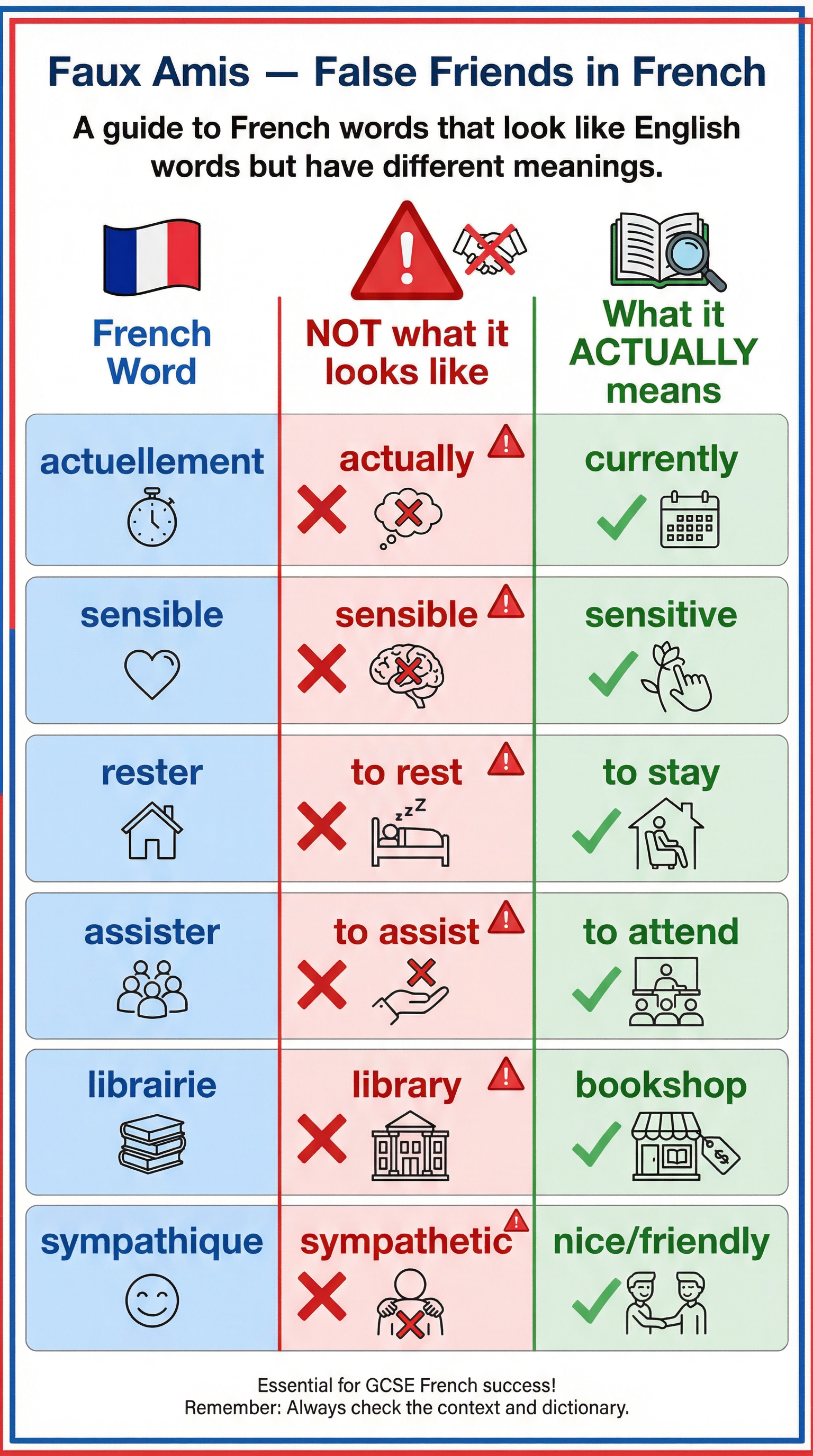
Specific Knowledge: Be vigilant for these common faux amis:
- actuellement (currently) ≠ actually
- sensible (sensitive) ≠ sensible
- rester (to stay) ≠ to rest
- assister à (to attend) ≠ to assist
- une librairie (a bookshop) ≠ a library
- sympathique (nice/friendly) ≠ sympathetic
Second-Order Concepts
Causation
Understanding why a writer holds a certain opinion. Look for connective words like car (because), parce que (because), and donc (therefore). These words explain the reasoning behind a statement, which is often where marks for inference are found.
Consequence
Identifying the results of actions or feelings. Words like alors (so), par conséquent (consequently), and c'est pourquoi (that's why) signal that a conclusion or result is about to be stated.
Change & Continuity
Tracking how a situation or opinion develops through a text. A writer might start with a positive view but then introduce a negative one. Look for 'pivot' words like cependant (however), pourtant (yet), and mais (but) which signal a change in direction.
Significance
Understanding the overall importance or main point of the text. After reading, you should be able to summarise the writer's key message in one sentence. This is the ultimate test of comprehension.
Worked Examples
2 detailed examples with solutions and examiner commentary
Practice Questions
Test your understanding — click to reveal model answers
Lisez le texte: 'Hier, il faisait beau, donc je suis allé à la plage. J'aurais voulu nager, mais l'eau était trop froide. Demain, je pense que je resterai à la maison.' Lequel des énoncés suivants est VRAI?
Hint: Pay close attention to the time markers ('hier', 'demain') and the conditional tense ('j'aurais voulu').
Dans la phrase 'Il n'a invité que ses proches', qu'est-ce que cela signifie?
Hint: Remember the specific meaning of the 'ne... que' construction.
Lisez le texte: 'J'assiste à une réunion importante ce matin, donc je suis un peu stressé. Je suis sensible aux critiques et j'espère que tout se passera bien.' Trouvez dans le texte le mot qui signifie 'sensitive'.
Hint: Look for a 'faux ami' that looks like an English word but has a different meaning.