OCR · GCSE · French
Responding to questions confidently
Mastering the OCR GCSE French Paper 3 Speaking exam is about confident, spontaneous communication across three time frames. This guide equips you with strategies to handle any question type, extend your answers with justified opinions, and demonstrate the linguistic range that examiners reward with top marks.
- 13 min read
- 5 worked examples
- 6 practice questions
- 7 key terms
Study Notes

Overview
The OCR GCSE French Paper 3 Speaking exam assesses your ability to communicate spontaneously and confidently in French. Unlike the reading and writing papers, this is your opportunity to demonstrate fluency, pronunciation, and the ability to initiate and sustain a conversation. Examiners are looking for candidates who can narrate events, express and justify opinions, and handle unpredictable questions across the past, present, and future time frames. The assessment is weighted entirely on AO2 (Spoken Language) at 100%, meaning your ability to speak clearly, accurately, and with variety is paramount. This guide will help you understand the question types you will face, the structures that access higher mark bands, and the common pitfalls that prevent candidates from achieving their potential.
The speaking exam is divided into three tasks: a Role Play (15 marks), a Photo Card discussion (15 marks), and a General Conversation (30 marks). The General Conversation is where spontaneous interaction is most heavily tested, and where you must demonstrate the ability to respond to questions confidently without relying on pre-learned scripts. Examiners award marks for communication (how well you convey your message), range and accuracy of language (variety of vocabulary, structures, and tenses), and pronunciation and intonation (clarity and natural flow). It is important to understand that minor errors do not prevent you from accessing the highest bands, provided your message is clear and you demonstrate linguistic ambition.
Understanding Question Types
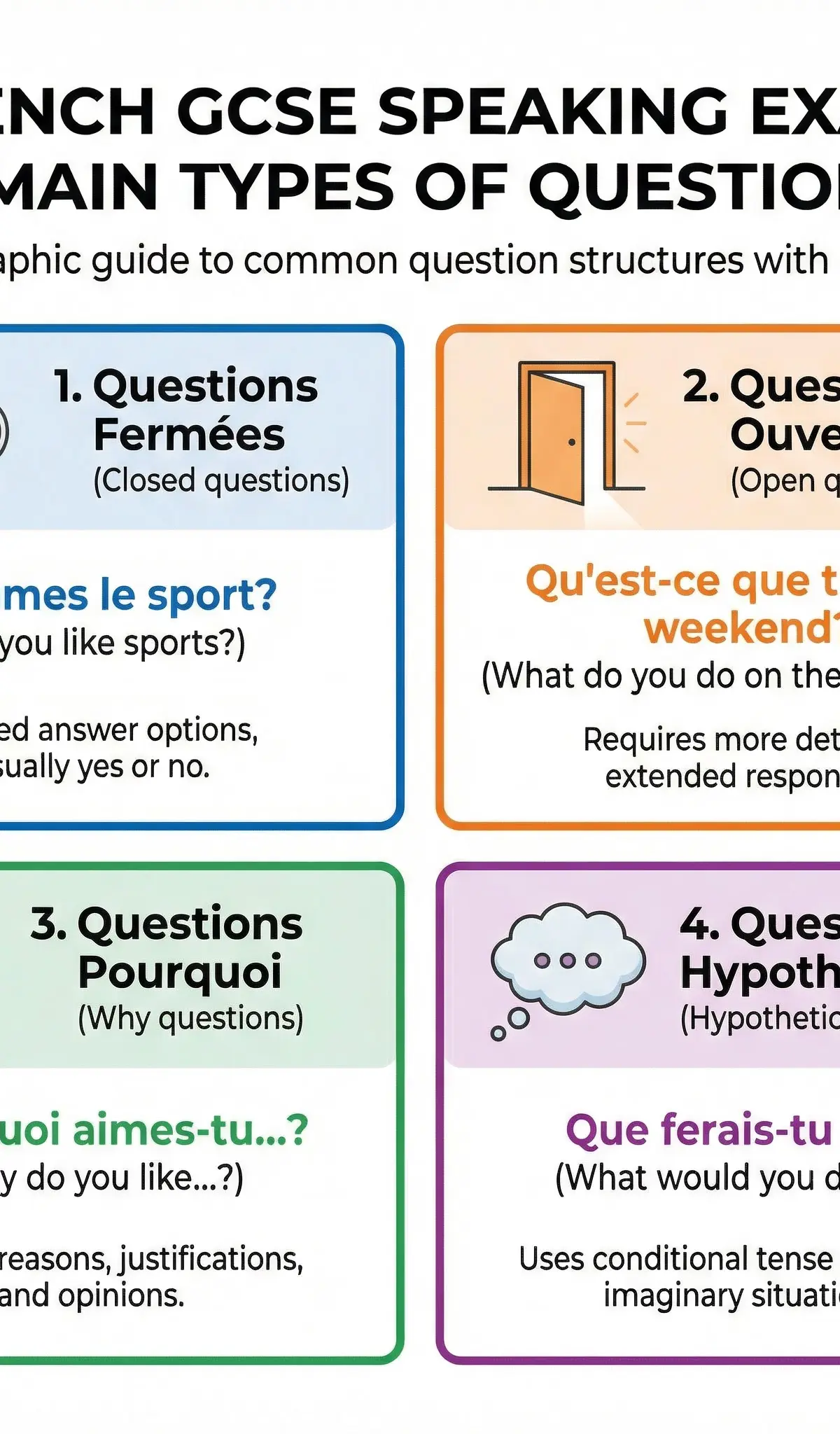
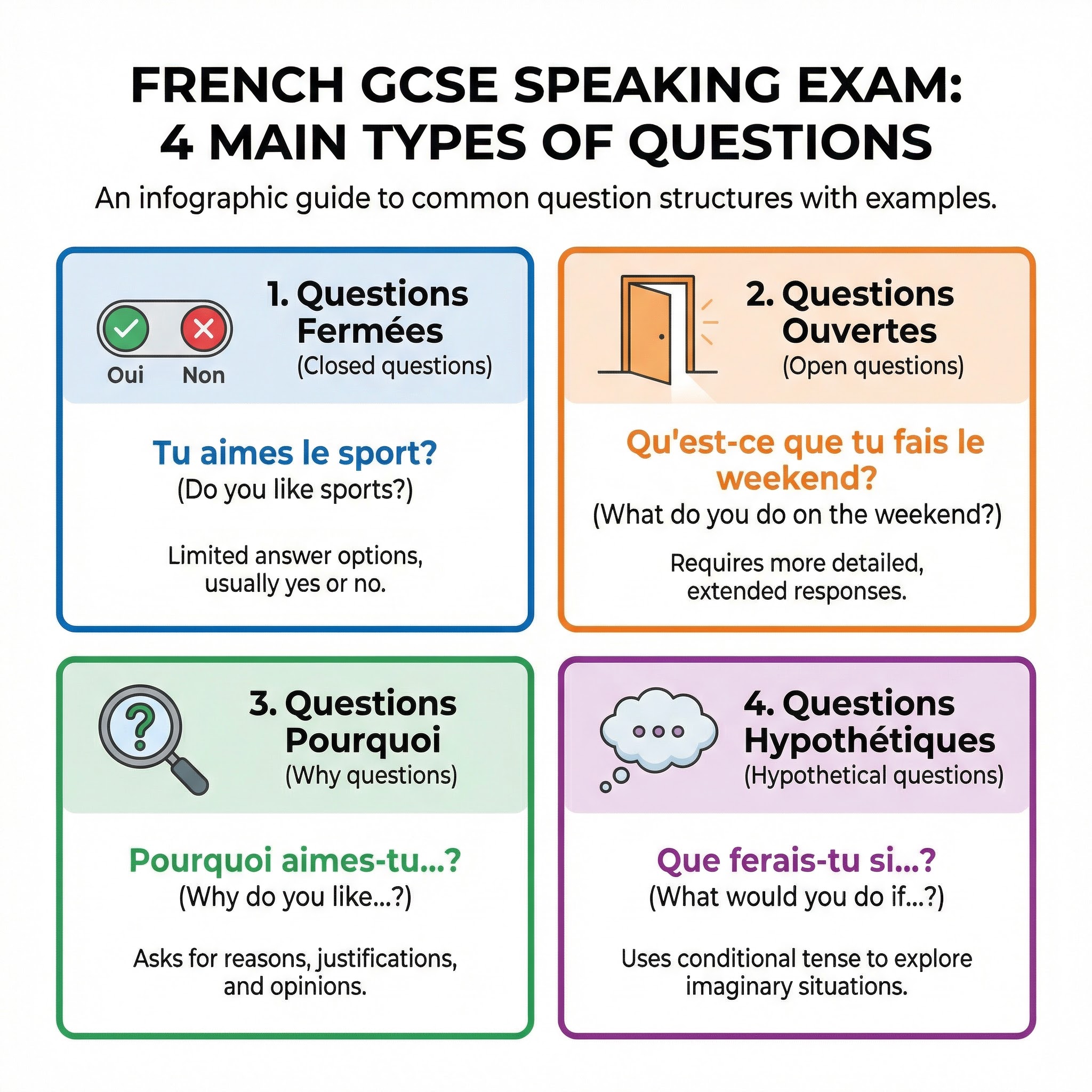
In the speaking exam, you will encounter four main types of questions, each requiring a different response strategy. Understanding these question types and how to extend your answers is essential for accessing higher mark bands.
Questions Fermées (Closed Questions)
Closed questions typically require a 'oui' or 'non' answer, such as 'Tu aimes le sport?' (Do you like sports?). However, candidates who simply respond with 'oui' or 'non' will not access higher marks. Examiners expect you to extend your answer by adding an opinion and a reason. For example, 'Oui, j'aime le sport parce que c'est bon pour la santé et je me sens énergique après' (Yes, I like sports because it's good for health and I feel energetic afterwards). This demonstrates the ability to justify your response and use connectives like 'parce que' (because) to link ideas.
Questions Ouvertes (Open Questions)
Open questions begin with interrogative words such as 'Que' (What), 'Quand' (When), 'Où' (Where), 'Comment' (How), or 'Combien' (How many/much). An example is 'Qu'est-ce que tu fais le weekend?' (What do you do on the weekend?). These questions invite more detailed responses and are an opportunity to showcase your vocabulary and sentence structures. A strong answer might be: 'Le weekend, je fais du sport avec mes amis. Normalement, nous jouons au football dans le parc. C'est très amusant et ça me permet de me détendre après une semaine stressante' (On the weekend, I do sports with my friends. Normally, we play football in the park. It's very fun and it allows me to relax after a stressful week). Notice the use of time markers ('le weekend', 'normalement'), varied vocabulary, and a justification at the end.
Questions Pourquoi (Why Questions)
Why questions are a direct invitation to express and justify your opinion. The examiner is testing your ability to use causal connectives and provide reasoned arguments. For example, if asked 'Pourquoi aimes-tu ce film?' (Why do you like this film?), a strong response would be: 'À mon avis, ce film est fascinant parce que l'histoire est très originale et les acteurs jouent de manière convaincante. De plus, la musique crée une atmosphère incroyable' (In my opinion, this film is fascinating because the story is very original and the actors perform convincingly. Moreover, the music creates an incredible atmosphere). Key phrases to use include 'parce que', 'car' (because), 'à mon avis' (in my opinion), 'je pense que' (I think that), and 'de plus' (moreover).
Questions Hypothétiques (Hypothetical Questions)
Hypothetical questions require the use of the conditional tense and often begin with 'Que ferais-tu si…?' (What would you do if…?). An example is 'Que ferais-tu si tu gagnais au loto?' (What would you do if you won the lottery?). To access the highest marks, you must demonstrate control of the conditional: 'Si je gagnais au loto, j'achèterais une grande maison pour ma famille et je voyagerais partout dans le monde. Je voudrais aussi donner de l'argent à des organisations caritatives' (If I won the lottery, I would buy a big house for my family and I would travel all over the world. I would also like to give money to charities). This shows not only grammatical range but also the ability to develop ideas.
Mastering the Three Time Frames
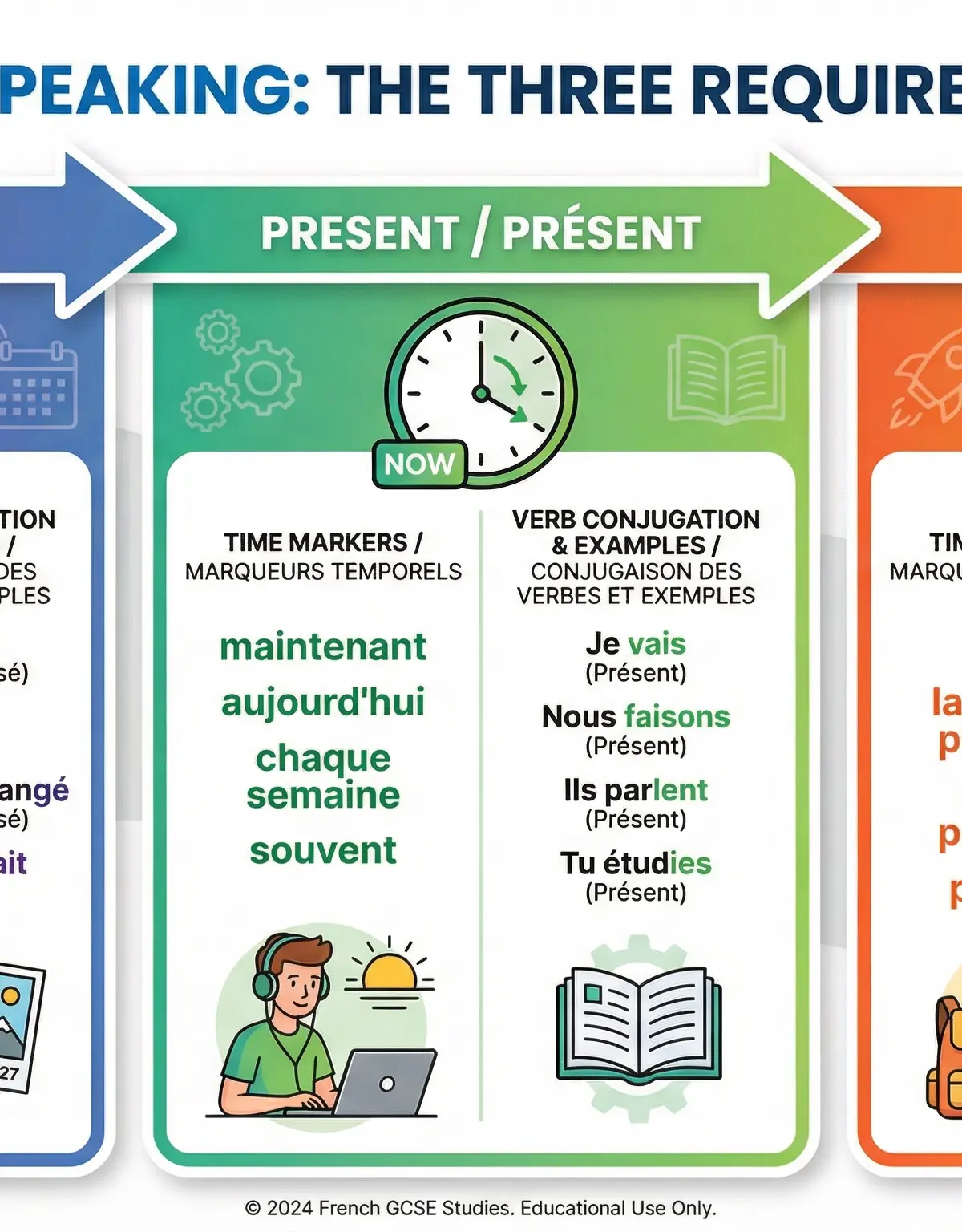
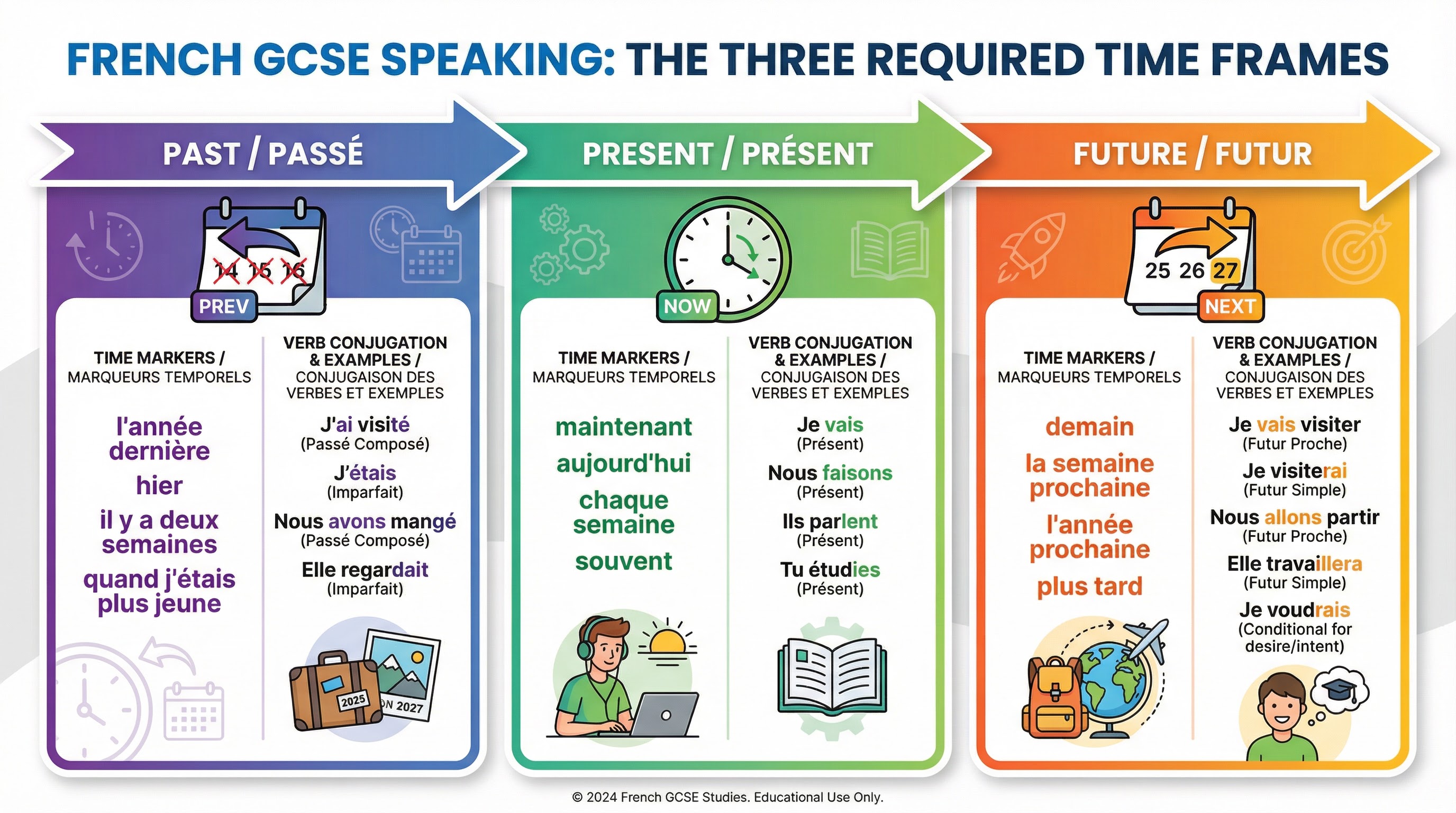
One of the most important requirements for accessing higher mark bands is the ability to refer to past, present, and future events. Examiners explicitly look for evidence that you can manipulate tenses and use appropriate time markers to signal changes in time frame. Failure to demonstrate all three time frames will cap your mark, even if your communication is otherwise strong.
Past (Passé)
When talking about the past, you must use either the passé composé or the imparfait, depending on the context. The passé composé is used for completed actions ('J'ai visité Paris l'année dernière' – I visited Paris last year), while the imparfait is used for descriptions or habitual actions in the past ('Quand j'étais plus jeune, je jouais au tennis tous les jours' – When I was younger, I played tennis every day). Common time markers for the past include 'l'année dernière' (last year), 'hier' (yesterday), 'il y a deux semaines' (two weeks ago), and 'quand j'étais plus jeune' (when I was younger). A critical error to avoid is confusing the auxiliary verbs 'avoir' and 'être' in the passé composé. For example, 'Je suis allé' (I went) uses 'être', while 'J'ai mangé' (I ate) uses 'avoir'. Getting this wrong can lead to a breakdown in meaning.
Present (Présent)
The present tense is used to describe current actions, habits, or general truths. Time markers include 'maintenant' (now), 'aujourd'hui' (today), 'chaque semaine' (every week), and 'souvent' (often). For example, 'Aujourd'hui, je vais à l'école et je fais mes devoirs le soir' (Today, I go to school and I do my homework in the evening). The present tense is also used in the futur proche construction ('aller' + infinitive), which expresses near-future intentions: 'Je vais visiter ma grand-mère demain' (I am going to visit my grandmother tomorrow).
Future (Futur)
To talk about the future, you can use the futur proche ('aller' + infinitive) or the futur simple (future tense endings added to the infinitive). For example, 'Demain, je vais faire du shopping avec mes amis' (Tomorrow, I am going to go shopping with my friends) or 'L'année prochaine, je visiterai l'Espagne' (Next year, I will visit Spain). Time markers for the future include 'demain' (tomorrow), 'le weekend prochain' (next weekend), 'l'année prochaine' (next year), and 'plus tard' (later). Using a variety of future structures demonstrates linguistic range and ambition.
Exam Technique and Top Tips
Success in the speaking exam is not just about knowing French; it is about understanding how to perform under exam conditions and how to maximize your marks through strategic communication.
Use Fillers to Maintain Flow
In spontaneous speech, it is natural to pause while thinking. However, long silences can disrupt the flow of conversation and suggest a lack of confidence. Instead, use hesitation fillers such as 'euh' (um), 'alors' (so), 'ben' (well), 'en fait' (in fact), and 'voyons' (let's see). These fillers signal to the examiner that you are thinking and maintaining engagement, rather than simply not knowing what to say. For example, 'Euh, à mon avis, le sport est important parce que… ben, c'est bon pour la santé' (Um, in my opinion, sport is important because… well, it's good for health).
Ask for Clarification Without Penalty
If you do not understand a question, do not guess. Instead, politely ask the examiner to repeat or rephrase the question using a full sentence: 'Pouvez-vous répéter, s'il vous plaît?' (Can you repeat, please?) or 'Je ne comprends pas. Pouvez-vous expliquer?' (I don't understand. Can you explain?). You will not lose marks for asking for clarification, and it demonstrates your ability to manage communication breakdowns, which is a skill examiners value.
Always Extend Your Answers
A common mistake is giving simple, one-sentence answers. Examiners reward candidates who develop their responses by adding opinions, reasons, examples, or additional details. For instance, if asked 'Tu aimes la musique?', do not simply say 'Oui, j'aime la musique.' Instead, say: 'Oui, j'aime beaucoup la musique, surtout le pop et le rock. J'écoute de la musique tous les jours parce que ça me détend et ça me donne de l'énergie. Mon chanteur préféré est Ed Sheeran parce que ses chansons sont très émouvantes' (Yes, I really like music, especially pop and rock. I listen to music every day because it relaxes me and gives me energy. My favorite singer is Ed Sheeran because his songs are very moving).
Vary Your Sentence Starters
Over-reliance on simple structures like 'c'est' (it is) or 'il y a' (there is/are) can make your speech sound repetitive and limit your access to higher bands. Instead, vary your sentence openers by using phrases like 'À mon avis' (in my opinion), 'Je pense que' (I think that), 'Selon moi' (according to me), 'Il me semble que' (it seems to me that), and 'D'après moi' (in my view). This demonstrates linguistic sophistication and keeps the examiner engaged.
Watch Out for Auxiliary Verbs in the Passé Composé
One of the most common errors in the speaking exam is confusing the auxiliary verbs 'avoir' and 'être' in the passé composé. Most verbs use 'avoir' (e.g., 'J'ai mangé' – I ate), but a small group of verbs, often remembered by the mnemonic DR MRS VANDERTRAMP, use 'être'. These verbs include: Devenir (to become), Revenir (to come back), Monter (to go up), Rester (to stay), Sortir (to go out), Venir (to come), Aller (to go), Naître (to be born), Descendre (to go down), Entrer (to enter), Rentrer (to return home), Tomber (to fall), Retourner (to return), Arriver (to arrive), Mourir (to die), and Partir (to leave). For example, 'Je suis allé au cinéma' (I went to the cinema) is correct, while 'J'ai allé' is incorrect and will confuse the examiner.
Pronunciation and Intonation
While you are not expected to sound like a native speaker, your pronunciation and intonation must be clear enough that the examiner can understand your message without difficulty. Examiners assess whether your accent interferes with communication. Key areas to focus on include:
- Nasal vowels: French has nasal sounds (e.g., 'bon', 'vin', 'un') that do not exist in English. Practice these sounds to avoid confusion.
- Silent letters: Many French words have silent final consonants (e.g., 'petit' is pronounced 'puh-tee', not 'puh-teet').
- Liaison: In French, the final consonant of a word is often pronounced when followed by a vowel (e.g., 'les amis' is pronounced 'lay-zah-mee').
- Intonation: French sentences often have a rising intonation at the end of questions and a falling intonation at the end of statements. Practicing this will make your speech sound more natural.
Common Mistakes to Avoid
Based on examiner reports, the following are the most frequent errors that prevent candidates from accessing higher marks:
- Over-reliance on 'c'est' or 'il y a': These structures are useful but should not dominate your speech. Vary your sentence starters to demonstrate range.
- Confusion of auxiliary verbs in the passé composé: Mixing up 'avoir' and 'être' leads to errors that can obscure meaning. Memorize the DR MRS VANDERTRAMP verbs.
- Answering 'Pourquoi?' questions without justification: Simply stating a fact is not enough. Always use 'parce que' or 'car' to provide a reason.
- Failing to use all three time frames: Even if you are comfortable in the present tense, you must demonstrate past and future to access the highest bands.
- Not extending answers: Short, simple responses limit your mark. Always add an opinion, reason, or example.
- Ignoring time markers: Time markers like 'l'année dernière', 'maintenant', and 'demain' signal tense changes and help the examiner follow your narrative.

Listen to the Podcast
To reinforce your learning, listen to the 10-minute podcast episode above. It covers the core concepts, exam tips, and includes a quick-fire recall quiz to test your understanding.
Summary
The key to success in the OCR GCSE French Speaking exam is confident, extended communication. Understand the four main question types and how to respond to each. Master the three time frames by using appropriate tenses and time markers. Extend your answers with opinions, reasons, and examples. Use fillers to maintain flow and ask for clarification when needed. Avoid common mistakes like over-relying on simple structures or confusing auxiliary verbs. With practice and the strategies outlined in this guide, you can demonstrate the linguistic range and spontaneity that examiners reward with top marks.
Visual Resources
2 diagrams and illustrations
Interactive Diagrams
1 interactive diagram to visualise key concepts
Conceptual Flow Outline
Decision tree for responding to different question types in the speaking exam
Worked Examples
5 worked examples — open one to explore the question and available guidance.
Practice Questions
Test your understanding — click to reveal model answers
Décris ta routine quotidienne. (Describe your daily routine.)
Hint: Use time markers (le matin, l'après-midi, le soir) and a variety of present tense verbs. Include specific details about what you do and when.
Qu'est-ce que tu as fait pendant les dernières vacances? (What did you do during the last holidays?)
Hint: Use the passé composé and include specific details (where you went, what you did, who you were with). Remember to use 'être' for DR MRS VANDERTRAMP verbs.
Pourquoi est-il important de protéger l'environnement? (Why is it important to protect the environment?)
Hint: This is a 'Pourquoi?' question, so you must justify your answer with 'parce que' or 'car'. Provide at least two reasons and extend your response with examples or opinions.
Que feras-tu après tes examens? (What will you do after your exams?)
Hint: Use the future tense (futur proche or futur simple) and include specific plans. Use time markers like 'après mes examens', 'cet été', 'l'année prochaine'.
Que ferais-tu si tu pouvais voyager n'importe où dans le monde? (What would you do if you could travel anywhere in the world?)
Hint: This is a hypothetical question, so use the conditional tense. Use 'si' + imparfait in the first clause, then the conditional in the main clause. Develop multiple ideas.
Parle-moi de ton meilleur ami. (Tell me about your best friend.)
Hint: Provide detailed information about your best friend: name, age, appearance, personality, interests, and why you are friends. Use descriptive adjectives and varied vocabulary.