WJEC · A-Level · Further Mathematics
Further Algebra and Functions
Master the core of WJEC A-Level Further Maths with this guide to Further Algebra and Functions. We break down polynomial roots, series summation, and advanced partial fractions to show you how to secure top marks in your exams.
- 6 min read
- 3 worked examples
- 5 practice questions
- 6 key terms
Study Notes

Overview
Welcome to Further Algebra and Functions (1.4), a cornerstone of the WJEC A-Level Further Mathematics specification. This topic builds directly on your A-Level Maths foundation, introducing powerful techniques for manipulating complex algebraic structures. Mastery here is not just about following algorithms; it’s about understanding the deep connections between a polynomial's roots and its coefficients, the elegant cancellation in series summation, and the logic of decomposing complicated rational functions. These skills are fundamental for both Unit 1 and Unit 4, frequently appearing in multi-stage problems that test your ability to select the right tool for the job. Expect to see questions ranging from short, single-technique calculations to longer, unstructured problems requiring proof and algebraic dexterity. This guide will equip you with the methods, exam technique, and conceptual understanding needed to tackle them all with confidence.
Key Concepts
Concept 1: Relationships Between Roots and Coefficients (Vieta's Formulas)
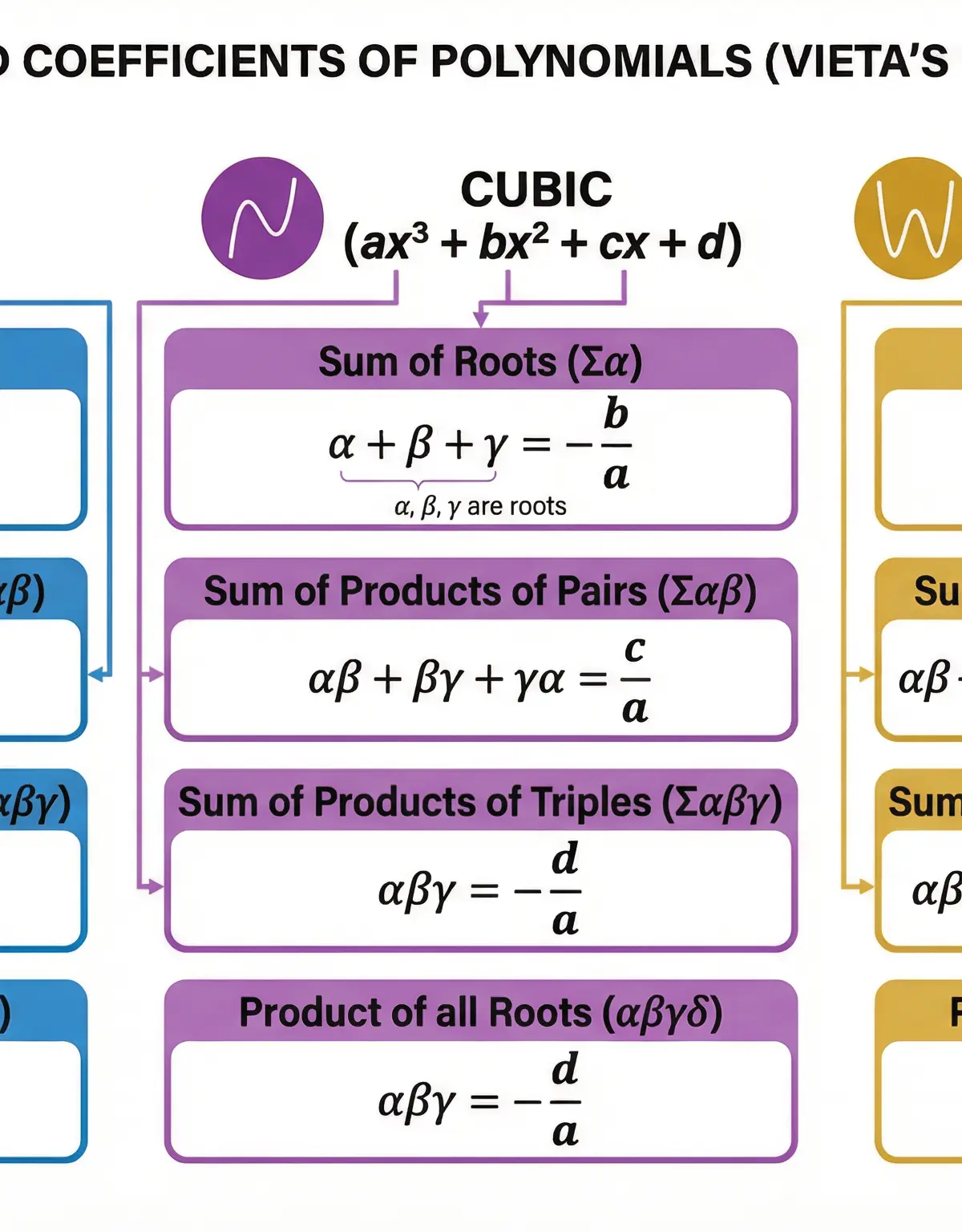
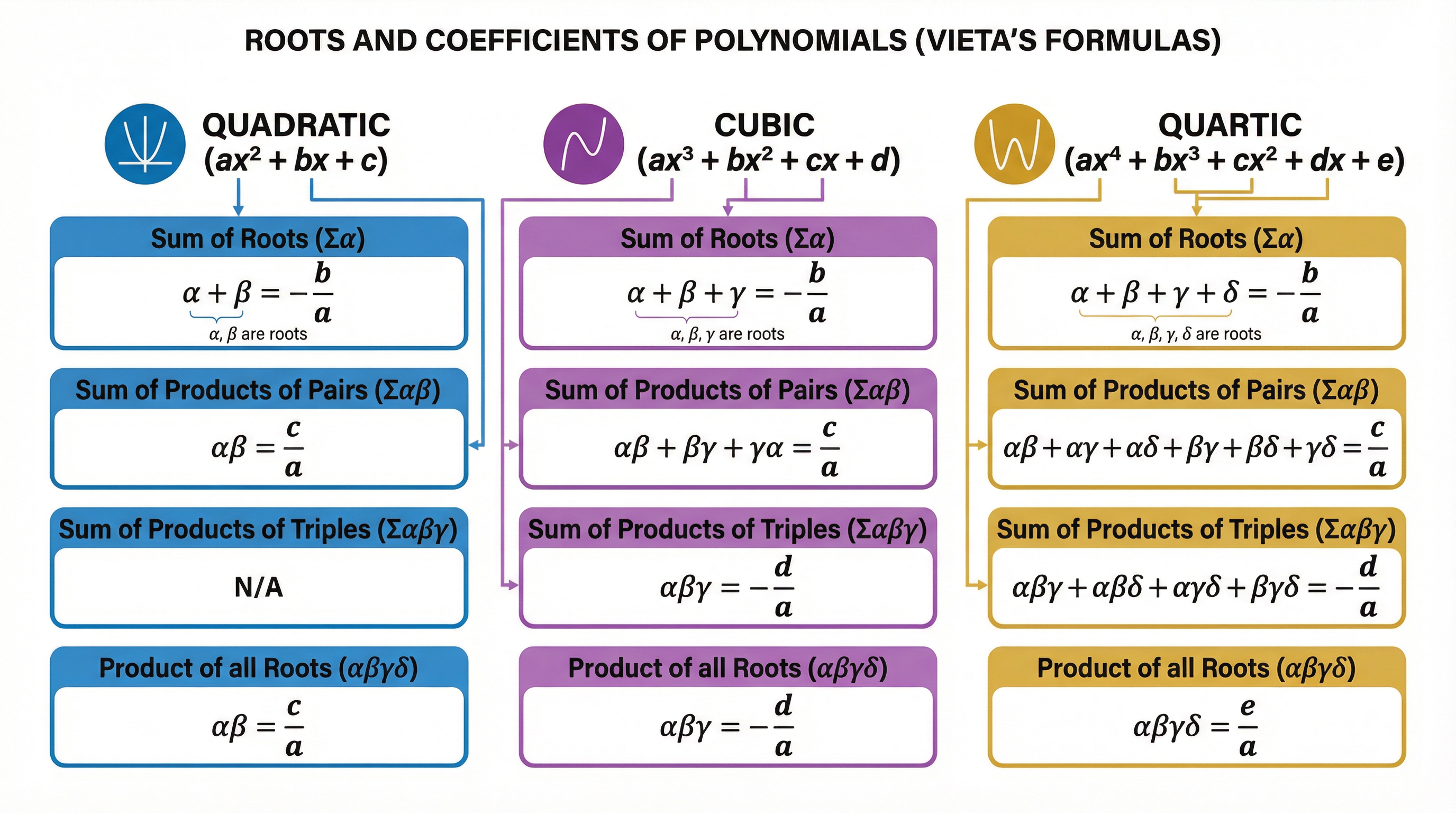
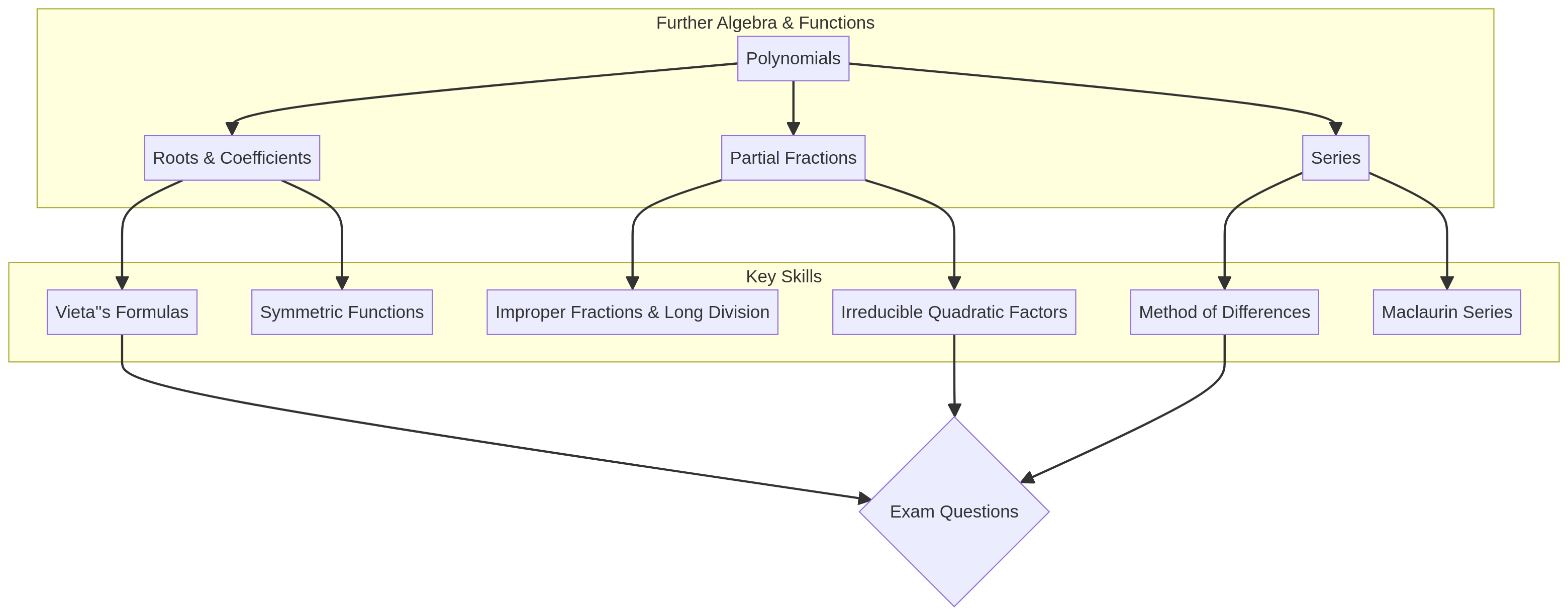
At the heart of this topic lies a beautiful set of relationships known as Vieta's formulas. These connect the coefficients of a polynomial to the sums and products of its roots, without needing to find the roots themselves. For an examiner, this is a test of pure algebraic manipulation and attention to detail. For a cubic equation ax³ + bx² + cx + d = 0 with roots α, β, and γ, you must be able to instantly recall and apply these symmetric properties:
- Sum of the roots (Σα): α + β + γ = -b/a
- Sum of the products of the roots in pairs (Σαβ): αβ + βγ + γα = c/a
- Product of the roots (αβγ): αβγ = -d/a
Notice the crucial alternating sign pattern (-, +, -). This is a common pitfall where candidates lose accuracy marks. The real power comes when examiners ask for a new polynomial whose roots are related to the original ones (e.g., 2α, 2β, 2γ) or when they ask for the value of a more complex symmetric function like Σα². To solve this, you use an identity you must know: Σα² = (Σα)² - 2Σαβ. This isn't just a formula; it’s a structural property of polynomials, and being able to derive or recall it shows true mathematical understanding.
Concept 2: Method of Differences (Telescoping Series)
This is a clever technique for finding the sum of a finite series. The core idea is to express the general term of the series, u_r, as the difference between two consecutive terms of another sequence, f(r+1) - f(r). When you write out the sum, term by term, an elegant cancellation occurs, much like a collapsing telescope. All the middle terms disappear, leaving only the first part of the first term and the second part of the last term (or a few terms at each end).
Example: To sum Σ [1/(r(r+1))], you first use partial fractions to show 1/(r(r+1)) = 1/r - 1/(r+1). Here, f(r) = -1/r. When you sum this from r=1 to n, you get:
(1/1 - 1/2) + (1/2 - 1/3) + (1/3 - 1/4) + ... + (1/n - 1/(n+1))
The -1/2 cancels with +1/2, -1/3 with +1/3, and so on. You are left with just 1 - 1/(n+1). Examiners award marks for showing this cancellation explicitly. A common mistake is to just guess the final terms; you must write out the first few and last few terms to demonstrate the pattern. This is non-negotiable for securing the method marks.
Concept 3: Advanced Partial Fractions
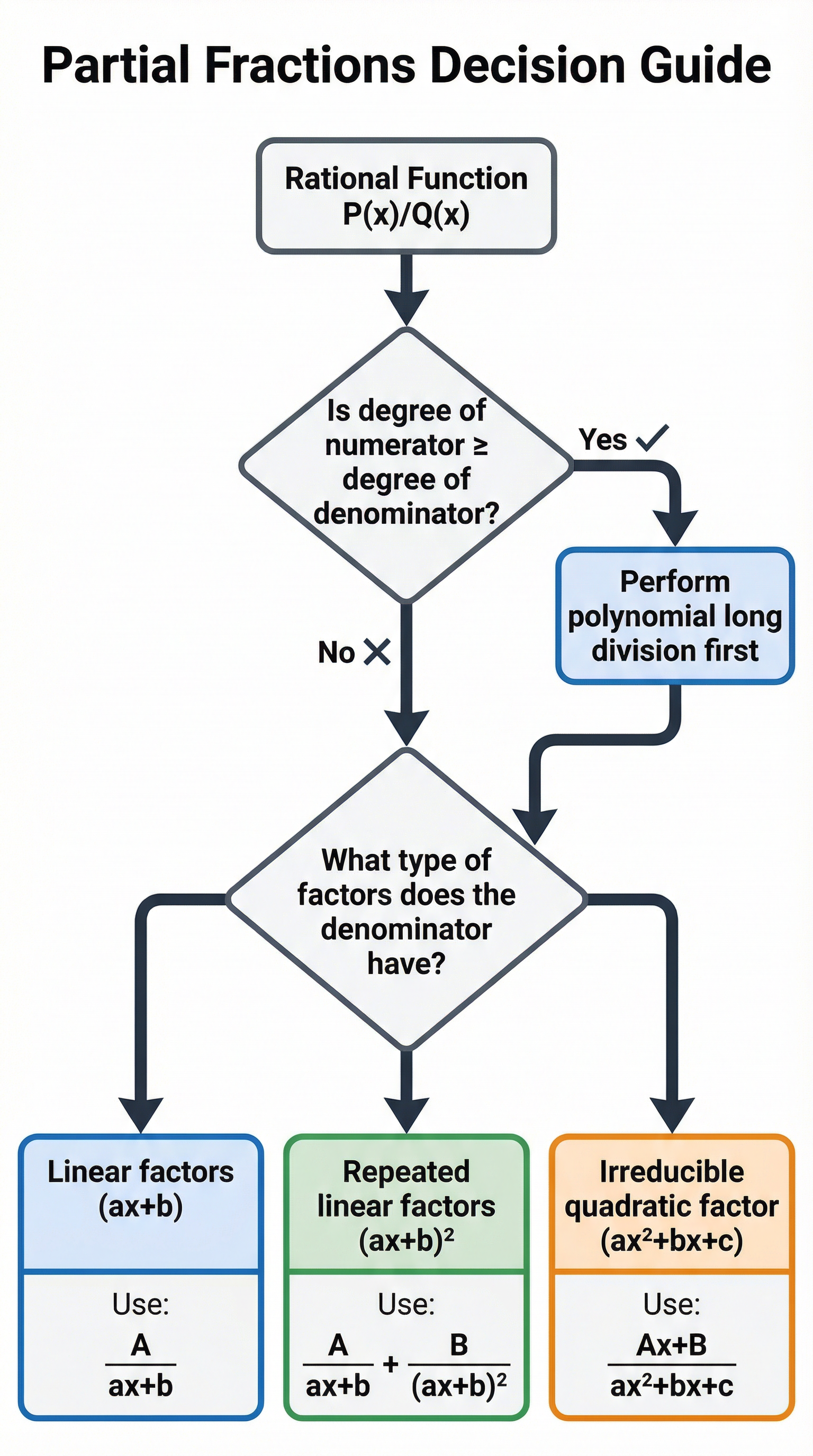
Further Maths extends your knowledge of partial fractions to handle more complex denominators. The two key cases are repeated linear factors and irreducible quadratic factors.
- Repeated Linear Factors: If your denominator has a factor like
(ax+b)², you must create two partial fractions for it:A/(ax+b) + B/(ax+b)². A frequent error is to only include the squared term. - Irreducible Quadratic Factors: This is the big one. If the denominator has a factor that cannot be factorised over real numbers (e.g.,
x² + 4orx² + x + 5), its corresponding numerator must be a linear term,(Ax+B), not just a constant. Forgetting thexterm (Ax) is a classic error that costs significant marks.
Also, never forget the first rule of partial fractions: if the degree of the numerator is greater than or equal to the degree of the denominator, you must perform polynomial long division first. Examiners love to test this pre-requisite step.

Mathematical Relationships
- Vieta's Formulas (Cubic):
Σα = -b/a,Σαβ = c/a,αβγ = -d/a(Must memorise) - Vieta's Formulas (Quartic):
Σα = -b/a,Σαβ = c/a,Σαβγ = -d/a,αβγδ = e/a(Must memorise) - Sum of Squares Identity:
Σα² = (Σα)² - 2Σαβ(Must memorise) - Maclaurin Series (ln(1+x)):
x - x²/2 + x³/3 - ...for|x| < 1(Given on formula sheet) - Maclaurin Series (e^x):
1 + x + x²/2! + x³/3! + ...for all x (Given on formula sheet)
Practical Applications
While highly abstract, these concepts have roots in practical problem-solving. Polynomial root-finding is essential in engineering and physics for analysing the stability of systems, where the location of roots in the complex plane determines whether oscillations grow or decay. Series expansions are the backbone of numerical methods, allowing computers to approximate complex functions (like those used in weather forecasting or financial modelling) with simple polynomials. Partial fractions are a vital integration tool used in fields from electrical engineering (analysing circuit responses) to pharmacokinetics (modelling drug concentration in the body over time).
Worked Examples
3 worked examples — open one to explore the question and available guidance.
Practice Questions
Test your understanding — click to reveal model answers
A quartic equation x⁴ + 2x³ - 7x² + 3x - 1 = 0 has roots α, β, γ, δ. State the value of Σα and αβγδ.
Hint: Remember the alternating sign pattern for Vieta's formulas.
Express (3x²+x+1)/((x-1)(x²+4)) in partial fractions.
Hint: The denominator has a linear factor and an irreducible quadratic factor. What form should the numerators take?
The roots of the equation x³ - 4x² + 5x - 2 = 0 are α, β, γ. Find a new cubic equation with integer coefficients whose roots are α², β², γ².
Hint: First, find the symmetric functions for the new roots: Σα², Σ(αβ)², and (αβγ)². You will need to use identities.
Find the first three non-zero terms in the Maclaurin expansion of ln(1-3x) and state the range of values of x for which it is valid.
Hint: Use the standard expansion for `ln(1+u)` from the formula book and substitute `u = -3x`.
Show that Σ [r/(r+1)!] from r=1 to n is equal to 1 - 1/((n+1)!).
Hint: Try to write the general term `r/((r+1)!)` in the form `f(r) - f(r+1)`. Hint: `r = (r+1) - 1`.
Test your understanding of Further Algebra and Functions
Active recall beats re-reading. Take an instant quiz now to test what you’ve learned and lock it into long-term memory.
7 days Premium · Then free forever · No card, no charge