AQA · GCSE · Mathematics
Number
Master the fundamentals of Number, the bedrock of the GCSE Maths specification. From fraction conversions to index laws and prime factorisation, this topic is essential for securing marks across all three papers.
- 4 min read
- 3 worked examples
- 5 practice questions
- 6 key terms
Study Notes
Overview

Number is the foundation of all mathematics. Whether you are aiming for a Grade 4 or a Grade 9, a solid grasp of Number is non-negotiable. It accounts for a significant proportion of the marks in your GCSE exams and, crucially, Number skills are embedded within Algebra, Geometry, and Statistics questions.
Examiners frequently test your ability to move fluently between fractions, decimals, and percentages, apply the laws of indices, and use standard form for very large or very small numbers. By mastering these core concepts, you not only secure the direct Number marks but also build the fluency needed to tackle complex, multi-step problem-solving questions.
Listen to our comprehensive revision podcast for a guided walk-through of the key concepts and common examiner traps:
Key Concepts
Concept 1: Types of Numbers and Place Value
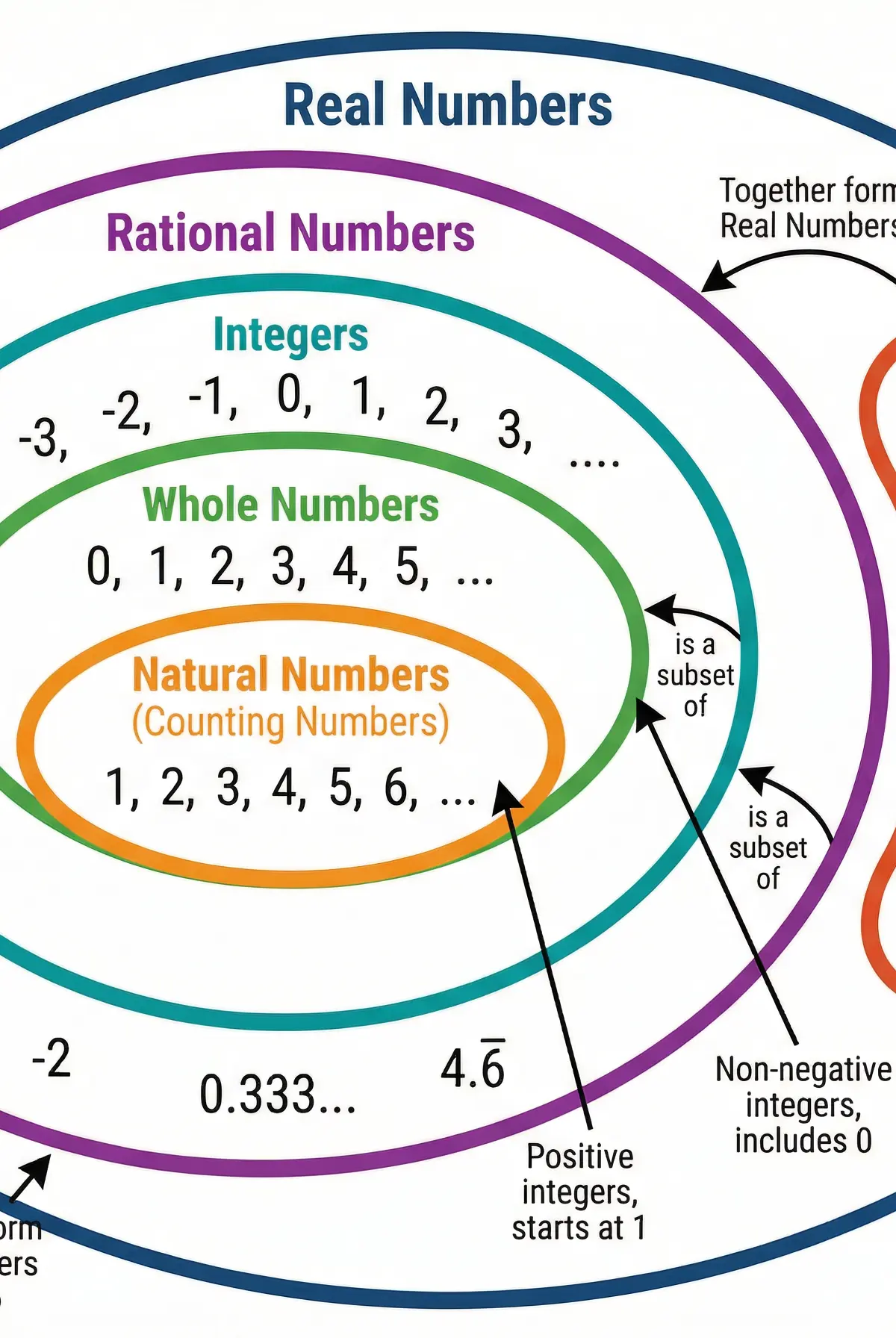
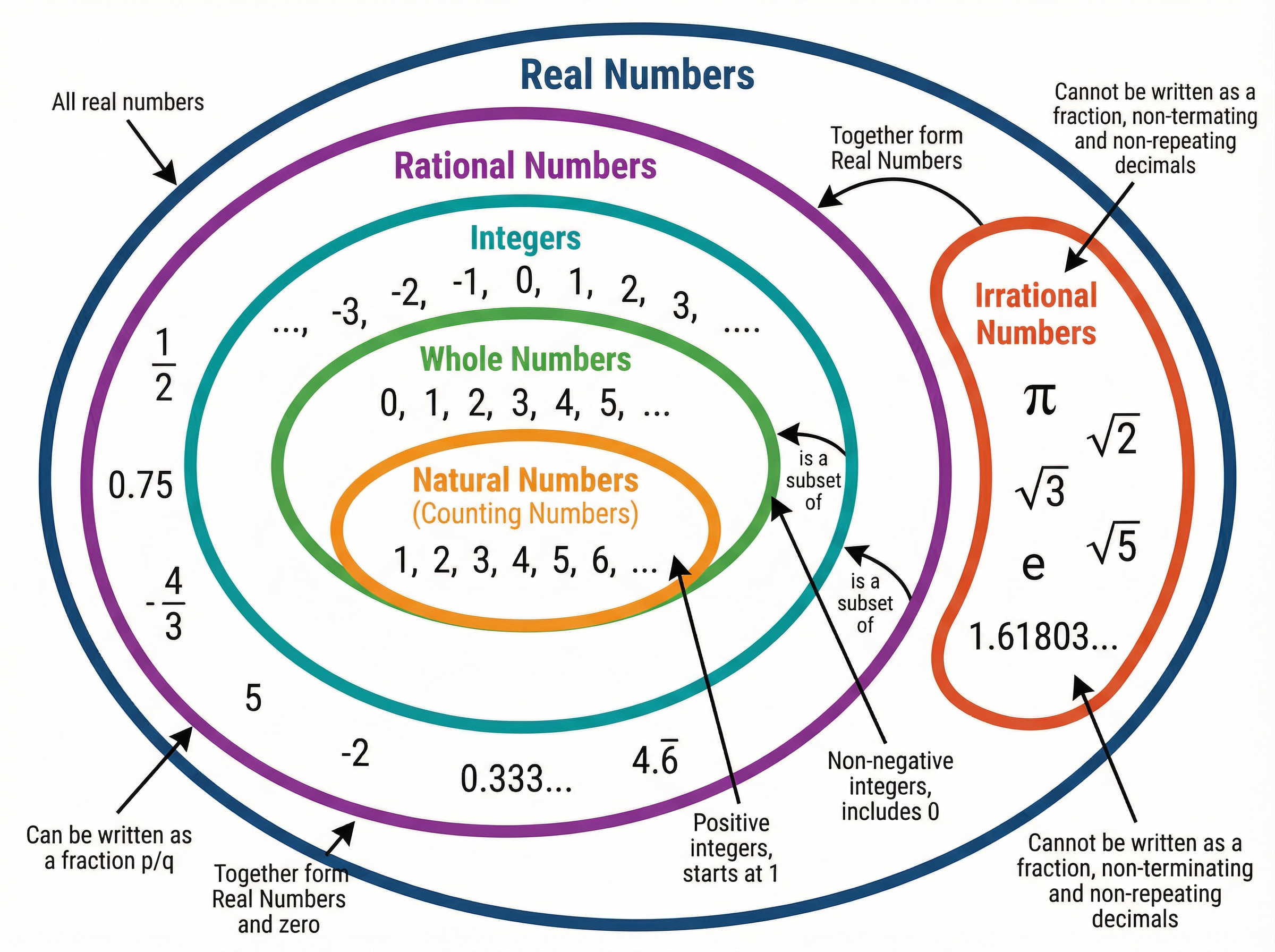
Candidates must be able to classify numbers correctly. Natural numbers are positive counting numbers (1, 2, 3...). Integers include all whole numbers, both positive and negative, including zero. Rational numbers can be written as a fraction p/q where p and q are integers. Irrational numbers cannot be written as a fraction; their decimal expansions are non-terminating and non-recurring (e.g., \pi, \sqrt{2}).
Example: Classify the number 0.\dot{3}. It is a rational number because it can be written exactly as the fraction 1/3.
Concept 2: Fractions, Decimals, and Percentages
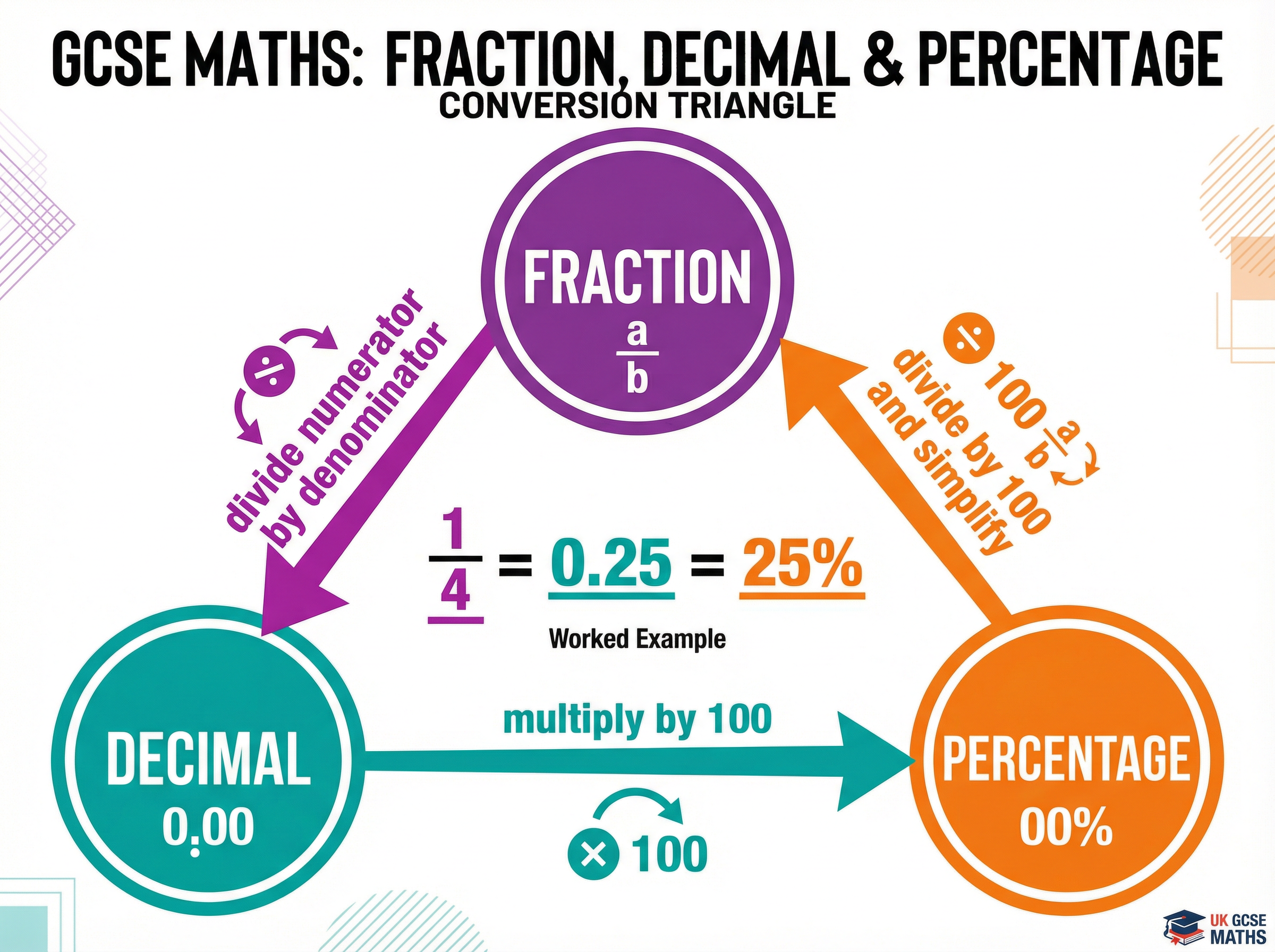
Fluency in converting between fractions, decimals, and percentages (FDP) is a core skill. Examiners often mix these formats in a single question to test your understanding.
To find a percentage of an amount, the most efficient method is to use a decimal multiplier. For a percentage increase, add the percentage to 100% and convert to a decimal. For a decrease, subtract from 100%.
Example: Increase £450 by 15%.
The multiplier is 1 + 0.15 = 1.15.
450 \times 1.15 = £517.50.
Concept 3: Powers, Roots, and Standard Form
The laws of indices govern how we manipulate powers. You must know these rules perfectly, as they apply to both numerical and algebraic terms.
Standard form (A \times 10^n, where 1 \leq A < 10 and n is an integer) is used to represent very large or very small numbers. Examiners frequently test standard form on non-calculator papers, requiring you to use index laws to multiply or divide.
Concept 4: Prime Factorisation, HCF, and LCM
Every integer greater than 1 can be written as a unique product of prime numbers. This is called prime factor decomposition. It is a powerful tool for finding the Highest Common Factor (HCF) and Lowest Common Multiple (LCM) of two or more numbers.
Example: Express 60 as a product of its prime factors.
60 = 2 \times 30 = 2 \times 2 \times 15 = 2 \times 2 \times 3 \times 5 = 2^2 \times 3 \times 5.
Mathematical/Scientific Relationships
The Laws of Indices
- Multiplication: a^m \times a^n = a^{m+n} (Add the powers)
- Division: a^m \div a^n = a^{m-n} (Subtract the powers)
- Power of a Power: (a^m)^n = a^{m \times n} (Multiply the powers)
- Zero Power: a^0 = 1
- Negative Power: a^{-n} = \frac{1}{a^n} (Take the reciprocal)
- Fractional Power: a^{\frac{1}{n}} = \sqrt[n]{a} (The nth root)
Practical Applications
Number skills are essential in real-world contexts such as personal finance. Calculating compound interest over several years requires repeated percentage multipliers. Understanding exchange rates involves direct proportion and ratio. Best buy questions require you to find the cost per unit or units per pound to make a direct comparison, a skill frequently tested in context.
Interactive Diagrams
2 interactive diagrams to visualise key concepts
Conceptual Flow Outline
Decision tree for identifying and solving percentage questions.
Conceptual Flow Outline
Process for finding HCF and LCM using prime factorisation.
Worked Examples
3 worked examples — open one to explore the question and available guidance.
Practice Questions
Test your understanding — click to reveal model answers
Work out 2 \frac{1}{3} + 1 \frac{4}{5}. Give your answer as a mixed number in its simplest form.
Hint: Convert both mixed numbers to improper fractions first.
Write 360 as a product of its prime factors in index form.
Hint: Use a factor tree starting with $36 \times 10$.
A population of bacteria increases by 8% every hour. The initial population is 5000. Calculate the population after 6 hours. Give your answer to the nearest whole number.
Hint: Use a decimal multiplier raised to the power of the number of hours.
Estimate the value of \frac{4.93 \times 18.2}{0.51}.
Hint: Round every number to 1 significant figure before calculating.
Calculate (3.2 \times 10^4) \times (4.5 \times 10^3). Give your answer in standard form.
Hint: Multiply the numbers and the powers of 10 separately, then adjust to standard form.