AQA · GCSE · Mathematics
Probability
Master probability for your GCSE Mathematics exam. This comprehensive guide covers everything from basic chance and the probability scale to complex tree diagrams, Venn diagrams, and conditional probability, ensuring you secure those vital marks.
- 7 min read
- 3 worked examples
- 5 practice questions
- 6 key terms
Study Notes

Overview
Probability is the mathematics of chance, measuring how likely an event is to occur on a scale from 0 (impossible) to 1 (certain). It is a cornerstone of the GCSE Mathematics specification and appears consistently across both Foundation and Higher tier papers. Understanding probability is crucial because it not only tests your numerical skills but also your logical reasoning and ability to interpret real-world scenarios.
This topic connects deeply with fractions, decimals, and percentages, as you must fluently convert between these forms. It also links to statistics and data handling, particularly when dealing with relative frequency and expected outcomes. Exam questions typically range from straightforward single-event calculations to complex multi-stage problems involving tree diagrams or Venn diagrams. By mastering the core rules—such as the addition rule for mutually exclusive events and the multiplication rule for independent events—you will be well-equipped to tackle any probability question the examiners throw at you.
Listen to our comprehensive revision podcast to reinforce these concepts:
Key Concepts
Concept 1: The Probability Scale and Basic Probability
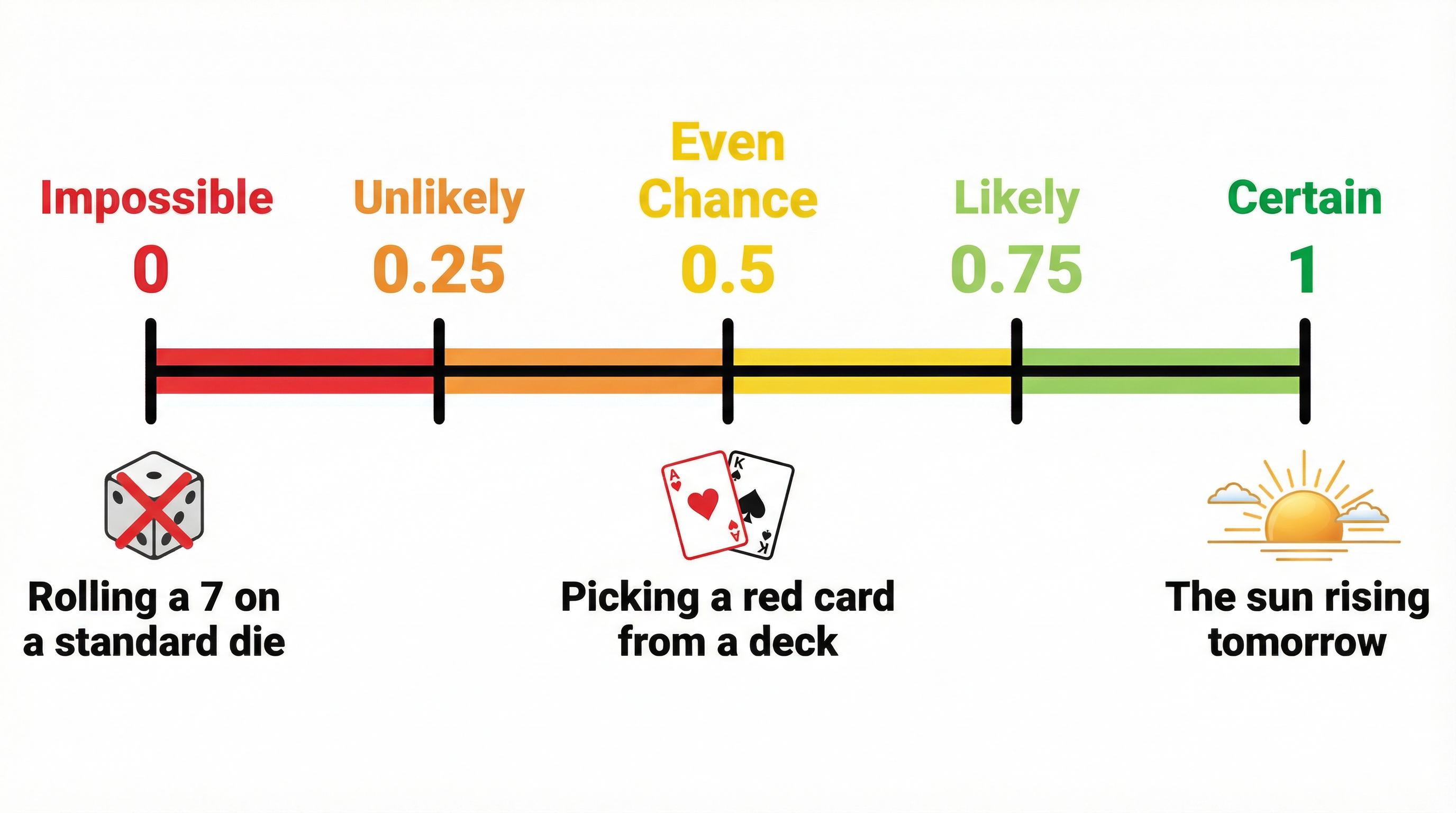
The probability of any event always lies between 0 and 1. An event with a probability of 0 is impossible, while an event with a probability of 1 is certain. An even chance is represented by 0.5 (or 1/2).
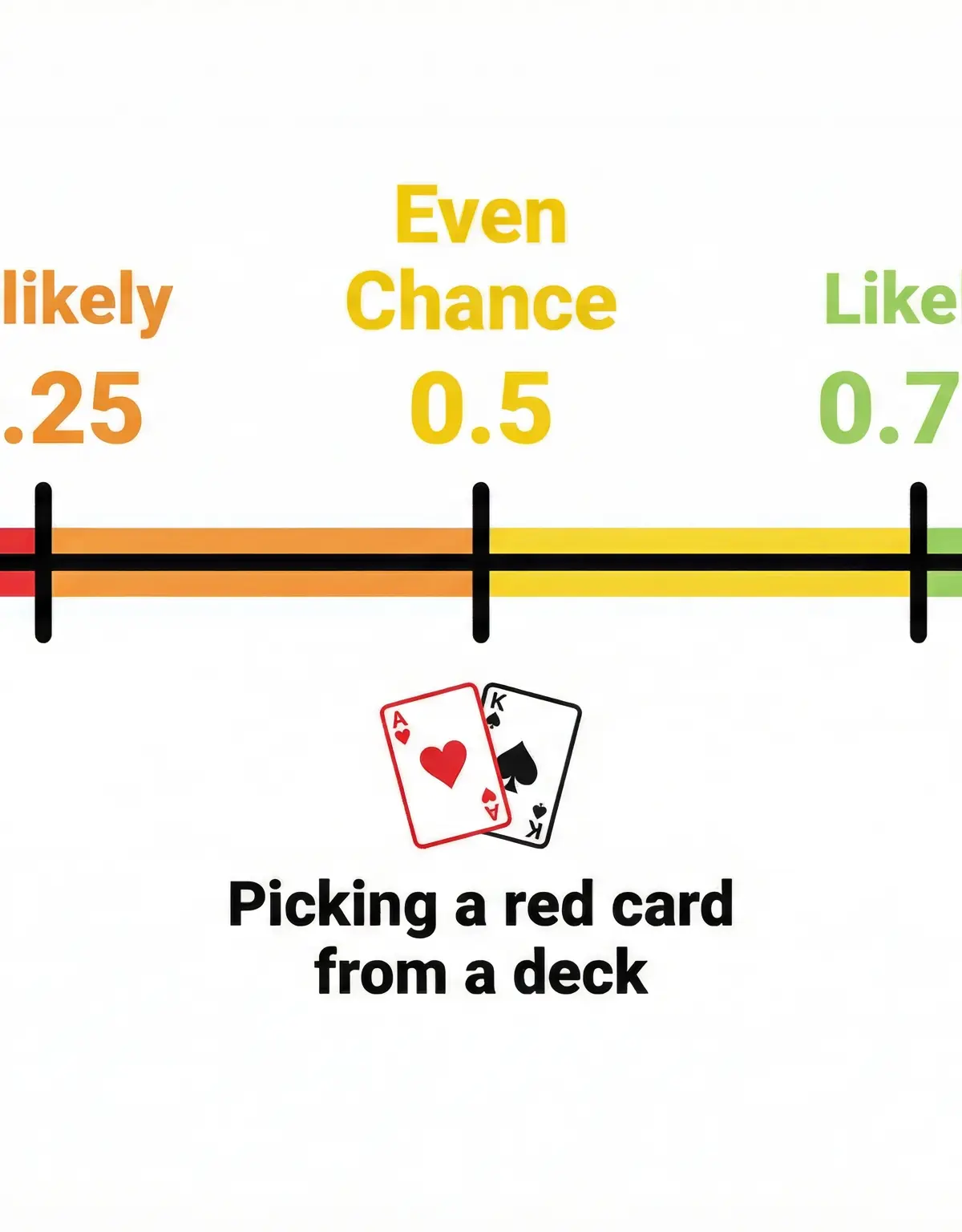
The fundamental formula for calculating the theoretical probability of a single event is:
P(Event) = Number of successful outcomes ÷ Total number of possible outcomesThis works because we assume all outcomes are equally likely. For instance, when rolling a fair six-sided die, each number has an equal 1/6 chance of landing face up.
Example: What is the probability of rolling a prime number on a fair six-sided die?
The possible outcomes are 1, 2, 3, 4, 5, 6. The prime numbers are 2, 3, and 5. There are 3 successful outcomes out of 6 possible outcomes.
P(Prime) = 3/6 = 1/2.
Concept 2: Mutually Exclusive and Complementary Events
Two events are mutually exclusive if they cannot happen at the same time. For example, you cannot roll a 3 and a 4 on a single roll of a die. For mutually exclusive events, we use the Addition Rule (the "OR" rule):
P(A or B) = P(A) + P(B)
Complementary events are mutually exclusive events that cover all possible outcomes. If event A happens, its complement (not A, written as A') does not happen. Because one of them must happen, their probabilities add up to 1.
P(not A) = 1 - P(A)
Example: The probability that it rains tomorrow is 0.3. What is the probability that it does not rain?
P(not rain) = 1 - 0.3 = 0.7.
Concept 3: Independent Events and the Multiplication Rule
Two events are independent if the outcome of the first event does not affect the outcome of the second event. For example, flipping a coin and rolling a die are independent. The coin landing on Heads does not change the probability of the die landing on a 6.
For independent events, we use the Multiplication Rule (the "AND" rule):
P(A and B) = P(A) × P(B)
Example: A fair coin is flipped and a fair die is rolled. What is the probability of getting Heads and rolling a 4?
P(Heads) = 1/2. P(4) = 1/6.
P(Heads and 4) = 1/2 × 1/6 = 1/12.
Concept 4: Tree Diagrams (With and Without Replacement)
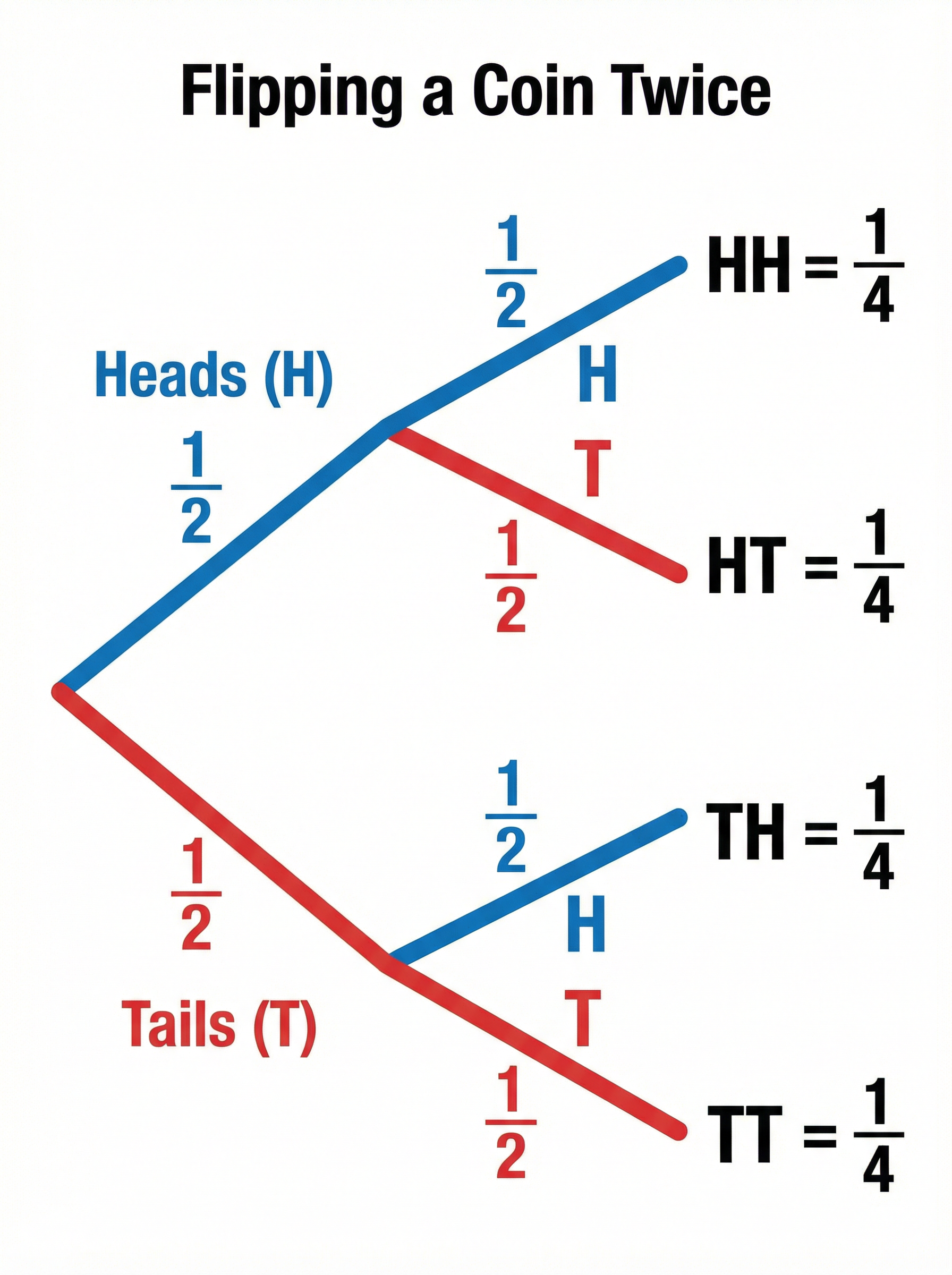
Tree diagrams are powerful visual tools for organising multi-stage probability problems. Each branch represents an outcome, and the probability is written on the branch.
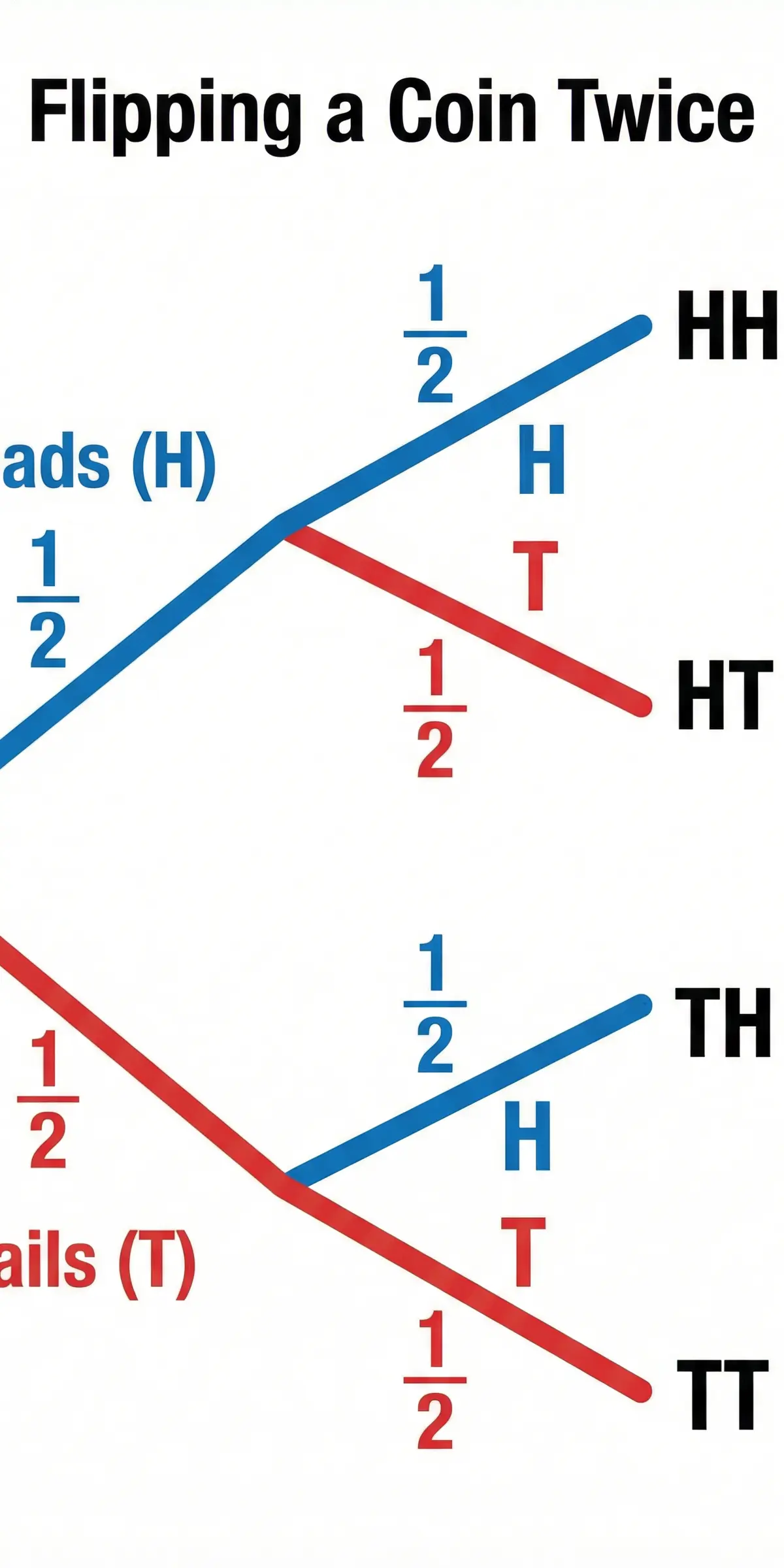
The key rules for tree diagrams are:
- Probabilities on branches from the same point must add up to 1.
- Multiply along the branches to find the probability of a combined outcome (AND rule).
- Add the probabilities of different successful end outcomes (OR rule).
A critical distinction at Higher tier is whether sampling is with replacement or without replacement (conditional probability). If an item is NOT replaced, the total number of items decreases for the next selection, changing the probabilities on the subsequent branches.
Concept 5: Venn Diagrams
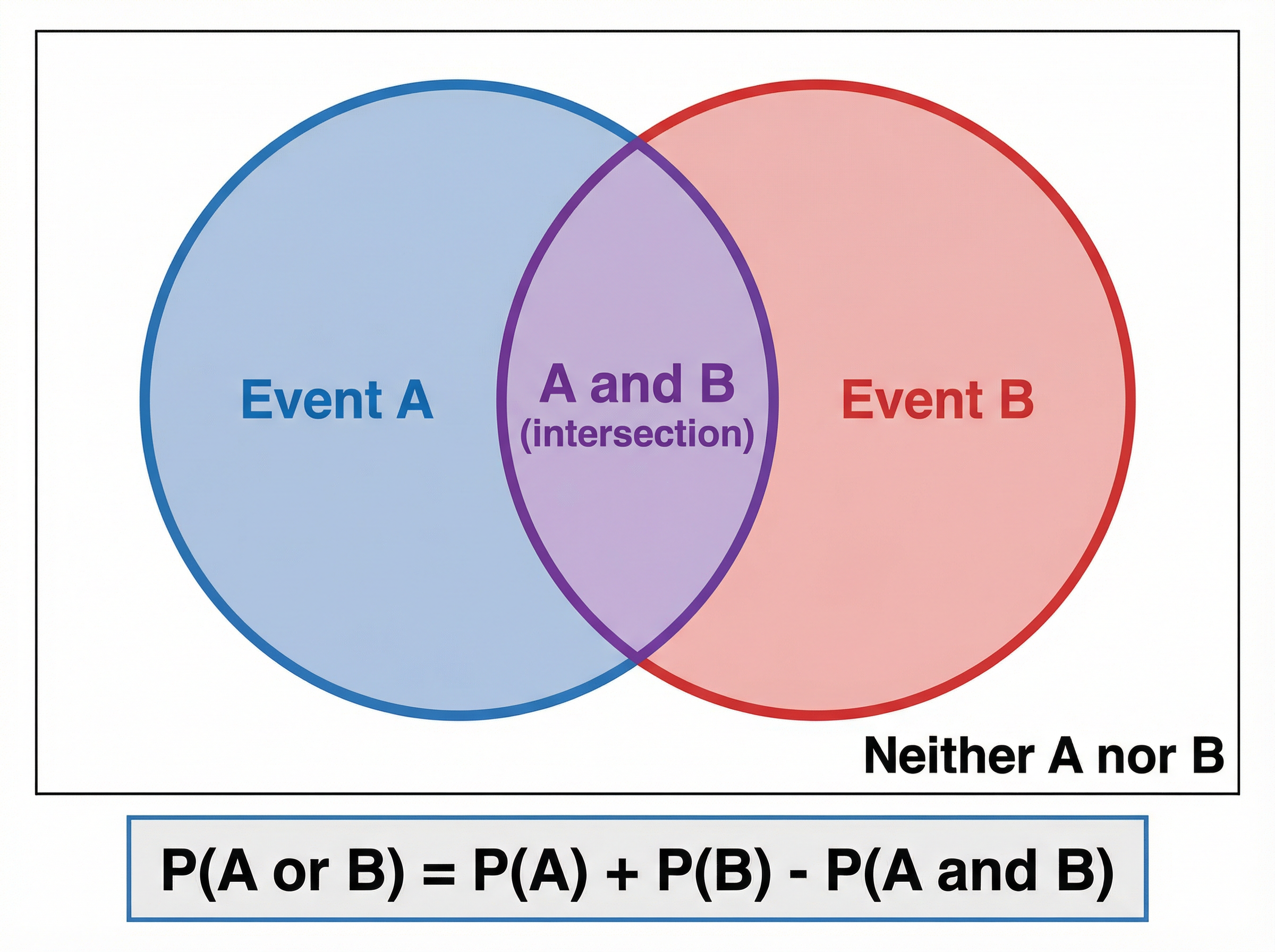
Venn diagrams use overlapping circles to show relationships between different sets of data. The rectangle represents the universal set (all possible outcomes, denoted by ε or ξ).
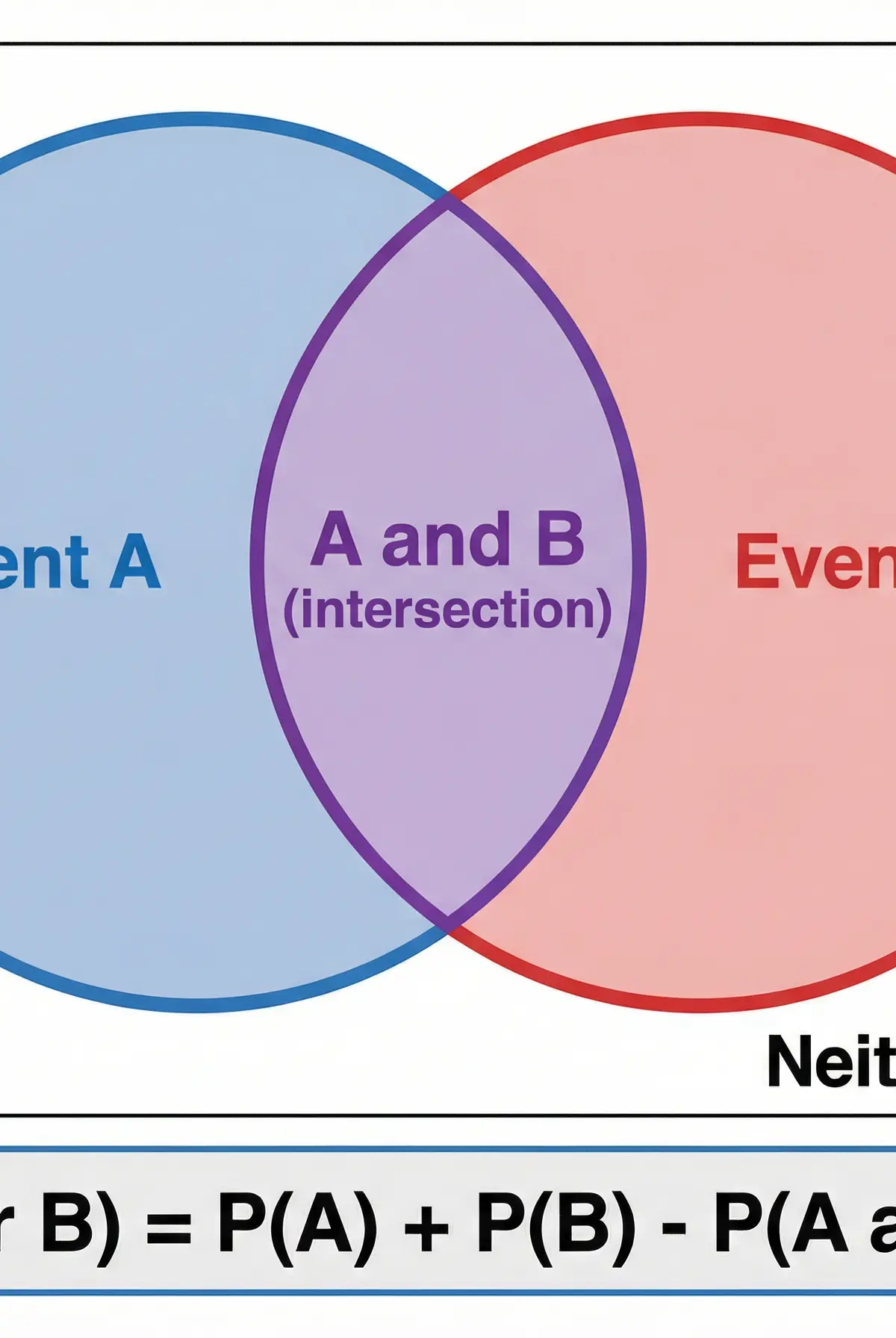
Key notation:
- Intersection (A ∩ B): The overlapping region. Outcomes in both A AND B.
- Union (A ∪ B): Both circles combined. Outcomes in A OR B OR both.
- Complement (A'): Everything outside circle A. Outcomes NOT in A.
For any two events A and B, the general addition rule is:
**P(A ∪ B) = P(A) + P(B) - P(A ∩ B)**We subtract the intersection because it was counted twice (once in A and once in B).
Concept 6: Relative Frequency (Experimental Probability)
While theoretical probability is based on mathematical reasoning, relative frequency is based on actual experiments or surveys.
Relative Frequency = Frequency of successful trials ÷ Total number of trialsAs the number of trials increases, the relative frequency gets closer to the theoretical probability. This is known as the Law of Large Numbers.
Mathematical Relationships and Formulas
- Basic Probability: P(A) = \frac{\text{Number of successful outcomes}}{\text{Total possible outcomes}} (Must memorise)
- Complementary Events: P(A') = 1 - P(A) (Must memorise)
- Addition Rule (Mutually Exclusive): P(A \text{ or } B) = P(A) + P(B) (Must memorise)
- Multiplication Rule (Independent): P(A \text{ and } B) = P(A) \times P(B) (Must memorise)
- General Addition Rule: P(A \cup B) = P(A) + P(B) - P(A \cap B) (Must memorise for Higher tier)
- Relative Frequency: \text{Relative Frequency} = \frac{\text{Frequency of event}}{\text{Total number of trials}} (Must memorise)
- Expected Frequency: \text{Expected Frequency} = P(\text{Event}) \times \text{Number of trials} (Must memorise)
Practical Applications
Probability is used extensively in real-world scenarios:
- Insurance and Risk Assessment: Actuaries use probability to calculate premiums based on the likelihood of claims (e.g., car accidents).
- Quality Control: Factories test a sample of products to estimate the probability of defective items in an entire batch using relative frequency.
- Medical Testing: Venn diagrams and conditional probability are used to understand false positives and the accuracy of diagnostic tests.
- Weather Forecasting: Meteorologists use complex models to determine the percentage chance of precipitation.
Visual Resources
3 diagrams and illustrations
Interactive Diagrams
2 interactive diagrams to visualise key concepts
Conceptual Flow Outline
Decision flowchart for choosing the correct probability rule.
Conceptual Flow Outline
Relationship between sets in probability.
Worked Examples
3 worked examples — open one to explore the question and available guidance.
Practice Questions
Test your understanding — click to reveal model answers
A spinner has sections coloured red, blue, green, and yellow. The probability of landing on red is 0.3. The probability of landing on blue is 0.2. The probability of landing on green is 0.15. Calculate the probability of landing on yellow. (2 marks)
Hint: Remember that all probabilities for mutually exclusive, exhaustive events must add up to 1.
In a class of 30 students, 18 study French, 15 study Spanish, and 5 study neither. A student is chosen at random. Find the probability that the student studies both French and Spanish. (3 marks)
Hint: Draw a Venn diagram. How many students study at least one language? Compare this to the total of the French and Spanish classes.
A box contains 7 chocolate biscuits and 3 toffee biscuits. Sarah takes a biscuit at random and eats it. She then takes a second biscuit at random and eats it. Calculate the probability that she eats one of each type of biscuit. (4 marks)
Hint: Because she eats the biscuit, this is 'without replacement'. There are two ways to get one of each: Chocolate then Toffee, OR Toffee then Chocolate.
A factory produces lightbulbs. A sample of 500 lightbulbs is tested, and 12 are found to be defective. The factory produces 25,000 lightbulbs in a week. Estimate the total number of defective lightbulbs produced in that week. (3 marks)
Hint: First find the relative frequency of a defective bulb, then multiply by the total weekly production.
Events A and B are independent. P(A) = 0.4 and P(A and B) = 0.12. Work out P(B). (2 marks)
Hint: Use the multiplication rule for independent events and rearrange the formula.