AQA · GCSE · Mathematics
Ratio, proportion and rates of change
Master Ratio, Proportion, and Rates of Change to unlock some of the most practical and heavily tested concepts in GCSE Mathematics. This topic connects directly to algebra, geometry, and real-world problem-solving, making it essential for securing top grades.
- 5 min read
- 3 worked examples
- 5 practice questions
- 6 key terms
Study Notes

Overview
Ratio, Proportion, and Rates of Change form a cornerstone of the GCSE Mathematics specification. This topic is not just about abstract numbers; it's about understanding how different quantities relate to one another in the real world. Whether you are scaling a recipe, calculating the speed of a vehicle, or working out the best value in a supermarket, you are applying these principles.
In the exam, these concepts are heavily weighted because they test your ability to reason proportionally—a skill examiners highly reward. This topic connects seamlessly with Algebra (forming equations for direct and inverse proportion) and Geometry (similar shapes and scale factors). Typical exam questions range from simple 2-mark ratio sharing problems to complex 5-mark multi-step proportion calculations requiring algebraic manipulation.
Key Concepts
Concept 1: Simplifying and Sharing in a Ratio
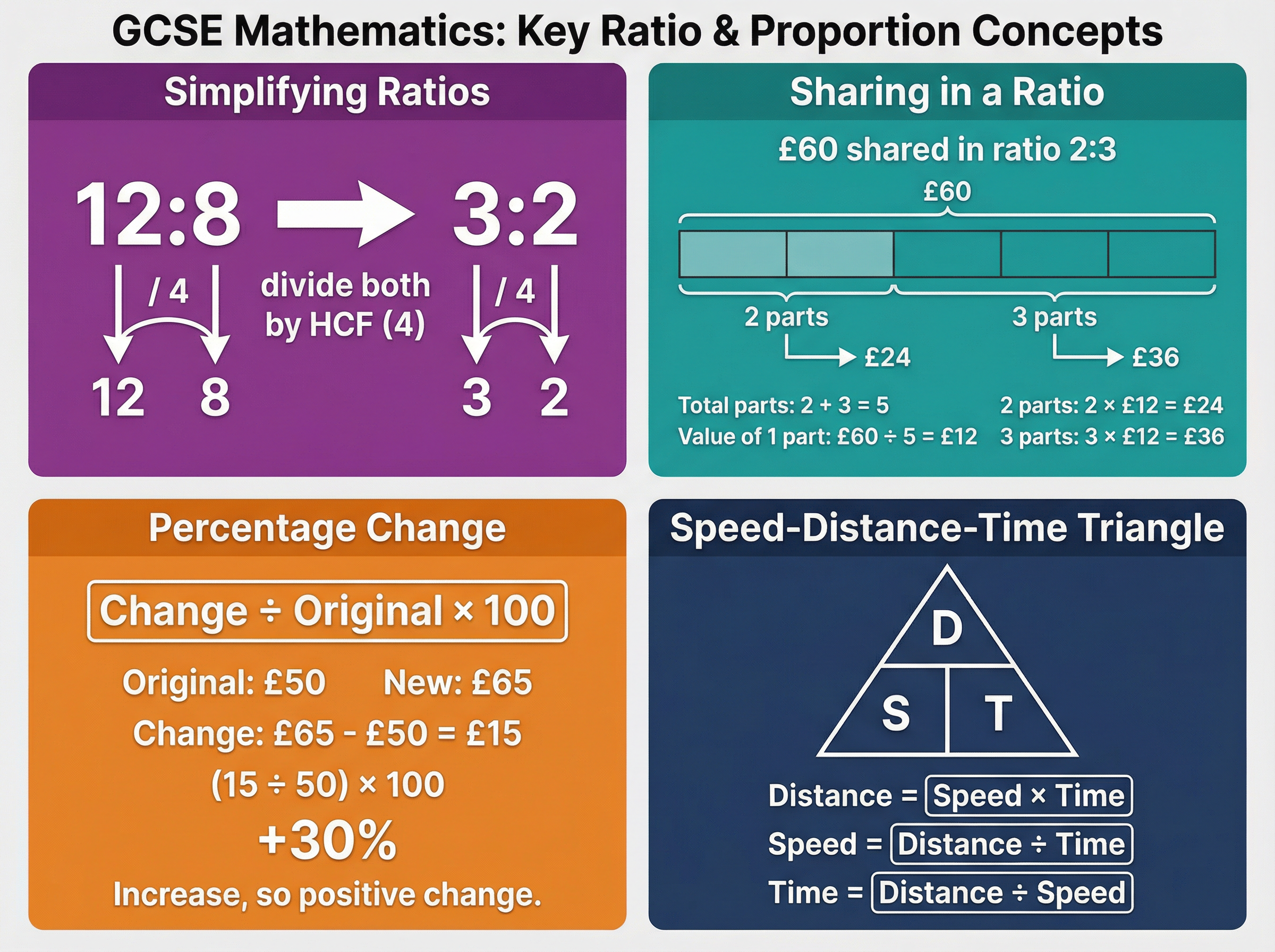
A ratio compares the size of one part to another part. Ratios must always be presented in their simplest integer form, much like fractions. To simplify a ratio, you divide all parts by their Highest Common Factor (HCF). When a question asks you to share an amount in a given ratio, you must find the total number of parts, calculate the value of one single part, and then multiply to find the value of each share.
Example: Share £120 in the ratio 3:5.
First, find the total parts: 3 + 5 = 8 parts.
Next, find the value of one part: £120 \div 8 = £15.
Finally, calculate the shares: 3 \times £15 = £45 and 5 \times £15 = £75.

Concept 2: Direct and Inverse Proportion
Proportion describes how two variables change together.
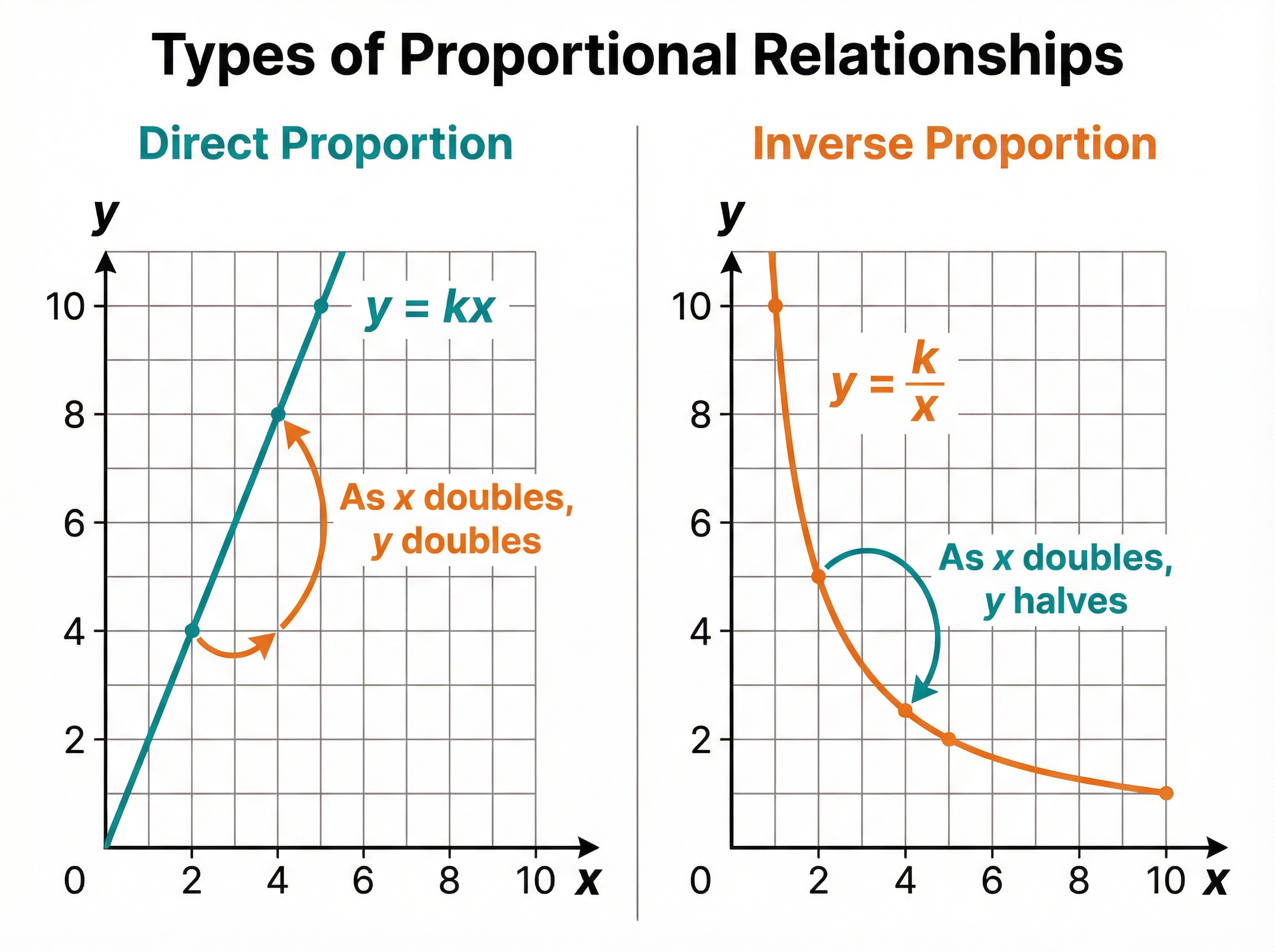
- Direct Proportion: As one variable increases, the other increases at the same rate. If y is directly proportional to x, we write y \propto x, which means y = kx (where k is the constant of proportionality). The graph is a straight line through the origin.
- Inverse Proportion: As one variable increases, the other decreases at a proportional rate. If y is inversely proportional to x, we write y \propto \frac{1}{x}, which means y = \frac{k}{x}. The graph is a reciprocal curve (hyperbola).
Example: y is directly proportional to x. When x = 4, y = 20. Find y when x = 7.
First, find k: 20 = k \times 4, so k = 5.
The formula is y = 5x.
When x = 7, y = 5 \times 7 = 35.
Concept 3: Percentage Change and Reverse Percentages
Percentage change measures the difference between an old value and a new value as a fraction of the original value. Examiners frequently test reverse percentages, where you are given the final amount after a percentage change and must calculate the original amount. This requires dividing by the decimal multiplier rather than subtracting the percentage.
Example: A car's value decreases by 15% to £10,200. What was its original value?
The car is now worth 85% of its original value. The multiplier is 0.85.
Original Value = £10,200 \div 0.85 = £12,000.
Concept 4: Rates of Change (Speed, Density, Pressure)
A rate of change compares how one quantity changes relative to another. The most common compound measures are Speed (distance per time), Density (mass per volume), and Pressure (force per area). You must be able to recall these formulas and use them accurately, paying careful attention to unit conversions (e.g., minutes to hours).
Example: A block of metal has a mass of 400g and a volume of 50cm³. Calculate its density.
Density = Mass \div Volume = 400 \div 50 = 8 g/cm³.
Mathematical/Scientific Relationships
- Direct Proportion: y = kx (Linear), y = kx^2 (Quadratic), y = k\sqrt{x} (Square root)
- Inverse Proportion: y = \frac{k}{x}
- Percentage Change: \frac{\text{Change}}{\text{Original}} \times 100
- Speed: S = \frac{D}{T} (Speed = Distance \div Time)
- Density: \rho = \frac{m}{V} (Density = Mass \div Volume)
- Pressure: P = \frac{F}{A} (Pressure = Force \div Area)
Practical Applications
Proportional reasoning is used daily in currency conversions when travelling, adjusting recipe ingredients for different numbers of guests, calculating fuel efficiency (miles per gallon) for vehicles, and determining tax brackets. Understanding compound measures is essential in engineering (calculating pressure on foundations) and logistics (planning delivery times based on average speeds).
Visual Resources
2 diagrams and illustrations
Interactive Diagrams
2 interactive diagrams to visualise key concepts
Conceptual Flow Outline
Decision tree for solving ratio problems
Conceptual Flow Outline
Relationship between original and new amounts in percentage change
Worked Examples
3 worked examples — open one to explore the question and available guidance.
Practice Questions
Test your understanding — click to reveal model answers
A machine takes 4 hours to produce 200 widgets. How long will it take to produce 350 widgets at the same rate?
Hint: Find out how long it takes to produce 1 widget, or how many widgets are produced in 1 hour.
Alex, Ben, and Chloe share £84 in the ratio 2:3:7. How much more does Chloe receive than Alex?
Hint: First, find the value of one part. Then find Chloe's and Alex's shares and subtract.
The force F applied to a spring is directly proportional to its extension x. When F = 15N, x = 6cm. Calculate the force required to produce an extension of 10cm.
Hint: Write the equation F = kx and find k first.
A solid cylinder has a mass of 5.4kg and a volume of 2000cm³. Calculate the density of the cylinder in g/cm³.
Hint: Check the units carefully. The mass is given in kg but the answer requires g/cm³.
The time taken (t) to complete a journey is inversely proportional to the average speed (s). When s = 60 km/h, t = 4 hours. Form an equation for t in terms of s, and use it to find the time taken when the speed is 80 km/h.
Hint: Inverse proportion means t = k/s. Find k.