Pearson Edexcel · GCSE · Mathematics
Geometry and measures
Geometry and Measures is a fundamental GCSE Mathematics topic covering everything from basic shape properties to advanced trigonometry, circle theorems, and vector calculus. Mastering this topic is essential for unlocking top grades, as examiners frequently use it to test multi-step problem-solving and logical reasoning skills.
- 7 min read
- 3 worked examples
- 5 practice questions
- 6 key terms
Study Notes
Overview
Geometry and Measures is a cornerstone of the GCSE Mathematics specification, forming a significant portion of both Foundation and Higher tier examinations. This topic is about understanding the physical space around us—how to measure it, how to describe it, and how to prove relationships within it. It connects deeply with algebra, as you'll frequently need to set up and solve equations to find missing lengths or angles.
Examiners love this topic because it allows them to assess your ability to construct logical arguments and apply multiple concepts simultaneously. A typical exam question might require you to use circle theorems to find an angle, apply the Sine Rule to find a length, and then calculate an area. Success here requires not just memorising formulas, but understanding why they work and when to apply them. Let's dive in.
Key Concepts
Concept 1: Angle Properties and Polygons
Angles are the foundation of geometry. You must be fluent in the basic rules: angles on a straight line add to 180°, angles around a point add to 360°, and vertically opposite angles are equal. When dealing with parallel lines, look for corresponding (F), alternate (Z), and co-interior (C) angles.
For polygons, the sum of the interior angles is given by the formula 180(n-2), where n is the number of sides. This works because any polygon can be split into (n-2) triangles. Crucially, the sum of the exterior angles of any polygon is always 360°. This is often the fastest way to solve regular polygon problems.
Example: To find the interior angle of a regular decagon (10 sides): Exterior angle = 360 \div 10 = 36°. Interior angle = 180 - 36 = 144°.
Concept 2: Trigonometry in Right-Angled Triangles
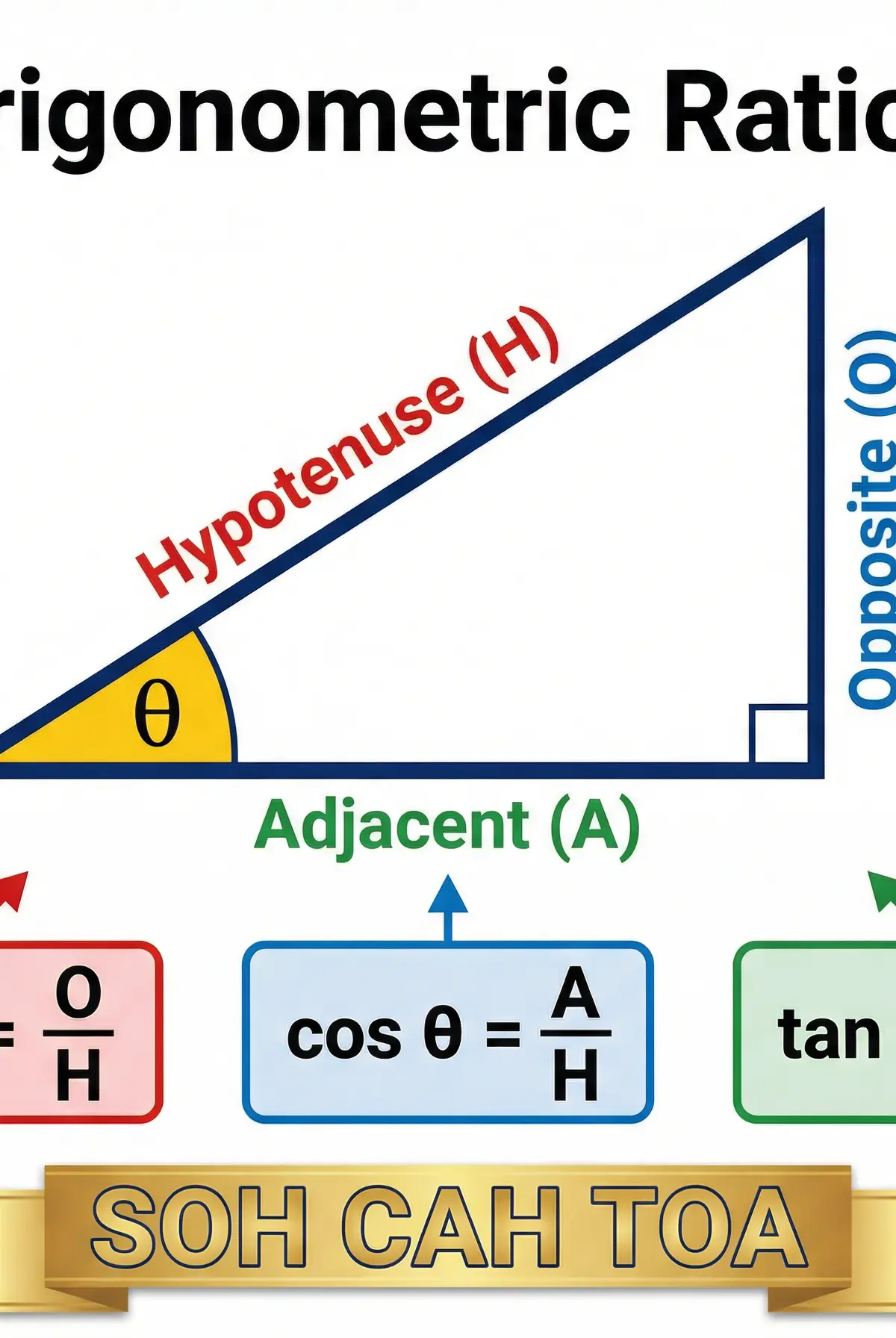
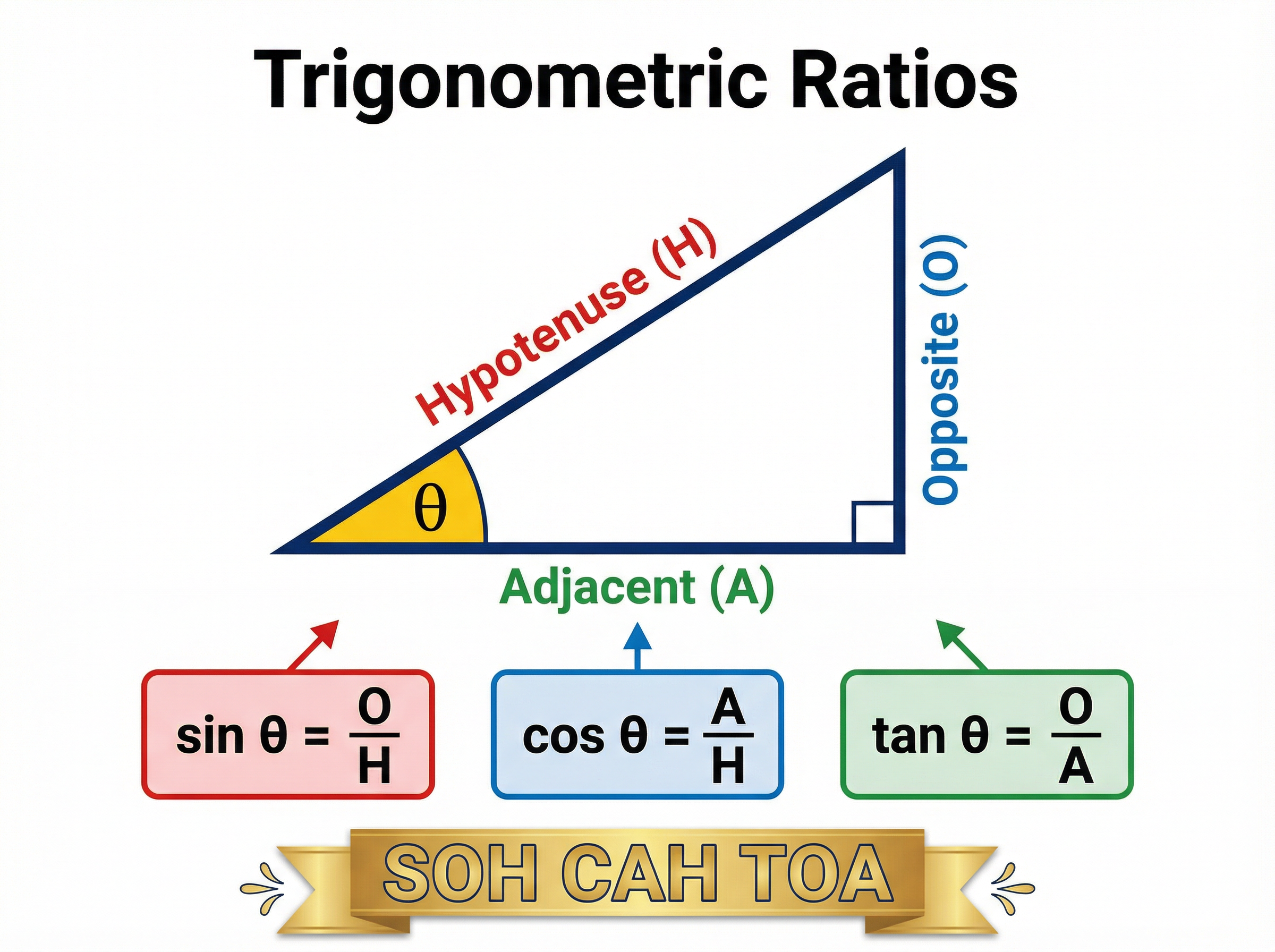
Trigonometry allows us to find missing sides and angles in right-angled triangles using the ratios Sine, Cosine, and Tangent. The most critical step is correctly labelling your triangle: the Hypotenuse is always the longest side (opposite the right angle), the Opposite is across from the angle \theta, and the Adjacent is next to the angle \theta.
Use the mnemonic SOH CAH TOA to remember the ratios. If you know two sides, you can find an angle using inverse trigonometric functions (e.g., \sin^{-1}). If you know a side and an angle, you can find another side.
Example: A ladder of length 5m leans against a wall, making an angle of 60° with the ground. How high up the wall does it reach? We want the Opposite, we have the Hypotenuse. Use Sine: \sin(60°) = \frac{O}{5}, so O = 5 \times \sin(60°) = 4.33m.
Concept 3: Advanced Trigonometry (Higher Tier)
For non-right-angled triangles, we use the Sine Rule and the Cosine Rule.
The Sine Rule (\frac{a}{\sin A} = \frac{b}{\sin B}) is used when you have a 'matching pair'—a known side and its opposite angle. The Cosine Rule (a^2 = b^2 + c^2 - 2bc \cos A) is used when you know all three sides (to find an angle) or two sides and the included angle (to find the third side).
To find the area of any triangle without knowing its perpendicular height, use the formula Area = \frac{1}{2}ab \sin C.
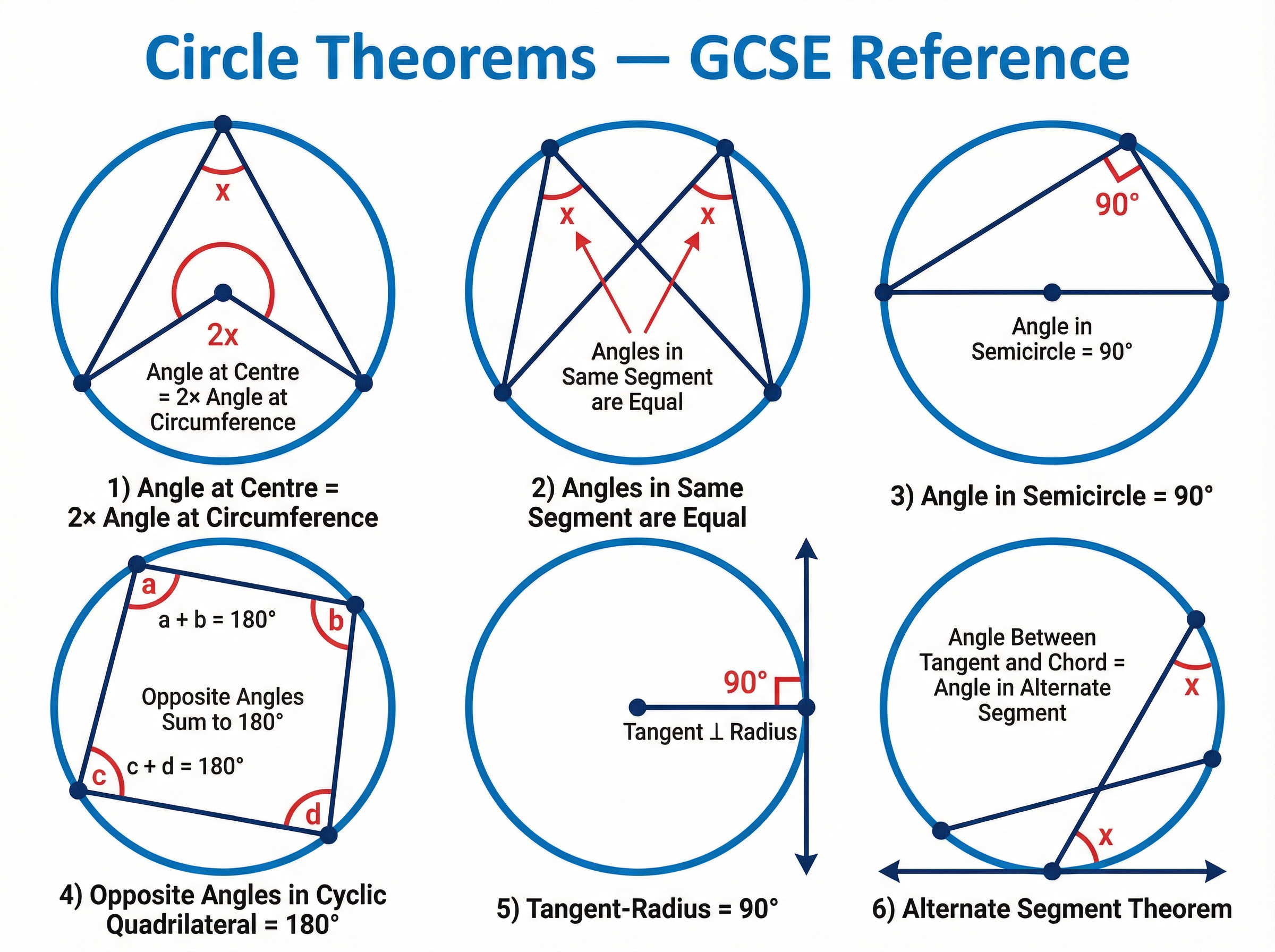
Concept 4: Circle Theorems (Higher Tier)
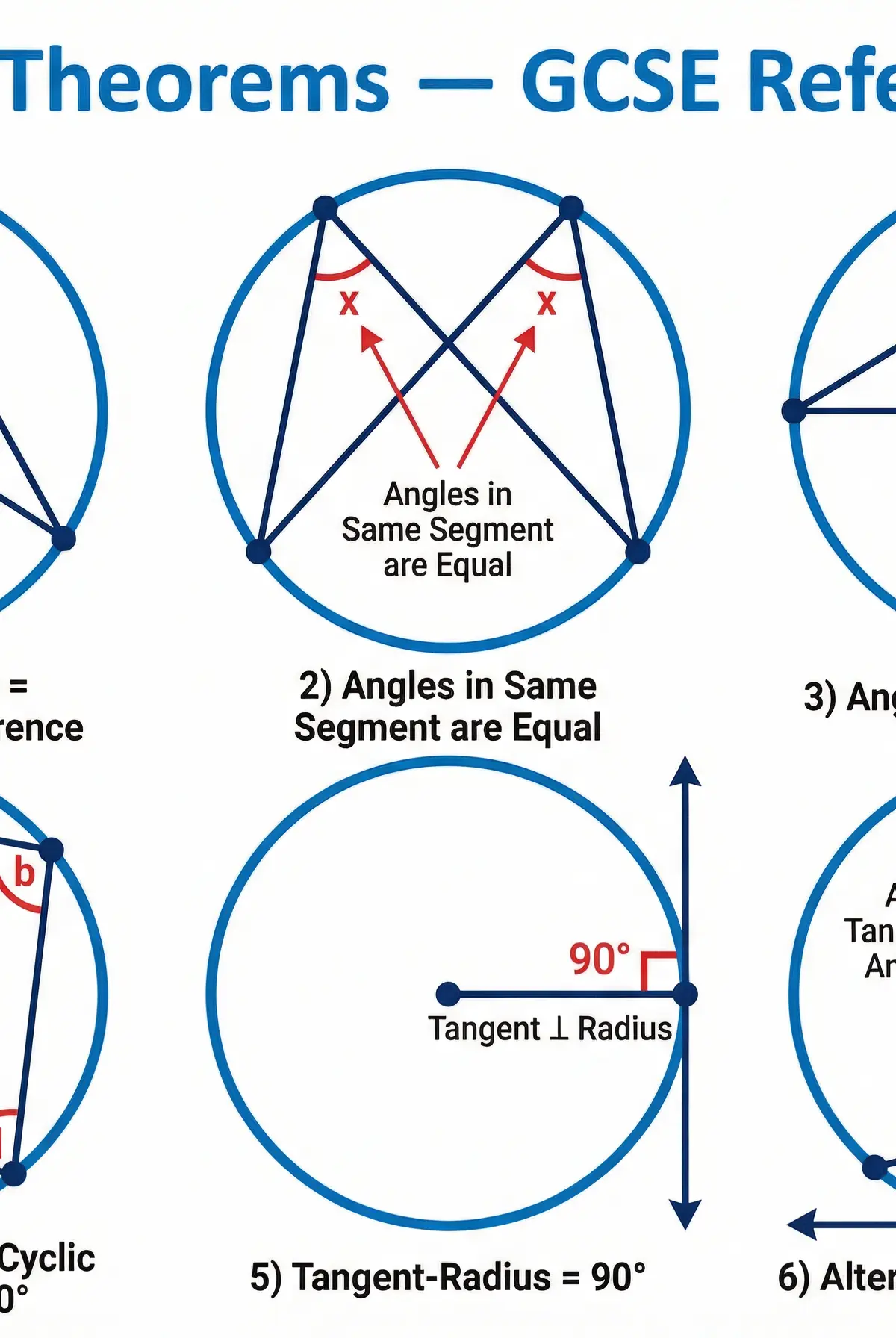
Circle theorems are geometric rules that apply to angles and lines within circles. There are six main theorems you must memorise and be able to state clearly in exams:
- The angle at the centre is twice the angle at the circumference.
- Angles in the same segment are equal.
- The angle in a semicircle is a right angle (90°).
- Opposite angles in a cyclic quadrilateral sum to 180°.
- The angle between a tangent and a radius is 90°.
- The Alternate Segment Theorem: the angle between a tangent and a chord equals the angle in the alternate segment.
Examiners specifically look for the correct terminology. Writing "angles in the same segment" earns the mark; writing "the bow-tie rule" does not.
Concept 5: Mensuration (Perimeter, Area, and Volume)
Mensuration deals with the measurement of 2D and 3D shapes. You must be comfortable calculating the perimeter and area of compound shapes by breaking them down into simpler rectangles, triangles, and circles.
For 3D shapes, volume is the amount of space inside, and surface area is the total area of all the faces. The volume of any prism is the area of its cross-section multiplied by its length. For cylinders, cones, and spheres, you will need to use \pi. Remember that the radius is half the diameter—this is the most common pitfall in circle calculations.
Concept 6: Vectors
A vector is a quantity that has both magnitude (size) and direction. In GCSE Maths, vectors are usually written as column vectors \begin{pmatrix} x \ y \end{pmatrix} or represented by directed line segments (e.g., \overrightarrow{AB}).
To add vectors, you add their corresponding components. To multiply by a scalar, multiply each component. In geometry problems, you often need to find a route from one point to another using known vectors. If you travel in the opposite direction to a vector \mathbf{a}, it becomes -\mathbf{a}. Proving that two lines are parallel involves showing that their vectors are scalar multiples of each other.
Mathematical/Scientific Relationships
- Pythagoras' Theorem: a^2 + b^2 = c^2 (Must memorise). Used to find missing sides in right-angled triangles.
- Trigonometric Ratios: \sin \theta = \frac{O}{H}, \cos \theta = \frac{A}{H}, \tan \theta = \frac{O}{A} (Must memorise).
- Sine Rule: \frac{a}{\sin A} = \frac{b}{\sin B} = \frac{c}{\sin C} (Given on formula sheet). Used for non-right-angled triangles with a known side-angle pair.
- Cosine Rule: a^2 = b^2 + c^2 - 2bc \cos A (Given on formula sheet). Used for non-right-angled triangles with 3 sides or 2 sides and included angle.
- Area of a Triangle: \frac{1}{2}ab \sin C (Given on formula sheet). Used when perpendicular height is unknown.
- Area of a Circle: A = \pi r^2 (Must memorise).
- Circumference of a Circle: C = 2\pi r or C = \pi d (Must memorise).
- Area of a Trapezium: \frac{1}{2}(a+b)h (Must memorise).
- Volume of a Prism: Area of cross-section \times length (Must memorise).
- Volume of a Cylinder: V = \pi r^2 h (Must memorise).
- Volume of a Cone: V = \frac{1}{3}\pi r^2 h (Given on formula sheet).
- Volume of a Sphere: V = \frac{4}{3}\pi r^3 (Given on formula sheet).
Practical Applications
Geometry and measures are heavily used in architecture, engineering, and construction. Architects use trigonometry to calculate roof pitches and load-bearing angles. Surveyors use advanced trigonometry and vectors to map land contours accurately. In computer graphics and video game design, 3D environments are entirely constructed using vector mathematics and coordinate geometry to calculate lighting, movement, and perspective.
Interactive Diagrams
2 interactive diagrams to visualise key concepts
Conceptual Flow Outline
Decision tree for choosing the correct trigonometric or geometric rule for triangles.
Conceptual Flow Outline
Relationship between linear, area, and volume scale factors for similar shapes.
Worked Examples
3 worked examples — open one to explore the question and available guidance.
Practice Questions
Test your understanding — click to reveal model answers
A solid cylinder has a radius of 4 cm and a height of 10 cm. Calculate the total surface area of the cylinder. Give your answer in terms of π. (4 marks)
Hint: Remember that a cylinder has three surfaces: the curved surface and two circular ends.
Triangle ABC has sides AB = 8cm, BC = 12cm, and AC = 15cm. Calculate the size of the largest angle in the triangle. Give your answer to 1 decimal place. (4 marks)
Hint: The largest angle is always opposite the longest side.
A regular polygon has an exterior angle of 24°. Calculate the number of sides the polygon has. (2 marks)
Hint: What do the exterior angles of ANY polygon add up to?
\mathbf{a} = \begin{pmatrix} 3 \ -2 \end{pmatrix} and \mathbf{b} = \begin{pmatrix} -1 \ 4 \end{pmatrix}. Calculate the vector 2\mathbf{a} - 3\mathbf{b}. (2 marks)
Hint: Multiply the vectors by the scalars first, then do the subtraction.
A ship sails 40km on a bearing of 060°, then 30km on a bearing of 150°. Calculate the distance of the ship from its starting point. (4 marks)
Hint: Draw a sketch. Look at the angle between the two paths—it might be a special type of triangle.