Pearson Edexcel · GCSE · Mathematics
Number
Master the foundation of mathematics with our comprehensive guide to Number. From BODMAS and prime factors to standard form and surds, secure the essential skills that underpin the entire GCSE specification.
- 7 min read
- 3 worked examples
- 5 practice questions
- 6 key terms
Study Notes
Overview
Welcome to the Number topic — the fundamental bedrock of your entire GCSE Mathematics course. This topic is not just about basic arithmetic; it's about mastering the language of mathematics. It covers everything from the strict rules of BODMAS and the structure of the number system to advanced concepts like standard form, surds, and limits of accuracy.
Why is this so important? Because Number skills are tested in almost every other topic. Whether you're calculating probabilities, solving algebraic equations, or finding the area of a circle, you need solid number skills to secure the final marks. Examiners frequently design questions that combine Number with other areas to test your synoptic understanding.
Typical exam questions range from quick 1-mark recall questions (like identifying prime numbers or rounding to significant figures) to complex 4-6 mark problem-solving questions involving bounds, error intervals, or rationalising denominators in surds.
Listen to our exclusive podcast episode to consolidate your learning:
Key Concepts
Concept 1: Order of Operations (BODMAS/BIDMAS)
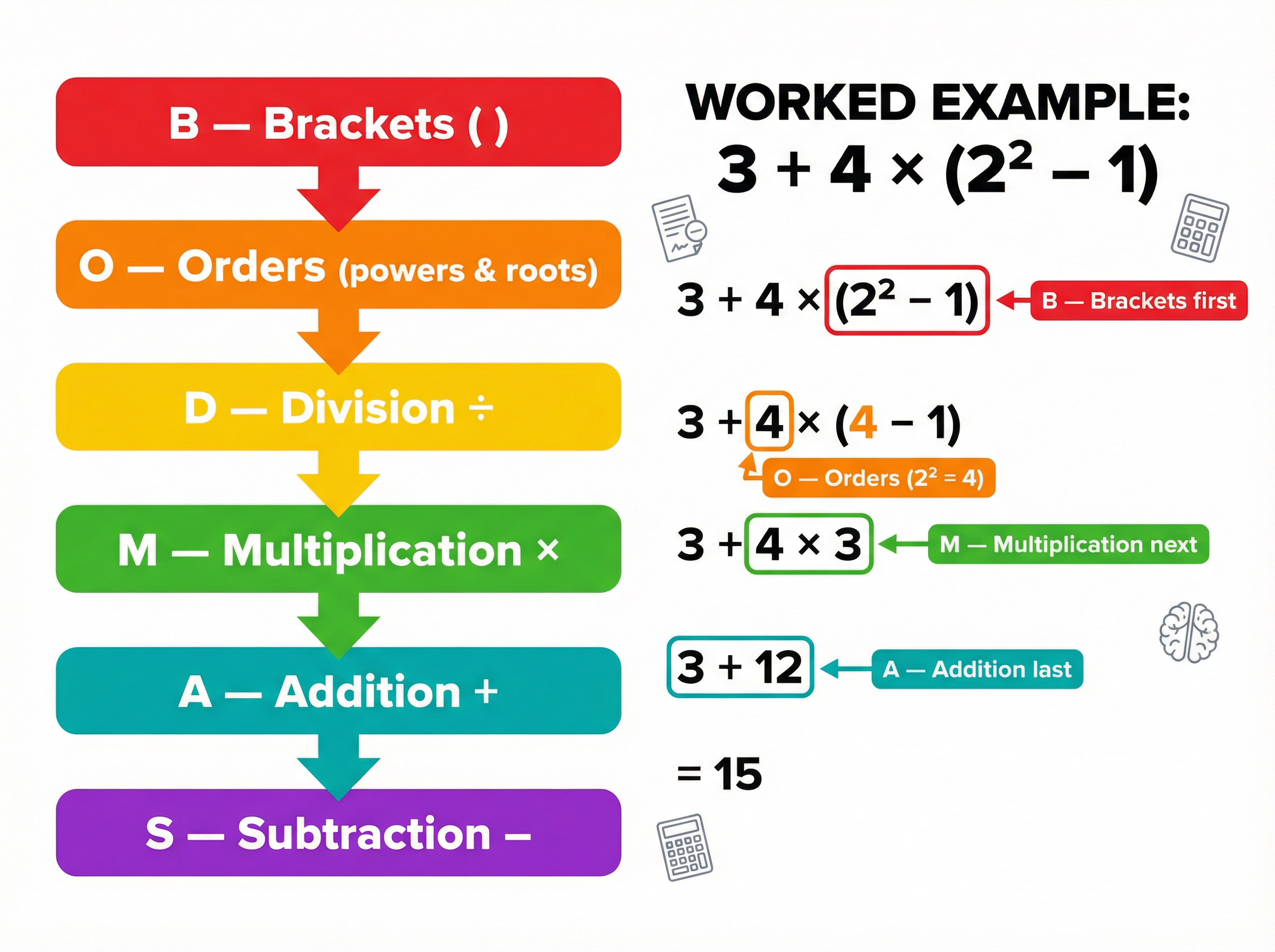
The order of operations is the strict sequence in which mathematical calculations must be performed. Examiners will deliberately write expressions that test whether you know this rule. If you just calculate from left to right, you will often get the wrong answer.
BODMAS stands for:
- Brackets
- Orders (Powers and Roots)
- Division and Multiplication (Left to right)
- Addition and Subtraction (Left to right)
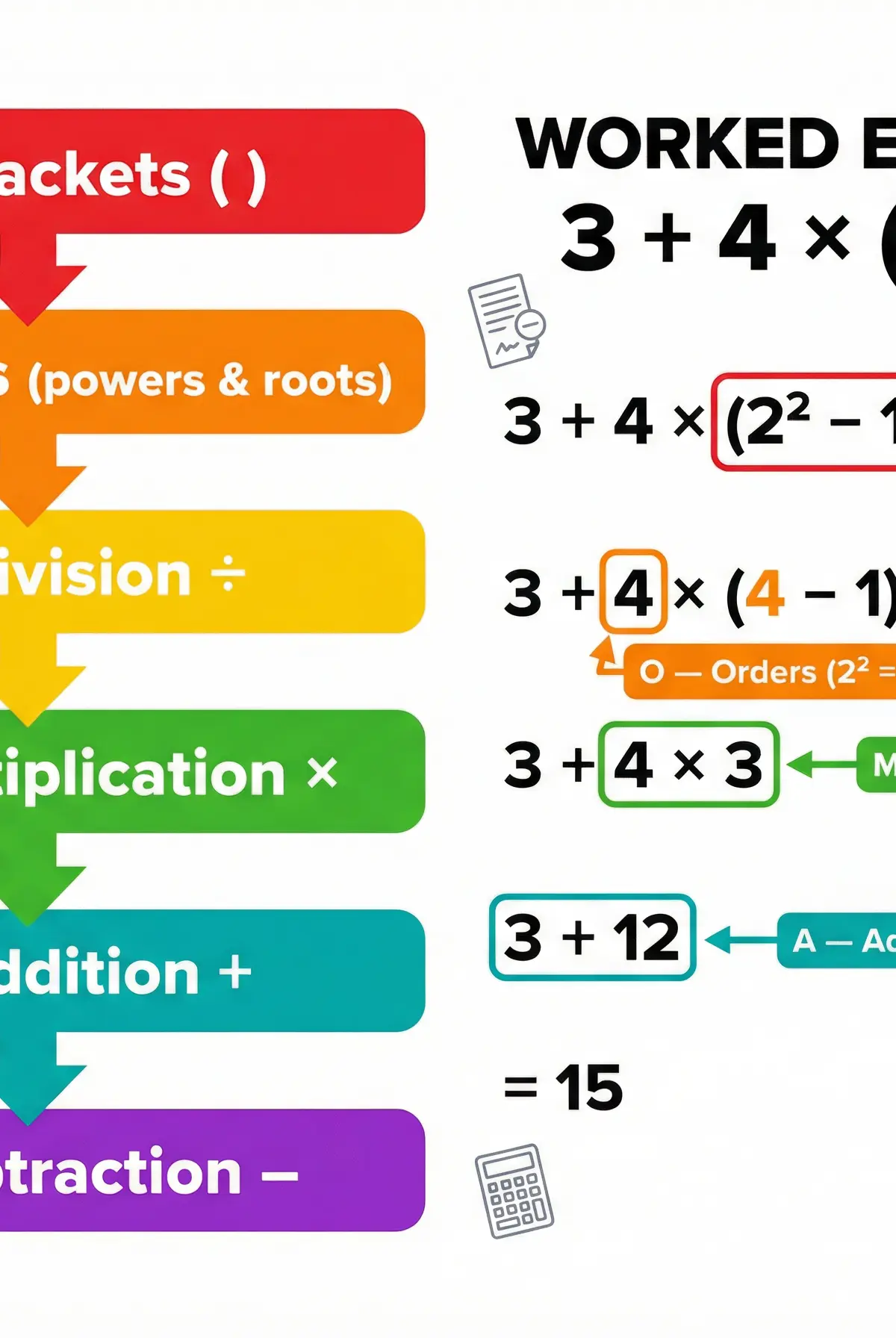
Why does this work? Mathematics requires a universal standard so that everyone calculating the same expression gets the same result. Without BODMAS, an expression like 3 + 4 \times 2 could be 14 (if you add first) or 11 (if you multiply first). The convention is that multiplication and division take precedence over addition and subtraction.
Example: Calculate 15 - 3 \times (2^2 + 1)
- Brackets & Orders: Inside the bracket, calculate the power first: 2^2 = 4. So the bracket is (4 + 1) = 5.
- The expression is now 15 - 3 \times 5.
- Multiplication: 3 \times 5 = 15.
- Subtraction: 15 - 15 = 0.
Concept 2: Types of Numbers
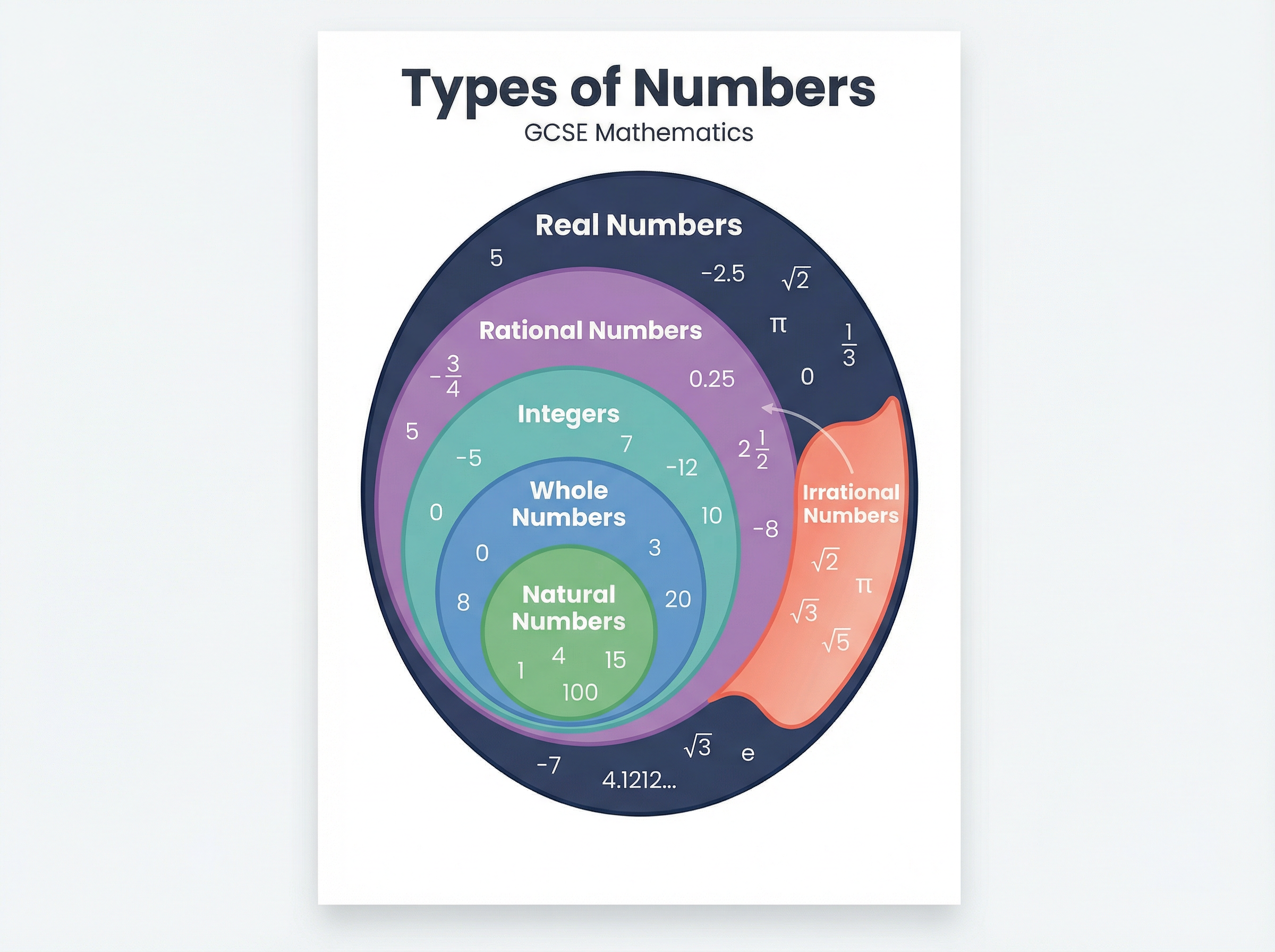
You must be able to classify numbers into different categories. Examiners often use these terms in questions (e.g., "Write down an integer...").
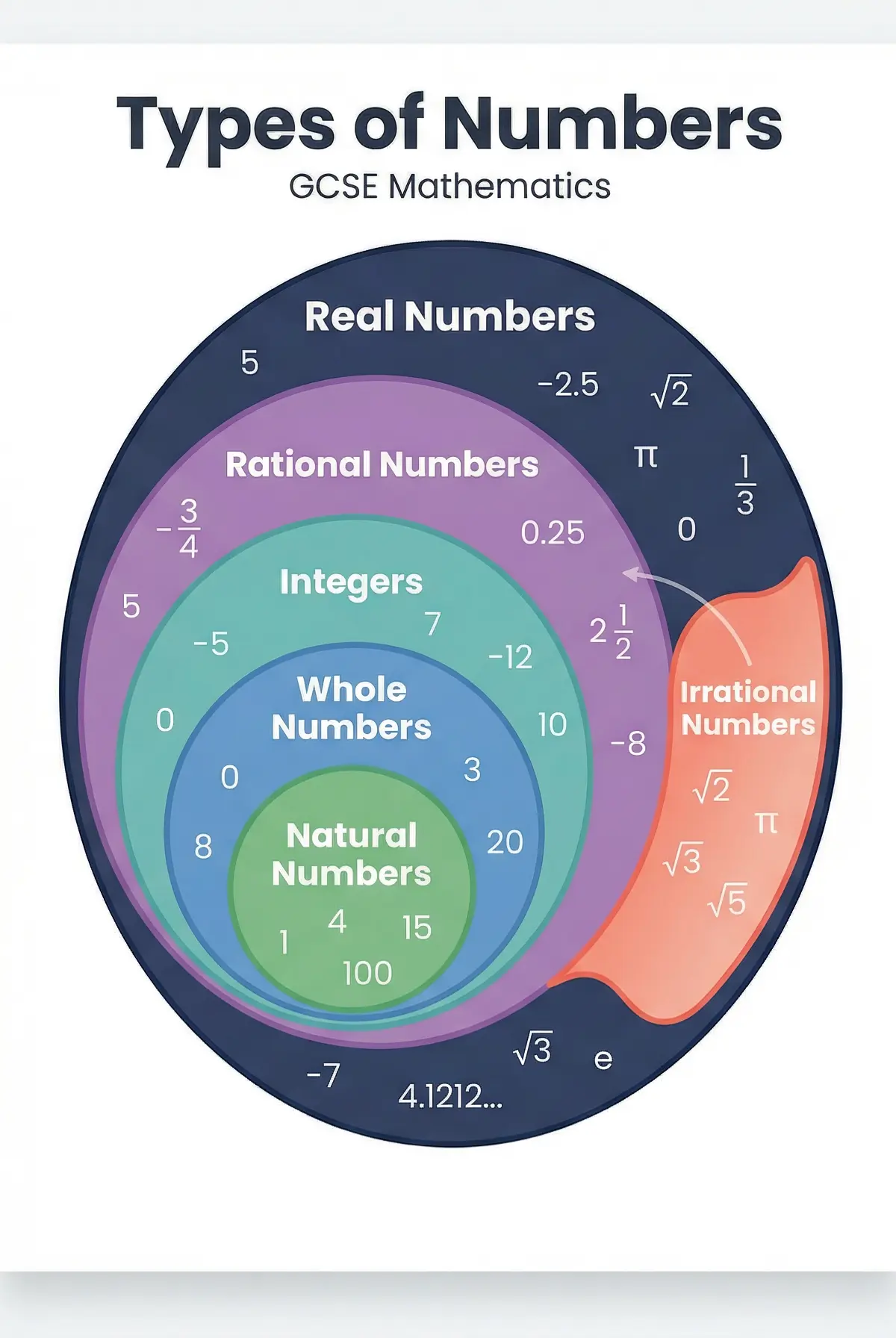
- Integers: Whole numbers, both positive and negative, including zero (e.g., -3, 0, 7).
- Rational Numbers: Any number that can be written as a fraction \frac{a}{b} where a and b are integers. This includes terminating decimals (like 0.25) and recurring decimals (like 0.333...).
- Irrational Numbers: Numbers that cannot be written as a simple fraction. Their decimal expansions go on forever without repeating (e.g., \pi, \sqrt{2}, \sqrt{5}).
- Prime Numbers: A number with exactly two factors: 1 and itself. (Note: 1 is NOT a prime number. 2 is the only even prime number).
Concept 3: Prime Factor Decomposition, HCF, and LCM
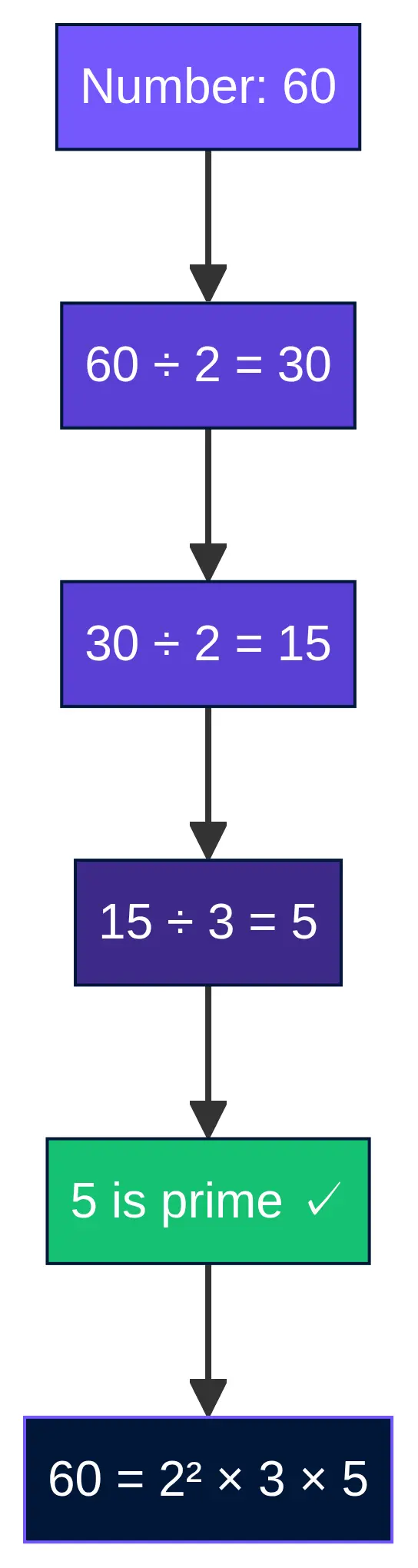
Every integer greater than 1 can be expressed as a unique product of prime numbers. This is called its prime factor decomposition.
To find the Highest Common Factor (HCF) and Lowest Common Multiple (LCM) of two numbers, using a prime factor tree and a Venn diagram is the most robust method, avoiding the errors common in simply listing factors or multiples.
Why does this work? The HCF is the largest number that divides into both. Therefore, it must be made up of the prime factors that both numbers share (the intersection of the Venn diagram). The LCM is the smallest number that both divide into. Therefore, it must contain all the prime factors required to build either number (the union of the Venn diagram).
Example: Find the HCF and LCM of 24 and 36.
- 24 = 2^3 \times 3
- 36 = 2^2 \times 3^2
- HCF: Multiply the shared prime factors. They share two 2s and one 3. HCF = 2 \times 2 \times 3 = 12.
- LCM: Multiply the highest powers of all prime factors present. LCM = 2^3 \times 3^2 = 8 \times 9 = 72.
Concept 4: Standard Form
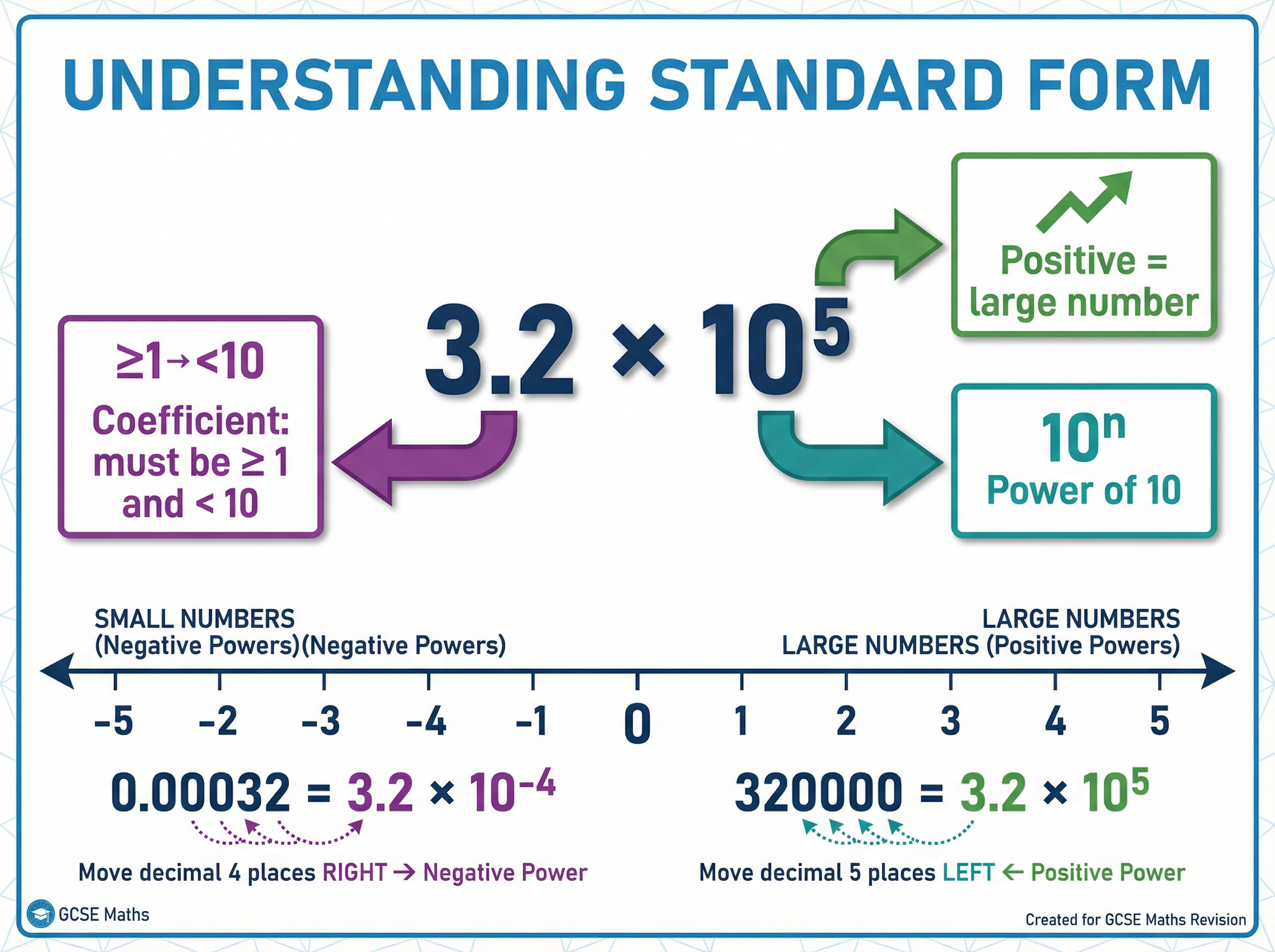
Standard form is a way of writing very large or very small numbers efficiently. It is always written in the format:
A \times 10^n
Where 1 \leq A < 10 and n is an integer.

Why does this work? Our number system is base-10. Multiplying or dividing by powers of 10 simply shifts the digits relative to the decimal point. Standard form standardises this by ensuring the leading digit is always in the units column.
Example: Write 0.00045 in standard form.
- The coefficient A must be between 1 and 10, so A = 4.5.
- To get from 4.5 to 0.00045, the digits must shift 4 places to the right (or the decimal point moves 4 places left).
- Therefore, we are dividing by 10^4, which is the same as multiplying by 10^{-4}.
- Answer: 4.5 \times 10^{-4}.
Concept 5: Rounding, Estimation, and Bounds
Examiners frequently test your ability to round numbers appropriately and use them to estimate answers.
- Decimal Places (d.p.): Count from the decimal point.
- Significant Figures (s.f.): Count from the first non-zero digit.
Estimation: When asked to estimate a calculation, you MUST round every number to 1 significant figure before calculating.
Bounds and Error Intervals: If a measurement is rounded, its true value lies within a range. The lower bound is the smallest possible value; the upper bound is the largest.
If length L = 8.4 cm (to 1 d.p.), the error interval is 8.35 \leq L < 8.45. Notice the strict inequality (<) for the upper bound!
Concept 6: Surds and Fractional Indices (Higher Tier)
A surd is an irrational number left in square root form to maintain exact precision.
- Simplifying Surds: Look for the largest square number that is a factor. E.g., \sqrt{50} = \sqrt{25 \times 2} = \sqrt{25} \times \sqrt{2} = 5\sqrt{2}.
- Rationalising the Denominator: Multiply the numerator and denominator by the surd to remove the root from the bottom. E.g., \frac{1}{\sqrt{3}} = \frac{1 \times \sqrt{3}}{\sqrt{3} \times \sqrt{3}} = \frac{\sqrt{3}}{3}.
Fractional Indices:
- a^{\frac{1}{2}} = \sqrt{a}
- a^{\frac{1}{3}} = \sqrt[3]{a}
- a^{\frac{m}{n}} = (\sqrt[n]{a})^m
Mathematical Relationships & Formulas
While Number doesn't have as many formulas as Geometry, there are key rules of indices you must memorise:
- Multiplication Rule: a^m \times a^n = a^{m+n}
- Division Rule: a^m \div a^n = a^{m-n}
- Power of a Power Rule: (a^m)^n = a^{mn}
- Zero Power Rule: a^0 = 1 (for $a
eq 0$) - Negative Power Rule: a^{-n} = \frac{1}{a^n}
Note: None of these are provided on the formula sheet. You must memorise them.
Practical Applications
Number skills are used constantly in the real world:
- Standard Form: Used by astronomers to measure distances between galaxies (e.g., 9.46 \times 10^{12} km in a light-year) and by microbiologists to measure the size of cells or viruses.
- Estimation: Used daily in budgeting, construction, and engineering to quickly verify if calculated values are reasonable.
- Bounds: Crucial in manufacturing and engineering tolerances. A machine part must be machined to a specific size within strict upper and lower bounds to function correctly.
Visual Resources
4 diagrams and illustrations
Interactive Diagrams
2 interactive diagrams to visualise key concepts
Conceptual Flow Outline
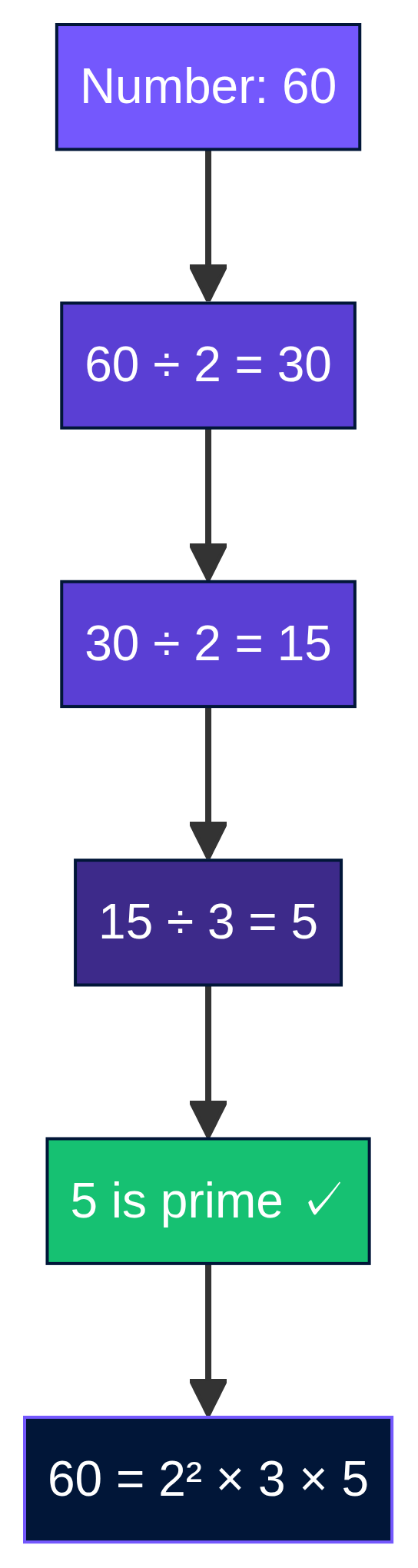
Prime Factor Decomposition of 60 using a factor tree approach.
Conceptual Flow Outline
Concept map showing the structure of the Number topic.
Worked Examples
3 worked examples — open one to explore the question and available guidance.
Practice Questions
Test your understanding — click to reveal model answers
Estimate the value of \frac{38.4 \times 5.12}{0.193}
Hint: Round every number to 1 significant figure before you do any multiplication or division.
Express 108 as a product of its prime factors. Give your answer in index form.
Hint: Start by dividing by the smallest prime number, 2.
Evaluate 8^{-\frac{2}{3}}
Hint: Deal with the negative sign first, then the denominator of the fraction (the root), and finally the numerator (the power).
Given that x = 4.2 correct to 1 decimal place and y = 5.6 correct to 1 decimal place, calculate the upper bound for the value of \frac{x}{y}.
Hint: To make a fraction as large as possible, you need the largest possible numerator and the smallest possible denominator.
Prove algebraically that the recurring decimal 0.4\dot{5} can be written as the fraction \frac{41}{90}.
Hint: Let $x = 0.4555...$ and find equations for $10x$ and $100x$ so the decimal parts match.