Pearson Edexcel · GCSE · Mathematics
Probability
Master the fundamentals of probability to confidently tackle combined events, tree diagrams, and Venn diagrams. This topic is essential for interpreting data and predicting outcomes, and it frequently features in high-mark exam questions.
- 4 min read
- 3 worked examples
- 5 practice questions
- 6 key terms
Study Notes

Overview
Probability is the mathematical language of uncertainty. It allows us to quantify how likely an event is to occur, ranging from impossible (0) to certain (1). In GCSE Mathematics, mastering probability is crucial because it connects deeply with fractions, decimals, percentages, and data handling. Examiners love to test probability through multi-stage problems, requiring candidates to interpret frequency trees, construct tree diagrams, and analyse Venn diagrams.
Questions often blend probability with ratio or algebra, especially in Higher Tier papers where 'without replacement' scenarios are common. A strong grasp of these concepts will not only secure you marks in straightforward calculation questions but also in complex problem-solving scenarios where you must communicate your assumptions clearly.
Listen to our comprehensive revision podcast to reinforce these concepts:
Key Concepts
Concept 1: The Probability Scale and Exhaustive Events
Every probability must be a value between 0 and 1, inclusive. It can be expressed as a fraction, decimal, or percentage. The fundamental rule that examiners test is that the sum of the probabilities of all mutually exclusive and exhaustive outcomes is exactly 1. This means if you list every possible thing that could happen, their probabilities must add up to a whole. If you are given a table of probabilities with one missing value, you can find it by subtracting the sum of the known probabilities from 1.
Example: If the probability of winning a game is 0.4 and the probability of drawing is 0.1, the probability of losing must be 1 - (0.4 + 0.1) = 0.5.
Concept 2: Tree Diagrams and Combined Events
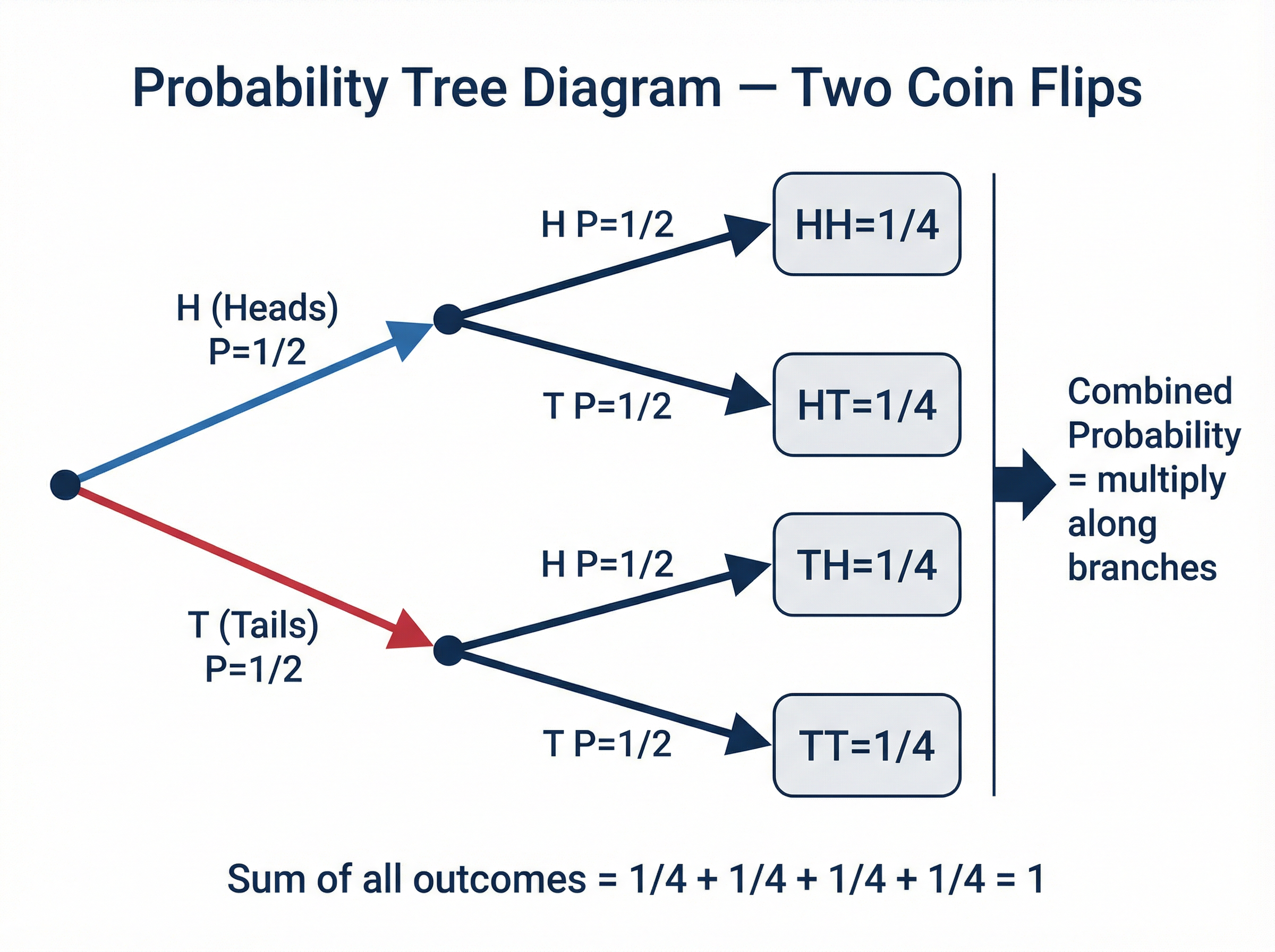
Tree diagrams are visual tools used to calculate the probabilities of two or more events happening in sequence. Each branch represents an outcome, and the probability is written on the branch. The golden rule for tree diagrams is to multiply along the branches to find the probability of a combined outcome (Event A AND Event B), and add the probabilities of different successful outcomes (Outcome 1 OR Outcome 2).
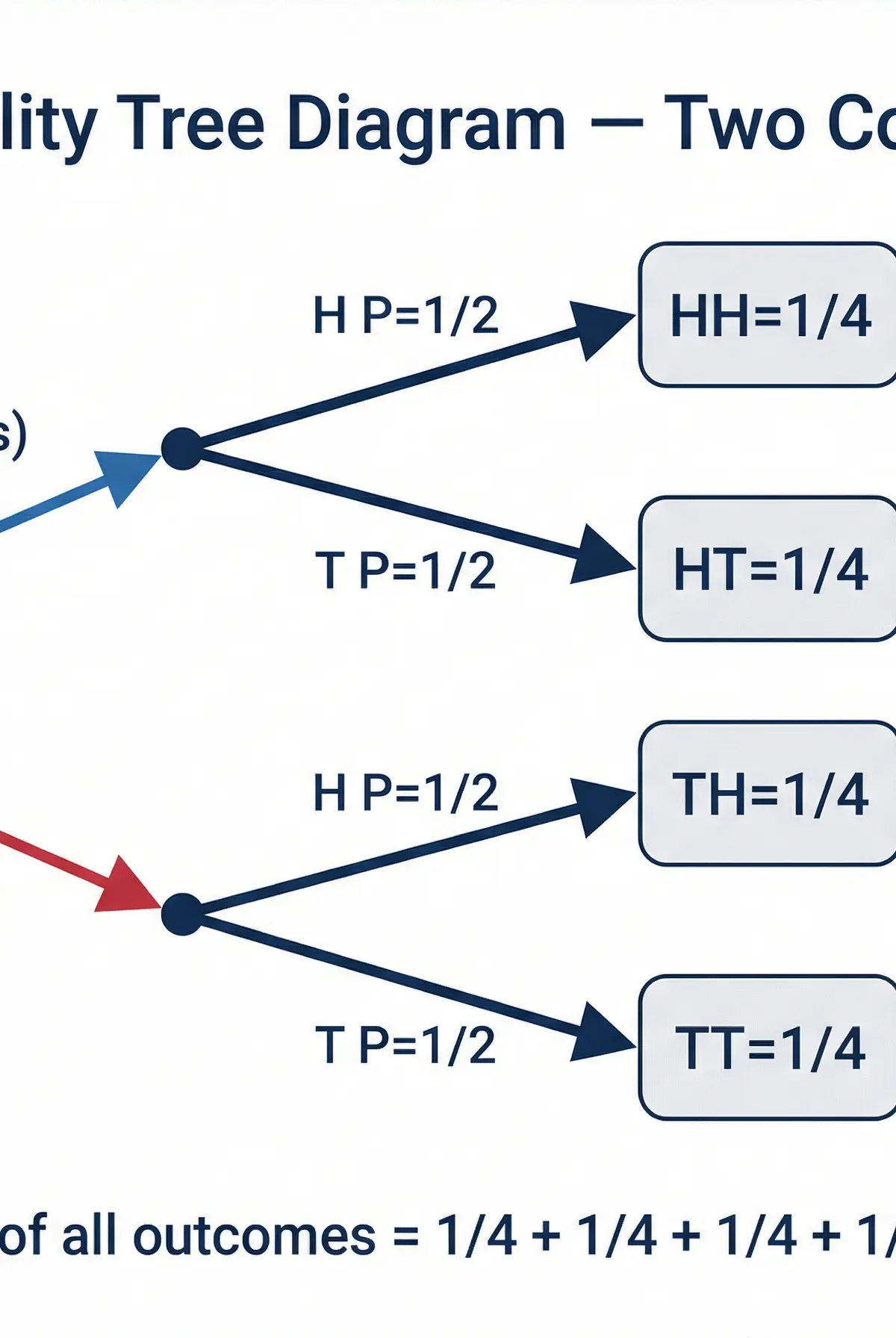
Crucially, you must identify whether the events are independent or dependent. Independent events (like flipping a coin twice) do not affect each other, so the probabilities on the second set of branches remain the same. Dependent events (like taking two sweets from a bag without replacement) mean the first event changes the probabilities for the second event. Examiners frequently target the 'without replacement' condition to test if candidates remember to decrease the denominator for the second pick.
Concept 3: Venn Diagrams and Conditional Probability
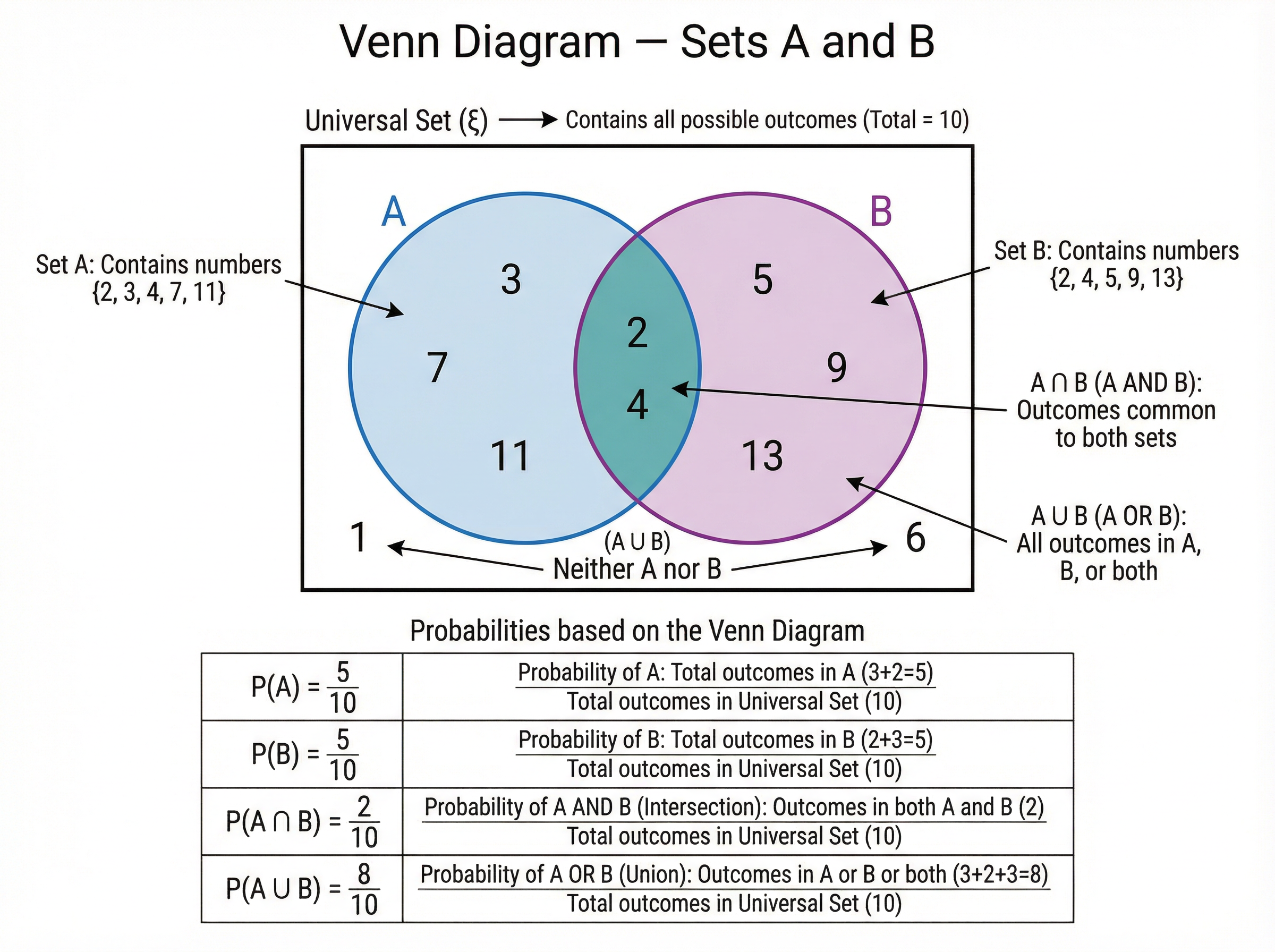
Venn diagrams use overlapping circles to show the relationships between different sets of data. The rectangle represents the universal set (all possible outcomes). The overlap (intersection) represents outcomes that satisfy both conditions, while the combined area of the circles (union) represents outcomes that satisfy either condition or both.

Venn diagrams are particularly useful for calculating conditional probability—the probability of an event happening given that another event has already happened. In these questions, the 'given' condition restricts the sample space. Instead of dividing by the total number of outcomes in the universal set, you divide by the total number of outcomes in the restricted set.
Mathematical/Scientific Relationships
- Probability of an event = \frac{\text{Number of successful outcomes}}{\text{Total number of possible outcomes}}
- Complementary Events: P(\text{Not A}) = 1 - P(A)
- Addition Rule (Mutually Exclusive): P(A \text{ or } B) = P(A) + P(B)
- Multiplication Rule (Independent): P(A \text{ and } B) = P(A) \times P(B)
Practical Applications
Probability is used extensively in real-world risk assessment, from insurance companies calculating premiums based on accident likelihoods to meteorologists predicting the chance of rain. In quality control, manufacturers use probability to determine the likelihood of a defective product coming off the assembly line, allowing them to adjust processes before significant losses occur.
Visual Resources
2 diagrams and illustrations
Interactive Diagrams
2 interactive diagrams to visualise key concepts
Conceptual Flow Outline
Decision-making process for tree diagram questions.
Conceptual Flow Outline
Relationship between sets in a Venn diagram.
Worked Examples
3 worked examples — open one to explore the question and available guidance.
Practice Questions
Test your understanding — click to reveal model answers
A fair six-sided die is rolled. What is the probability of rolling a prime number?
Hint: List the numbers on a die and identify which ones are prime. Remember, 1 is not a prime number.
The probability that a train is late is 0.15. Calculate the probability that the train is not late.
Hint: Use the rule for complementary events.
A box contains 5 strawberry chocolates, 4 orange chocolates, and 3 caramel chocolates. Sarah takes a chocolate at random, eats it, and then takes a second chocolate. Calculate the probability that she eats two strawberry chocolates.
Hint: Because she eats the first chocolate, this is a 'without replacement' question.
In a group of 50 people, 30 own a dog, 22 own a cat, and 8 own neither. A person is chosen at random. Given that they own a dog, what is the probability that they also own a cat?
Hint: Draw a Venn diagram first to find the intersection.
A spinner has 4 sections coloured Red, Blue, Green, and Yellow. The probability of landing on Red is 0.2 and Blue is 0.3. The probability of landing on Green is twice the probability of landing on Yellow. Calculate the probability of landing on Green.
Hint: Set up an equation using algebra. Let P(Yellow) = x.