Pearson Edexcel · GCSE · Mathematics
Ratio, proportion and rates of change
Master the essential principles of Ratio, Proportion, and Rates of Change. This topic is heavily tested in GCSE Mathematics, offering significant marks for students who can accurately apply multipliers, interpret compound measures, and distinguish between direct and inverse proportion.
- 5 min read
- 3 worked examples
- 5 practice questions
- 6 key terms
Study Notes
Overview

Ratio, Proportion, and Rates of Change form a cornerstone of the GCSE Mathematics specification. This topic is about understanding how quantities relate to one another and how they change over time or space. Whether you are scaling up a recipe, calculating the best value for money in a supermarket, or determining the speed of a vehicle, you are applying the principles of ratio and proportion.
Examiners frequently use this topic to test your problem-solving skills (AO3), often embedding these concepts within real-world contexts. It connects deeply with fractions, percentages, and algebraic graphing. Typical exam questions might ask you to divide an amount into a given ratio, calculate compound interest over several years, or interpret the gradient of a velocity-time graph. Mastering these concepts will not only secure you substantial marks but also build a solid foundation for further mathematical study.
Listen to the companion podcast for a detailed walkthrough of these concepts:
Key Concepts
Concept 1: Simplifying and Sharing in a Ratio
A ratio compares the sizes of different parts of a whole. To simplify a ratio, you must find the highest common factor (HCF) of all parts and divide through, just as you would with a fraction.
When sharing an amount in a given ratio, the most reliable approach is the unitary method. This involves finding the value of a single 'part' before calculating the required amounts.
Example: Share £350 in the ratio 2:5.
- Add the parts to find the total number of parts: 2 + 5 = 7 parts.
- Find the value of one part by dividing the total amount by the total parts: £350 \div 7 = £50.
- Multiply each part of the ratio by the value of one part: 2 \times £50 = £100 and 5 \times £50 = £250.
- Check your answer: £100 + £250 = £350.
Concept 2: Percentage Change and Multipliers
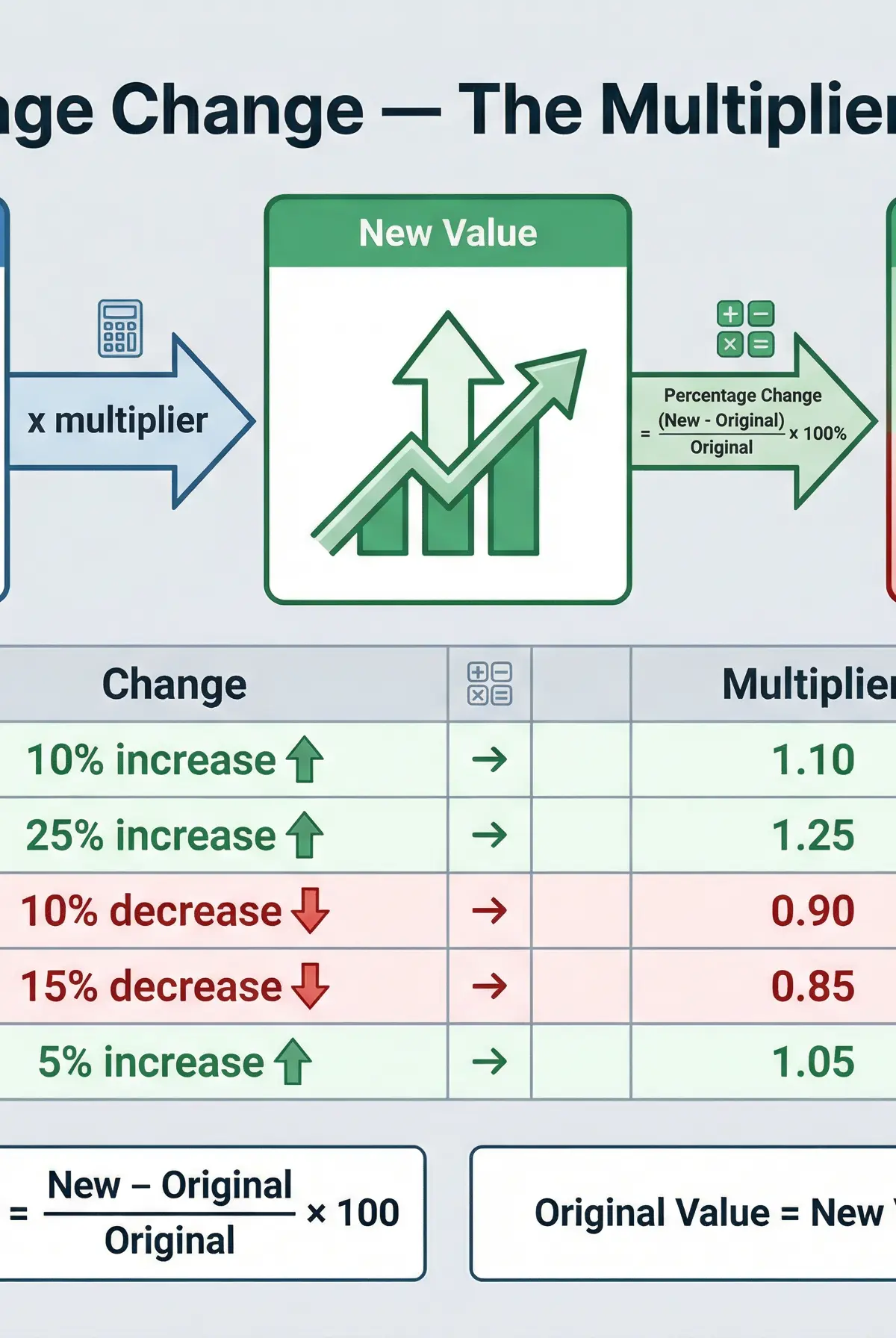
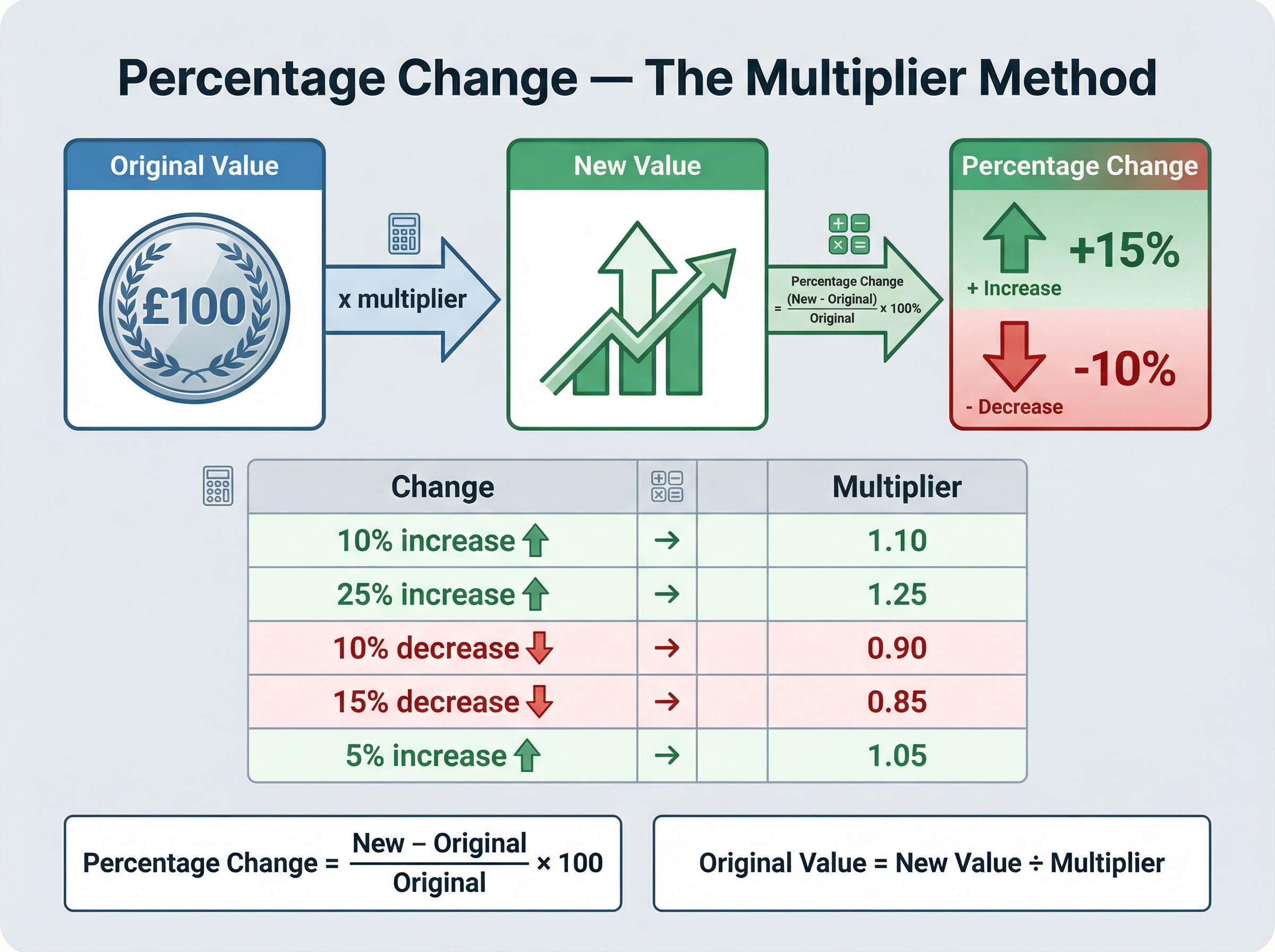
Calculating percentage increases and decreases using multipliers is far more efficient than finding the percentage and adding or subtracting it. A multiplier is the decimal equivalent of the new percentage.
For an increase, add the percentage to 100% and convert to a decimal. For a 15% increase, the multiplier is 1.15 (100% + 15% = 115%).
For a decrease, subtract the percentage from 100% and convert to a decimal. For a 20% decrease, the multiplier is 0.80 (100% - 20% = 80%).
This method is crucial for reverse percentage problems. If you know the final value and the percentage change, you must divide by the multiplier to find the original value. Never calculate the percentage of the new value and add/subtract it—this is a fundamental error that examiners penalise heavily.
Concept 3: Direct and Inverse Proportion
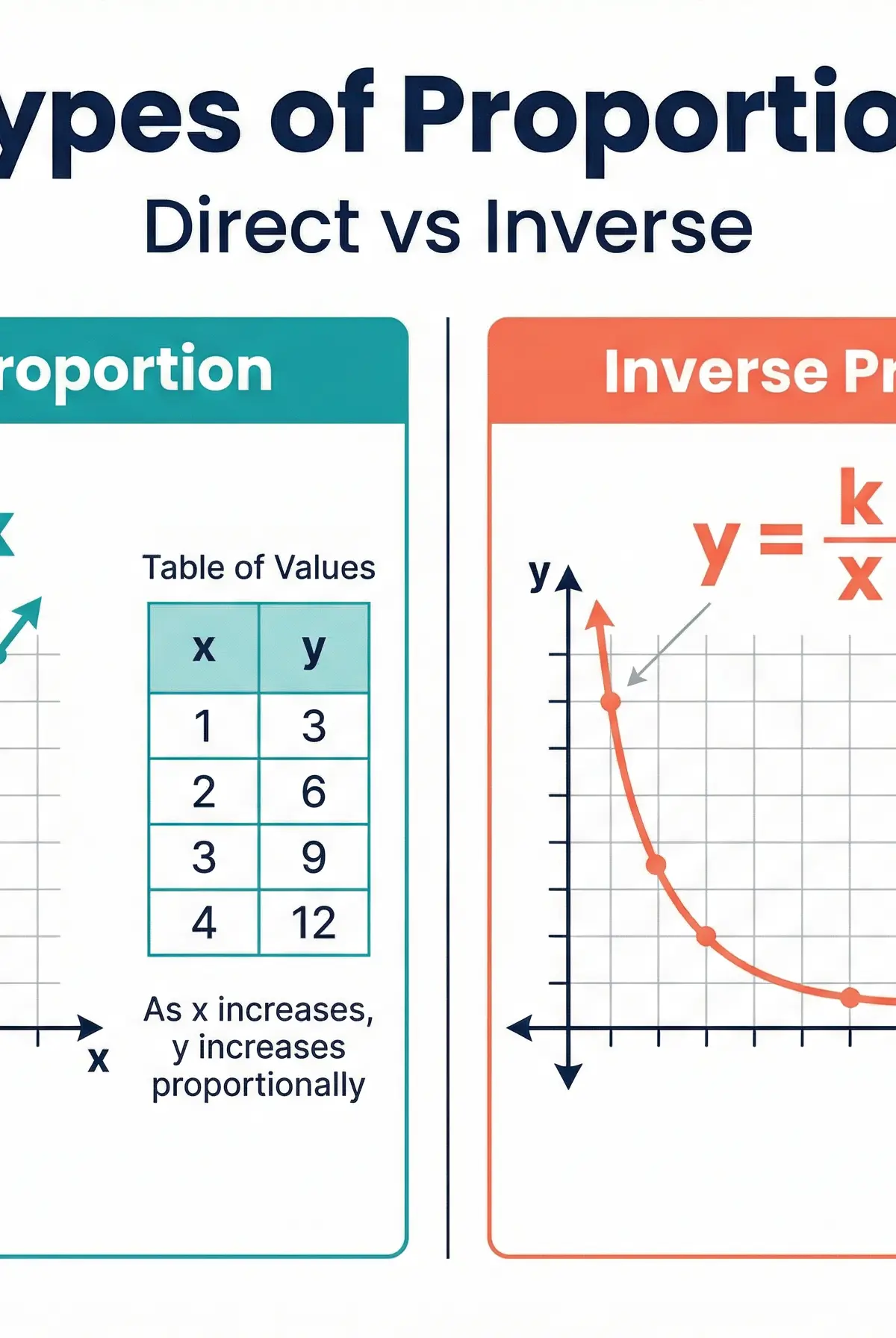
Proportion describes the mathematical relationship between two variables.
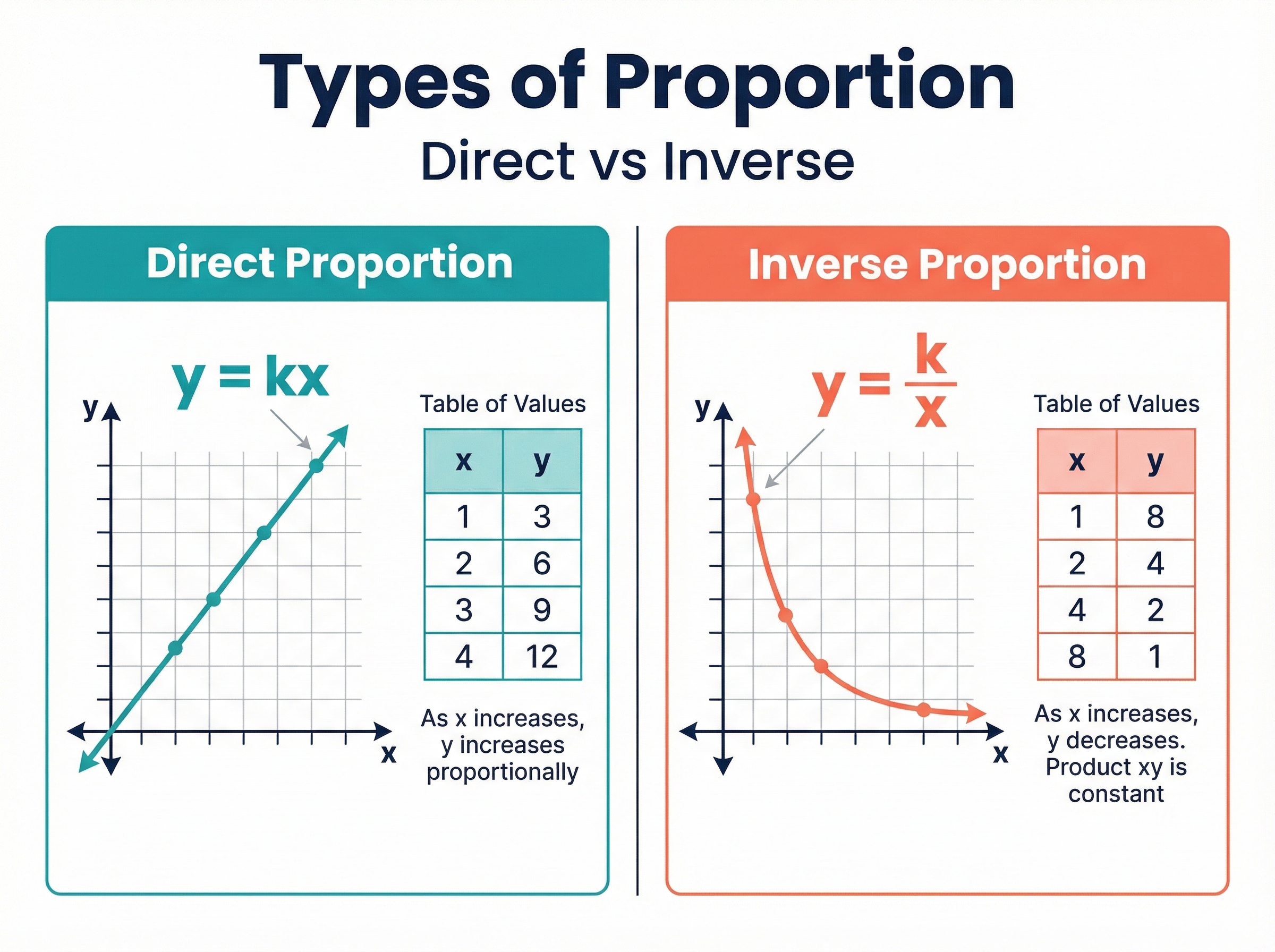
In direct proportion, as one variable increases, the other increases at the same rate. The ratio between them remains constant. The equation is y = kx, where k is the constant of proportionality. Graphically, this is a straight line passing through the origin (0,0).
In inverse proportion, as one variable increases, the other decreases. The product of the two variables remains constant. The equation is y = \frac{k}{x}. Graphically, this produces a reciprocal curve (hyperbola) that approaches but never touches the axes.
Concept 4: Compound Measures
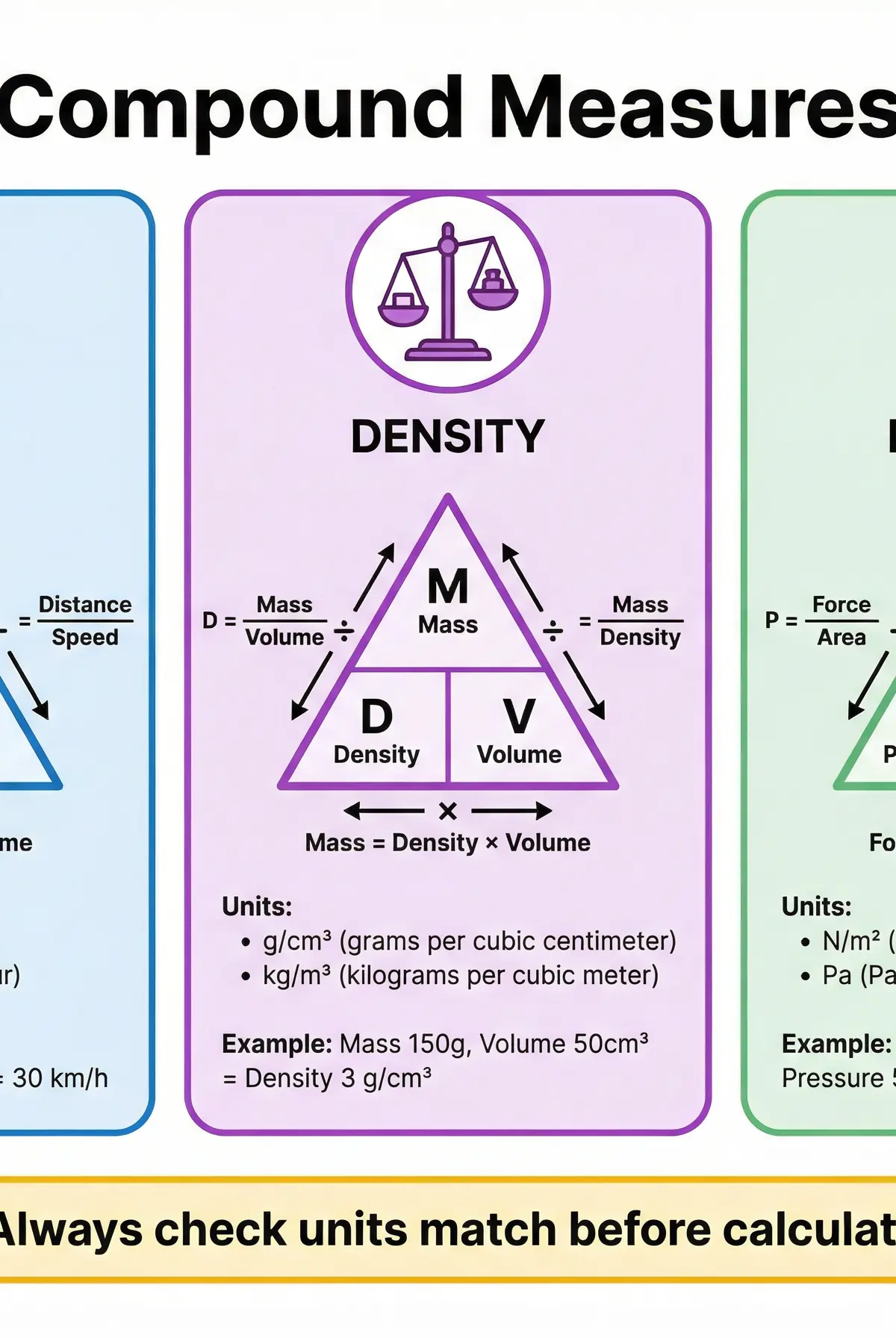
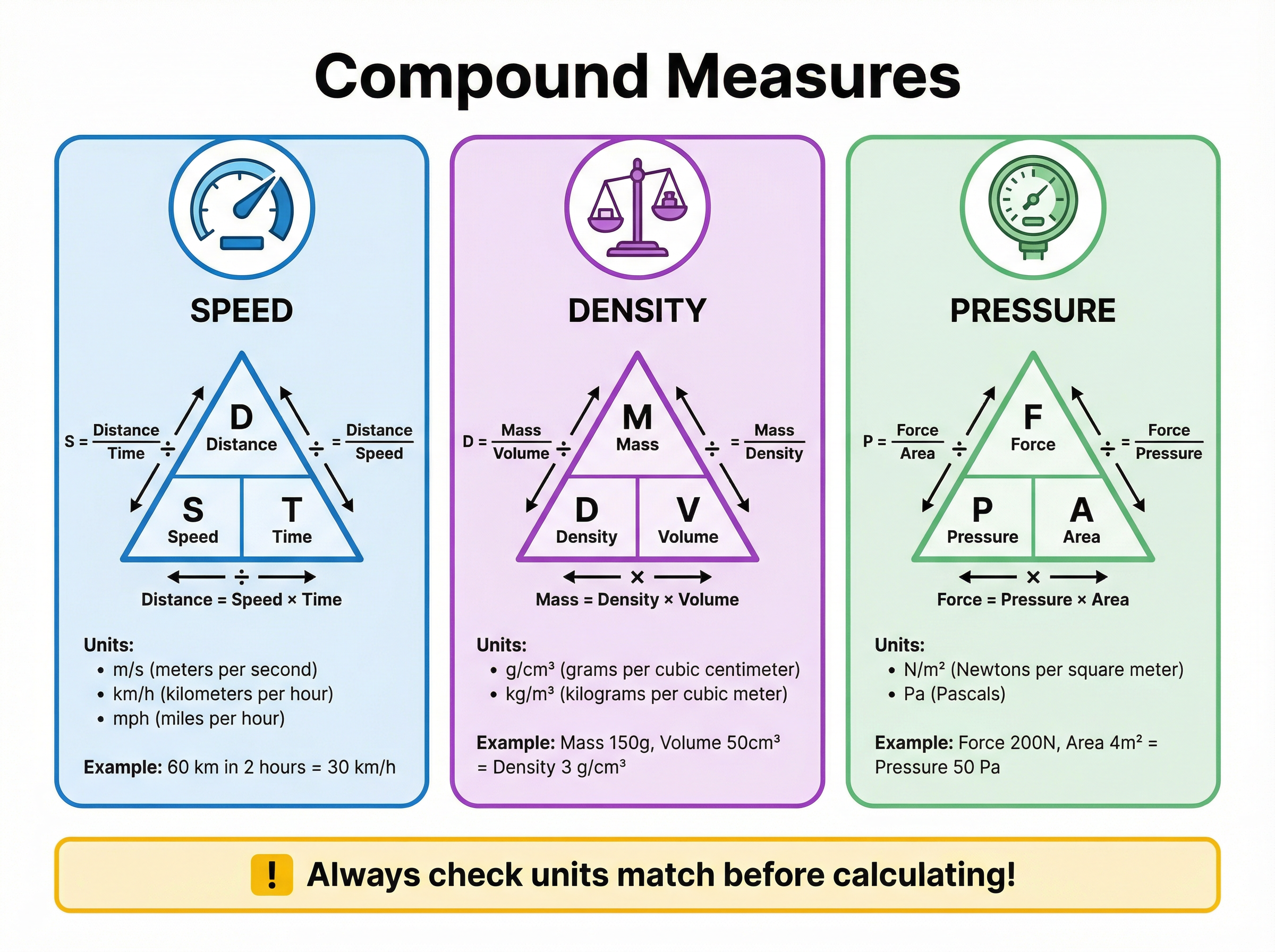
Compound measures involve two or more different units combined, such as speed (distance/time), density (mass/volume), and pressure (force/area).
The most critical step in any compound measure calculation is ensuring unit consistency before you calculate. If a question gives distance in kilometres and time in minutes, but asks for speed in km/h, you must convert the time into hours first.
Mathematical/Scientific Relationships
- Direct Proportion: y \propto x \Rightarrow y = kx
- y and x are variables; k is the constant of proportionality.
- Inverse Proportion: y \propto \frac{1}{x} \Rightarrow y = \frac{k}{x}
- Used when one quantity decreases as the other increases.
- Compound Interest: A = P(1 + r)^n
- A = Final Amount, P = Principal (original amount), r = interest rate as a decimal, n = number of time periods. (Must memorise)
- Speed, Distance, Time: S = \frac{D}{T}
- (Must memorise)
- Density, Mass, Volume: D = \frac{M}{V}
- (Must memorise)
- Pressure, Force, Area: P = \frac{F}{A}
- (Must memorise)
Practical Applications
- Currency Conversion: Using exchange rates to convert between currencies is an application of direct proportion.
- Best Buy Problems: Comparing the cost per unit (e.g., cost per 100g) to determine the best value for money in supermarkets.
- Scaling Recipes: Adjusting the quantities of ingredients based on the number of people you are cooking for uses ratio.
- Population Growth/Decay: Using compound multipliers to model bacterial growth or the depreciation of a car's value.
Visual Resources
3 diagrams and illustrations
Interactive Diagrams
2 interactive diagrams to visualise key concepts
Conceptual Flow Outline
Decision flowchart for solving proportion problems
Conceptual Flow Outline
The Multiplier Method for Percentage Change
Worked Examples
3 worked examples — open one to explore the question and available guidance.
Practice Questions
Test your understanding — click to reveal model answers
A map has a scale of 1:50000. The distance between two towns on the map is 8 cm. Calculate the actual distance between the towns in kilometres. (3 marks)
Hint: First find the actual distance in cm, then convert to metres, then to kilometres.
In a school, the ratio of teachers to students is 1:15. There are 1200 students. How many teachers are there? (2 marks)
Hint: This is a part-to-part ratio. You know the value of the '15' parts.
A car depreciates in value by 15% each year. It was bought for £18,000. Calculate its value after 3 years. (3 marks)
Hint: Use the compound multiplier method. What is the multiplier for a 15% decrease?
The time taken (t) to build a wall is inversely proportional to the number of workers (w). It takes 4 workers 15 days to build the wall. How long would it take 6 workers? (3 marks)
Hint: Find the constant of proportionality first. Remember, inverse proportion means $t = k/w$.
A cyclist travels at an average speed of 18 km/h for 40 minutes. Calculate the distance travelled in kilometres. (3 marks)
Hint: Check the units! Speed is in km/h, but time is in minutes. Convert time to hours first.