Pearson Edexcel · GCSE · Mathematics
Statistics
Master the art of data with this comprehensive guide to GCSE Statistics. From calculating averages to interpreting complex scatter graphs and cumulative frequency curves, this topic is packed with highly predictable, winnable marks that appear in every single exam series.
- 6 min read
- 3 worked examples
- 5 practice questions
- 6 key terms
Study Notes
Overview

Welcome to Statistics, one of the most practical and predictable topics in GCSE Mathematics. This topic is fundamentally about making sense of the world through data—how we collect it, present it, and draw meaningful conclusions from it.
In your exam, Statistics is guaranteed to appear across multiple papers. Examiners love testing this topic because it assesses both your raw calculation skills (like finding the mean from a grouped table) and your analytical reasoning (like interpreting the spread of data). Statistics connects closely with Probability and Algebra, particularly when dealing with equations of lines of best fit.
Typical exam questions range from quick 1-2 mark calculations to 4-6 mark extended problems where you must construct complex diagrams like histograms or compare two data sets using averages and spread. Mastering this topic is often the key to securing your target grade.
Podcast Revision
Listen to our comprehensive 10-minute revision podcast covering all key concepts, common mistakes, and exam techniques for Statistics:
Key Concepts
Concept 1: Measures of Central Tendency (Averages)
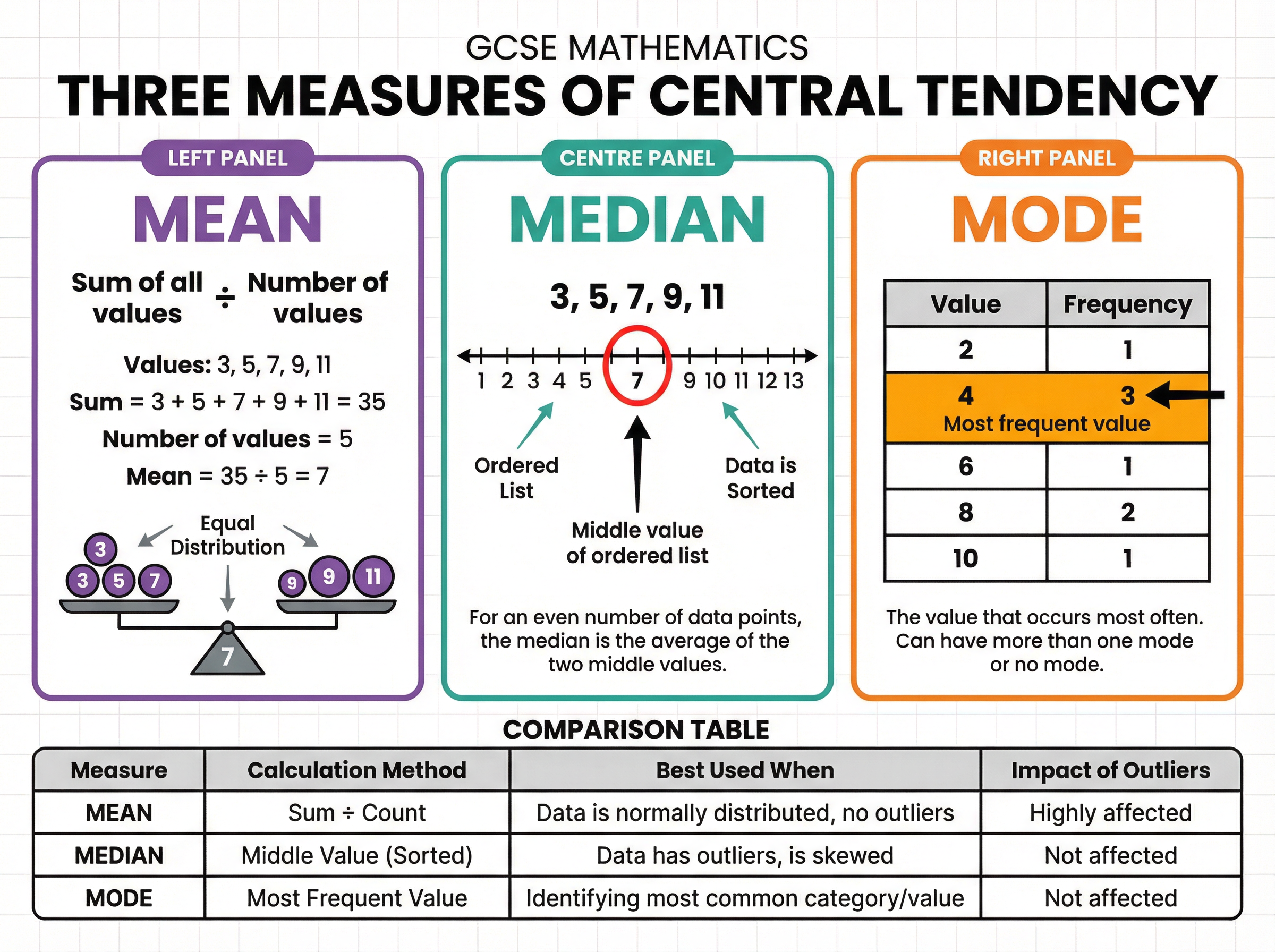
An average is a single value that represents the 'middle' or 'typical' value of a data set. You must know three types: Mean, Median, and Mode.
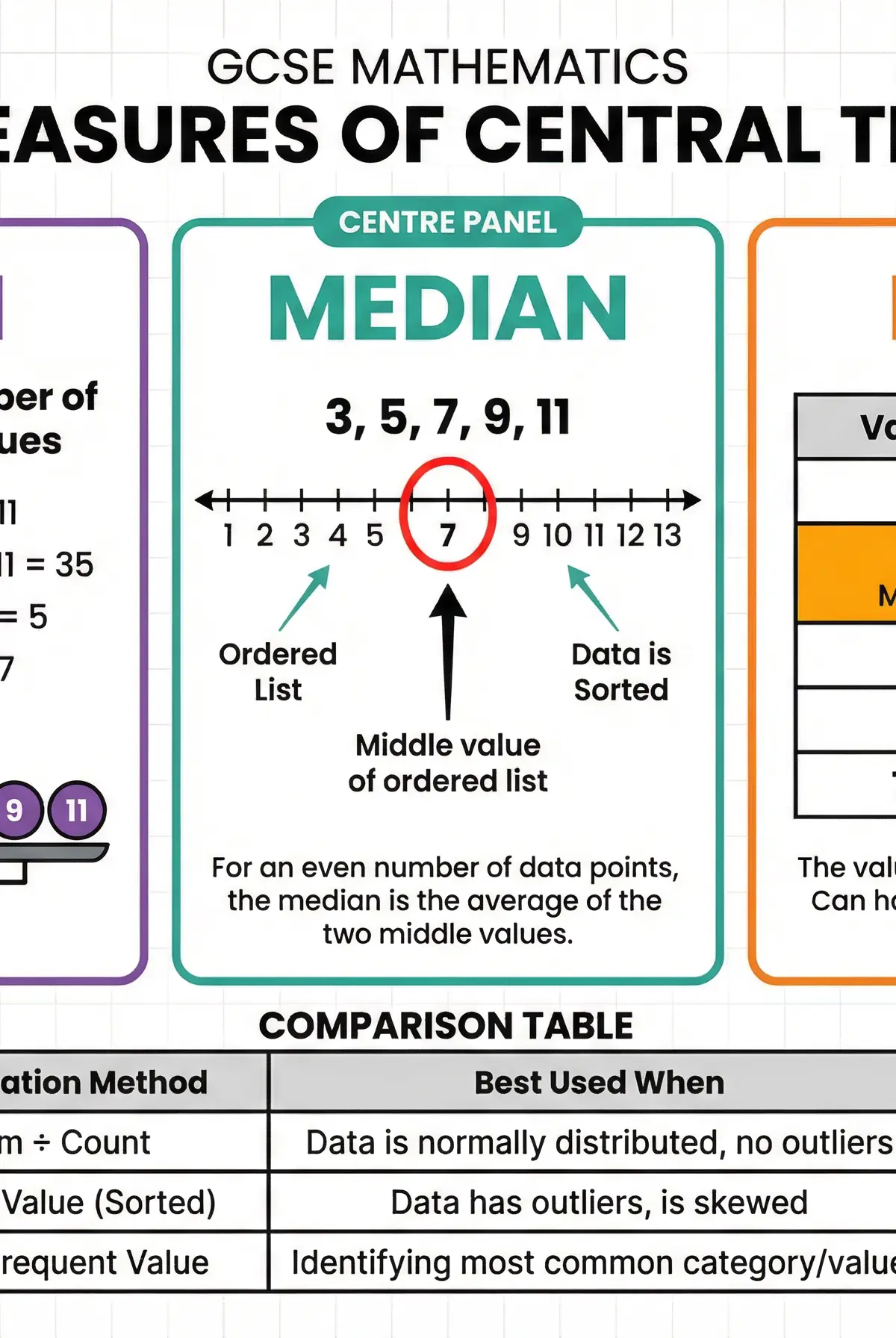
The Mean is the 'fair share' average. You calculate it by adding all values together and dividing by the total number of values. It uses all the data, making it mathematically strong, but it is easily skewed by extreme outliers.
The Median is the middle value when the data is placed in order of size. If there is an even number of values, the median is the midpoint between the two middle values. The median is excellent for data with extreme outliers (like house prices) because it ignores the extremes.
The Mode is the most frequently occurring value. It is the only average that can be used for non-numerical (categorical) data, like eye colour.
Examiner Tip: When asked to calculate the mean from a grouped frequency table, you MUST use the midpoint of each class interval. Multiplying the class boundaries instead of the midpoint is a classic error that costs candidates marks every year.
Concept 2: Measures of Spread
While averages tell us about the 'typical' value, measures of spread tell us how consistent or varied the data is. Examiners almost always ask you to compare two data sets using one average and one measure of spread.
The Range is the simplest measure: the largest value minus the smallest value. Like the mean, it is heavily affected by outliers.
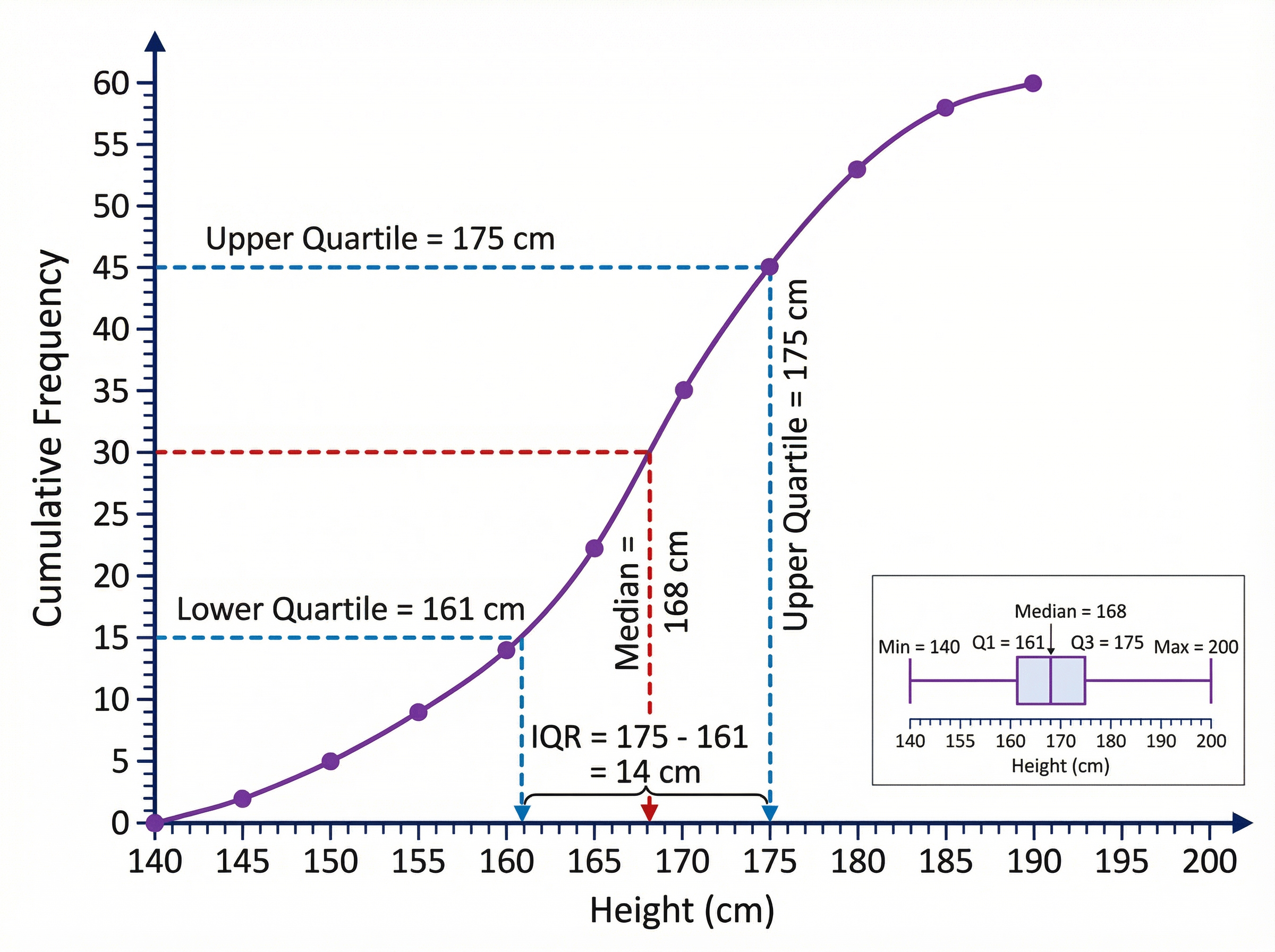
The Interquartile Range (IQR) is much more robust. It measures the spread of the middle 50% of the data, ignoring the highest 25% and lowest 25%.
\text{IQR} = \text{Upper Quartile (Q3)} - \text{Lower Quartile (Q1)}
A smaller IQR indicates that the data is more consistent (less varied). A larger IQR indicates the data is more spread out.
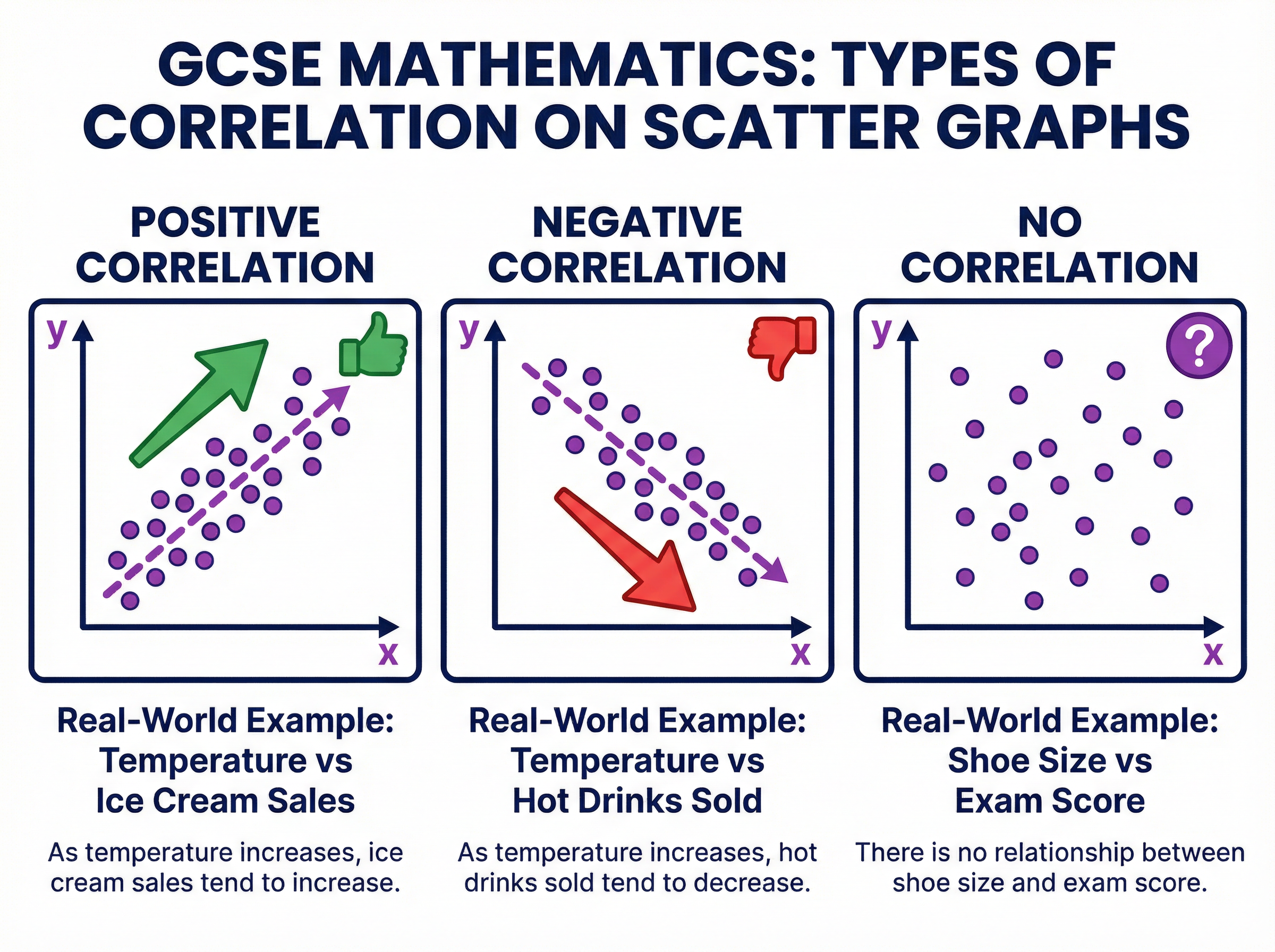
Concept 3: Scatter Graphs and Correlation
Scatter graphs are used to investigate the relationship between two variables (bivariate data).
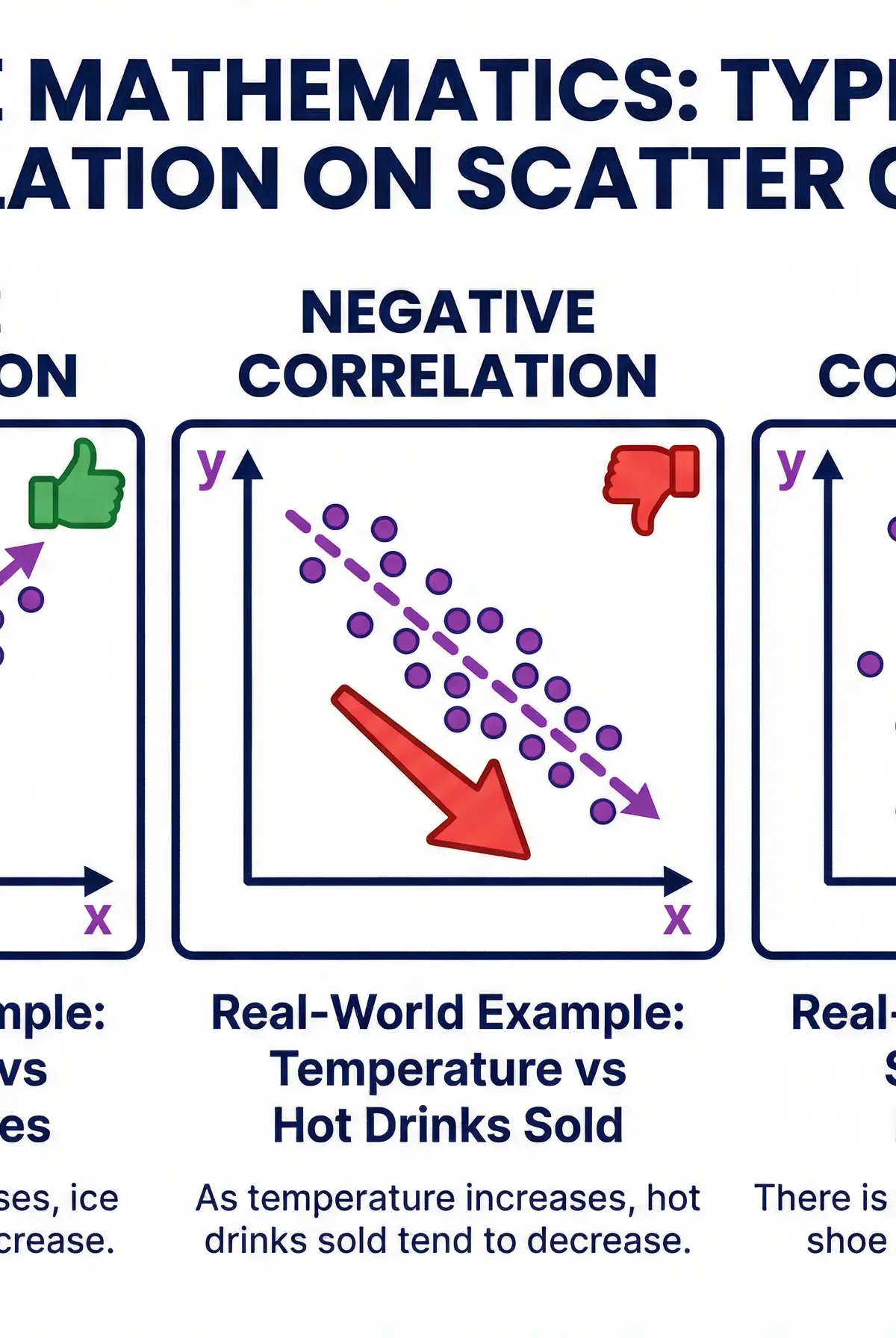
Correlation describes the nature of this relationship:
- Positive Correlation: As one variable increases, the other increases (e.g., hours revised and exam score).
- Negative Correlation: As one variable increases, the other decreases (e.g., age of a car and its value).
- No Correlation: There is no discernible pattern.
When describing correlation for marks, you must state both the direction (positive/negative) and the strength (strong/weak).
The Golden Rule: Correlation does NOT imply causation. Just because ice cream sales and shark attacks both increase in summer (strong positive correlation), it does not mean eating ice cream causes shark attacks. They are both caused by a third variable: warm weather. Examiners will specifically test if you understand this distinction.
Concept 4: Cumulative Frequency
Cumulative frequency is a running total of the frequencies. When plotted, it creates a characteristic S-shaped curve.
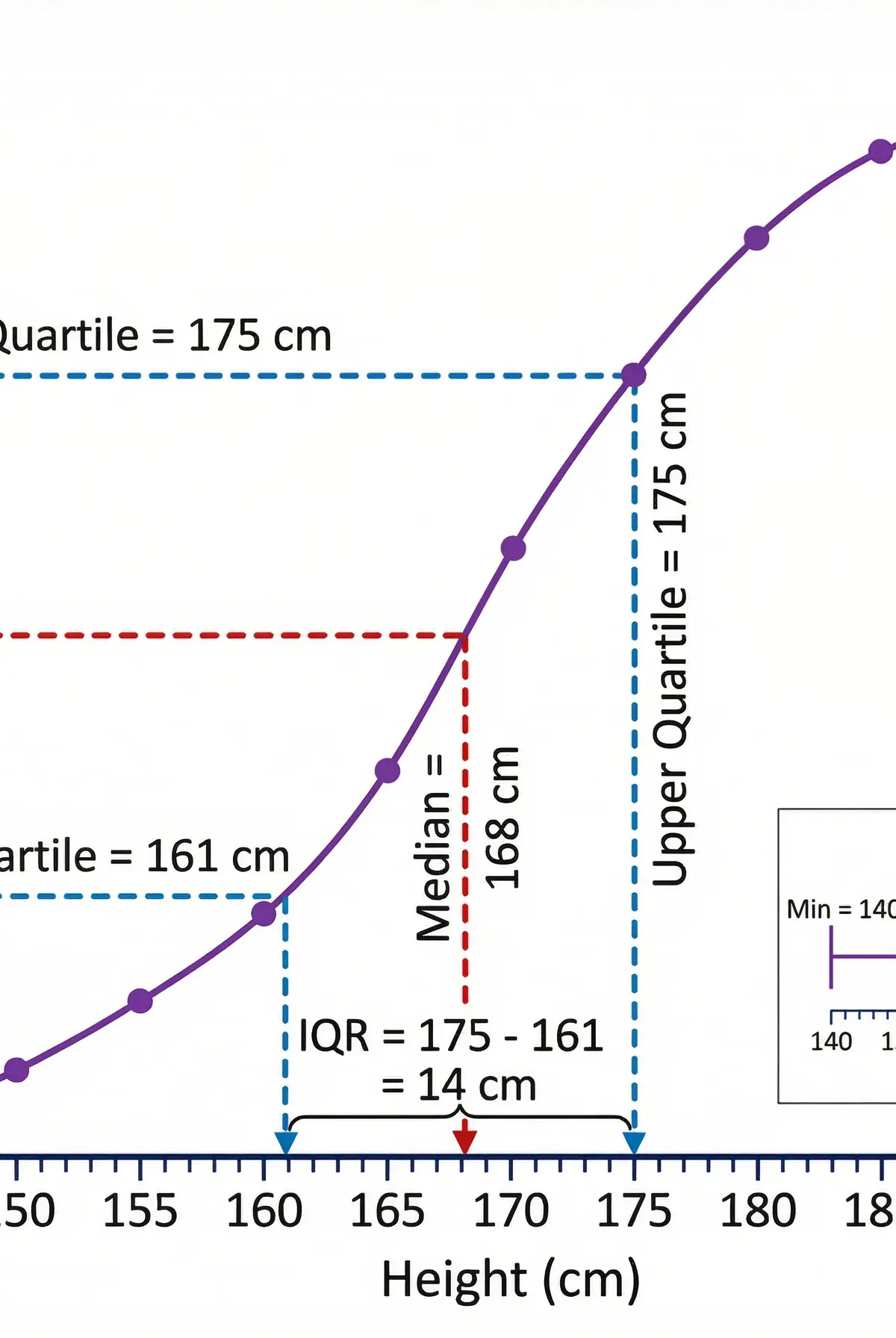
To construct the graph, you must plot the cumulative frequency against the upper class boundary of each interval, NOT the midpoint. This is because the cumulative frequency represents all values up to and including that boundary.
From this curve, you can estimate the median (at 50% of the total frequency), the lower quartile (at 25%), and the upper quartile (at 75%).
Concept 5: Histograms (Higher Tier Only)
Unlike bar charts, histograms are used for continuous data and can have unequal class widths. Because the widths vary, the height of the bar no longer represents the frequency. Instead, the area of the bar represents the frequency.
The y-axis on a histogram is always Frequency Density.
\text{Frequency Density} = \frac{\text{Frequency}}{\text{Class Width}}
Mathematical Relationships and Formulas
| Formula | Equation | Notes |
|---|---|---|
| Mean | $\frac{\sum x}{n}$ | Must memorise. Sum of values divided by number of values. |
| Mean (Grouped) | $\frac{\sum fx}{\sum f}$ | Must memorise. $x$ is the midpoint of the class. |
| Range | $\text{Max} - \text{Min}$ | Must memorise. |
| Interquartile Range | $\text{Q3} - \text{Q1}$ | Must memorise. |
| Frequency Density | $\frac{\text{Frequency}}{\text{Class Width}}$ | Must memorise (Higher Tier). Used for histograms. |
Practical Applications
Statistics is perhaps the most widely applied area of mathematics in the real world:
- Medical Trials: Using samples and averages to determine if a new drug is effective.
- Quality Control: Factories use sampling and range to ensure products (like the volume of a soft drink bottle) are consistent.
- Actuarial Science: Insurance companies use scatter graphs and correlation to assess risk and set premiums.
- Machine Learning: Modern AI relies heavily on statistical correlation and lines of best fit (regression) to make predictions.
Visual Resources
3 diagrams and illustrations
Interactive Diagrams
2 interactive diagrams to visualise key concepts
Conceptual Flow Outline
Decision tree for selecting the most appropriate measure of central tendency.
Conceptual Flow Outline
Classification of statistical data types.
Worked Examples
3 worked examples — open one to explore the question and available guidance.
Practice Questions
Test your understanding — click to reveal model answers
Here is a list of numbers: 12, 15, 14, 17, 22, 19, 14. Find the median. (2 marks)
Hint: What is the very first thing you must do with a list of numbers before finding the middle?
A student measures the time taken for 20 people to complete a puzzle. The times are recorded in a grouped frequency table. Explain why calculating the mean from this table only gives an estimate. (1 mark)
Hint: Think about what information is lost when data is put into groups.
The scatter graph shows the engine size and the fuel efficiency (mpg) of 15 cars. The line of best fit has been drawn. A car has an engine size of 4.5 litres. This is outside the range of the plotted data. Explain why using the line of best fit to estimate its fuel efficiency might not be reliable. (1 mark)
Hint: What is the technical term for predicting outside the data range?
Compare the distribution of test scores for Class A and Class B.
Class A: Median = 65, IQR = 12
Class B: Median = 72, IQR = 20
(2 marks)
Hint: You need two distinct comparisons. One for the average, one for the spread. Use context.
A histogram is drawn to show the weights of parcels. The class interval 2 < w \leq 5 has a frequency of 18. Calculate the frequency density for this class. (2 marks)
Hint: What is the formula linking frequency, class width, and frequency density?