OCR · A-Level · Mathematics
Vectors
Master the geometry and algebra of 3D space with this guide to A-Level Vectors. We will break down complex proofs and mechanics problems into manageable steps, ensuring you can secure every mark available for this crucial topic."
- 5 min read
- 3 worked examples
- 5 practice questions
Study Notes

Overview
Vectors are a fundamental concept in mathematics, representing quantities that possess both magnitude (size) and direction. Unlike scalars (like mass or temperature), vectors provide a powerful tool for describing movement and forces in two and three dimensions. For OCR A-Level candidates, a deep understanding of vectors is essential, as it forms a bridge between pure mathematics and mechanics. Typical exam questions range from geometric proofs involving collinearity and intersecting lines to modelling real-world scenarios like the motion of a particle in 3D space. Mastery of vector notation (both column and i, j, k form), manipulation, and geometric interpretation is key to earning high marks.
Key Concepts
1. Vector Notation and Representation
A vector can be represented in several ways, and candidates must be fluent in converting between them.
- Column Vector: e.g.,
(3, -1, 4)represents a displacement of 3 units along the x-axis, -1 along the y-axis, and 4 along the z-axis. - i, j, k Notation: The same vector can be written as
3i - j + 4k, wherei,j, andkare unit vectors (magnitude 1) in the positive x, y, and z directions, respectively. - Handwritten Form: In exams, it is crucial to distinguish vectors from scalars. This is done by underlining the vector name (e.g.,
a) or drawing an arrow above it.
2. Position and Displacement Vectors
This is a common area of confusion, but the distinction is vital.
- Position Vector: A vector that starts at the origin (O) and ends at a specific point (P). It is denoted as
OPor simplyp. It defines the position of P in space. - Displacement Vector: A vector that represents the journey from one point (A) to another (B). It is denoted
ABand is calculated using the formula:AB = b - a, whereaandbare the position vectors of A and B. Credit is given for this correct formulation.

3. Magnitude of a Vector
The magnitude (or modulus) of a vector is its length. For a vector v = ai + bj + ck, its magnitude |v| is found using Pythagoras' Theorem in 3D.
Example: For vector v = 3i - 4j + 5k, the magnitude is |v| = sqrt(3^2 + (-4)^2 + 5^2) = sqrt(9 + 16 + 25) = sqrt(50) = 5 * sqrt(2). An M1 mark is typically awarded for a correct method.
4. Vector Operations
Basic arithmetic operations have geometric interpretations.
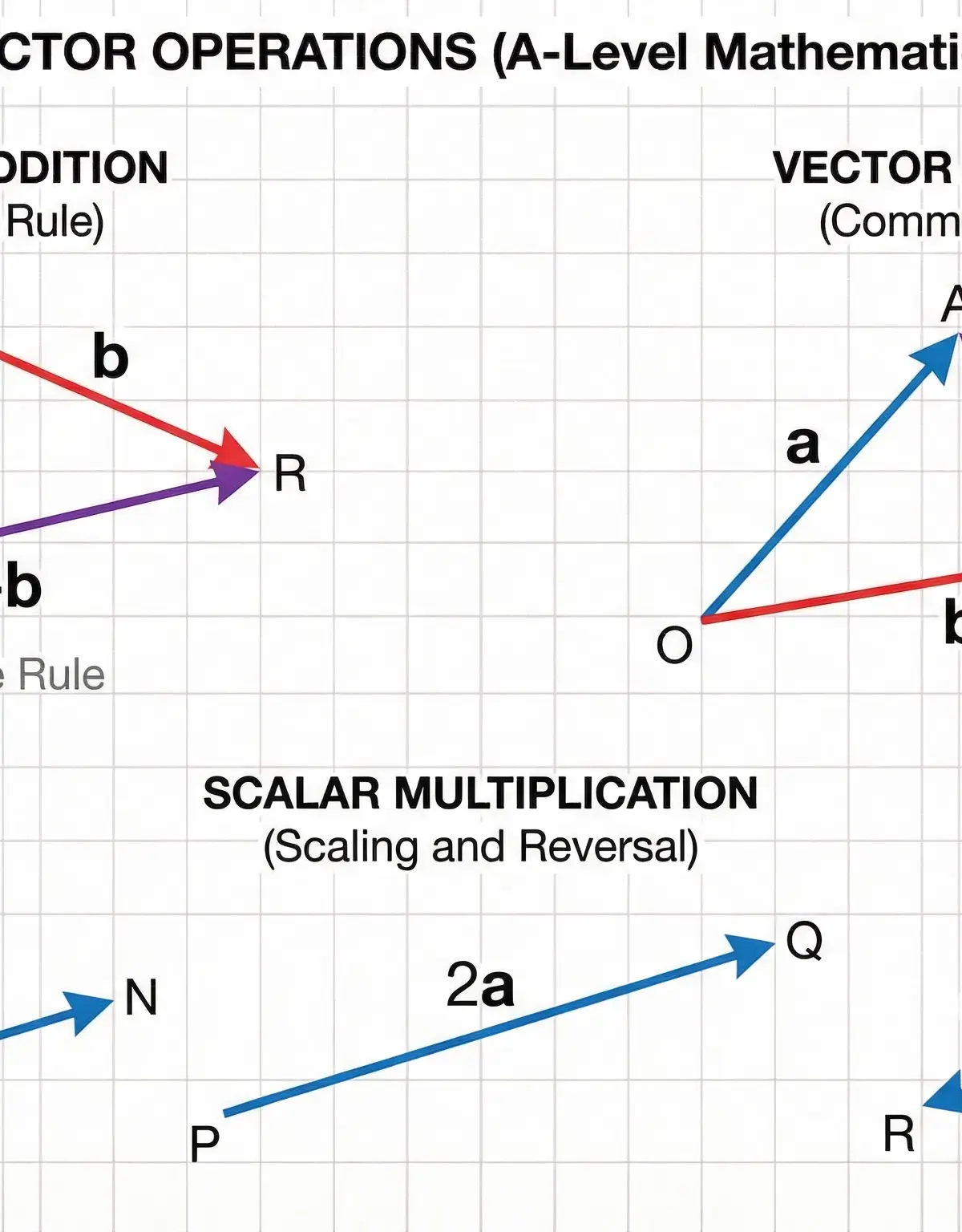
- Addition:
a + bis found by placing the vectors head-to-tail. The resultant vector goes from the start ofato the end ofb. - Subtraction:
a - bis equivalent toa + (-b). Geometrically, ifaandbstart from the same point,a - bis the vector from the end ofbto the end ofa. - Scalar Multiplication: Multiplying a vector by a scalar
kchanges its magnitude by a factor of|k|. Ifkis negative, the vector's direction is reversed. Two vectorsaandbare parallel if and only ifa = kbfor some non-zero scalark.
5. Geometric Proofs
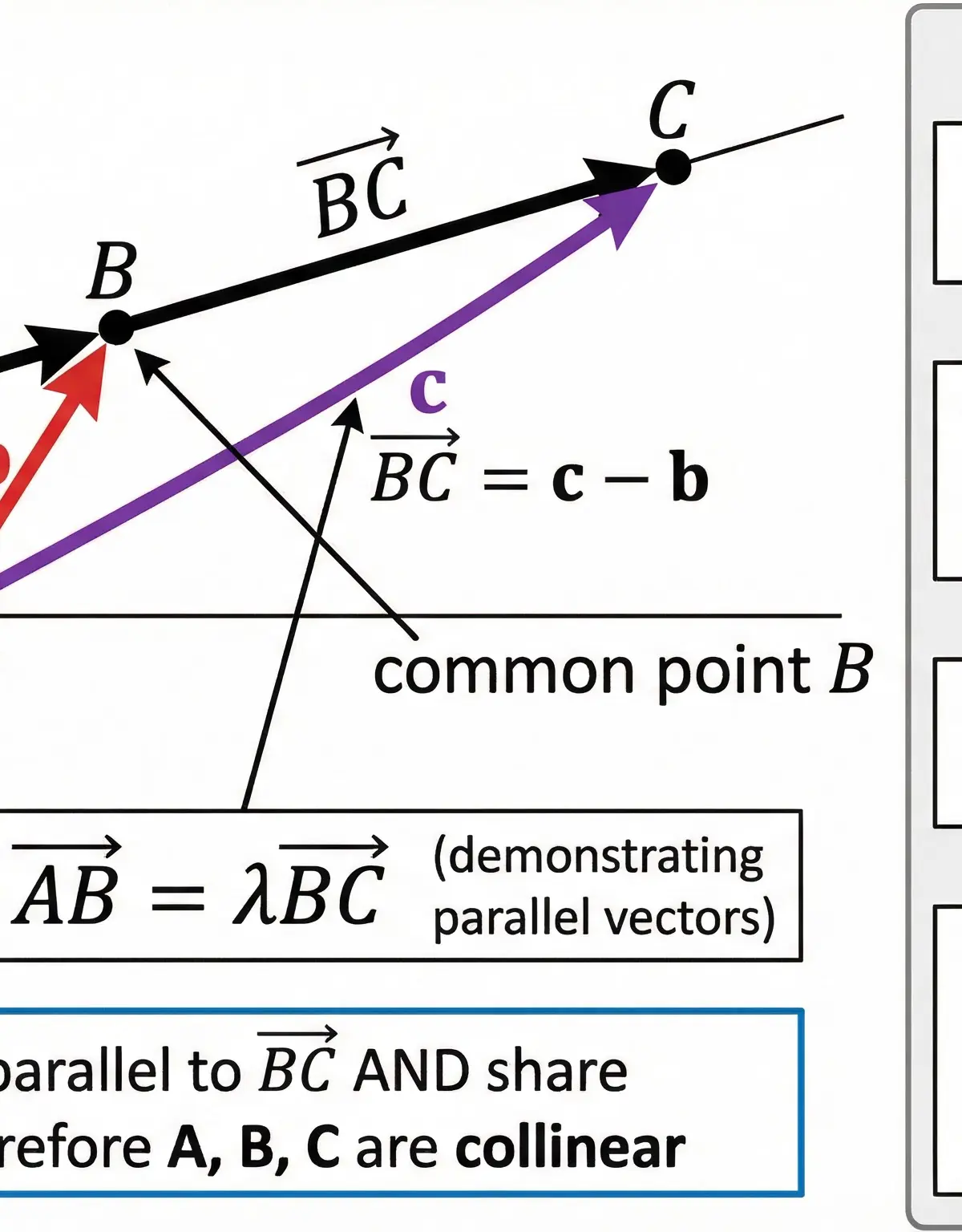
Vectors are a powerful tool for proving geometric properties. A classic exam question involves proving that three points (A, B, C) are collinear (lie on the same straight line).
Method for Collinearity: To prove A, B, and C are collinear, you must:
- Find two displacement vectors, e.g.,
ABandBC. - Show they are parallel by demonstrating that one is a scalar multiple of the other (e.g.,
AB = k * BC). - State that they share a common point (in this case, B).
- Conclude that because they are parallel and share a common point, A, B, and C must be collinear. An E1 mark is awarded for this final, rigorous conclusion.
Mathematical Relationships
| Formula/Relationship | Description | Status |
|---|---|---|
Displacement Vector AB | b - a | Must memorise |
| Magnitude ` | v | = |
| Parallel Vectors | a = kb for scalar k | Must memorise |
| Collinearity of A, B, C | AB = k * BC AND common point B | Must memorise |
| Vector Equation of a Line | r = a + t * d | Given on formula sheet |
| Scalar (Dot) Product | `a . b = | a |
Practical Applications
Vectors are not just an abstract concept; they are essential in many fields:
- Physics and Engineering: Modelling forces, velocity, and acceleration. For example, calculating the resultant force on a bridge or the trajectory of a projectile.
- Computer Graphics: Used extensively in 3D modelling and animation to determine the position and orientation of objects in virtual space.
- Navigation: GPS systems use vectors to represent location and displacement to calculate routes and travel times.
Worked Examples
3 worked examples — open one to explore the question and available guidance.
Practice Questions
Test your understanding — click to reveal model answers
Given the vector p = 2i - 6j + 3k, calculate its magnitude.
Hint: Remember the 3D version of Pythagoras' theorem.
The vectors a = 3i + mj and b = 6i - 8j are parallel. Find the value of m.
Hint: If two vectors are parallel, one must be a scalar multiple of the other.
OABC is a parallelogram. The position vector of A is a and the position vector of C is c. Find the position vector of the midpoint of the diagonal OB.
Hint: In a parallelogram, the diagonals bisect each other. First find the position vector of B.
The vector equation of two lines are r1 = (2i + j) + t(i - 3j) and r2 = (i - 2j) + s(2i + j). Find the position vector of their point of intersection.
Hint: At the point of intersection, `r1 = r2`. Equate the `i` and `j` components to form simultaneous equations.
A particle starts from rest. It moves with constant acceleration a = (2i - 3j) m/s^2. Find its speed after 4 seconds.
Hint: Use the vector form of the `suvat` equation `v = u + at`. Remember that 'speed' is the magnitude of the velocity.