OCR · GCSE · Mathematics
Congruence and Similarity
Master the principles of congruence and similarity, a high-yield topic that bridges geometry and proportional reasoning. Learn how to prove triangles are identical, apply scale factors to lengths, areas, and volumes, and secure top marks in multi-step exam questions.
- 5 min read
- 3 worked examples
- 5 practice questions
- 6 key terms
Study Notes
Overview
Welcome to Congruence and Similarity, a cornerstone topic in GCSE Mathematics that perfectly blends visual geometry with algebraic proportionality. This topic is essential because it teaches you how to formally prove that shapes are identical or proportional—skills that examiners test rigorously every year. Understanding these concepts allows you to solve complex problems involving missing lengths, areas, and volumes, often forming the basis of high-mark, multi-step questions at the end of the paper.
Congruence and similarity connect deeply to other areas of the specification, including ratio, proportion, transformations (such as enlargements and rotations), and trigonometry. Typical exam questions range from simple identification tasks on the Foundation tier to demanding formal proofs and 3D volume scale factor calculations on the Higher tier. By mastering the rules and learning to spot the relationships between shapes, you will build a reliable strategy for picking up marks.

Key Concepts
Concept 1: Congruence
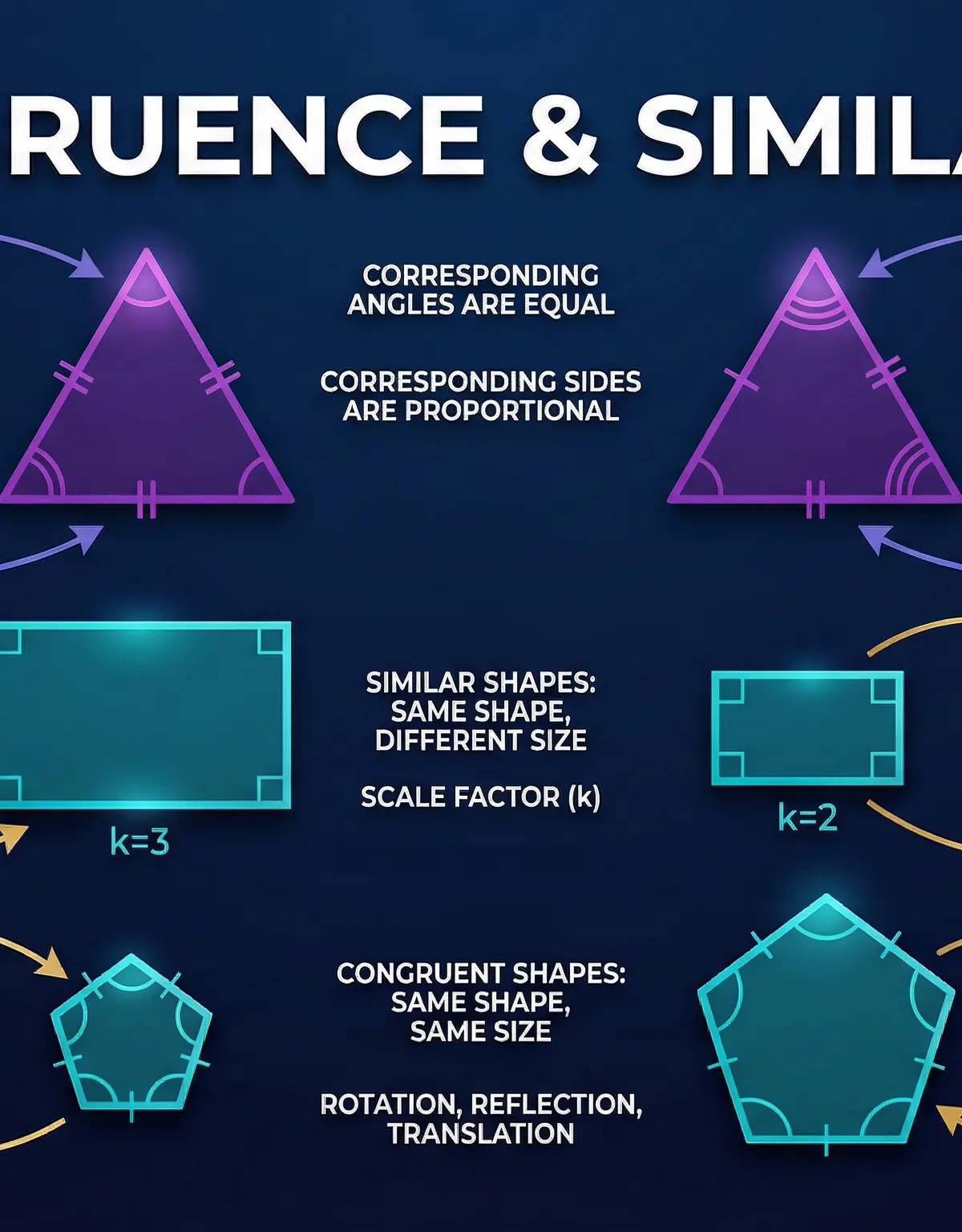
Congruent shapes are exactly the same shape and exactly the same size. Think of them as perfect clones or photocopies made at 100%. If you cut one out, it would fit perfectly on top of the other.
Crucially, congruent shapes can be rotated, reflected, or translated. They do not have to be oriented in the same direction. What matters to an examiner is that all corresponding sides are equal in length and all corresponding angles are equal in size.
Example: A triangle with sides 5cm, 12cm, and 13cm is congruent to another triangle with sides 5cm, 12cm, and 13cm, even if the second triangle is drawn upside down.
Concept 2: Conditions for Congruent Triangles
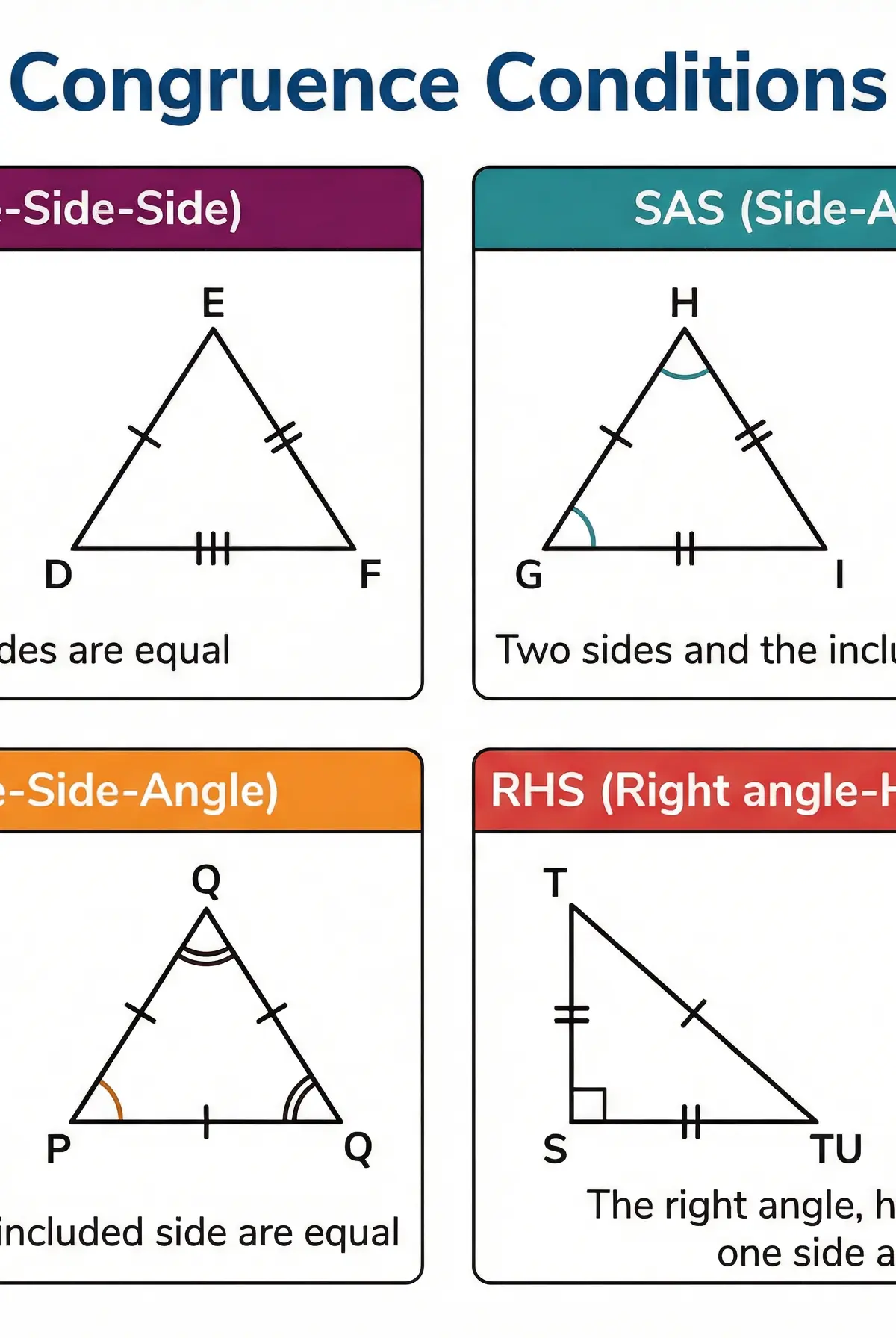
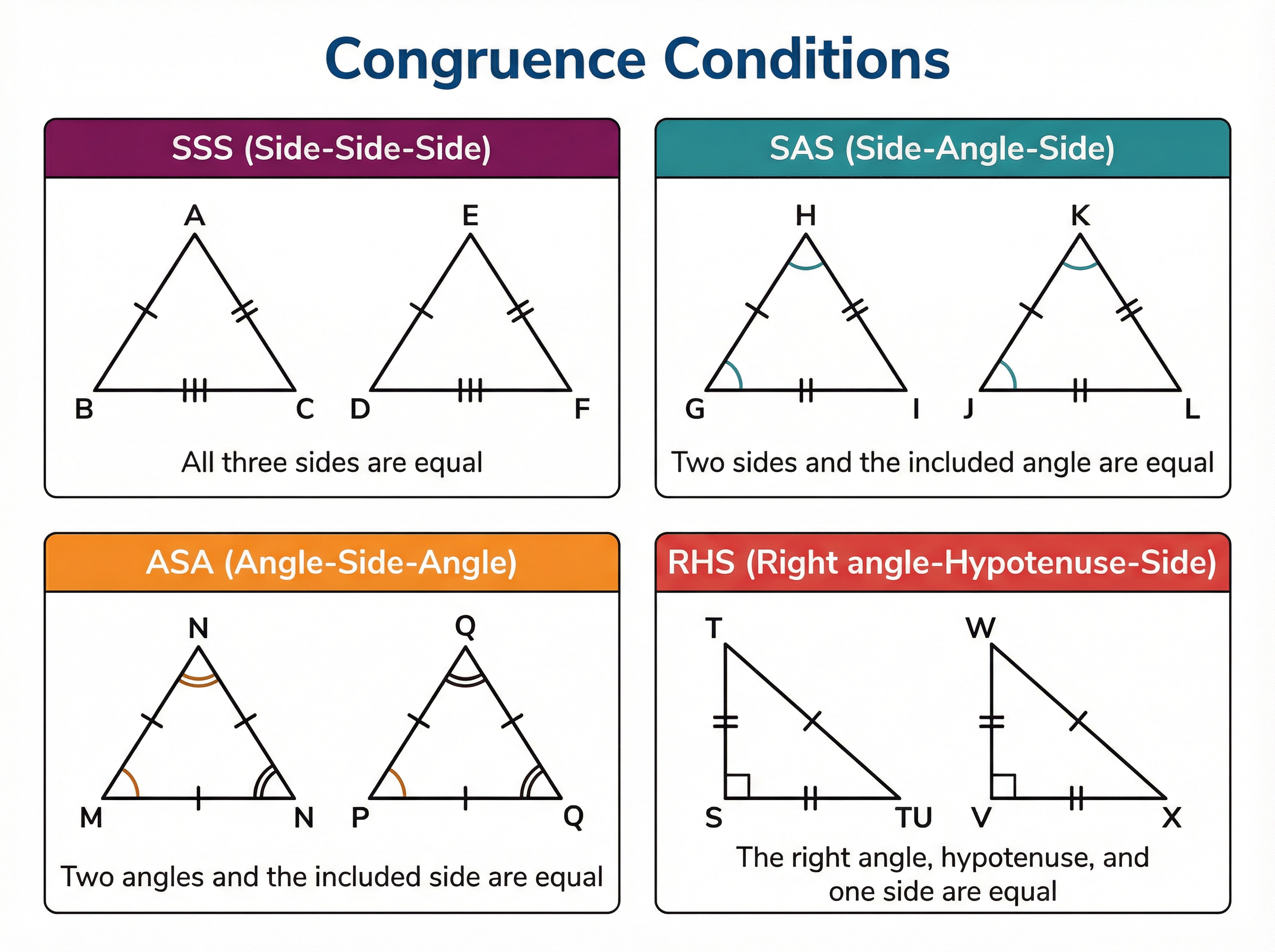
To prove two triangles are congruent, you don't need to measure all three sides and all three angles. You only need to prove one of four specific conditions. Examiners require you to state these exact abbreviations:
- SSS (Side-Side-Side): All three sides of one triangle are equal to the corresponding three sides of the other.
- SAS (Side-Angle-Side): Two sides and the included angle (the angle between those two sides) are equal.
- ASA (Angle-Side-Angle): Two angles and the included side are equal.
- RHS (Right angle-Hypotenuse-Side): In a right-angled triangle, the hypotenuse and one other side are equal.
Concept 3: Similarity
Similar shapes are the same shape, but not necessarily the same size. One is an enlargement of the other. Think of zooming in or out on a photograph.
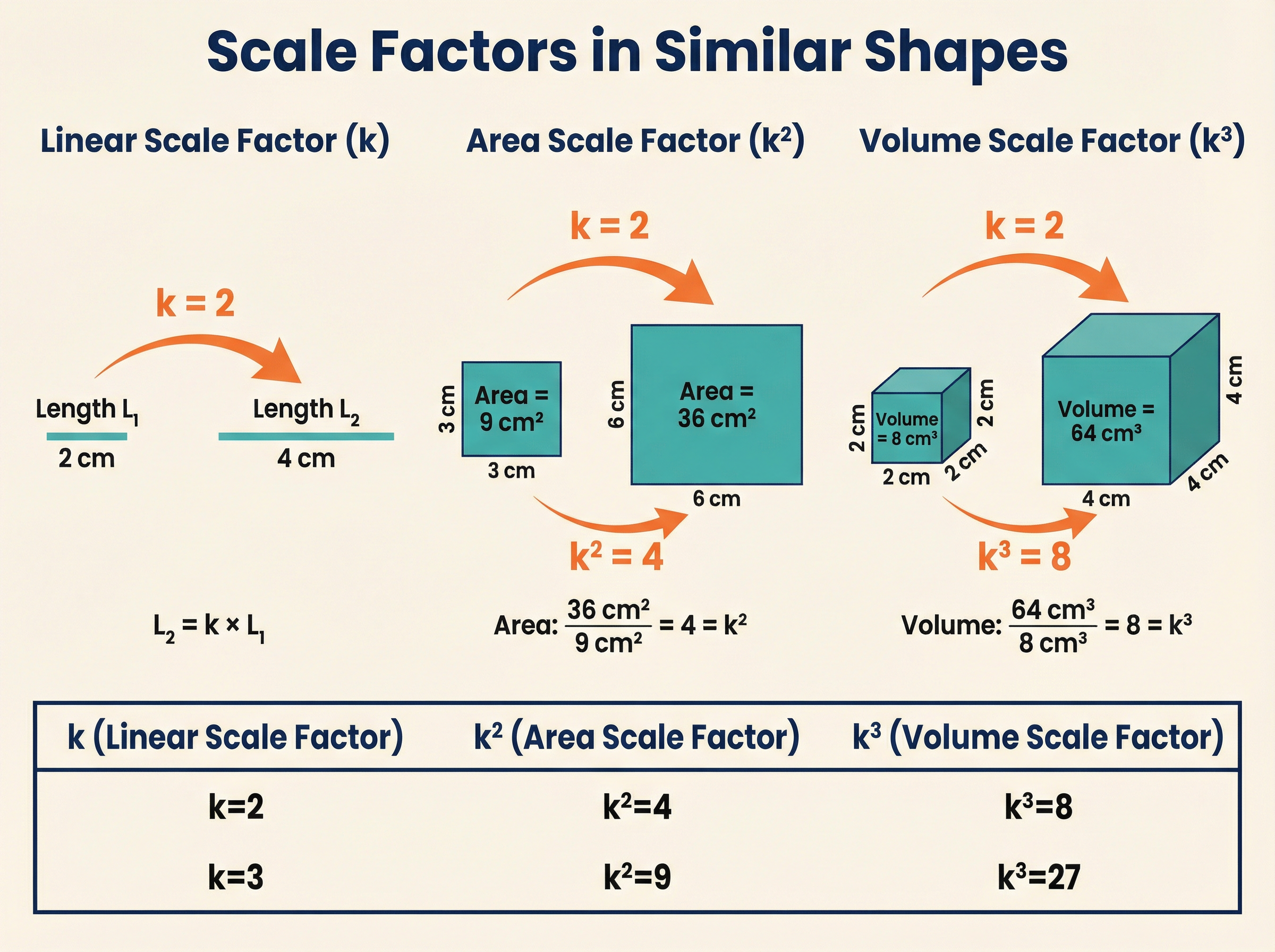
For two shapes to be similar, all corresponding angles must be equal, and all corresponding sides must be in the same proportion. This proportion is called the linear scale factor (k).
Example: If a rectangle has sides 2cm and 4cm, a similar rectangle might have sides 6cm and 12cm. The scale factor k is 3 (because 2 \times 3 = 6 and 4 \times 3 = 12).
Concept 4: Area and Volume Scale Factors (Higher Tier Focus)
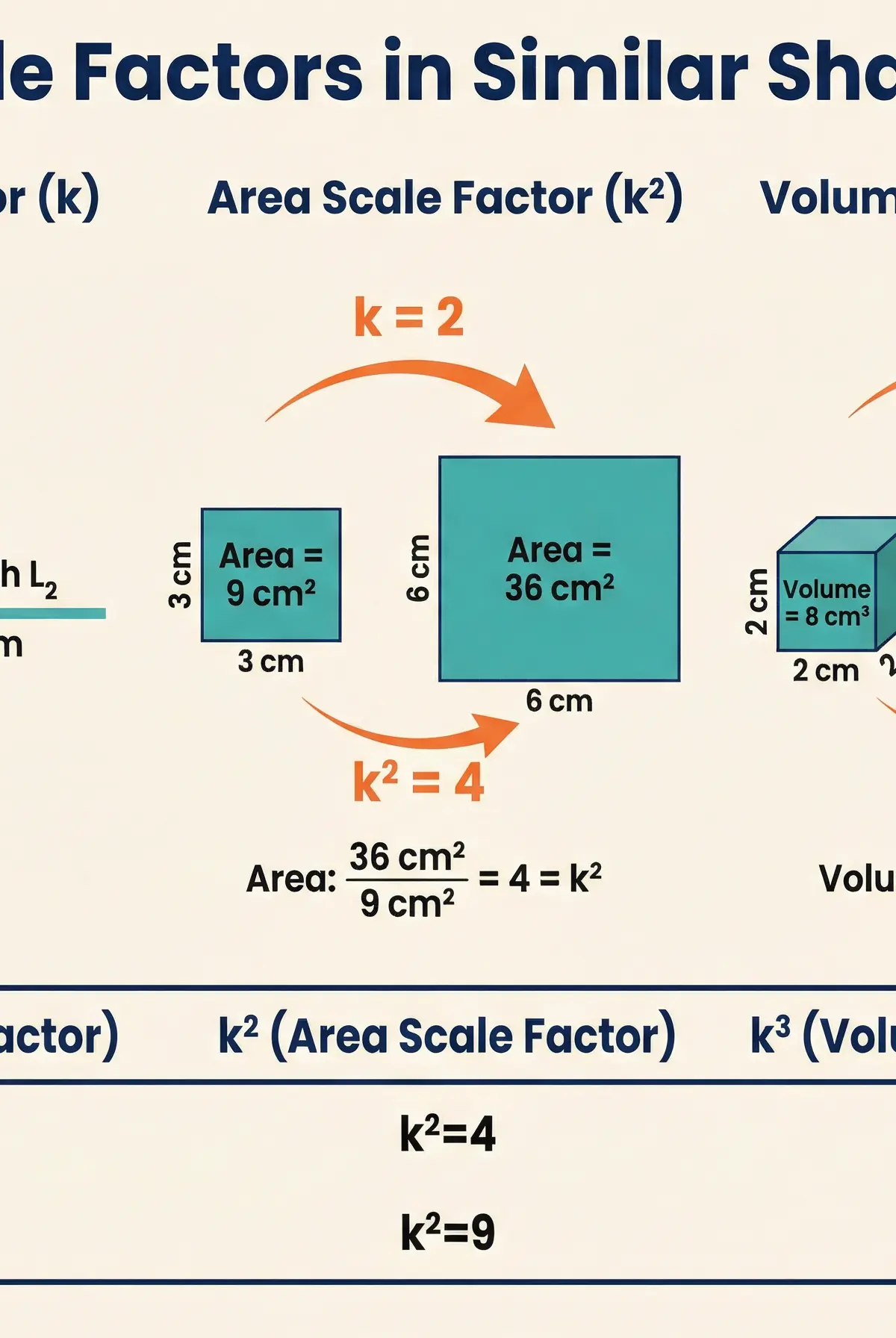
This is where many candidates lose marks. If the linear scale factor between two similar shapes is k, the relationship changes for area and volume:
- The Area Scale Factor is k^2.
- The Volume Scale Factor is k^3.
Why does this work? Imagine a 1cm by 1cm square. Its area is 1cm^2. If you double the lengths (scale factor k=2), the new square is 2cm by 2cm. Its area is 4cm^2. The lengths doubled (k=2), but the area quadrupled (k^2=4).
Mathematical Relationships
For similar shapes A (small) and B (large):
- Linear Scale Factor (k): k = \frac{\text{Length}_B}{\text{Length}_A}
- Area Scale Factor: \text{Area}_B = \text{Area}_A \times k^2
- Volume Scale Factor: \text{Volume}_B = \text{Volume}_A \times k^3
Note: To go from large to small, divide by the relevant scale factor, or use a fractional scale factor between 0 and 1.
Practical Applications
Similarity is used constantly in the real world. Architects use scale models and blueprints (linear scale factors) to design buildings. Engineers use wind tunnels to test scale models of cars and planes, relying on volume and area scale factors to predict how the full-size version will behave. Map reading relies entirely on linear scale factors (the map scale).
Visual Resources
2 diagrams and illustrations
Interactive Diagrams
2 interactive diagrams to visualise key concepts
Conceptual Flow Outline
Decision tree for identifying congruence and similarity conditions.
Conceptual Flow Outline
Converting between linear, area, and volume scale factors.
Worked Examples
3 worked examples — open one to explore the question and available guidance.
Practice Questions
Test your understanding — click to reveal model answers
Which of the following is NOT a condition for congruent triangles? A) SSS, B) SAS, C) AAA, D) RHS
Hint: Think about what happens when you enlarge a shape. Do the angles change?
Shape A and Shape B are similar rectangles. The width of A is 5cm and its length is 8cm. The width of B is 15cm. Calculate the length of B.
Hint: Find the multiplier (scale factor) to get from the width of A to the width of B.
Two mathematically similar statues have surface areas of 50cm² and 450cm². The smaller statue has a height of 12cm. Calculate the height of the larger statue.
Hint: You are given areas, so you will find the Area Scale Factor first. How do you get the linear scale factor from that?
Two similar cones have volumes of 24cm³ and 81cm³. The base radius of the larger cone is 6cm. Calculate the base radius of the smaller cone.
Hint: Find the volume scale factor, cube root it, then decide whether to multiply or divide.
In triangle ABC, AB = 7cm, BC = 9cm, and Angle ABC = 40°. In triangle XYZ, XY = 7cm, YZ = 9cm, and Angle YXZ = 40°. Explain why these triangles are not necessarily congruent.
Hint: Look closely at the letters for the angles. Are they the 'included' angles?