OCR · GCSE · Mathematics
Expressions and Formulae
Expressions and Formulae is a cornerstone topic in OCR GCSE Mathematics, testing your ability to manipulate algebraic expressions, substitute values accurately, factorise efficiently, and rearrange formulae with confidence. This topic accounts for approximately 60% of AO1 marks in this section and underpins almost every other algebra topic you'll encounter, from quadratics to simultaneous equations. Mastering these skills will unlock consistent marks across both Foundation and Higher tier papers.
- 10 min read
- 6 worked examples
- 8 practice questions
- 10 key terms
Study Notes
Overview
Expressions and Formulae forms the bedrock of algebraic fluency in GCSE Mathematics. This topic requires candidates to demonstrate a clear understanding of the distinctions between expressions, equations, formulae, and identities—a conceptual difference that examiners test rigorously. At Foundation tier, you'll be expected to substitute values into expressions and formulae, simplify by collecting like terms, expand single brackets, and factorise simple expressions. At Higher tier, these skills extend to rearranging complex formulae, handling algebraic fractions, and factorising expressions involving multiple variables. The topic connects directly to quadratic equations, simultaneous equations, sequences, and graphical work, making it essential for synoptic questions that draw on multiple areas of the specification. Typical exam questions range from straightforward 2-mark substitution tasks to challenging 6-mark formula rearrangement problems that demand methodical working and algebraic precision. Understanding command words is critical: 'simplify' means collect like terms or cancel; 'factorise' means extract common factors and insert brackets; 'solve' requires finding a numerical value; and 'show that' demands every step of algebraic manipulation to be written out explicitly. This topic rewards careful, systematic working and penalises careless sign errors, so developing robust checking habits is as important as learning the techniques themselves.
Key Concepts
Concept 1: Distinguishing Expressions, Equations, Formulae, and Identities
Understanding the difference between these four algebraic forms is fundamental to answering questions correctly. An expression is a mathematical phrase containing numbers, variables, and operations, but no equals sign. Examples include 3x + 5, 2a² - 7a + 3, and 5(x - 2). You cannot 'solve' an expression; you can only simplify it or substitute values into it. An equation contains an equals sign and can be solved to find the value of the unknown. For instance, 3x + 5 = 20 is an equation, and solving it gives x = 5. A formula is a rule that expresses the relationship between two or more variables. The formula for the area of a rectangle, A = lw, shows how area depends on length and width. You substitute known values into formulae to calculate unknown quantities. Finally, an identity is a statement that is true for all values of the variables involved. The identity 2(x + 3) ≡ 2x + 6 holds regardless of what value x takes. We use the identity symbol (≡) to distinguish identities from equations. Examiners frequently test this distinction by asking candidates to classify a given statement or by penalising those who attempt to 'solve' an expression.
Example: Classify each of the following: (a) 5x - 3, (b) 5x - 3 = 12, (c) C = 2πr, (d) x² - 1 ≡ (x - 1)(x + 1).
(a) Expression (no equals sign), (b) Equation (can be solved), (c) Formula (relates variables), (d) Identity (always true).
Concept 2: Substitution into Expressions and Formulae
Substitution involves replacing variables with numerical values. While this sounds straightforward, it is one of the most common sources of mark loss, particularly when negative numbers are involved. The golden rule is: always place negative numbers in brackets. Consider the expression x² when x = -3. If you write (-3)², your calculator correctly computes 9. If you write -3², many calculators interpret this as -(3²) = -9, costing you the mark. Similarly, when substituting into formulae with multiple operations, brackets ensure the correct order of operations is followed. For example, substituting a = -2 and b = 5 into 3a + 2b should be written as 3(-2) + 2(5) = -6 + 10 = 4. Examiners award one mark for correct substitution and a second mark for correct evaluation, so even if your arithmetic is slightly off, you can still earn the method mark by showing clear substitution.
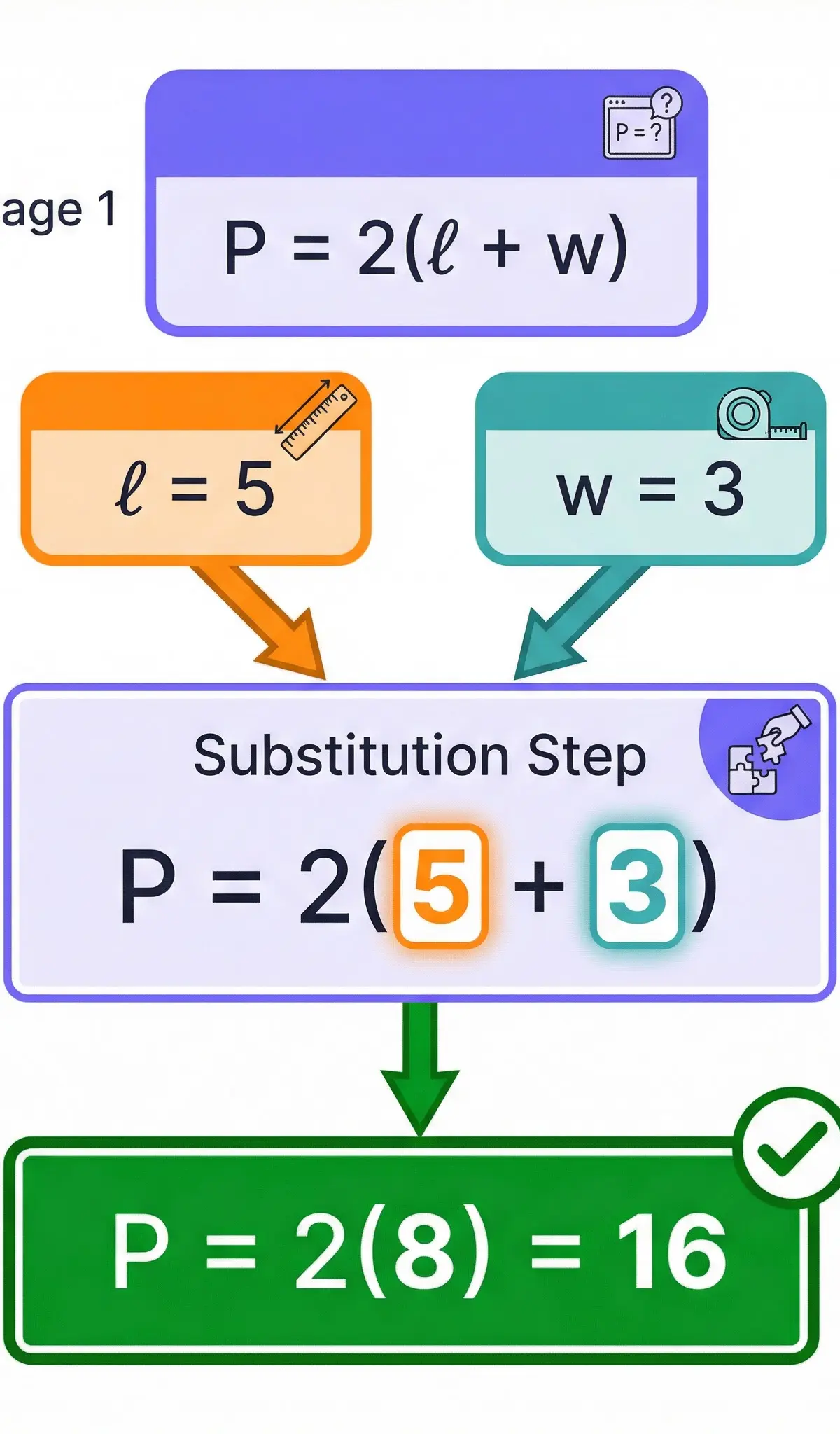
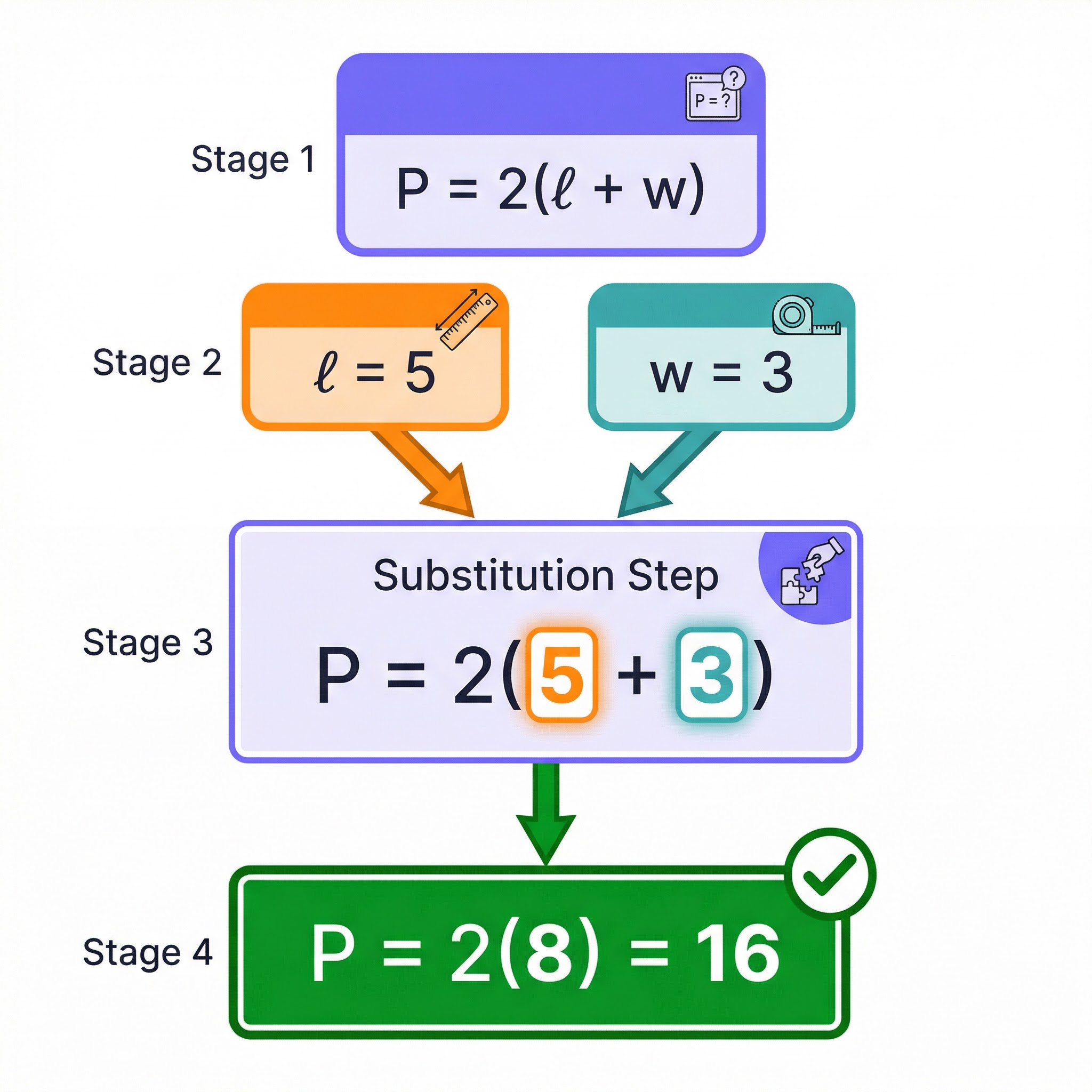
Example: The formula for the perimeter of a rectangle is P = 2(l + w). Find P when l = 5 cm and w = 3 cm.
Substitute: P = 2(5 + 3) = 2(8) = 16 cm.
Concept 3: Simplifying Expressions by Collecting Like Terms
Simplifying an expression means combining 'like terms'—terms that have identical variable parts. For instance, 3x and 5x are like terms because they both contain x to the first power, so 3x + 5x = 8x. However, 3x and 5x² are not like terms and cannot be combined. When simplifying, work systematically: first identify all terms involving the same variable and power, then add or subtract their coefficients. Be especially careful with negative signs. In the expression 4x - 2x + 7 - 3, the x-terms combine to give 2x, and the constant terms combine to give 4, yielding 2x + 4. Examiners typically award one mark for correctly identifying like terms and another for accurately combining them. A common error is to combine unlike terms, such as writing 3x + 5x² = 8x², which is mathematically incorrect.
Example: Simplify 5a + 3b - 2a + 7b.
Combine a-terms: 5a - 2a = 3a.
Combine b-terms: 3b + 7b = 10b.
Final answer: 3a + 10b.
Concept 4: Expanding Brackets
Expanding brackets (also called 'multiplying out') involves distributing a term outside the bracket to every term inside. For a single bracket, multiply the term outside by each term inside. For example, 3(x + 4) = 3x + 12. The most frequent error occurs with negative signs. When expanding -3(x - 2), you must multiply -3 by both x and -2, giving -3x + 6. Notice the second term becomes positive because (-3) × (-2) = +6. This is where many candidates lose marks. A useful check is to substitute a simple value (like x = 1) into both the original and expanded forms to verify they give the same result. At Higher tier, you may also encounter double brackets, such as (x + 3)(x + 5), which requires the FOIL method or grid method, but single bracket expansion is the focus of this section.
Example: Expand -2(3x - 5).
-2 × 3x = -6x
-2 × (-5) = +10
Final answer: -6x + 10.
Concept 5: Factorisation
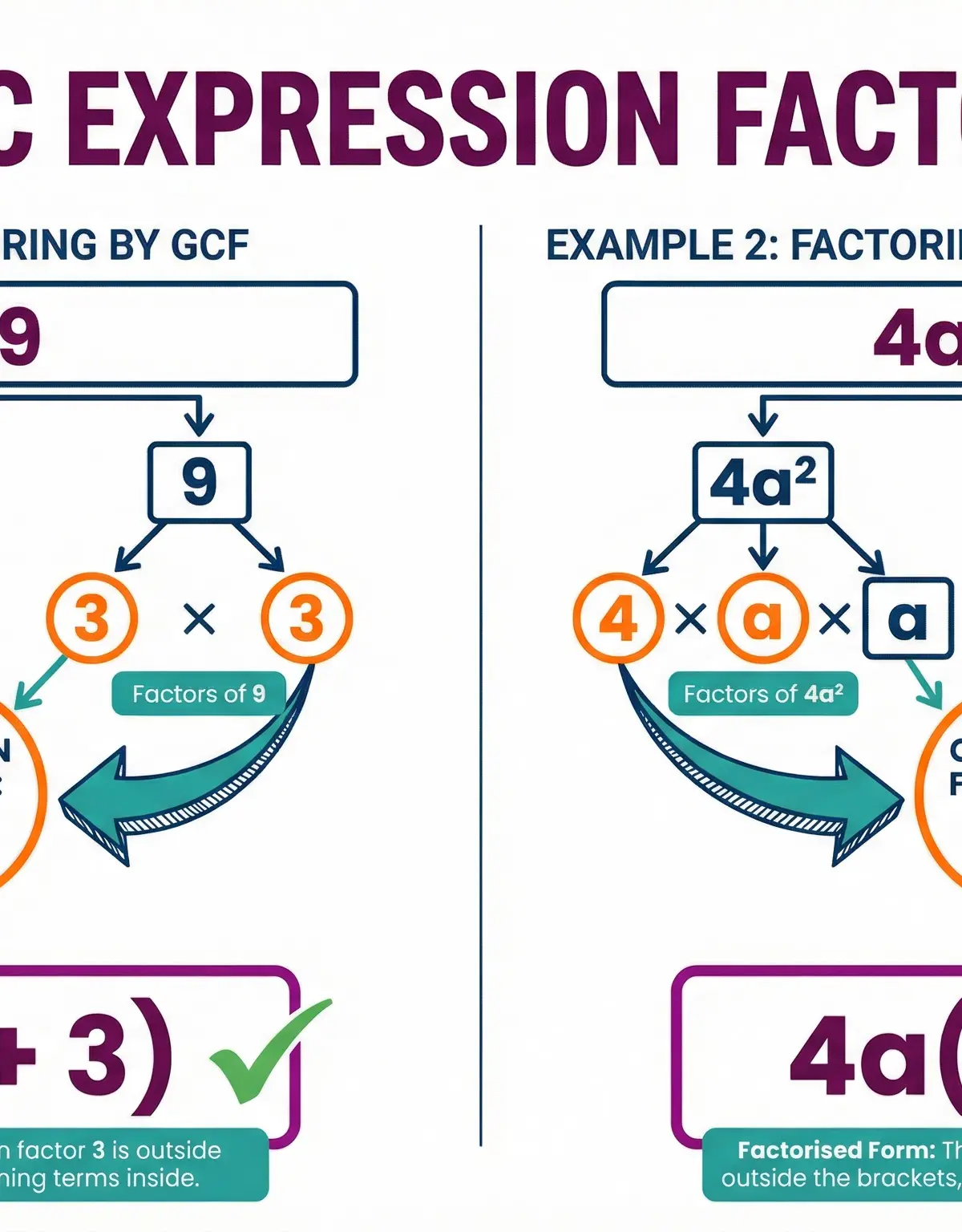
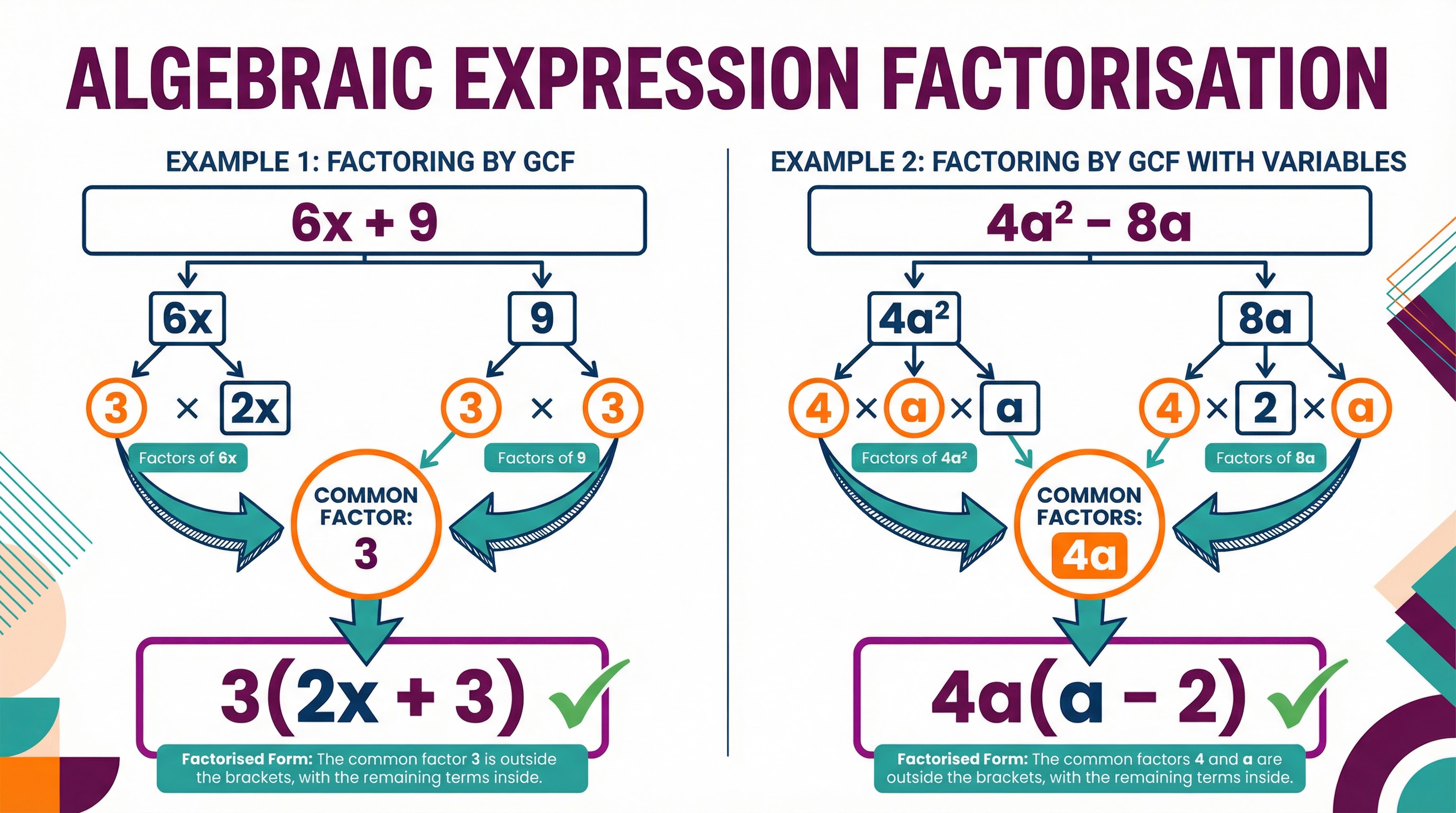
Factorisation is the reverse of expanding brackets. You identify the highest common factor (HCF) of all terms and 'take it out' by placing it outside brackets. For example, in 6x + 9, the HCF of 6 and 9 is 3, so we write 3(2x + 3). At Higher tier, the HCF may include variables. In 4a² - 8a, the HCF is 4a (since both terms are divisible by 4 and a), giving 4a(a - 2). Examiners award B1 for partial factorisation—for instance, if you correctly extract the numerical factor but miss the variable, you still earn one mark. A critical check is to expand your factorised answer: it should return you to the original expression. Factorisation is essential for solving quadratic equations, simplifying algebraic fractions, and rearranging formulae where the subject appears more than once.
Example: Factorise 10x - 15.
HCF of 10 and 15 is 5.
10x ÷ 5 = 2x, 15 ÷ 5 = 3.
Final answer: 5(2x - 3).
Concept 6: Rearranging Formulae (Higher Tier)
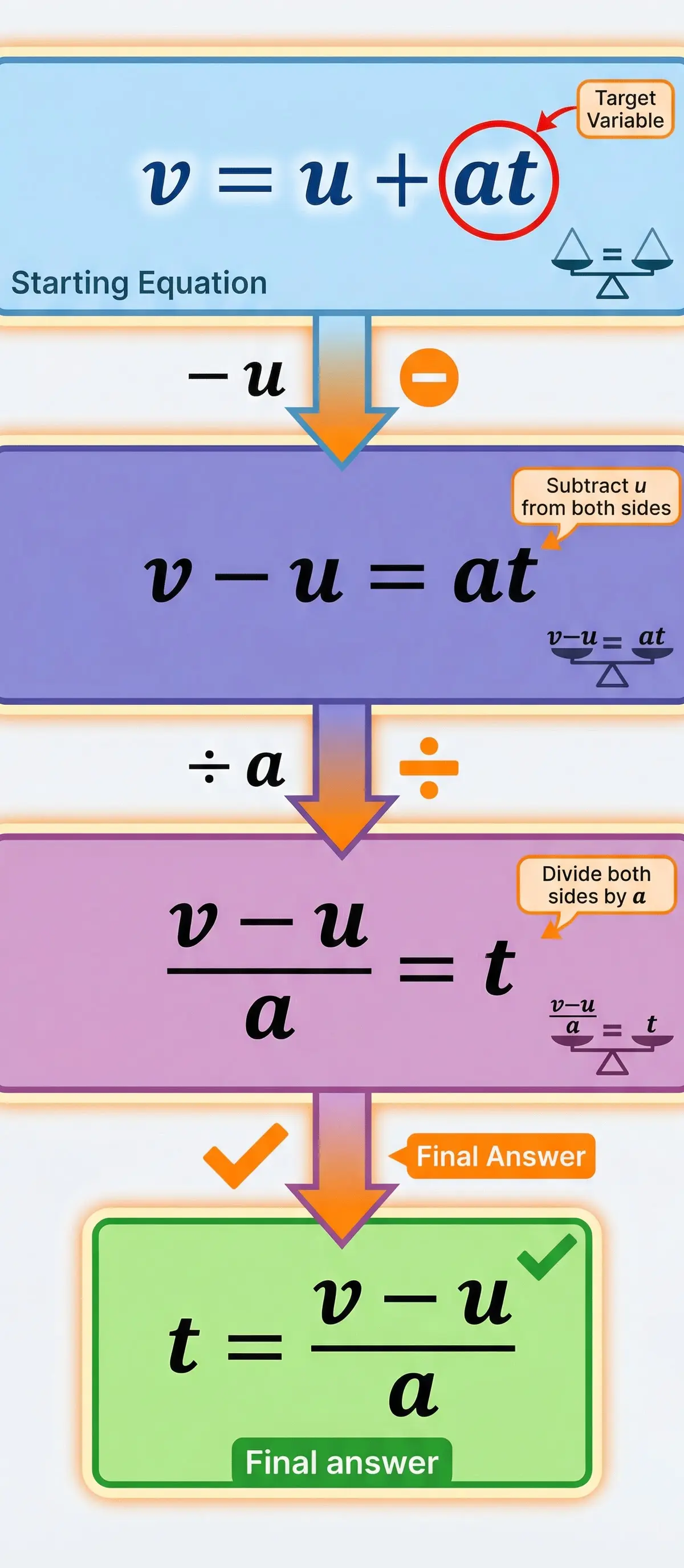
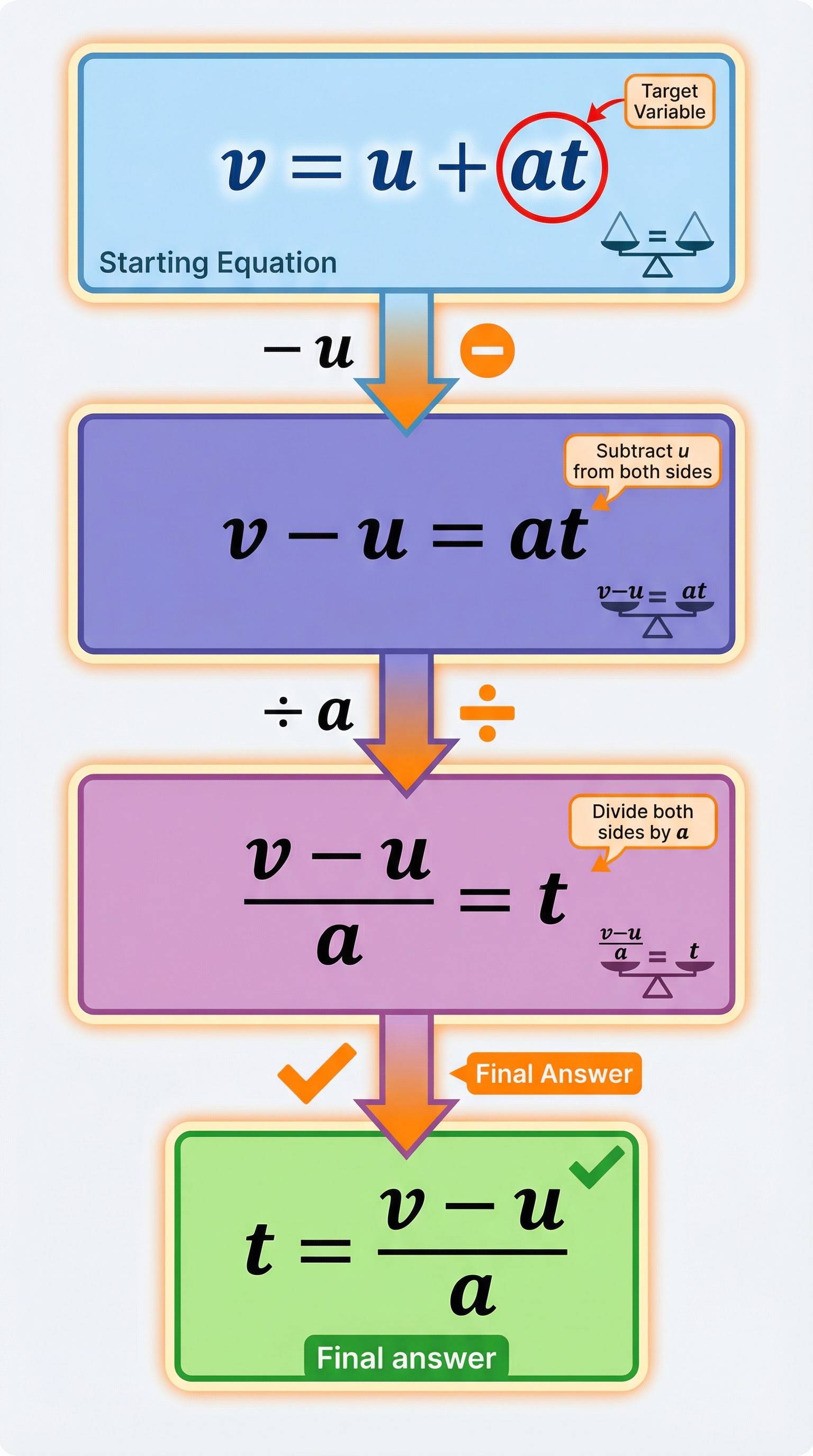
Rearranging a formula means making a different variable the subject. The fundamental principle is to maintain balance: whatever operation you perform on one side of the equation, you must perform on the other. Consider the formula v = u + at. To make t the subject, first isolate the term containing t by subtracting u from both sides: v - u = at. Then divide both sides by a: t = (v - u)/a. Examiners award M1 (method mark) for a correct first step, so even if you make an error later, you can still earn credit. A more complex scenario arises when the subject appears twice, such as in a = bc + bd. Here, you must factorise the right-hand side first: a = b(c + d), then divide by (c + d) to get b = a/(c + d). Failing to factorise is a common error that prevents candidates from isolating the subject.
Example: Rearrange A = πr² to make r the subject.
Divide both sides by π: A/π = r².
Take the square root of both sides: r = √(A/π).
Mathematical Relationships
Core Formulae and Relationships
While this topic focuses on algebraic manipulation rather than specific formulae, you should be familiar with common formulae that appear in exam questions:
- Perimeter of a rectangle: P = 2(l + w) or P = 2l + 2w (Must memorise)
- Area of a rectangle: A = lw (Must memorise)
- Area of a triangle: A = ½bh (Given on formula sheet)
- Circumference of a circle: C = 2πr or C = πd (Given on formula sheet)
- Area of a circle: A = πr² (Given on formula sheet)
- Speed, distance, time: s = d/t (Must memorise)
- Density, mass, volume: ρ = m/V (Must memorise)
When rearranging, remember:
- To isolate a term, perform the inverse operation: addition ↔ subtraction, multiplication ↔ division, squaring ↔ square root.
- Always perform operations on both sides of the equation to maintain equality.
- When the subject appears more than once, factorise to collect it on one side.
Order of Operations (BIDMAS/BODMAS)
When substituting or simplifying, follow the order of operations:
- Brackets first
- Indices (powers and roots)
- Division and Multiplication (left to right)
- Addition and Subtraction (left to right)
This order is critical when evaluating expressions with multiple operations.
Practical Applications
Algebraic manipulation underpins numerous real-world applications. Formulae are used extensively in science (e.g., rearranging F = ma to find acceleration), engineering (calculating stress and strain), finance (compound interest formulae), and everyday problem-solving (converting temperatures between Celsius and Fahrenheit using F = 9C/5 + 32). In GCSE exam contexts, you might be asked to substitute values into a hire-purchase formula, rearrange a formula for converting currencies, or simplify an expression representing the total cost of items. Understanding how to manipulate expressions and formulae gives you the tools to model and solve practical problems efficiently. For instance, if a mobile phone contract costs £20 per month plus £0.10 per minute of calls, the total cost C for m minutes is C = 20 + 0.1m. Rearranging this to find m when C = 35 involves solving 35 = 20 + 0.1m, which requires the algebraic skills covered in this topic.
Listen to the Podcast
Listen to this 10-minute podcast for a conversational walkthrough of all key concepts, exam tips, and a quick-fire recall quiz to test your understanding.
Visual Resources
3 diagrams and illustrations
Interactive Diagrams
2 interactive diagrams to visualise key concepts
Conceptual Flow Outline
Decision tree for classifying algebraic statements as expressions, equations, formulae, or identities
Conceptual Flow Outline
Step-by-step process for factorising an algebraic expression
Worked Examples
6 worked examples — open one to explore the question and available guidance.
Practice Questions
Test your understanding — click to reveal model answers
Simplify 7a - 3b + 2a - 5b.
Hint: Identify terms with 'a' and terms with 'b', then combine each group separately.
Expand 4(2x + 3).
Hint: Multiply 4 by each term inside the bracket.
Factorise 15x - 10.
Hint: Find the highest common factor of 15 and 10.
The formula for the area of a trapezium is A = ½(a + b)h. Find A when a = 6 cm, b = 10 cm, and h = 5 cm.
Hint: Substitute the values into the formula, remembering to work out the bracket first.
Rearrange the formula P = 2l + 2w to make w the subject.
Hint: First isolate the term containing w, then divide to make w the subject.
Expand and simplify 3(x + 4) - 2(x - 1).
Hint: Expand each bracket separately, then collect like terms. Watch the signs carefully.
Factorise fully 6xy + 9x.
Hint: Look for common factors in both the numbers and the variables.
The formula v² = u² + 2as is used in physics. Rearrange it to make a the subject.
Hint: First isolate the term containing a, then divide by what's multiplying a.