Fractions, Decimals and Percentages — OCR GCSE Study Guide
Exam Board: OCR | Level: GCSE
Mastering Fractions, Decimals, and Percentages (FDP) is essential for GCSE Mathematics, unlocking marks across the entire specification. This guide will teach you how to convert fluently between forms, use powerful percentage multipliers, and tackle complex exam questions with confidence.
## Overview
Fractions, Decimals, and Percentages (FDP) form the bedrock of GCSE Mathematics. These three forms are simply different ways of expressing the same mathematical truth: a proportion of a whole. Whether you are calculating a discount in a shop, determining the probability of an event, or analysing data in a pie chart, FDP skills are essential. Examiners frequently use FDP as a gateway to test other topics, meaning a solid grasp of conversions and multipliers will unlock marks across the entire paper.
In the exam, you will be expected to convert fluently between forms, order mixed lists of values, and apply percentage multipliers for both simple and compound changes. Higher tier candidates must also demonstrate algebraic methods for converting recurring decimals to fractions. This guide provides the step-by-step methods, examiner insights, and memory hooks you need to secure every available mark.
Listen to our companion podcast for a comprehensive review of this topic:

## Key Concepts
### Concept 1: The FDP Conversion Triangle
Converting between fractions, decimals, and percentages is a fundamental skill. Examiners expect candidates to move between these forms rapidly and accurately. The relationships can be visualised as a triangle.
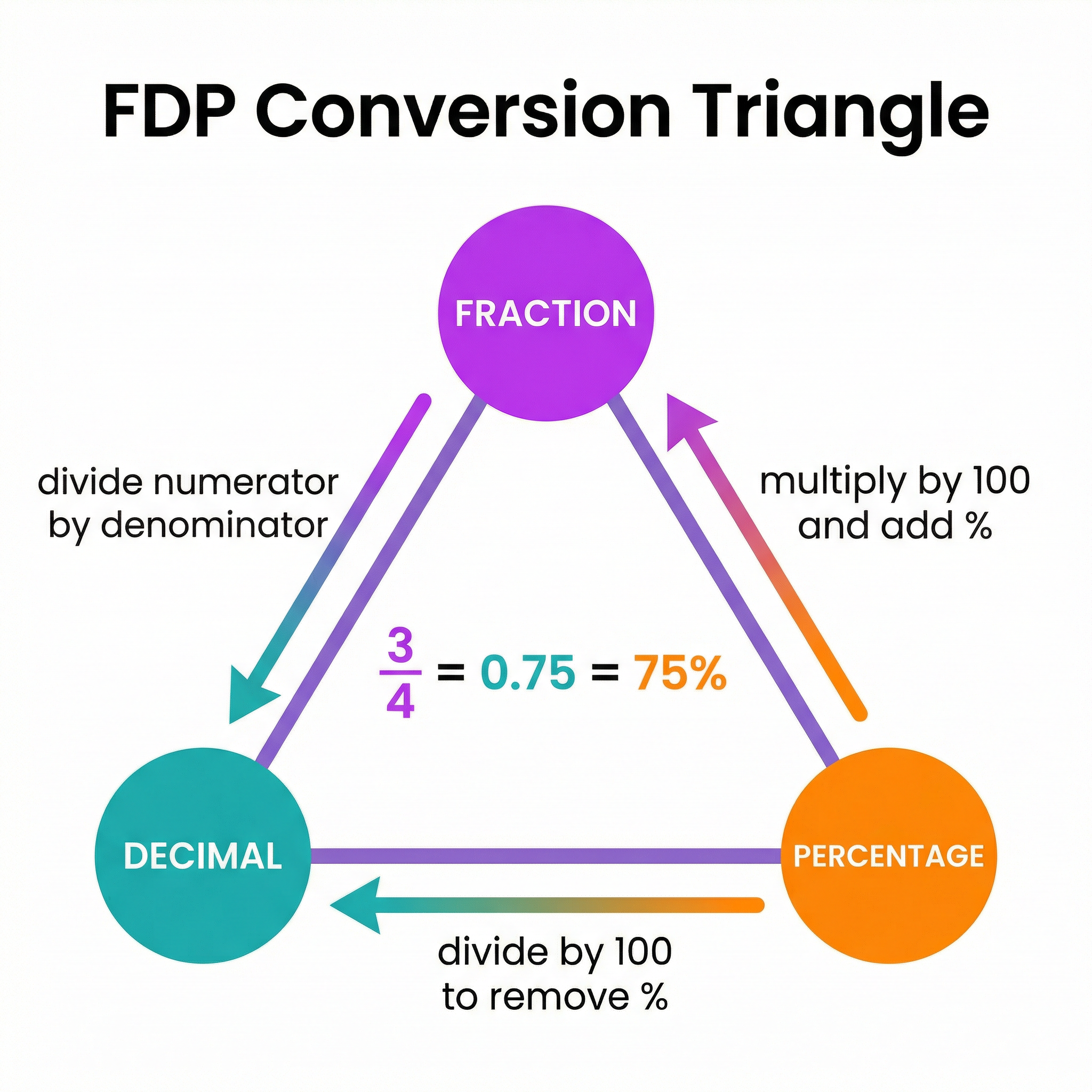
To convert a fraction to a decimal, divide the numerator by the denominator. For example, $\frac{3}{8}$ becomes $3 \div 8 = 0.375$. To convert a decimal to a percentage, multiply by $100$. Thus, $0.375 \times 100 = 37.5\%$. To convert a percentage back to a decimal, divide by $100$. Finally, to convert a percentage to a fraction, place the percentage value over $100$ and simplify. For instance, $45\%$ becomes $\frac{45}{100}$, which simplifies to $\frac{9}{20}$.
**Example**: Convert $0.65$ to a fraction in its simplest form.
$0.65 = \frac{65}{100}$. Dividing both numerator and denominator by $5$ gives $\frac{13}{20}$.
### Concept 2: Percentage Multipliers
Percentage multipliers are the most efficient way to calculate percentage changes. Instead of finding a percentage and then adding or subtracting it from the original amount, a multiplier allows you to complete the calculation in a single step. This is particularly crucial for compound interest questions where repeated calculations are required.
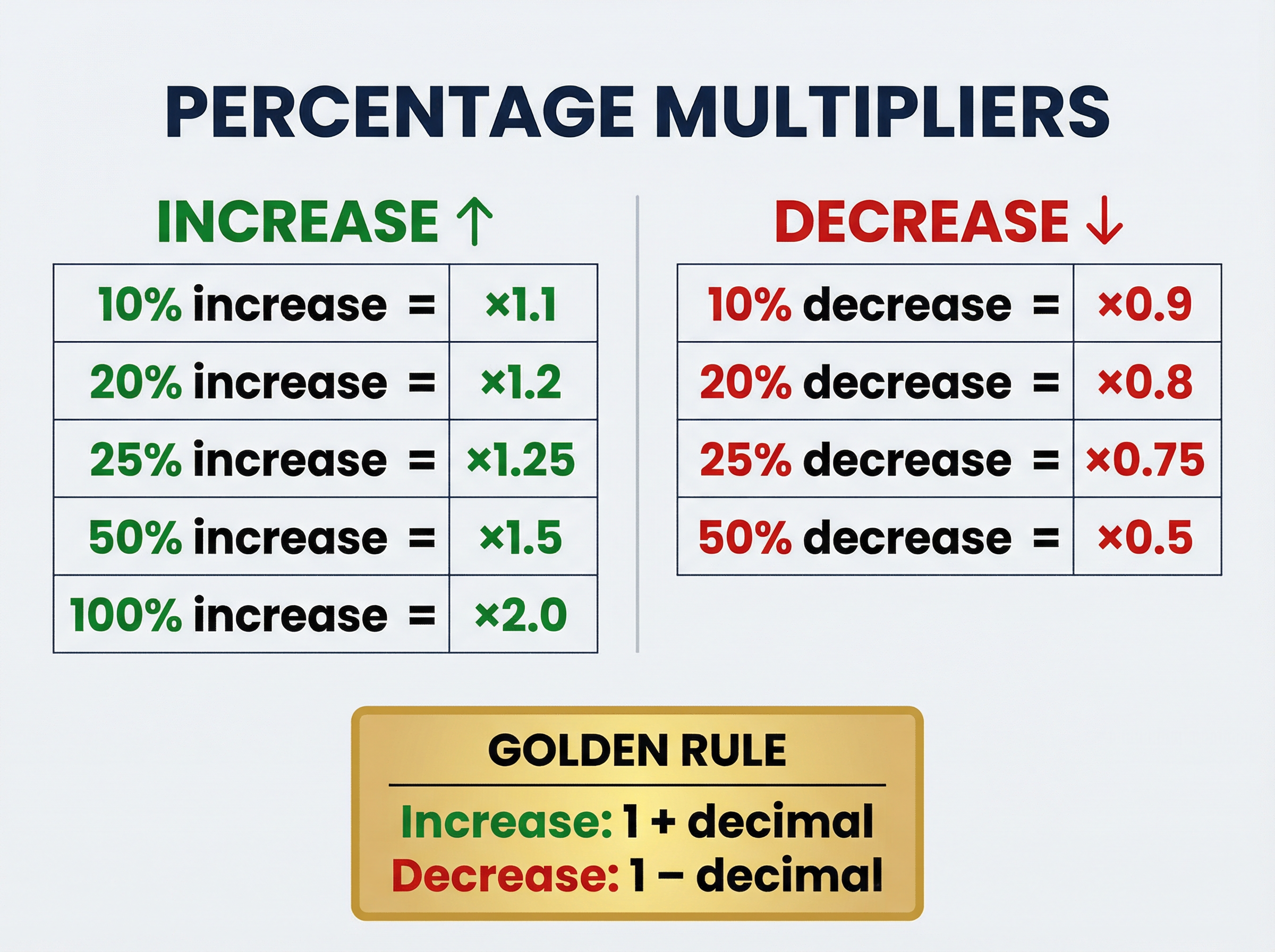
To find a multiplier for a percentage increase, add the percentage (as a decimal) to $1$. For a $15\%$ increase, the multiplier is $1 + 0.15 = 1.15$. For a percentage decrease, subtract the percentage (as a decimal) from $1$. For a $20\%$ decrease, the multiplier is $1 - 0.20 = 0.80$.
**Example**: A car costs $\pounds12,000$ and depreciates by $15\%$ each year. What is its value after $3$ years?
The multiplier is $1 - 0.15 = 0.85$. The calculation is $12000 \times 0.85^3 = \pounds7369.50$.
### Concept 3: Ordering Mixed FDP
Examiners frequently test your ability to order a list containing a mixture of fractions, decimals, and percentages. The most common error is attempting to compare the values in their original forms. The correct strategy is to convert all values to the same form—usually decimals or percentages—before making any comparisons.
**Example**: Order the following from smallest to largest: $\frac{3}{5}$, $0.58$, $62\%$.
Convert all to decimals: $\frac{3}{5} = 0.60$, $0.58 = 0.58$, $62\% = 0.62$.
Comparing the decimals: $0.58 < 0.60 < 0.62$.
Final order: $0.58$, $\frac{3}{5}$, $62\%$.
### Concept 4: Recurring Decimals to Fractions (Higher Tier Only)
Higher tier candidates must be able to convert recurring decimals into fractions using an algebraic method. This demonstrates an understanding of place value and algebraic manipulation.
**Example**: Prove algebraically that $0.\dot{4}\dot{5}$ can be written as $\frac{5}{11}$.
Let $x = 0.454545...$
Since two digits recur, multiply by $100$:
$100x = 45.454545...$
Subtract the original equation:
$100x - x = 45.454545... - 0.454545...$
$99x = 45$
$x = \frac{45}{99}$
Simplify by dividing by $9$:
$x = \frac{5}{11}$
## Mathematical Relationships
- **Percentage Increase Multiplier**: $1 + \frac{r}{100}$ (where $r$ is the percentage rate)
- **Percentage Decrease Multiplier**: $1 - \frac{r}{100}$
- **Compound Interest Formula**: $A = P(1 + \frac{r}{100})^n$ (where $A$ is the final amount, $P$ is the principal amount, $r$ is the annual interest rate, and $n$ is the number of years)
## Practical Applications
FDP skills are vital in everyday life, from calculating discounts during a sale to understanding interest rates on savings accounts and loans. In science, percentages are used to calculate percentage yield and percentage error in experiments. In geography, they are used to analyse demographic data and population growth rates.