OCR · GCSE · Mathematics
Graphs of Equations and Functions
Master the visual language of Mathematics. This comprehensive guide covers linear, quadratic, cubic, reciprocal, exponential, and circle graphs, showing you exactly how to secure top marks in every graph question.
- 4 min read
- 3 worked examples
- 5 practice questions
- 6 key terms
Study Notes
Overview
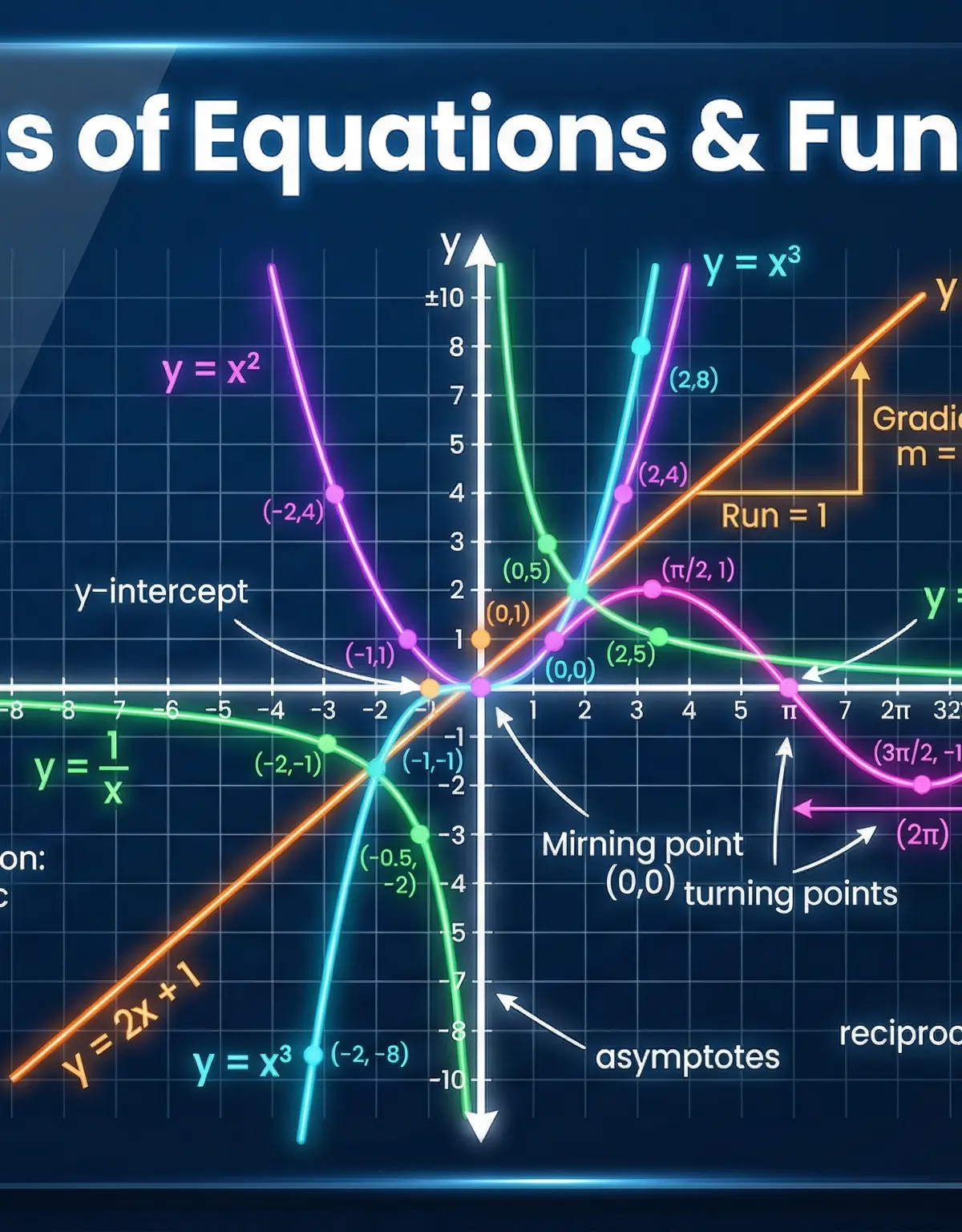
Welcome to the visual side of Mathematics! Graphs of Equations and Functions form a cornerstone of the GCSE Mathematics specification, translating abstract algebra into visual shapes. This topic is crucial because it connects multiple areas of mathematics—from solving simultaneous equations to understanding real-world rates of change. Examiners love testing this topic as it assesses your ability to process information algebraically and visually simultaneously.
Whether you are sketching a simple linear graph or finding the roots of a complex quadratic, the skills you develop here will earn you significant marks. Questions range from straightforward 'complete the table and plot' tasks to complex multi-step problems involving tangents and intersections.
Listen to the companion podcast below to reinforce your learning on the go:

Key Concepts
Concept 1: Linear Graphs (Straight Lines)
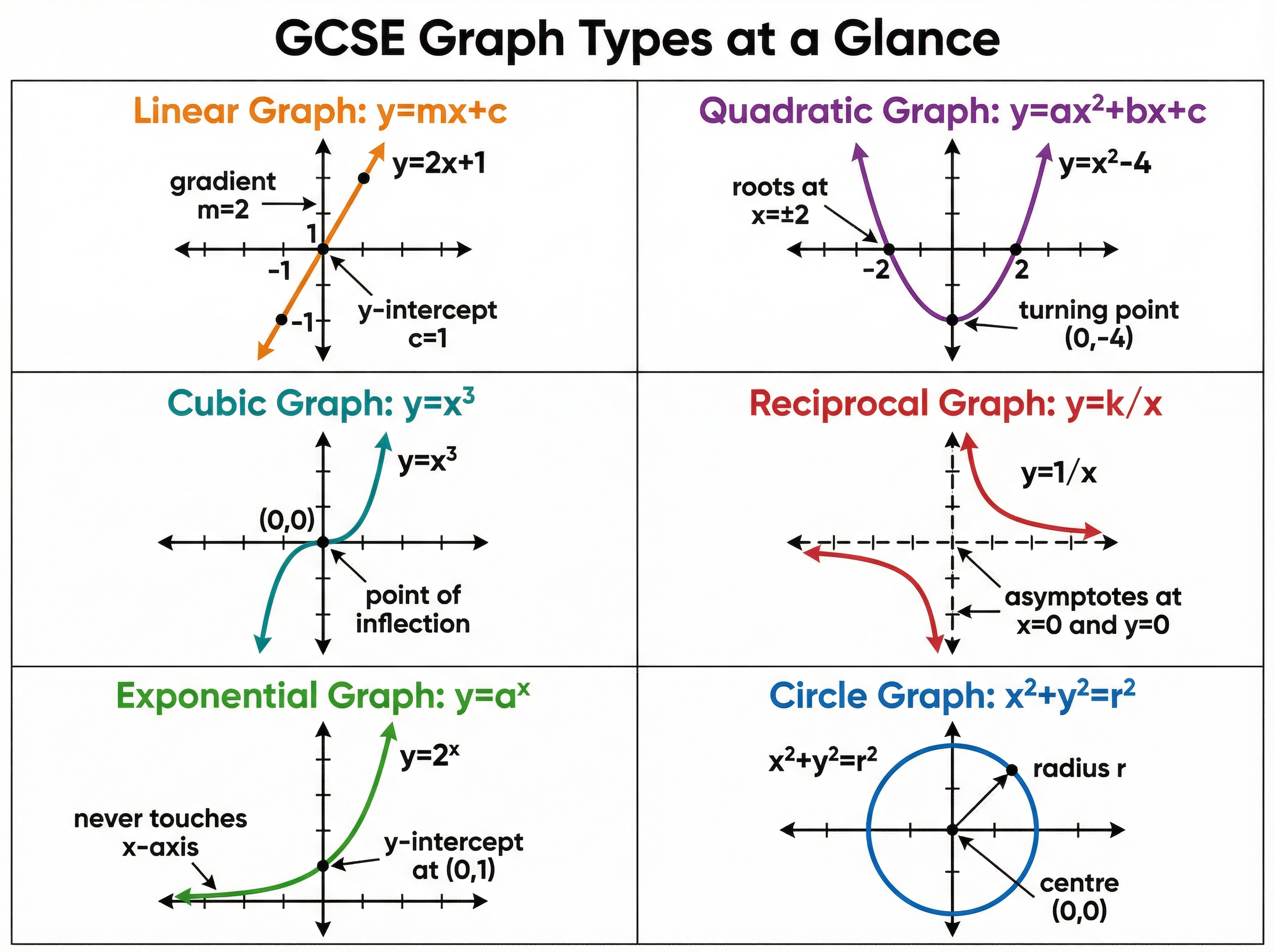
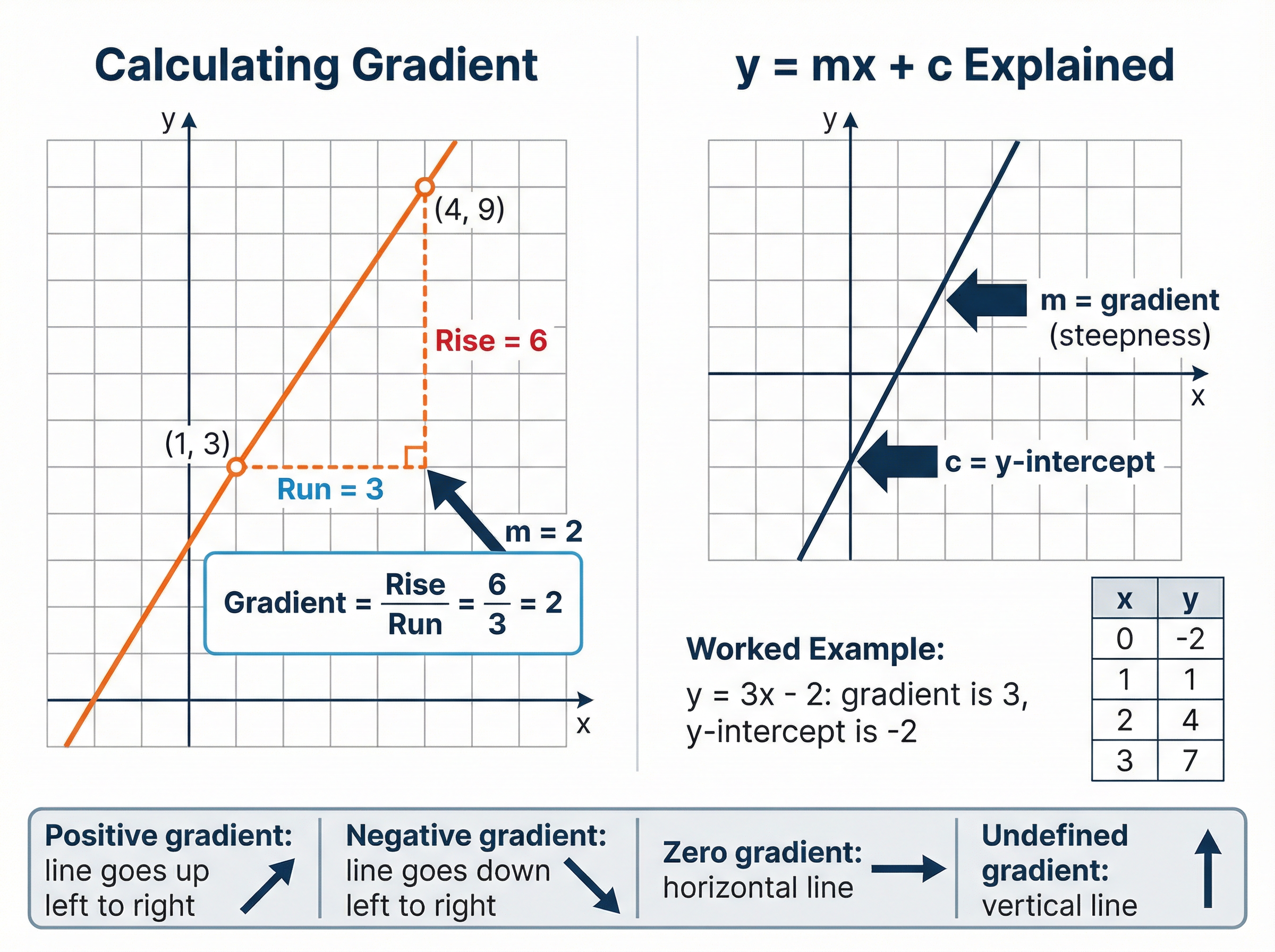
Linear graphs represent equations with no powers higher than 1 (e.g., y = 2x + 1). They always form straight lines. The general equation is y = mx + c.
- Gradient (m): This is the steepness of the line. It tells you how much y increases for every 1 unit increase in x. A positive gradient goes uphill (left to right), while a negative gradient goes downhill.
- y-intercept (c): This is the exact point where the line crosses the y-axis (where x = 0).
Why it works: The gradient is a constant rate of change. Because it never changes, the line never curves.
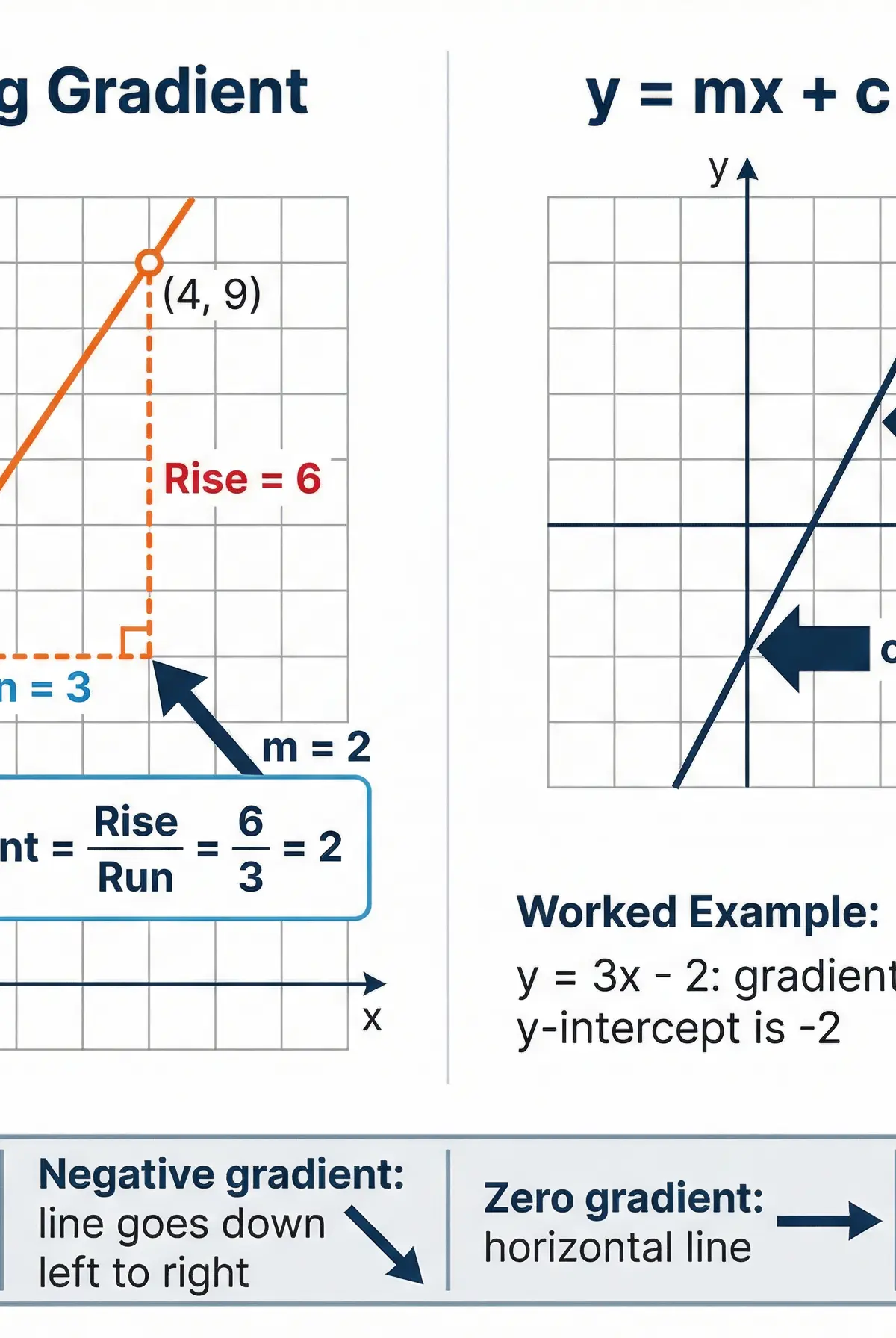
Example: For y = -3x + 4, the gradient is -3 (for every 1 step right, go 3 steps down), and it crosses the y-axis at (0, 4).
Concept 2: Quadratic Graphs (Parabolas)
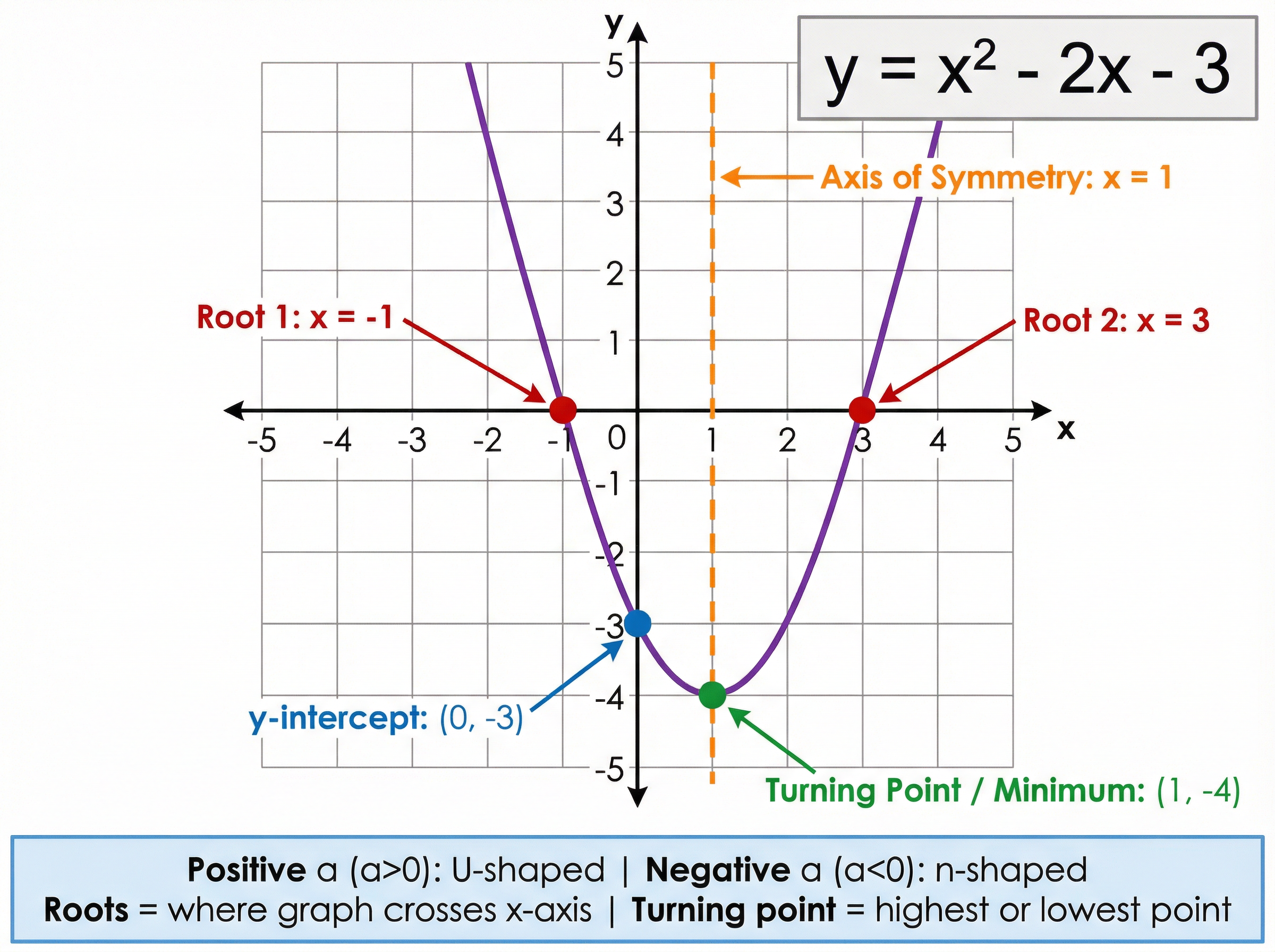
Quadratic graphs represent equations where the highest power of x is 2 (e.g., y = x^2 - 4x + 3). They form symmetrical 'U' or 'n' shaped curves called parabolas.
- Roots (x-intercepts): Where the curve crosses the x-axis. These are the solutions to the equation when y = 0.
- y-intercept: Where the curve crosses the y-axis (when x = 0).
- Turning Point: The lowest point (minimum) for a U-shape, or highest point (maximum) for an n-shape.
- Axis of Symmetry: The vertical line passing exactly through the turning point.
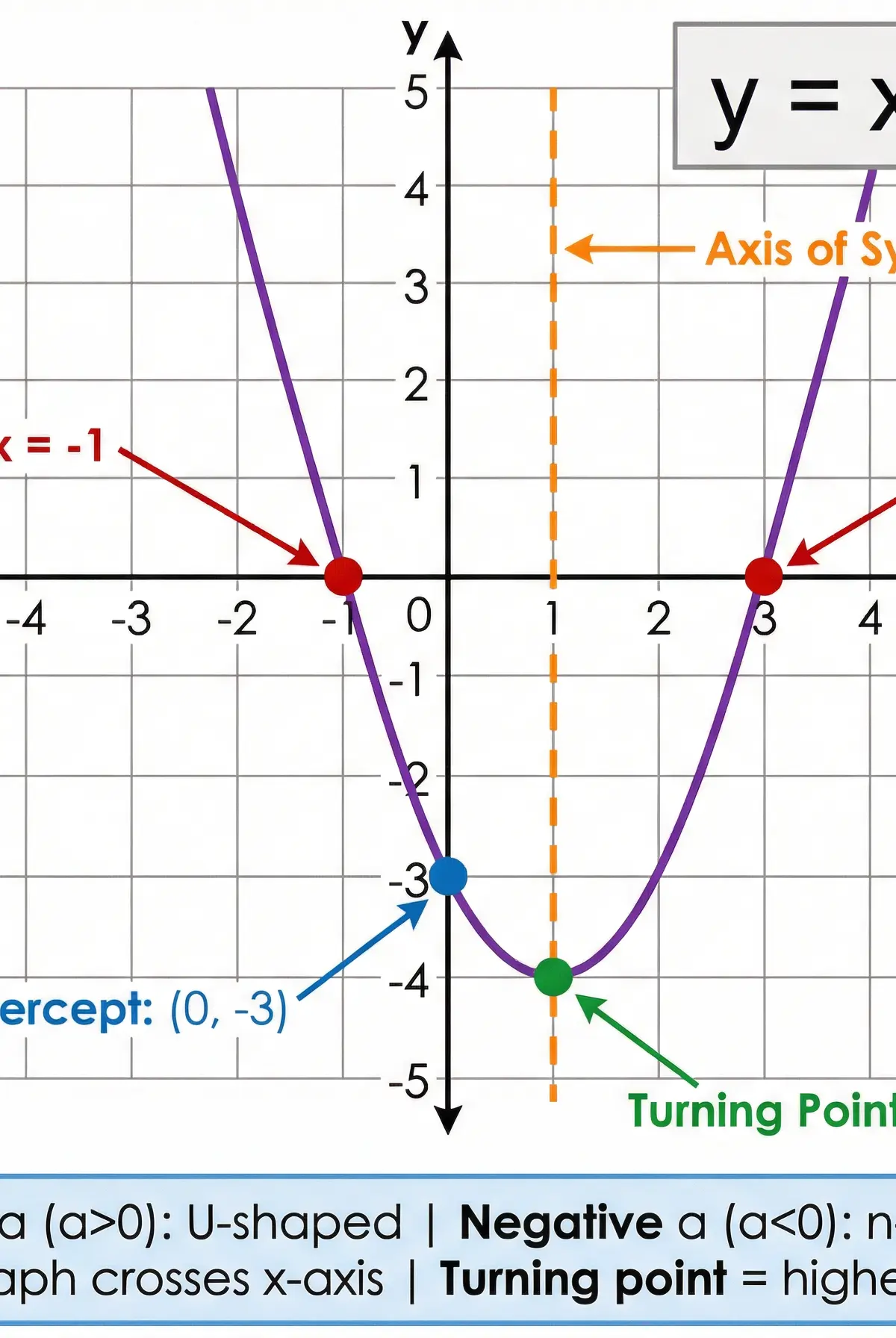
Example: For y = x^2 - 9, the roots are at x = 3 and x = -3, the y-intercept is at (0, -9), and the turning point is also at (0, -9).
Concept 3: Higher Tier Graphs
Higher tier candidates must master three additional graph types:
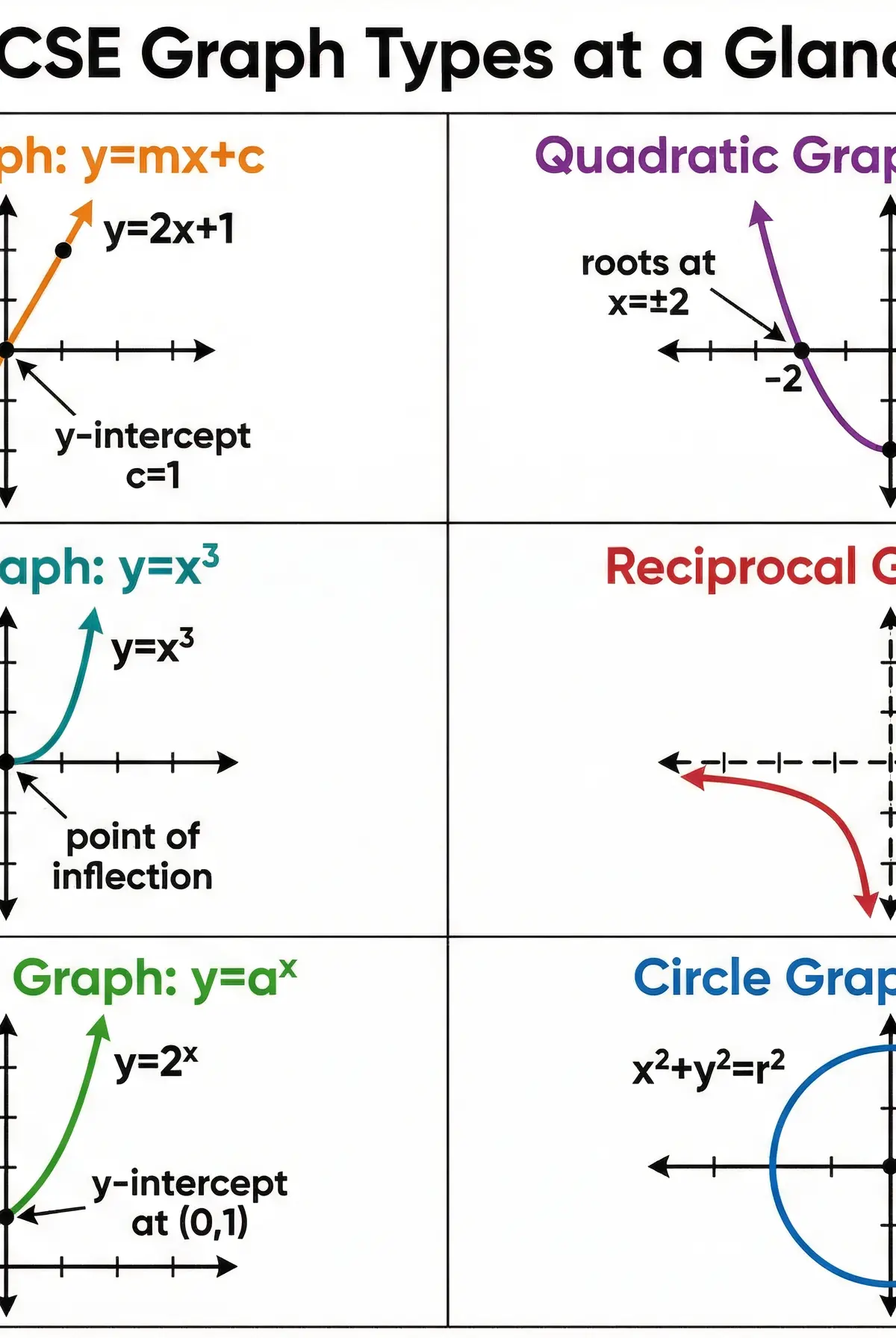
**Cubic Graphs (y = ax^3 + bx^2 + cx + d)**These form an 'S' shape. They can cross the x-axis up to three times and may have two turning points or a single point of inflection.
**Reciprocal Graphs (y = \frac{k}{x})**These graphs have two separate branches. They feature asymptotes—lines the curve approaches but never touches. For y = \frac{1}{x}, the asymptotes are the x-axis (y=0) and y-axis (x=0).
**Exponential Graphs (y = a^x)**These model rapid growth or decay. They curve upwards steeply and have an asymptote along the x-axis.
**Circle Graphs (x^2 + y^2 = r^2)**This equation produces a perfect circle centred at the origin (0,0) with a radius of r.
Mathematical Relationships
Gradient Formula: m = \frac{\text{change in } y}{\text{change in } x} = \frac{y_2 - y_1}{x_2 - x_1}
Use this to find the gradient between any two points (x_1, y_1) and (x_2, y_2).
Circle Equation: x^2 + y^2 = r^2
If x^2 + y^2 = 36, the radius is \sqrt{36} = 6.
Practical Applications
Graphs aren't just abstract curves. Linear graphs model fixed costs (like a taxi fare with a base charge plus a rate per mile). Exponential graphs model compound interest, population growth, and radioactive decay. Quadratics model the trajectory of thrown objects (projectiles) under gravity.
Visual Resources
3 diagrams and illustrations
Interactive Diagrams
2 interactive diagrams to visualise key concepts
Conceptual Flow Outline
Decision tree for identifying graph shapes from their equations.
Conceptual Flow Outline
Step-by-step process for plotting accurate graphs in an exam.
Worked Examples
3 worked examples — open one to explore the question and available guidance.
Practice Questions
Test your understanding — click to reveal model answers
A straight line has the equation y = 4x - 5. Write down the gradient and the coordinates of the y-intercept.
Hint: Compare the equation to the general form $y = mx + c$.
The graphs of y = 2x + 1 and y = x^2 - 2 intersect at two points. Find the coordinates of these points algebraically.
Hint: Set the two equations equal to each other to form a quadratic equation equal to zero.
(Higher Tier) Sketch the graph of y = \cos(x) for 0^\circ \leq x \leq 360^\circ. Label the coordinates of any intercepts with the coordinate axes.
Hint: Think about the values of cos(0), cos(90), cos(180), cos(270), and cos(360).
A curve has the equation y = x^3 - 4x. Find the coordinates of the points where the curve crosses the x-axis.
Hint: Where does a curve cross the x-axis? What is the value of y there? Try factorising.
The velocity-time graph of a car is shown. Estimate the acceleration of the car at t = 4 seconds.
Hint: Acceleration is the rate of change of velocity. How do you find the rate of change at a specific point on a curve?