OCR · GCSE · Mathematics
Indices and Surds
Master the foundational rules of Indices and Surds to unlock higher-level algebra. This topic covers the manipulation of powers, roots, and exact values, essential for maximizing marks in both calculator and non-calculator papers.
- 5 min read
- 3 worked examples
- 5 practice questions
- 6 key terms
Study Notes
Overview
Indices and Surds form the bedrock of algebraic manipulation in GCSE Mathematics. This topic is about understanding how to efficiently handle powers (indices) and exact roots (surds) without relying on decimal approximations. It is crucial because these skills are not just tested in isolation; they are embedded throughout the curriculum in quadratics, trigonometry, and advanced algebra.
Examiners frequently test this topic in non-calculator papers, requiring you to demonstrate clear method and precision. You'll encounter questions ranging from simple simplification of expressions to complex multi-step problems involving rationalising denominators.
Listen to our comprehensive podcast for a deep dive into these concepts:

Key Concepts
Concept 1: The Laws of Indices
Indices (or powers) tell you how many times a base number is multiplied by itself. The power of indices lies in the seven fundamental laws that allow you to simplify complex expressions rapidly.
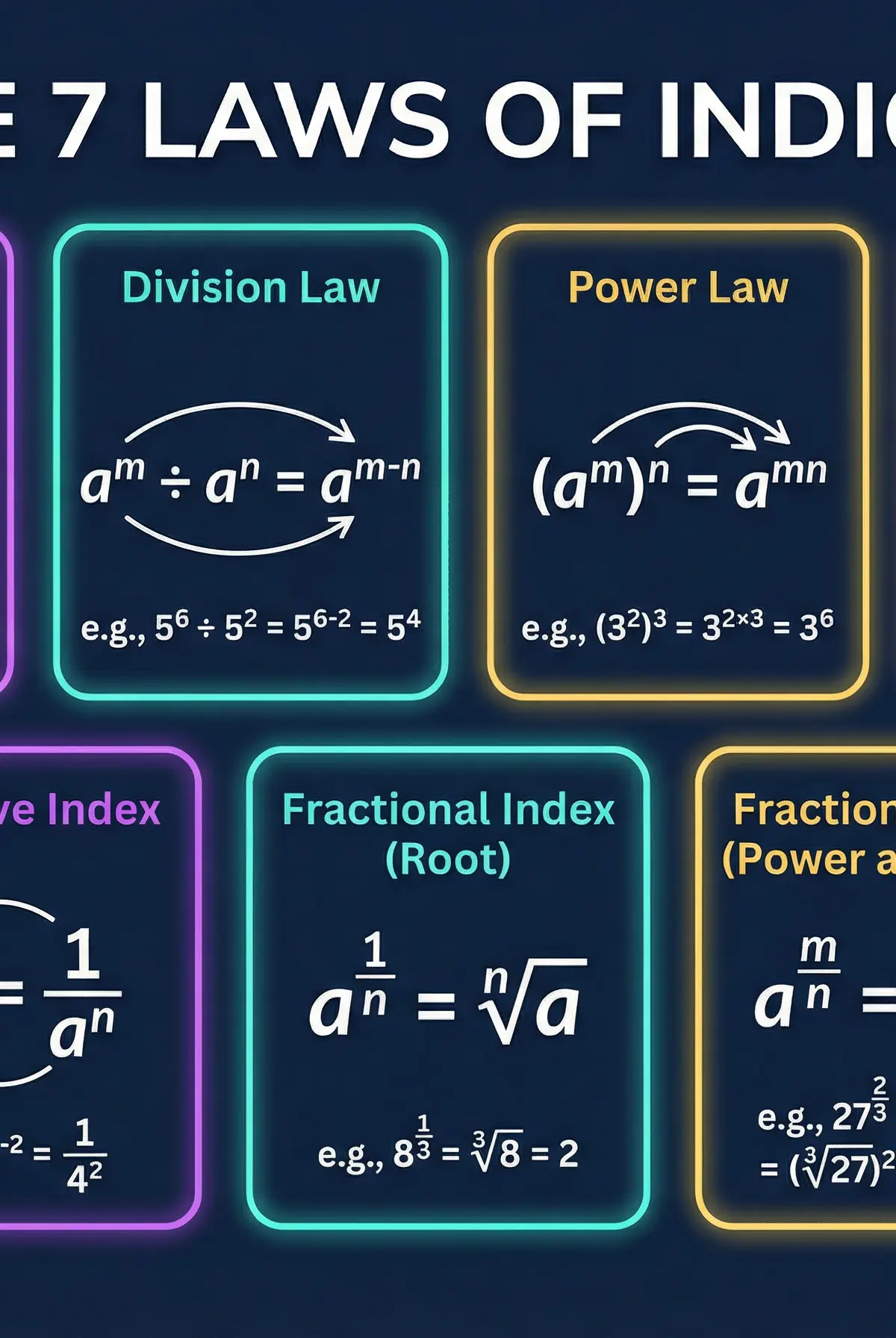
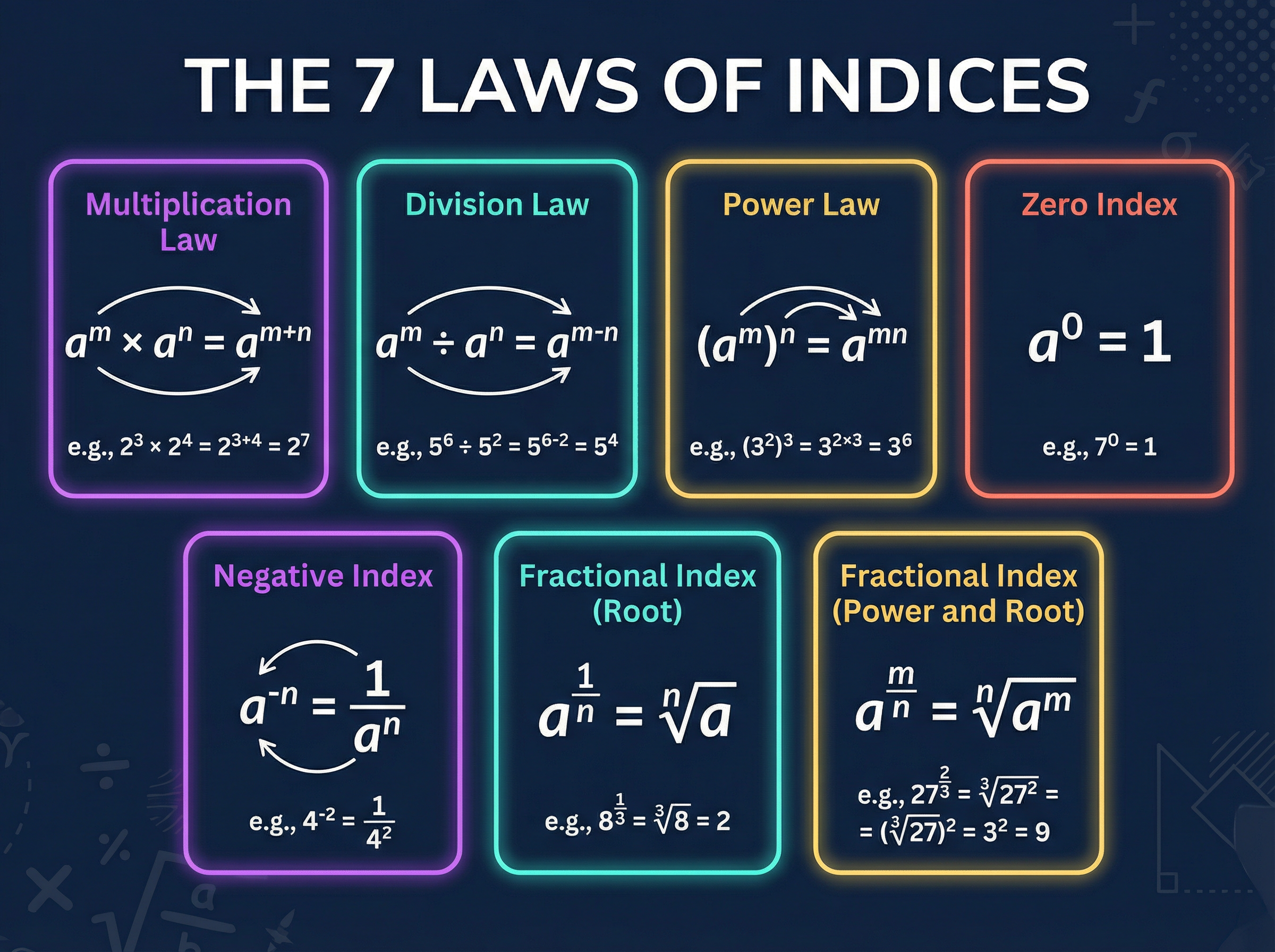
Multiplication Law: a^m \times a^n = a^{m+n}. When multiplying terms with the same base, you add the powers. Why? Because x^2 \times x^3 is (x \times x) \times (x \times x \times x) = x^5.
Division Law: a^m \div a^n = a^{m-n}. When dividing, you subtract the powers. This is effectively cancelling out terms from the numerator and denominator.
Power Law: (a^m)^n = a^{mn}. A power raised to another power means you multiply the indices.
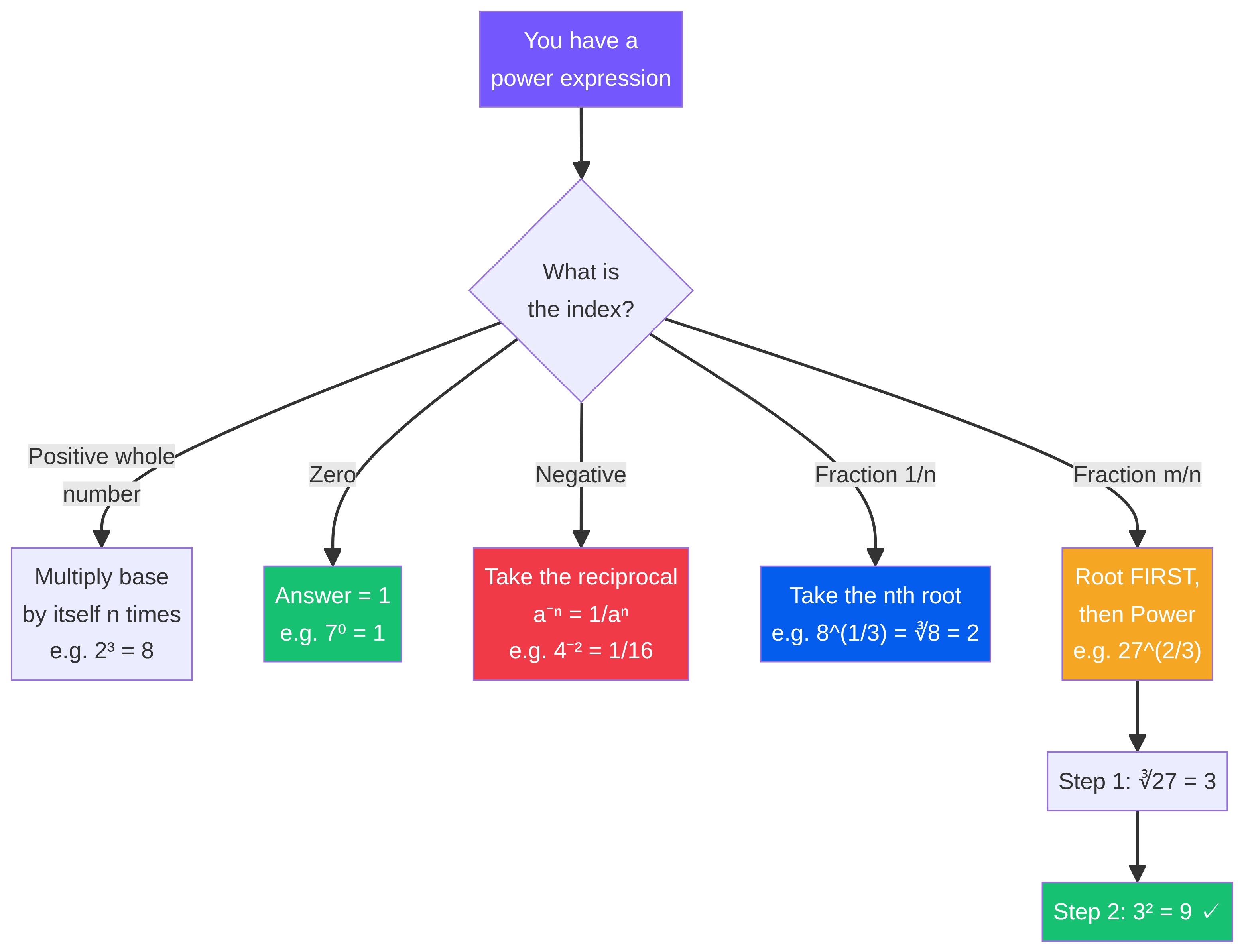
Zero Index: a^0 = 1. Any non-zero number to the power of zero is 1. This follows from the division law: a^n \div a^n = a^{n-n} = a^0, and any number divided by itself is 1.
Negative Index: a^{-n} = \frac{1}{a^n}. A negative power indicates the reciprocal. It does not make the number negative.
Fractional Index (Roots): a^{\frac{1}{n}} = \sqrt[n]{a}. A fractional power with a numerator of 1 represents a root. For example, 16^{\frac{1}{2}} = \sqrt{16} = 4.
Fractional Index (Power and Root): a^{\frac{m}{n}} = (\sqrt[n]{a})^m. The denominator tells you the root, and the numerator tells you the power. Always calculate the root first to keep numbers manageable.
Example: Evaluate 8^{\frac{2}{3}}.
First, find the cube root of 8, which is 2. Then, square the result: 2^2 = 4.
Concept 2: Understanding and Simplifying Surds
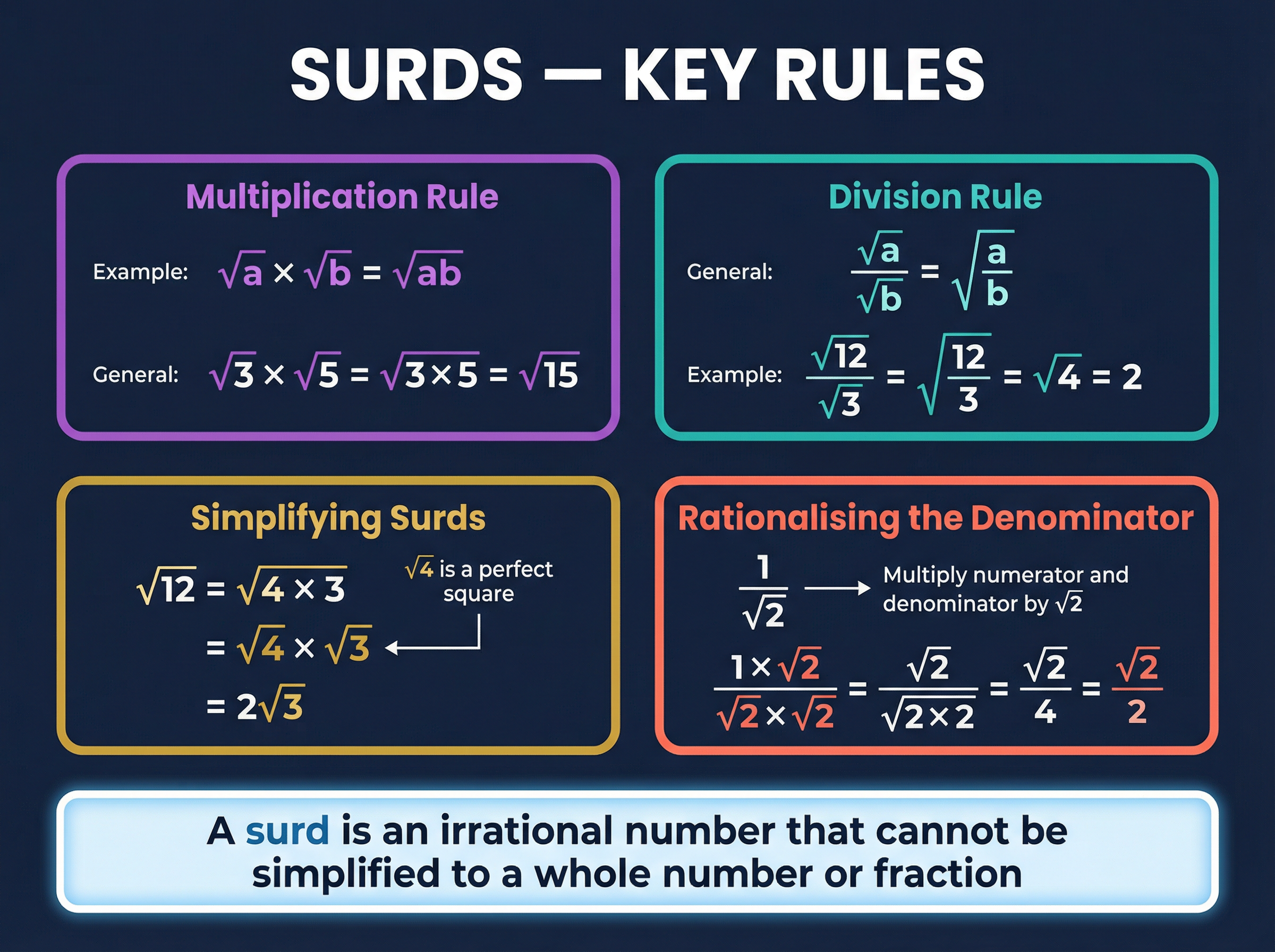
A surd is an irrational number expressed as a root, such as \sqrt{2} or \sqrt{3}. They are left in root form to maintain absolute precision, avoiding the rounding errors of decimals.
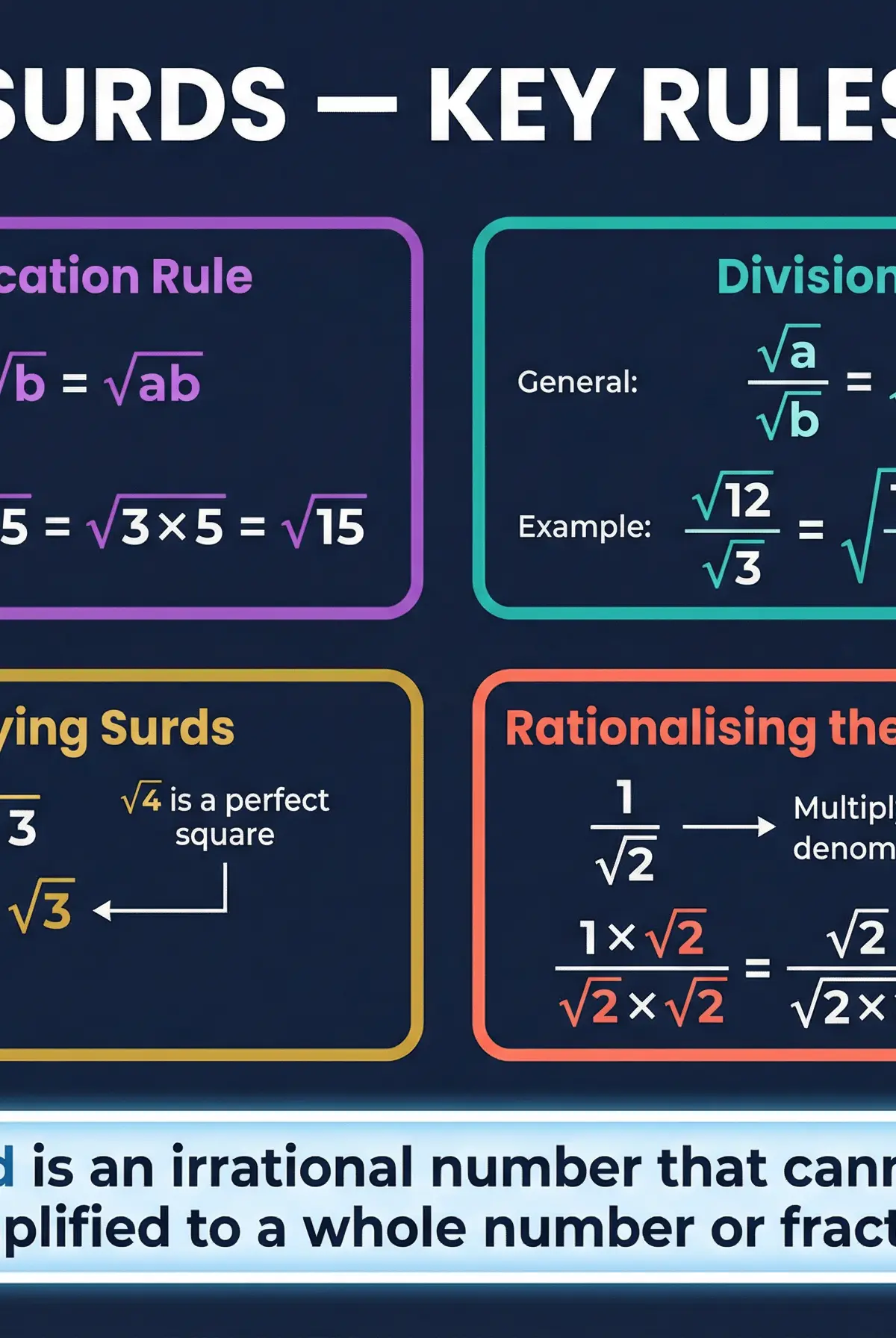
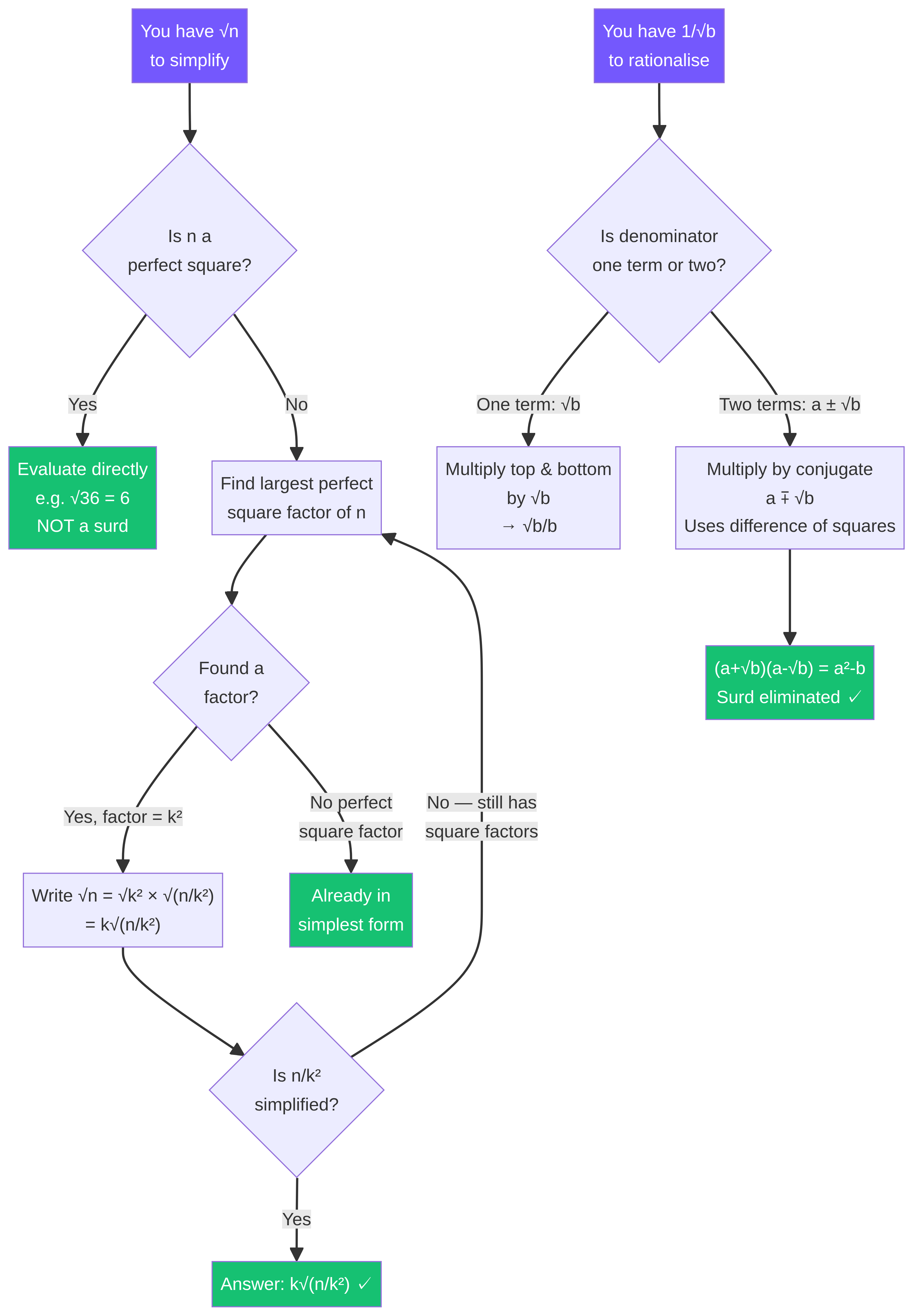
To simplify a surd, you must find the largest perfect square factor of the number under the root.
Example: Simplify \sqrt{72}.
The perfect square factors of 72 are 4, 9, and 36. We choose the largest, 36.
\sqrt{72} = \sqrt{36 \times 2} = \sqrt{36} \times \sqrt{2} = 6\sqrt{2}.
Concept 3: Rationalising the Denominator
In mathematics, it is conventional to remove surds from the denominator of a fraction. This process is called rationalising the denominator.
If the denominator is a single surd (e.g., \frac{a}{\sqrt{b}}), multiply the numerator and the denominator by \sqrt{b}.
If the denominator is a binomial containing a surd (e.g., \frac{1}{a + \sqrt{b}}), you must multiply the numerator and denominator by the conjugate of the denominator (a - \sqrt{b}). This utilizes the difference of two squares identity: (a + \sqrt{b})(a - \sqrt{b}) = a^2 - b, effectively eliminating the surd.
Example: Rationalise \frac{3}{2 - \sqrt{5}}.
Multiply top and bottom by the conjugate, 2 + \sqrt{5}:
\frac{3(2 + \sqrt{5})}{(2 - \sqrt{5})(2 + \sqrt{5})} = \frac{6 + 3\sqrt{5}}{4 - 5} = \frac{6 + 3\sqrt{5}}{-1} = -6 - 3\sqrt{5}.
Mathematical Relationships
- Difference of Two Squares: (a+b)(a-b) = a^2 - b^2. Crucial for rationalising complex denominators.
- Surd Multiplication: \sqrt{a} \times \sqrt{b} = \sqrt{ab}.
- Surd Division: \frac{\sqrt{a}}{\sqrt{b}} = \sqrt{\frac{a}{b}}.
Practical Applications
While pure mathematics, exact values (surds) are essential in physics and engineering where cumulative rounding errors can lead to catastrophic failures. For instance, calculating the diagonal of a square using Pythagoras' theorem yields a surd (e.g., \sqrt{2} for a 1x1 square). Keeping this exact is vital in architectural design software.
Visual Resources
4 diagrams and illustrations
Interactive Diagrams
2 interactive diagrams to visualise key concepts
Conceptual Flow Outline
Decision flowchart for evaluating indices
Conceptual Flow Outline
Process for simplifying surds
Worked Examples
3 worked examples — open one to explore the question and available guidance.
Practice Questions
Test your understanding — click to reveal model answers
Simplify x^5 \times x^3 \div x^2.
Hint: Apply the multiplication law first, then the division law.
Evaluate 64^{\frac{1}{3}}.
Hint: What does a fractional index of 1/3 represent?
Simplify \sqrt{48} + \sqrt{12}.
Hint: Find the largest perfect square factor for each number under the root.
Evaluate (\frac{8}{27})^{-\frac{2}{3}}.
Hint: Flip the fraction to remove the negative index, then apply the root, then the power.
Rationalise the denominator of \frac{5}{3 - \sqrt{2}}.
Hint: Multiply numerator and denominator by the conjugate.