OCR · GCSE · Mathematics
Mensuration
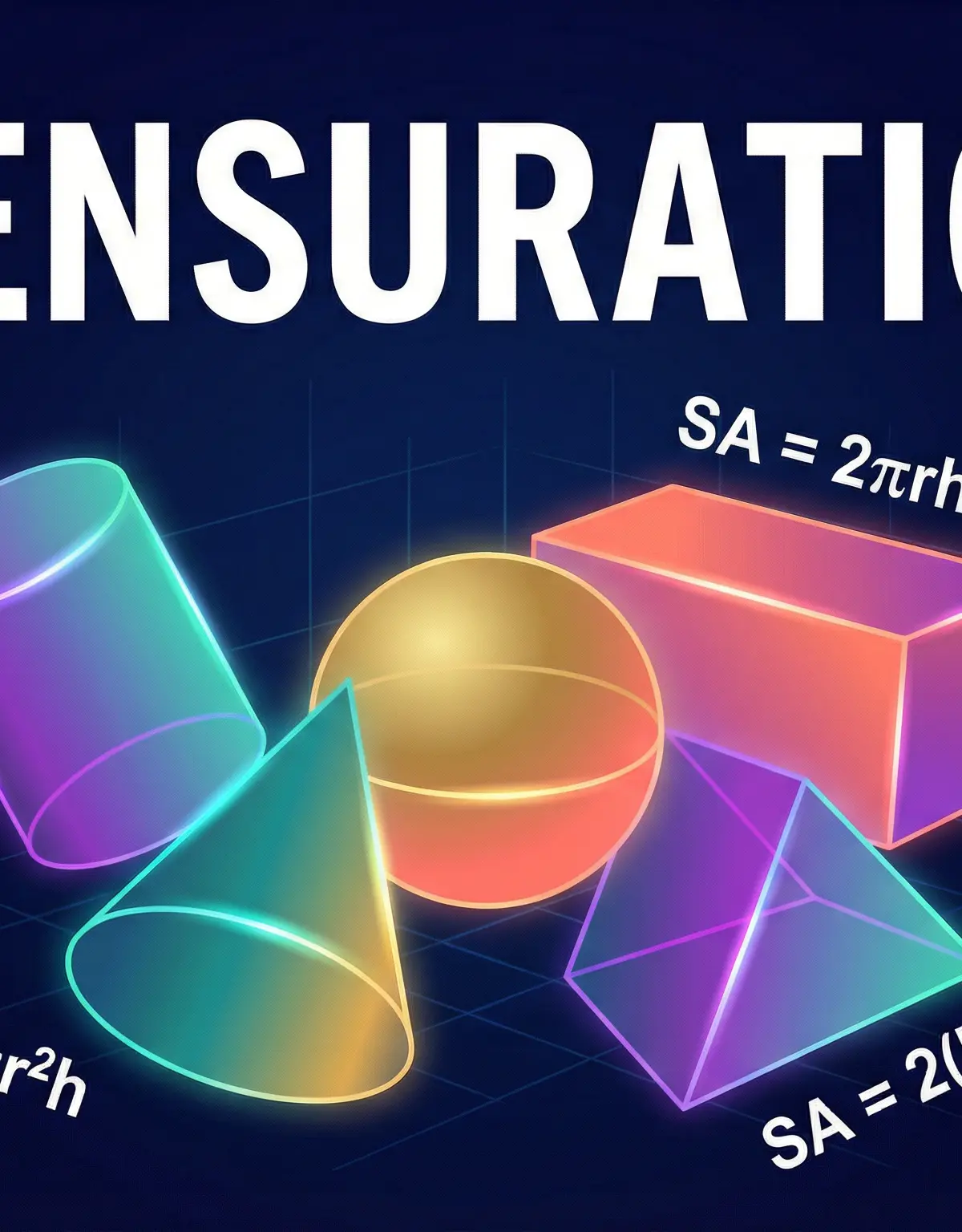
Mensuration is the mathematics of measuring shapes — from calculating the perimeter of a 2D field to finding the volume of a 3D sphere. It is a cornerstone of the GCSE Mathematics specification, appearing in almost every paper, and mastering these formulas guarantees reliable, accessible marks.
- 6 min read
- 3 worked examples
- 5 practice questions
- 6 key terms
Study Notes
Overview
Mensuration is the branch of geometry that deals with the measurement of length, area, and volume. In the context of GCSE Mathematics, it is one of the most reliably assessed topics across all exam boards, appearing in both calculator and non-calculator papers. It is fundamentally important because it bridges abstract algebraic formulas with real-world spatial reasoning.
Examiners use mensuration questions to test your ability to select the correct formula, substitute values accurately, and manipulate units. The topic connects heavily with algebra (rearranging formulas), ratio and proportion (similar shapes), and trigonometry (finding missing lengths before calculating area). Typical exam questions range from straightforward 2-mark area calculations on the Foundation tier to complex 6-mark multi-step problems involving frustums or composite 3D solids on the Higher tier.

Key Concepts
Concept 1: Perimeter and Circumference
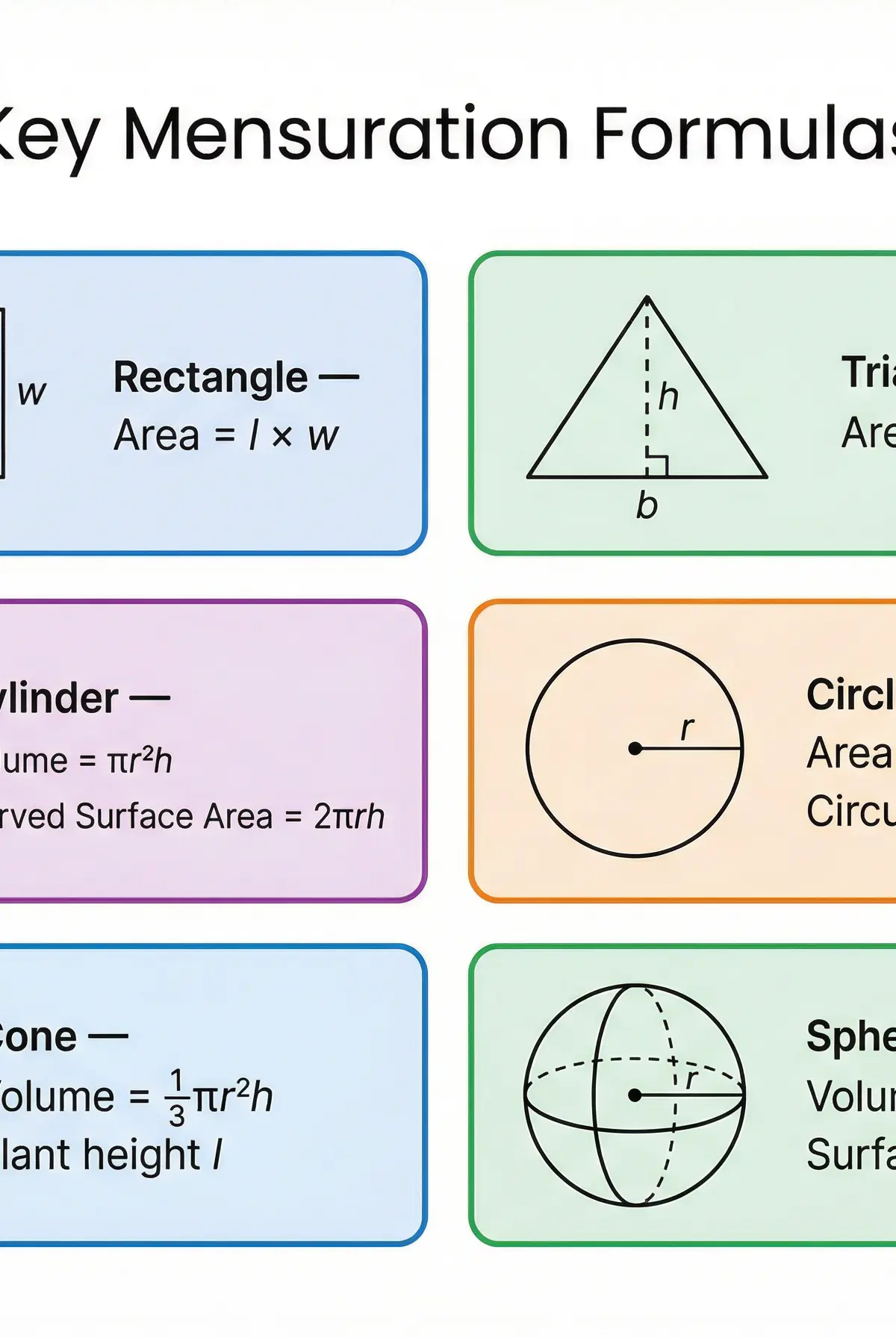
The perimeter is the total continuous distance around the outside boundary of a two-dimensional shape. For polygons with straight edges, you simply sum the lengths of all the sides. For a circle, this boundary is called the circumference. The relationship between a circle's circumference and its diameter is constant — it is always exactly \pi (approximately 3.14159).
This means that if you take the diameter of any circle and multiply it by \pi, you will get its circumference. This works universally, whether you are measuring a coin or a planet.
Example: A circular pond has a diameter of 12m. Its circumference is \pi \times 12 = 12\pi metres. If the question asks for 3 significant figures, this is 37.7m.
Concept 2: Area of 2D Shapes
Area measures the amount of two-dimensional space enclosed within a boundary. We measure this in square units (e.g., cm², m²). The fundamental principle of area is that most shapes can be related back to a rectangle.
For a triangle, the area is exactly half that of a rectangle with the same base and height. This is why the formula is \frac{1}{2} \times \text{base} \times \text{perpendicular height}. The height must be perpendicular (at exactly 90 degrees) to the base. Using the slanted edge of a triangle instead of the vertical height is a classic error that examiners frequently penalize.
Concept 3: Volume of 3D Solids
Volume measures the amount of three-dimensional space an object occupies, measured in cubic units (e.g., cm³, m³). For prisms (shapes with a constant cross-section throughout their length, like a cylinder or a Toblerone box), the volume is always the area of the cross-section multiplied by the length (or height).
For shapes that taper to a point, like a cone or a pyramid, the volume is exactly one-third of the volume of the corresponding prism. Therefore, the volume of a cone is \frac{1}{3}\pi r^2 h.
Example: A cylinder has a radius of 5cm and a height of 10cm. Its volume is \pi \times 5^2 \times 10 = 250\pi cm³.
Concept 4: Surface Area
Surface area is the total area of all the exposed faces of a 3D solid. To calculate it, you must conceptually unfold the 3D shape into a flat 2D 'net' and calculate the area of each individual component.
For a cylinder, the net consists of two identical circles (the top and bottom) and one rectangle (the curved surface unrolled). The width of this rectangle is equal to the circumference of the circle (2\pi r), and its height is the height of the cylinder (h). Therefore, the curved surface area is 2\pi rh.
Concept 5: Composite Shapes
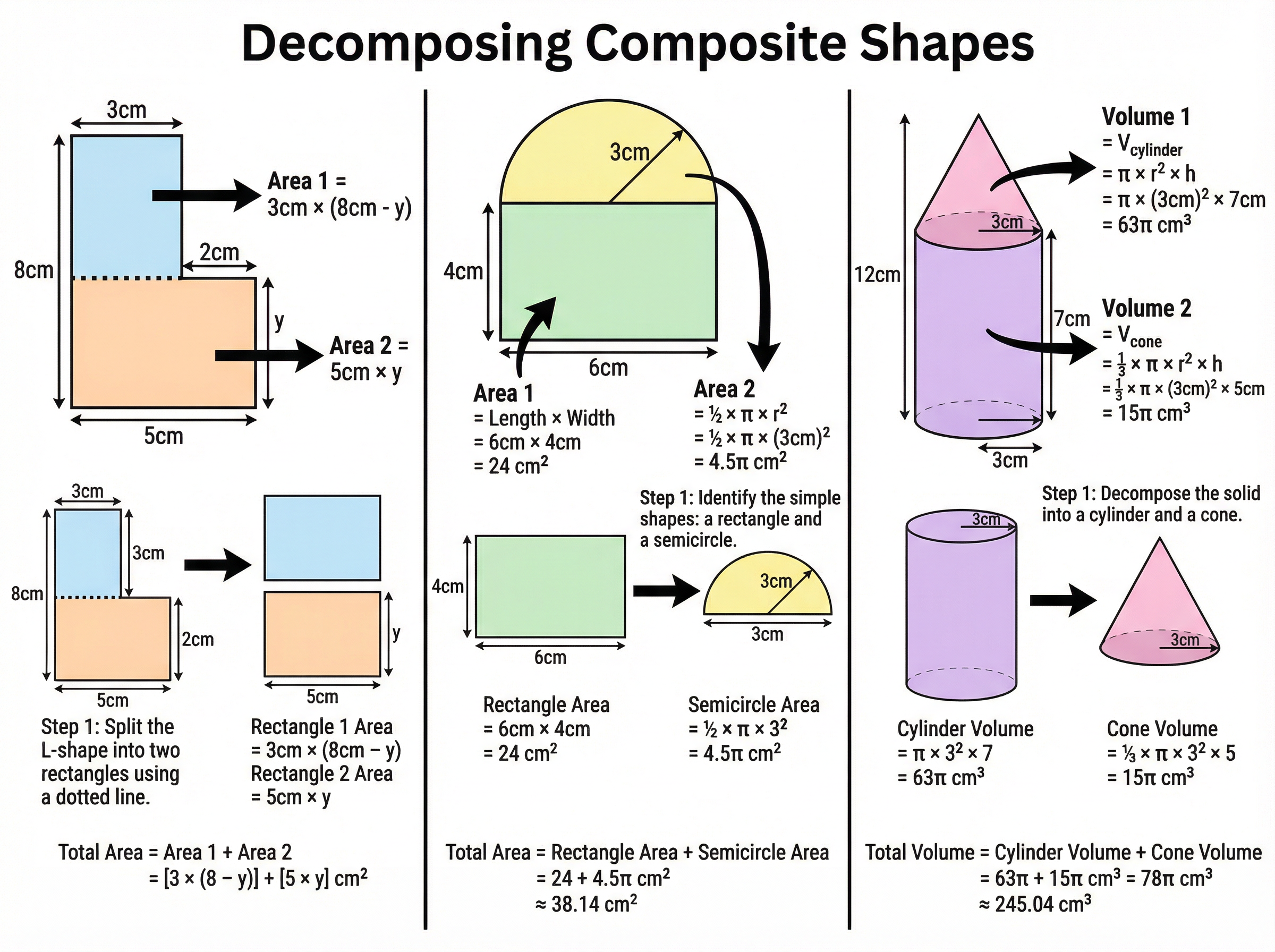
Many higher-mark questions involve composite shapes — complex figures made by joining simpler shapes together. The mathematical strategy is always decomposition. You must break the complex shape down into its fundamental geometric components (rectangles, triangles, semicircles, cylinders, hemispheres), calculate each part separately, and then combine them.
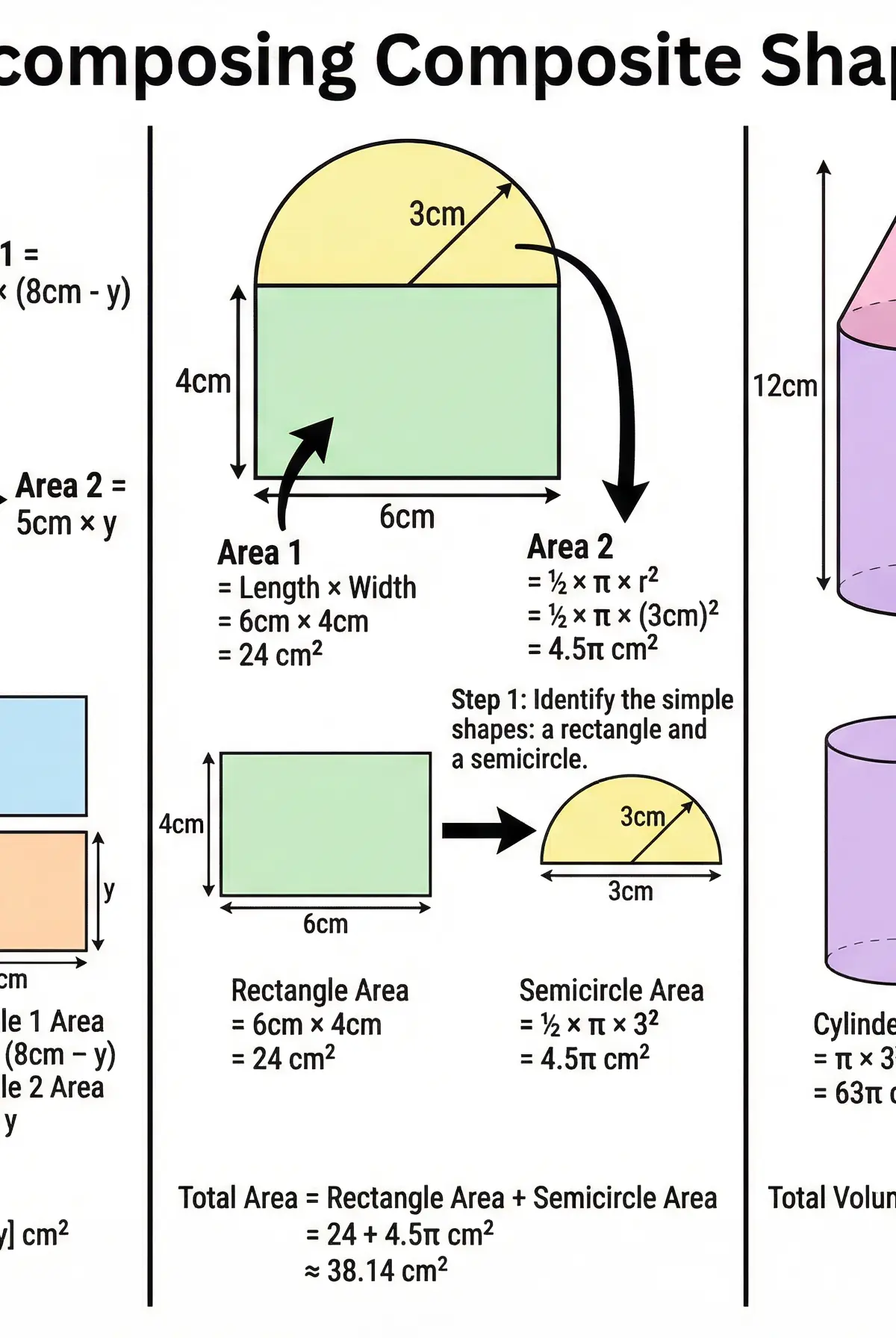
When calculating the volume of a composite solid, you generally add the volumes together. However, when calculating the surface area, you must be extremely careful not to include faces that are hidden where the two shapes join.
Mathematical Relationships and Formulas
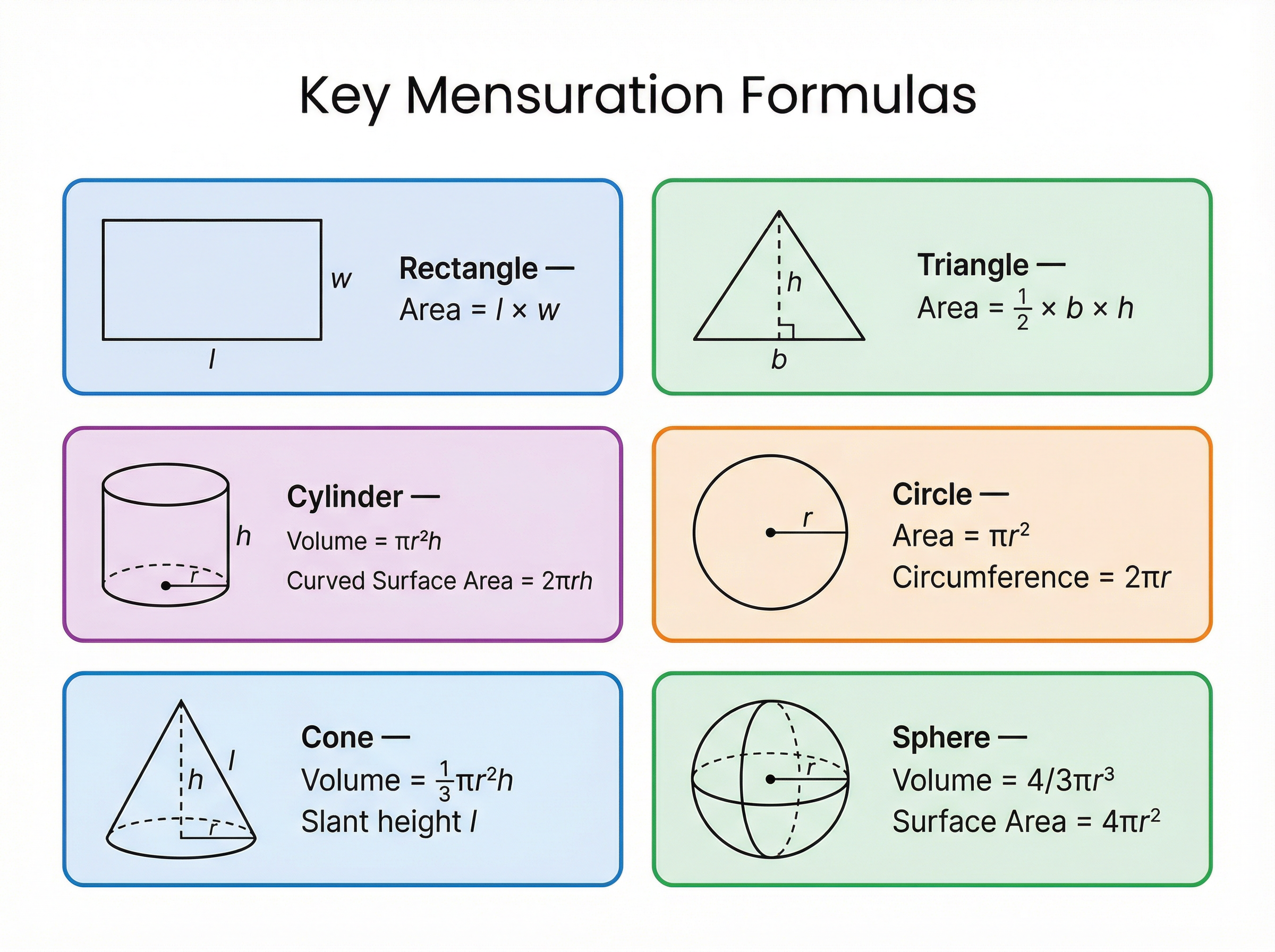
Here are the critical formulas you must know.
Must Memorise:
- Area of Rectangle: A = l \times w
- Area of Triangle: A = \frac{1}{2}bh
- Area of Parallelogram: A = bh
- Area of Trapezium: A = \frac{1}{2}(a+b)h (Often given, but better memorised)
- Circumference of Circle: C = \pi d or C = 2\pi r
- Area of Circle: A = \pi r^2
- Volume of Prism: V = \text{Area of cross-section} \times \text{length}
- Volume of Cylinder: V = \pi r^2 h
Usually Given on Formula Sheet (Check your specific board):
- Volume of Sphere: V = \frac{4}{3}\pi r^3
- Surface Area of Sphere: SA = 4\pi r^2
- Volume of Cone: V = \frac{1}{3}\pi r^2 h
- Curved Surface Area of Cone: CSA = \pi rl (where l is slant height)
Practical Applications
Mensuration is heavily applied in architecture, engineering, and manufacturing. For instance, calculating the surface area of a tin can allows a manufacturer to determine exactly how much sheet metal is required to produce 10,000 units, directly impacting cost. Calculating the volume of a cylindrical tank is essential for determining its fluid capacity in litres (noting the critical conversion: 1000 cm³ = 1 Litre).
Visual Resources
2 diagrams and illustrations
Interactive Diagrams
2 interactive diagrams to visualise key concepts
Conceptual Flow Outline
Decision flowchart for selecting the correct mensuration formula.
Conceptual Flow Outline
Step-by-step exam approach for mensuration calculation questions.
Worked Examples
3 worked examples — open one to explore the question and available guidance.
Practice Questions
Test your understanding — click to reveal model answers
A circle has a diameter of 14 cm. Calculate the area of the circle. Give your answer to 3 significant figures.
Hint: Remember to halve the diameter first to find the radius.
A solid prism has a cross-section in the shape of a trapezium. The parallel sides of the trapezium are 8 cm and 12 cm, and the perpendicular height is 5 cm. The length of the prism is 20 cm. Calculate the volume of the prism.
Hint: Find the area of the trapezium cross-section first, then multiply by the length.
A cone has a base radius of 5 cm and a perpendicular height of 12 cm. Calculate the total surface area of the cone. Give your answer to 1 decimal place.
Hint: You need the slant height ($l$) for the curved surface area. Use Pythagoras' theorem with the radius and perpendicular height to find it.
A solid is made by attaching a solid hemisphere to the flat circular face of a solid cone. The radius of the hemisphere and the base of the cone are both 6 cm. The total height of the solid is 14 cm. Work out the exact volume of the solid in terms of \pi.
Hint: The total height includes the radius of the hemisphere. Subtract the radius from the total height to find the height of the cone.
The volume of a sphere is 36\pi cm³. Calculate the surface area of the sphere. Give your answer in terms of \pi.
Hint: Work backwards from the volume formula to find the radius first. Then substitute that radius into the surface area formula.