OCR · GCSE · Mathematics
Number Operations and Integers
Mastering Fractions, Decimals, and Percentages is the foundation of GCSE Mathematics. This topic unlocks marks across the entire specification, from simple conversions to complex multi-step problem solving with multipliers.
- 6 min read
- 3 worked examples
- 5 practice questions
- 6 key terms
Study Notes
Overview
Number Operations and Integers, specifically the holy trinity of Fractions, Decimals, and Percentages (FDP), forms the bedrock of your GCSE Mathematics specification. This topic is not just about performing isolated calculations; it is about understanding that these three forms are simply different languages describing the exact same proportion of a whole.
Examiners love testing this topic because it inherently links to ratio, proportion, algebra, and statistics. Whether you are calculating the probability of an event, finding the percentage yield in chemistry, or determining compound interest, FDP fluency is non-negotiable. Typical exam questions range from simple 1-mark conversions in Foundation tier to complex 4-mark reverse percentage problems in Higher tier. Mastering this topic ensures you can confidently tackle problems across the entire paper without losing precious method marks to basic arithmetic errors.
Listen to the audio guide below for a comprehensive walk-through of these concepts:

Key Concepts
Concept 1: Fluency in Conversion
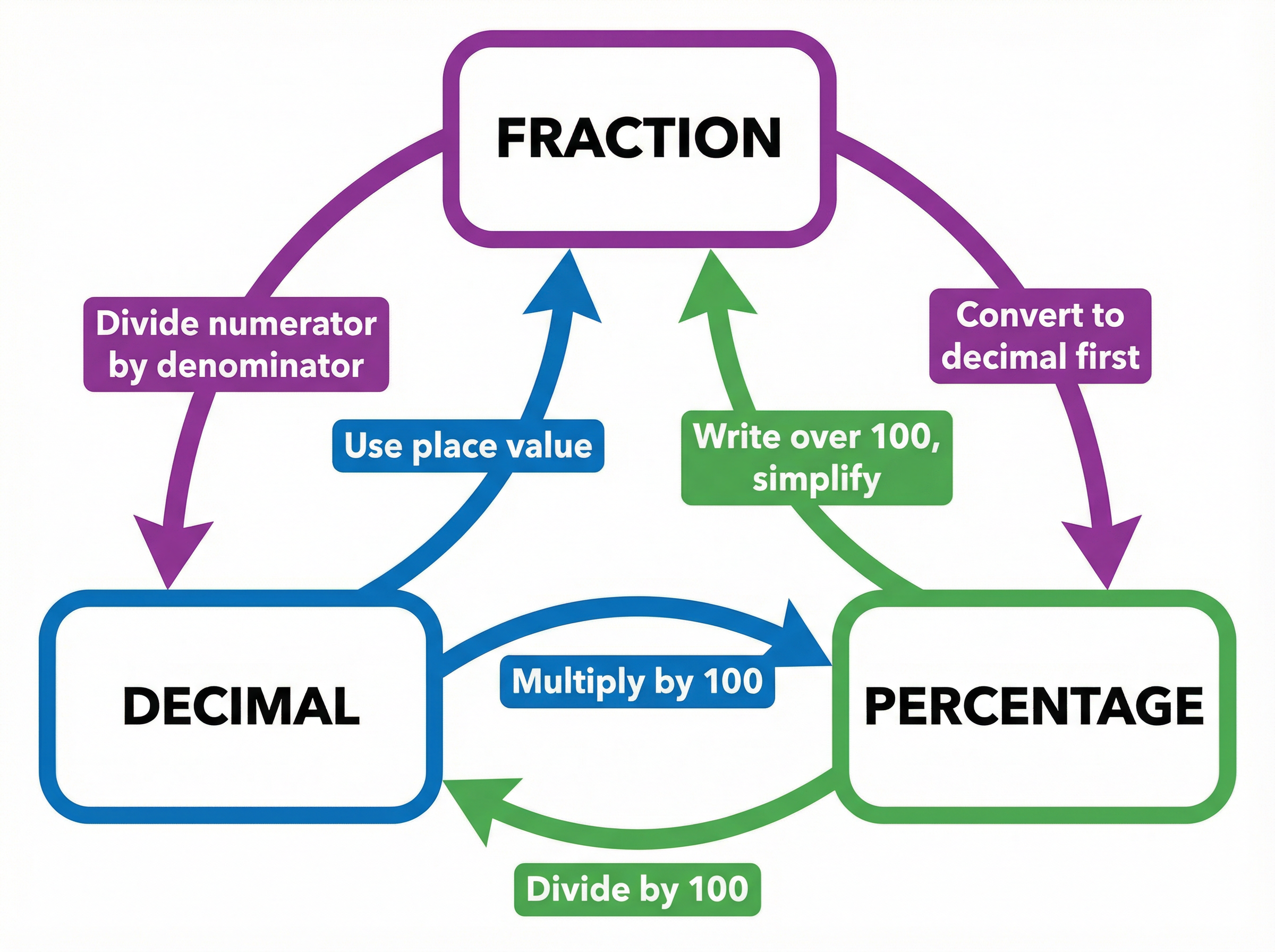
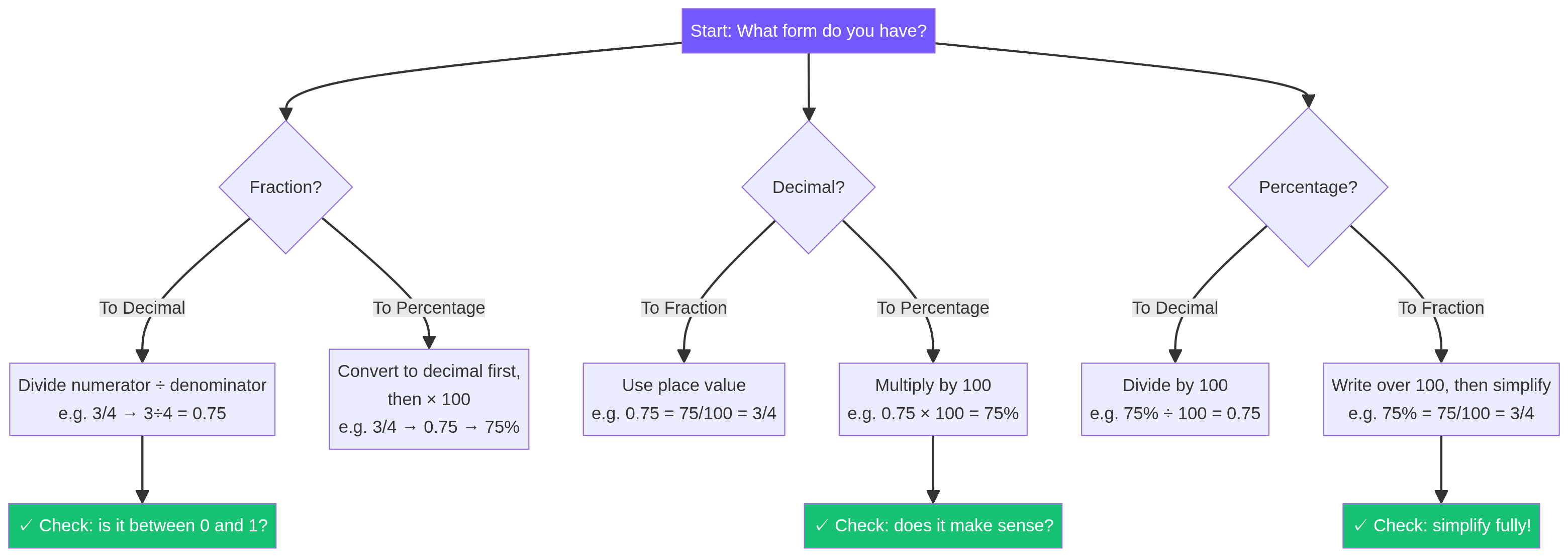
The ability to translate a value between its fraction, decimal, and percentage forms is essential. Think of it as a translation triangle where you must know the rules for moving along any path.
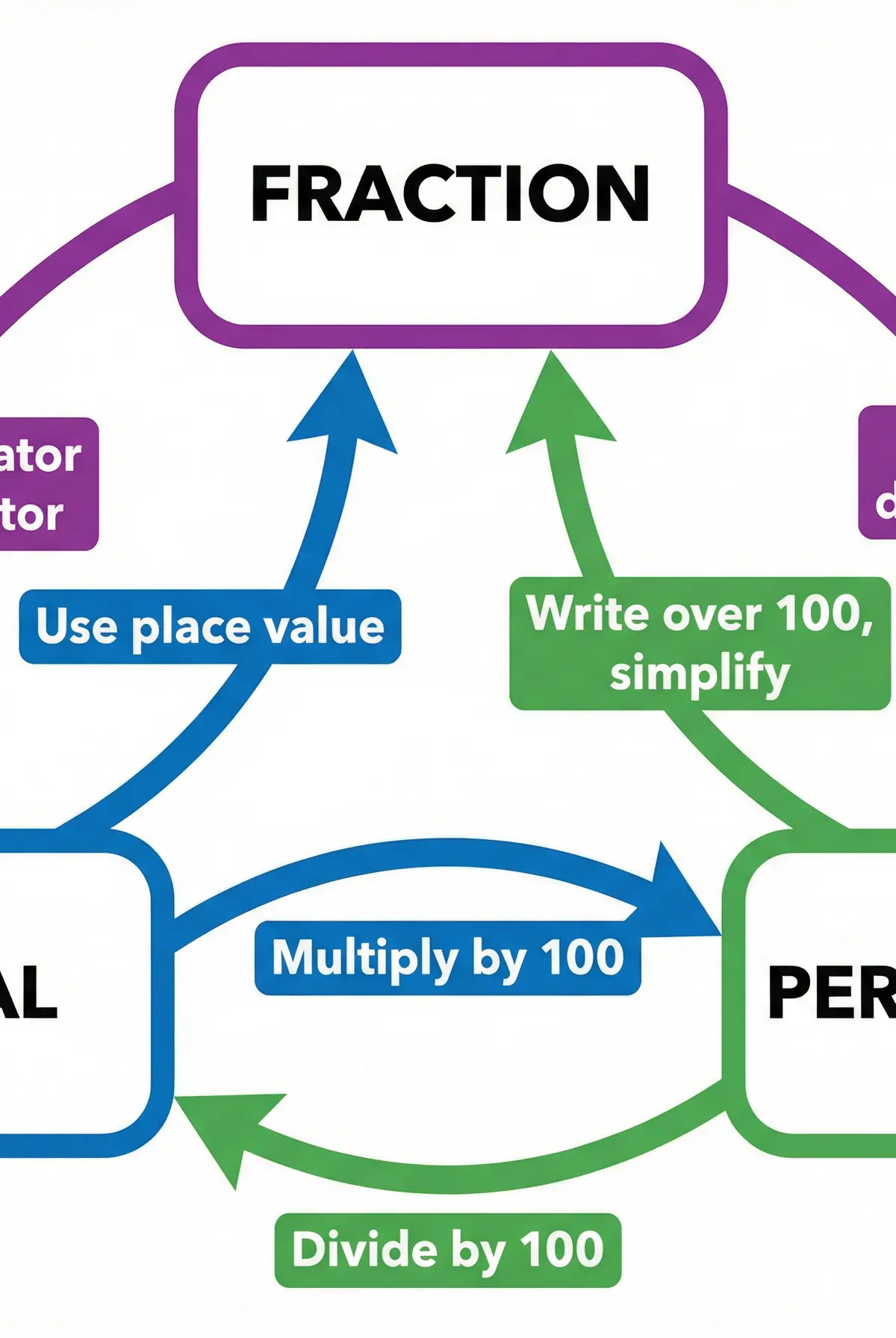
- Fraction to Decimal: Divide the numerator by the denominator. Why? Because the fraction bar literally means "divided by".
- Decimal to Percentage: Multiply by 100. "Percent" means "out of 100", so scaling a decimal (which is out of 1) by 100 gives the percentage.
- Percentage to Fraction: Write the percentage value over 100 and simplify. This directly applies the definition of percentage.
Example: Convert 3/8 to a percentage.
First, convert to a decimal: 3 \div 8 = 0.375. Then multiply by 100: 0.375 \times 100 = 37.5%.
Alternatively, find an equivalent fraction out of 100. Multiply numerator and denominator by 12.5: (3 \times 12.5) / (8 \times 12.5) = 37.5 / 100 = 37.5%.
Concept 2: Ordering Mixed Types
Examiners frequently present a list containing a mixture of fractions, decimals, and percentages, asking you to order them (usually smallest to largest). The golden rule here is to convert all values into the same format before comparing. Decimals are usually the safest and easiest format to use for comparison because place value makes ordering straightforward.
Example: Order the following from smallest to largest: 2/5, 45%, 0.405, 3/8.
Convert to decimals:
- 2/5 = 0.4
- 45% = 0.45
- 0.405 = 0.405
- 3/8 = 0.375
Comparing these: 0.375 < 0.4 < 0.405 < 0.45.
Final answer in original forms: 3/8, 2/5, 0.405, 45%.
Concept 3: Fraction Arithmetic
Performing operations with fractions requires strict adherence to specific rules. This is a common area where candidates drop marks due to confusion between the rules for addition and multiplication.
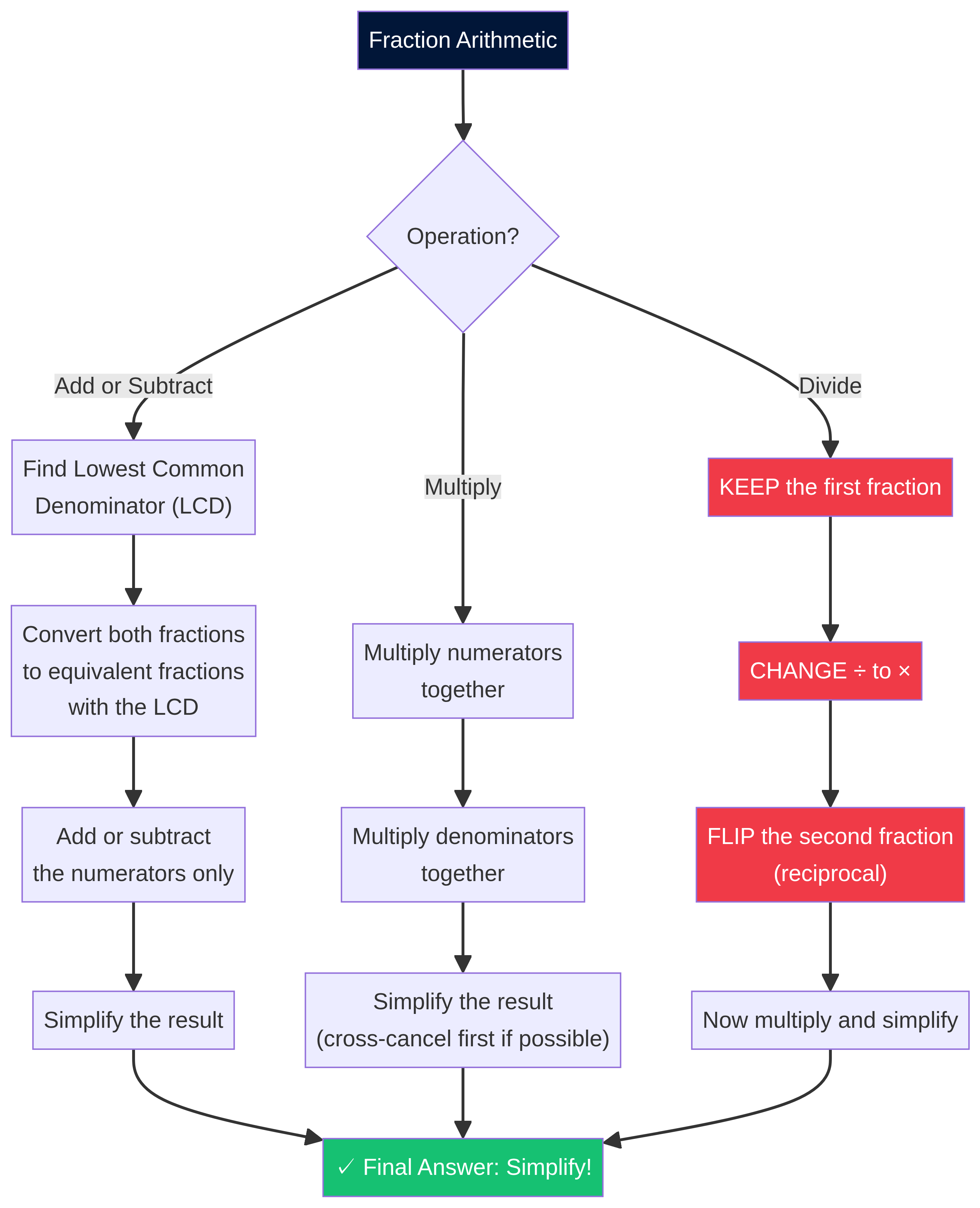
- Addition and Subtraction: You must find a common denominator. This ensures you are adding or subtracting pieces of the same size. Once denominators are equal, operate on the numerators only.
- Multiplication: Multiply the numerators together and the denominators together. Always look to cross-cancel before multiplying to simplify the arithmetic.
- Division: Use the "Keep, Change, Flip" method. Keep the first fraction, change the division sign to multiplication, and flip the second fraction (find its reciprocal).
Concept 4: Percentage Multipliers
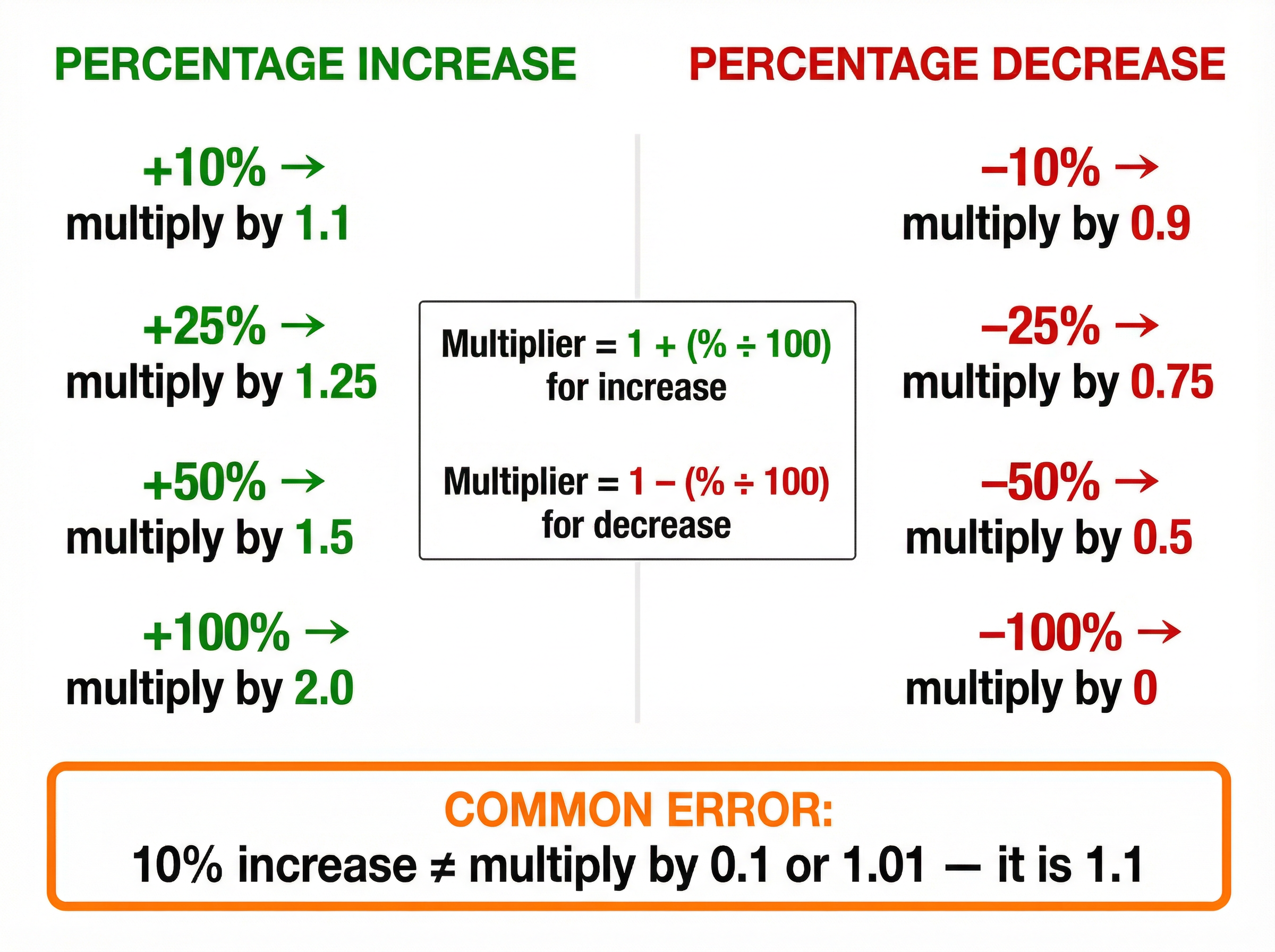
A percentage multiplier is a single decimal value that applies a percentage change in one operation. This is significantly more efficient than calculating the percentage amount and then adding or subtracting it from the original value, and it is essential for compound interest calculations.
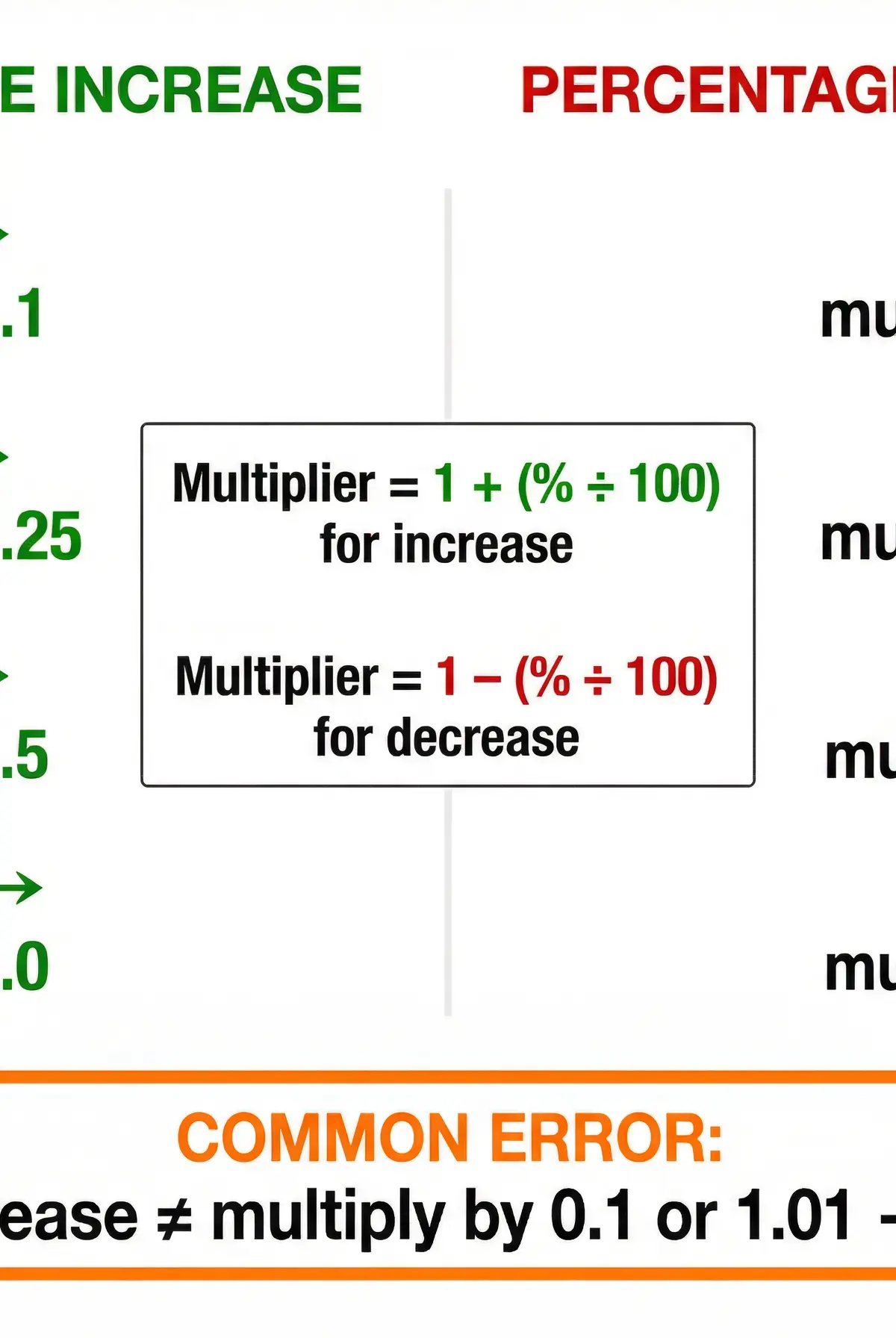
- Percentage Increase: Multiplier = 1 + (% \div 100). For a 15% increase, the multiplier is 1.15.
- Percentage Decrease: Multiplier = 1 - (% \div 100). For a 20% decrease, the multiplier is 0.80.
Example: A car costs £15,000. It depreciates by 12% in its first year. What is its new value?
Multiplier = 1 - 0.12 = 0.88.
New value = 15000 \times 0.88 = \text{\pounds}13,200.
Concept 5: Recurring Decimals to Fractions (Higher Tier)
Converting a recurring decimal to a fraction requires an elegant algebraic method. The goal is to set up two equations where the infinite recurring decimal parts align perfectly, allowing you to subtract one from the other and eliminate the recurring part entirely.
Example: Convert 0.\dot{4}\dot{5} to a fraction in its simplest form.
Let x = 0.454545...
Multiply by 100 to shift the decimal point past the repeating block: 100x = 45.454545...
Subtract the original equation:
100x - x = 45.4545... - 0.4545...
99x = 45
x = 45 / 99
Simplify by dividing numerator and denominator by 9: x = 5/11.
Mathematical/Scientific Relationships
- Percentage Change: \frac{\text{Change}}{\text{Original}} \times 100 (Must memorise)
- Percentage Multiplier (Increase): 1 + \frac{\text{Percentage}}{100} (Must memorise)
- Percentage Multiplier (Decrease): 1 - \frac{\text{Percentage}}{100} (Must memorise)
- Compound Interest: \text{Final Amount} = \text{Principal} \times (\text{Multiplier})^{\text{Time}} (Must memorise)
Practical Applications
- Finance: Calculating VAT, income tax, discounts in sales, and compound interest on savings or loans all rely heavily on percentage multipliers.
- Data Analysis: Interpreting survey results often involves converting raw data (fractions) into percentages to make comparisons meaningful.
- Scaling Recipes: Adjusting a recipe for a different number of people requires multiplying fractions or mixed numbers.
Visual Resources
4 diagrams and illustrations
Interactive Diagrams
2 interactive diagrams to visualise key concepts
Conceptual Flow Outline
Flowchart detailing the conversion pathways between fractions, decimals, and percentages.
Conceptual Flow Outline
Decision tree for selecting the correct method when performing arithmetic with fractions.
Worked Examples
3 worked examples — open one to explore the question and available guidance.
Practice Questions
Test your understanding — click to reveal model answers
Convert 0.35 to a fraction in its simplest form.
Hint: What place value does the '5' sit in?
Calculate 45% of £80.
Hint: You can find $10\%$ and $5\%$ first, or use a decimal multiplier.
A population of bacteria increases by 15% every hour. If the initial population is 4000, calculate the population after 3 hours. Give your answer to the nearest whole number.
Hint: This is repeated percentage change. Use a multiplier to a power.
Work out \frac{4}{5} \div \frac{2}{3}. Give your answer as a mixed number.
Hint: Keep, Change, Flip.
In a sale, normal prices are reduced by 18%. The sale price of a computer is £451. Work out the normal price.
Hint: The sale price represents what percentage of the original price?