OCR · GCSE · Mathematics
Ratio, Proportion and Rates Of Change
Mastering fractions, decimals, and percentages is the key to unlocking higher grades in GCSE Mathematics. This topic is heavily examined across all boards and forms the foundation for solving complex multi-step problems in finance, geometry, and probability.
- 5 min read
- 3 worked examples
- 5 practice questions
- 6 key terms
Study Notes
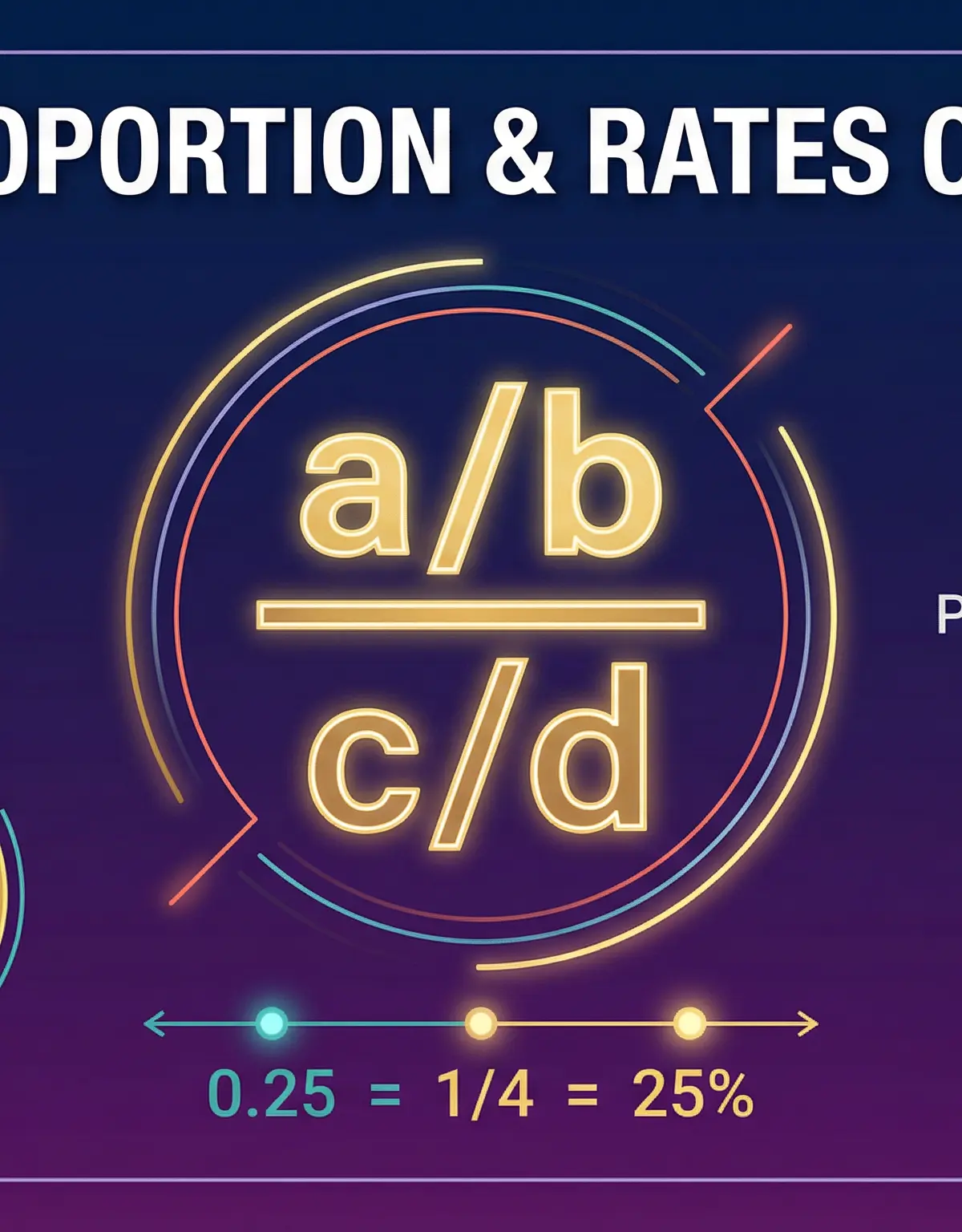
Overview
Welcome to one of the most critical topics in your GCSE Mathematics specification: Ratio, Proportion, and Rates of Change. This section focuses specifically on the holy trinity of numbers—fractions, decimals, and percentages. Why does this matter? Because examiners love to test your fluency in moving between these forms. It's not just about answering dedicated percentage questions; these skills are synoptic. You will need them for compound interest, probability, pie charts, and even algebraic fractions.
Typically, questions on this topic range from straightforward 1-mark conversions to complex 5-mark problem-solving scenarios involving repeated percentage change. The difference between a Grade 5 and a Grade 7 often comes down to one thing: using percentage multipliers efficiently instead of relying on slow, multi-step addition and subtraction methods.
Listen to the companion podcast for this topic below:

Key Concepts
Concept 1: The Three Languages of Number
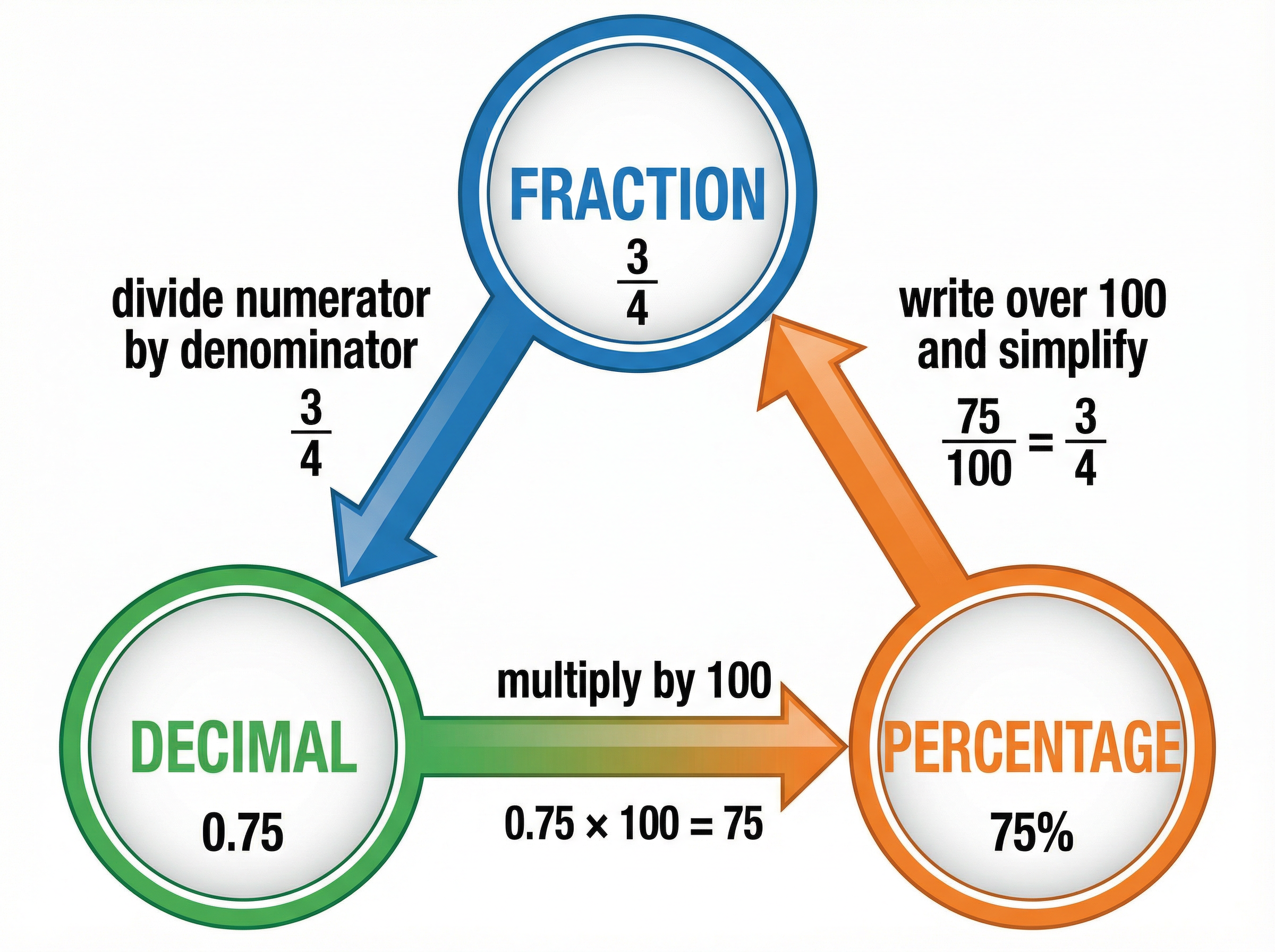
Fractions, decimals, and percentages are simply three different ways of writing the exact same value. Think of them as English, French, and Spanish—different words, same meaning. Examiners test your ability to translate between them seamlessly.
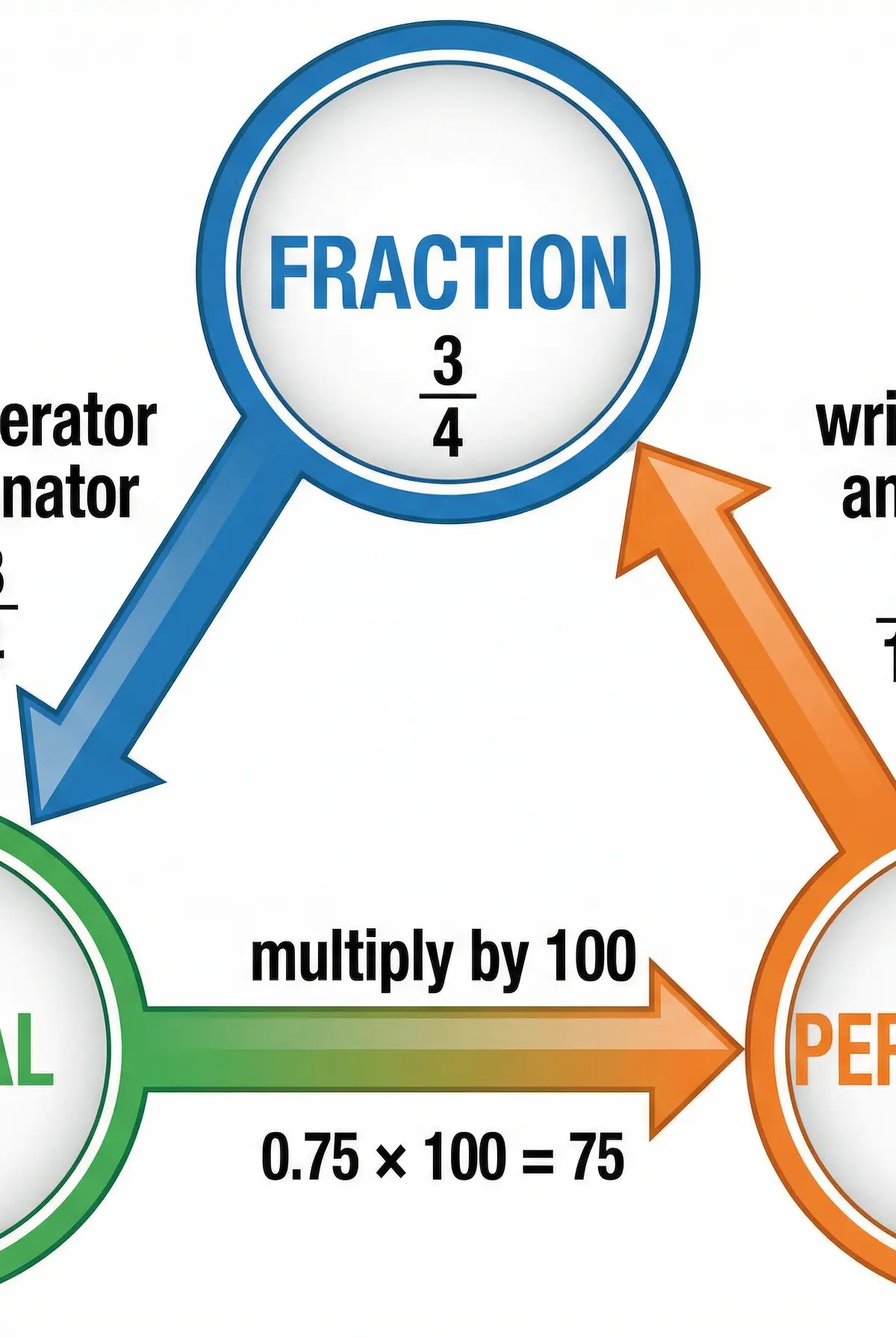
- Fractions to Decimals: Divide the numerator (top) by the denominator (bottom). For example, 3 \div 4 = 0.75.
- Decimals to Percentages: Multiply by 100. For example, 0.75 \times 100 = 75%.
- Percentages to Fractions: Write the percentage over 100 and simplify. For example, 75% becomes \frac{75}{100}, which simplifies to \frac{3}{4}.
Examiner Tip: A common error is converting 5% to a decimal. Many candidates write 0.5 (which is 50%). Remember, 5 \div 100 = 0.05.
Concept 2: Ordering Mixed Types
When faced with a list of numbers in different formats (e.g., \frac{2}{5}, 0.45, 42%), the golden rule is: convert everything to decimals first. Decimals are the easiest format to compare because of clear place value.
Example: Order \frac{3}{8}, 0.35, and 38% from smallest to largest.
- Convert \frac{3}{8}: 3 \div 8 = 0.375
- Convert 38% to a decimal: 0.38
- We now have: 0.375, 0.35, and 0.38.
- Ordering them: 0.35, 0.375, 0.38.
- Final answer in original format: 0.35, \frac{3}{8}, 38%.
Concept 3: Percentage Multipliers (The Game Changer)
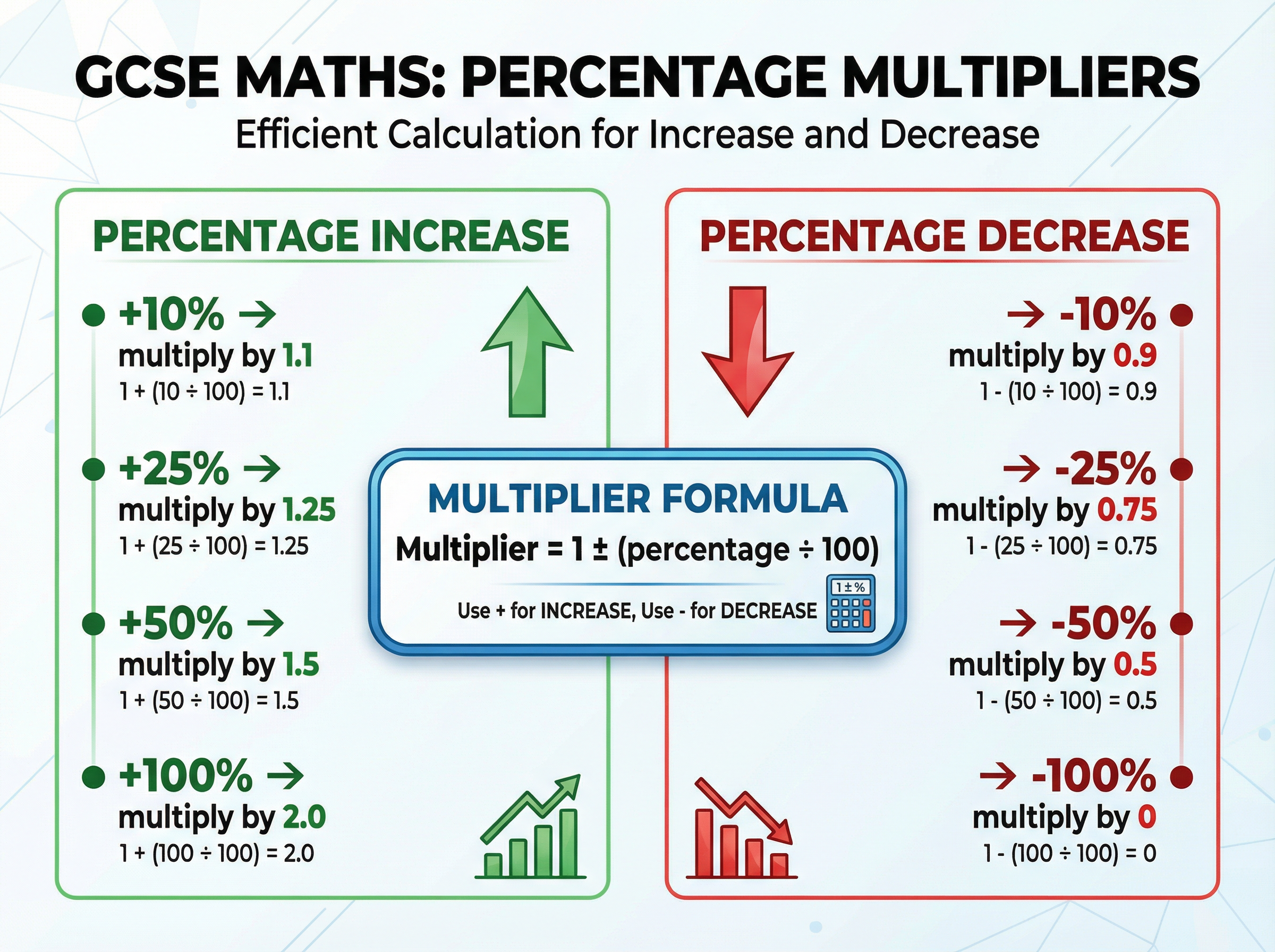
This is the most powerful tool in your GCSE Maths toolkit. A multiplier is a single decimal number that applies a percentage change in one swift calculation.
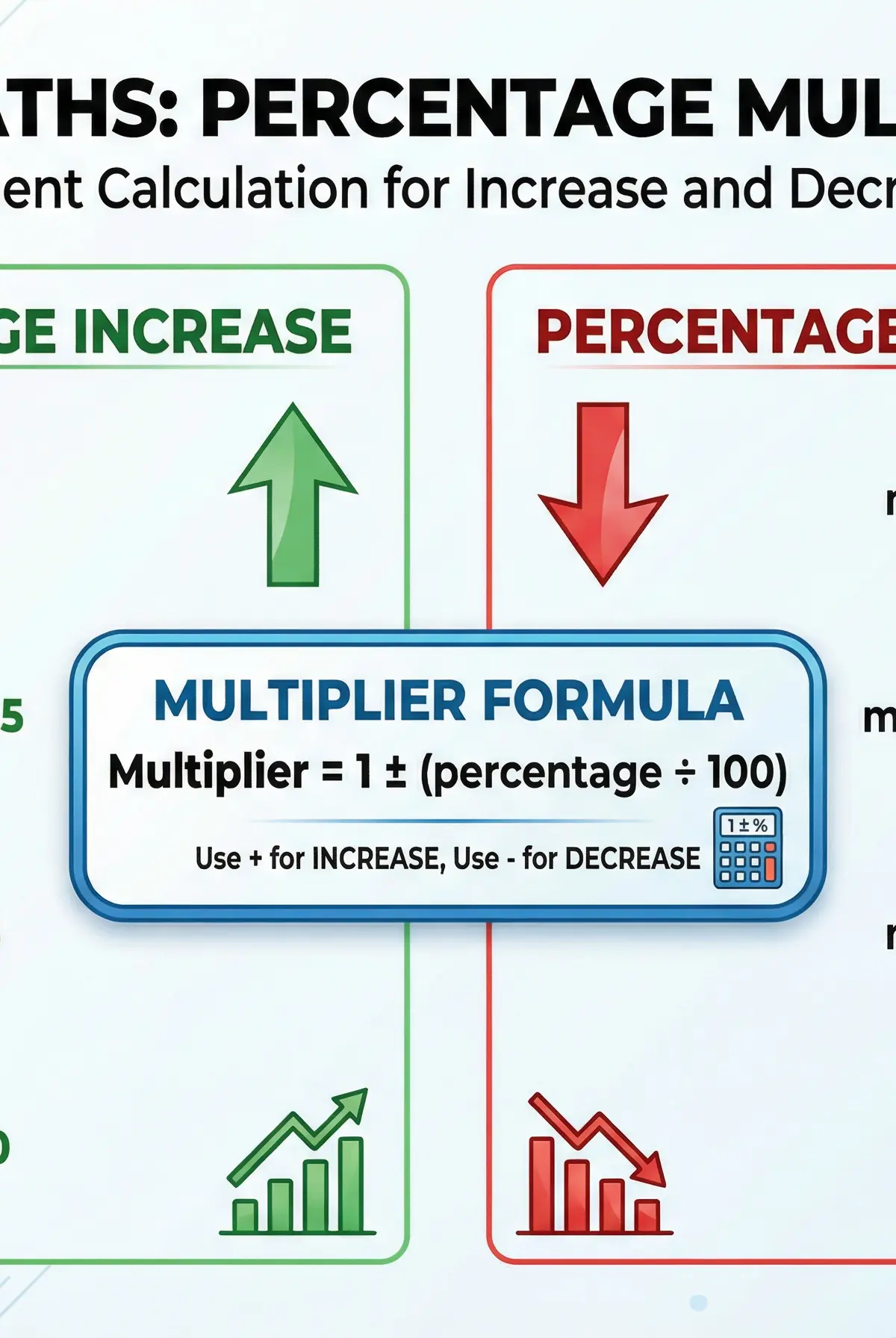
- For an Increase: Add the percentage to 100%, then convert to a decimal. (e.g., a 15% increase means you have 115%, so the multiplier is 1.15).
- For a Decrease: Subtract the percentage from 100%, then convert to a decimal. (e.g., a 20% decrease means you have 80% left, so the multiplier is 0.80).
Why this works: Instead of finding the percentage and then adding or subtracting it (a two-step process where errors often occur), you scale the original amount directly.
Concept 4: Reverse Percentages
This is where many candidates drop marks. A reverse percentage question gives you the new amount after a change and asks for the original amount. You cannot simply apply the percentage change in reverse. You must use algebraic thinking or inverse operations with multipliers.
Example: A shirt is on sale for £34 after a 15% discount. What was the original price?
- Let the original price be x.
- The multiplier for a 15% decrease is 0.85.
- Therefore, x \times 0.85 = 34.
- To find x, divide: x = 34 \div 0.85 = 40.
- The original price was £40.
Mathematical Relationships
- Multiplier Formula: \text{Multiplier} = 1 \pm \left(\frac{\text{Percentage Change}}{100}\right)
- Percentage Change Formula: \frac{\text{Change}}{\text{Original}} \times 100
- Compound Interest Formula: \text{Final Amount} = \text{Initial Amount} \times \text{Multiplier}^{\text{Years}}
Practical Applications
These skills are used daily in the real world. Calculating VAT on a purchase, determining the best mortgage rate, figuring out if a "Buy One Get One Half Price" deal is better than "30% Off", or calculating the depreciation of a car's value over time all rely on mastering fractions, decimals, and percentages.
Interactive Diagrams
2 interactive diagrams to visualise key concepts
Conceptual Flow Outline
Decision tree for tackling percentage questions in the exam.
Conceptual Flow Outline
Visualising how percentage multipliers are formed.
Worked Examples
3 worked examples — open one to explore the question and available guidance.
Practice Questions
Test your understanding — click to reveal model answers
Convert 0.08 to a fraction in its simplest form.
Hint: Remember that the second decimal place represents hundredths.
A shop has a sale. Everything is reduced by 15%. The normal price of a TV is £340. Work out the sale price of the TV.
Hint: What is the multiplier for a 15% reduction?
Katie invests £2000 in a savings account for 4 years. The account pays compound interest at a rate of 2.5% per annum. Calculate the total amount in the account at the end of 4 years.
Hint: Use the compound interest formula with a power.
The price of a train ticket increases by 8% to £135. Work out the price of the ticket before the increase.
Hint: This is a reverse percentage question. You need to divide by the multiplier.
Prove algebraically that the recurring decimal 0.27̇ (where the 7 is recurring) can be written as 5/18.
Hint: Let x = 0.2777... Multiply by 10 and by 100 to get two equations with the same decimal part.