OCR · GCSE · Mathematics
Statistics
Master the essential trio of Fractions, Decimals, and Percentages (FDP) — a fundamental topic that underpins almost every GCSE Maths paper. This guide breaks down conversions, percentage multipliers, and ordering mixed types, ensuring you can fluently switch between forms to secure maximum marks.
- 5 min read
- 3 worked examples
- 5 practice questions
- 6 key terms
Study Notes
Overview
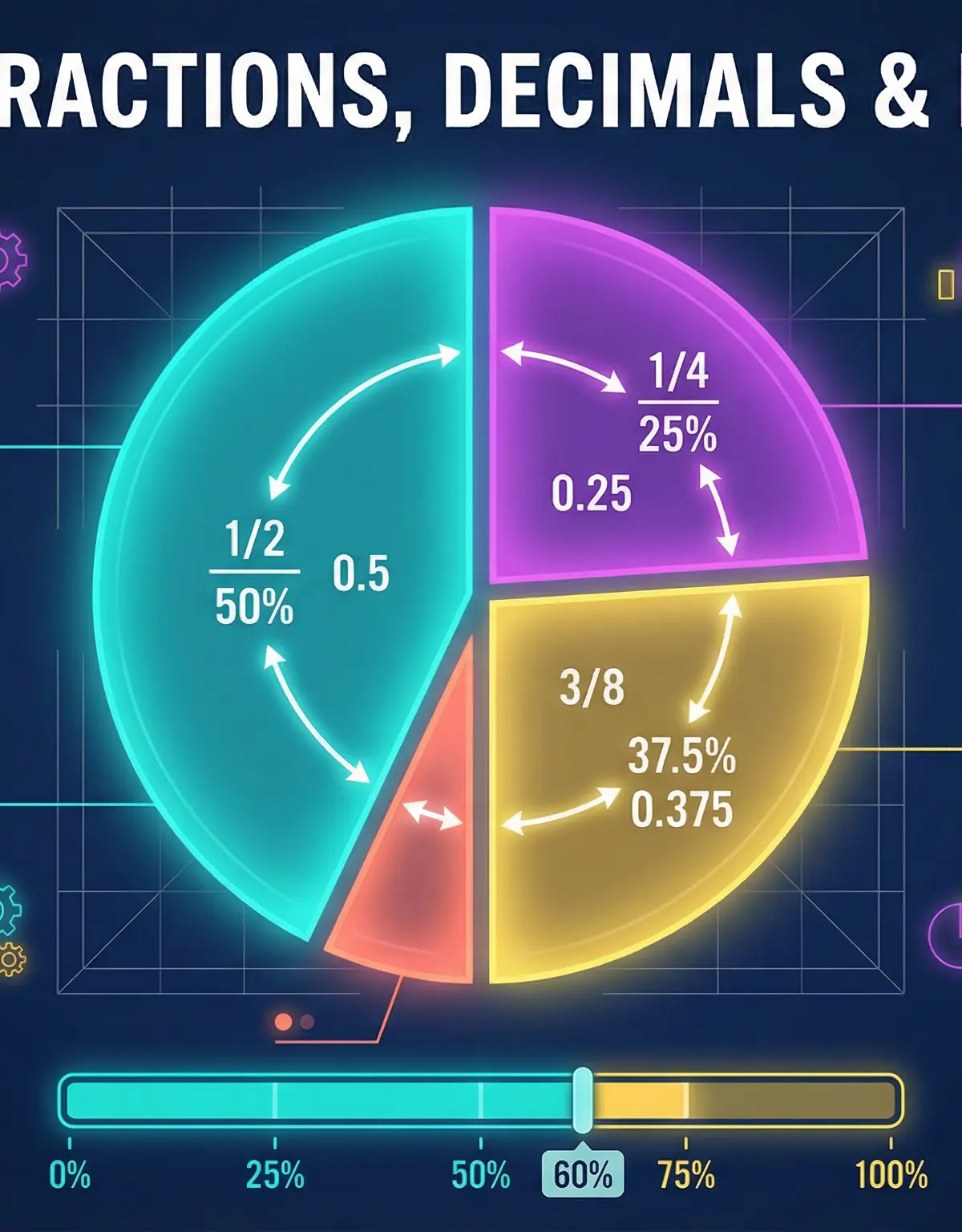
Fractions, decimals, and percentages are simply three different languages used to describe exactly the same mathematical concept: a proportion of a whole. Whether you are calculating a discount in a shop, interpreting data in a science experiment, or splitting a bill, fluency in converting between these three forms is an essential life skill and a cornerstone of GCSE Mathematics.
Examiners test this topic rigorously across all papers. Questions range from straightforward one-mark conversions to complex, multi-step problem-solving scenarios involving percentage change and reverse percentages. Because this topic connects heavily to probability, ratio, and algebra, mastering FDP is one of the highest-yield investments you can make in your revision.
Key Concepts
Concept 1: Conversions Between Forms
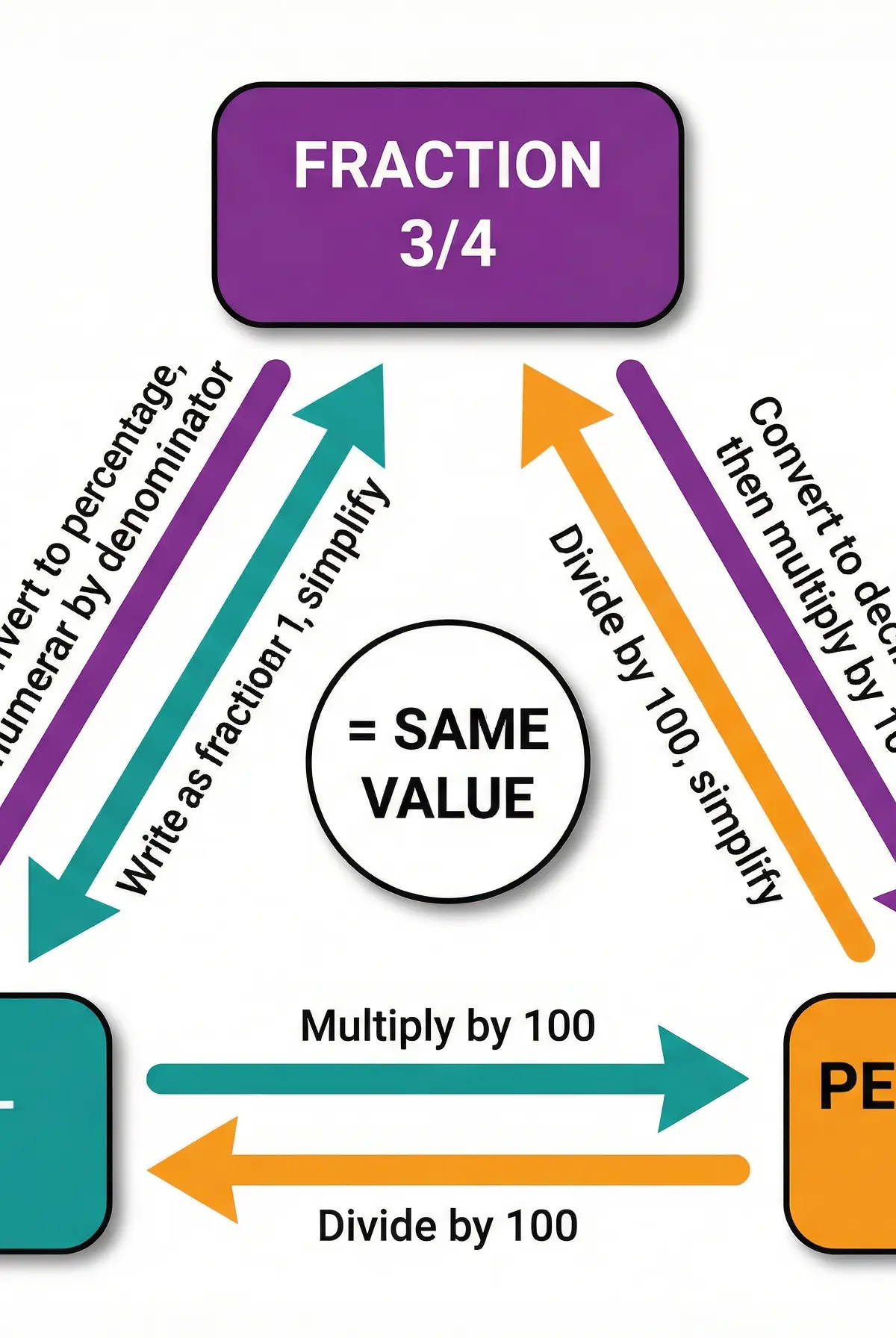
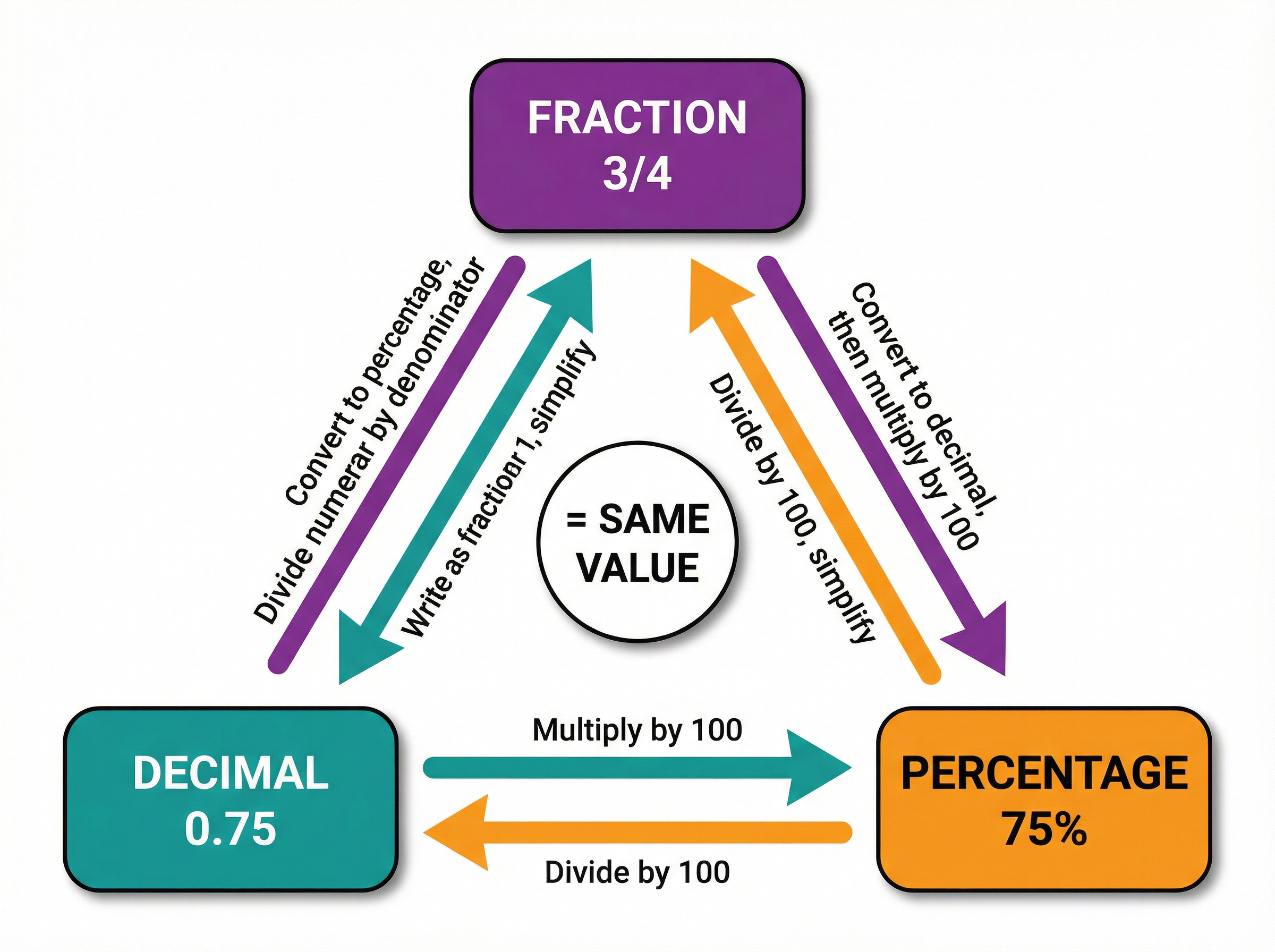
The foundation of this topic is the ability to translate a value from one form to another. Examiners frequently test your ability to convert a fraction to a decimal, a decimal to a percentage, and so on.
Fraction to Decimal: Divide the numerator (top number) by the denominator (bottom number).
Why this works: A fraction line literally means "divided by".
Example: \frac{3}{8} = 3 \div 8 = 0.375
Decimal to Percentage: Multiply by 100.
Why this works: "Percent" means "per hundred". By multiplying by 100, you are finding how many hundredths the decimal represents.
Example: 0.375 \times 100 = 37.5%
Percentage to Fraction: Write the percentage over 100 and simplify.
Why this works: Again, percent means per hundred. 37.5% is 37.5 per 100. To remove the decimal in the numerator, multiply top and bottom by 10 to get \frac{375}{1000}, then simplify by dividing by common factors to reach \frac{3}{8}.
Concept 2: Percentage Multipliers
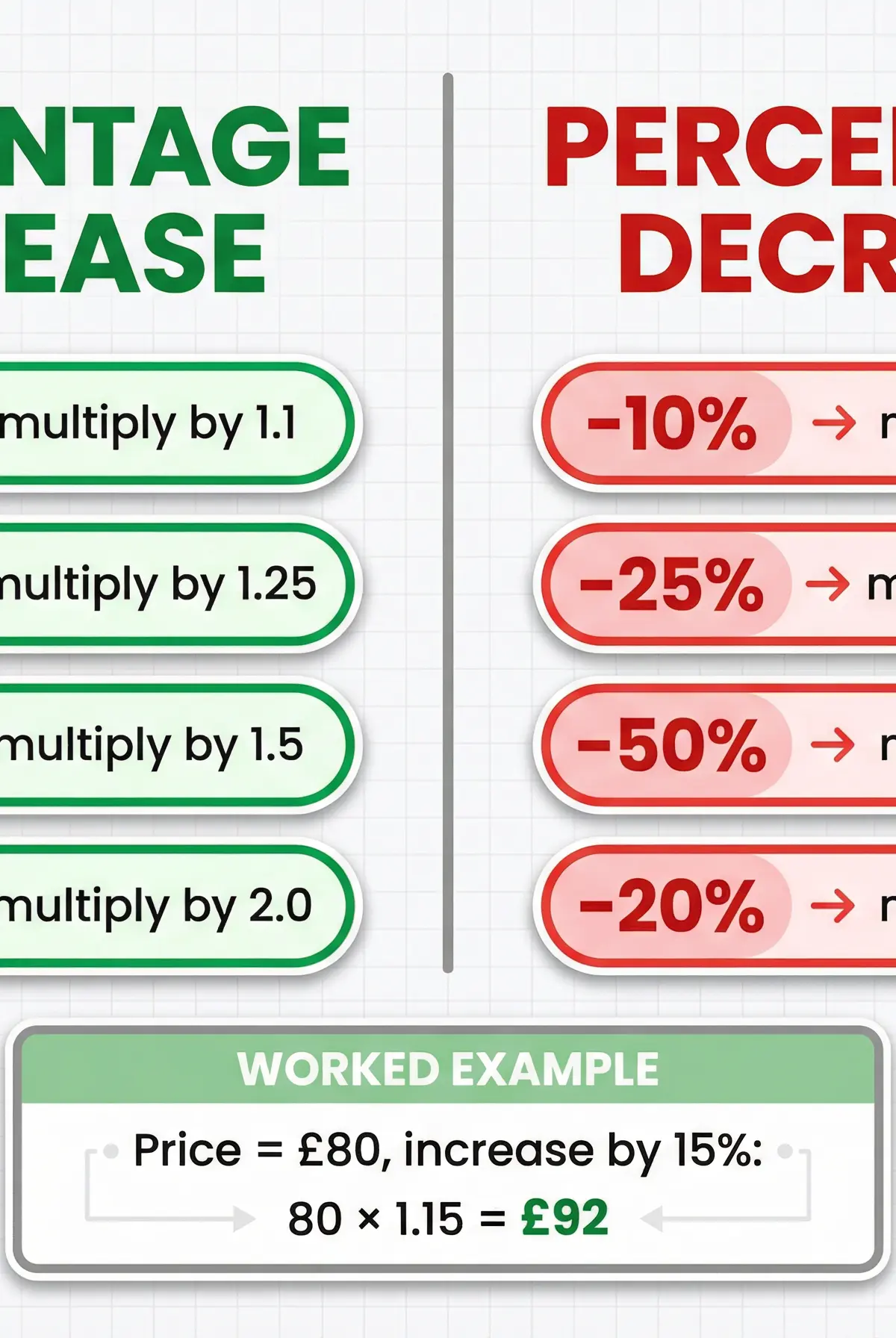
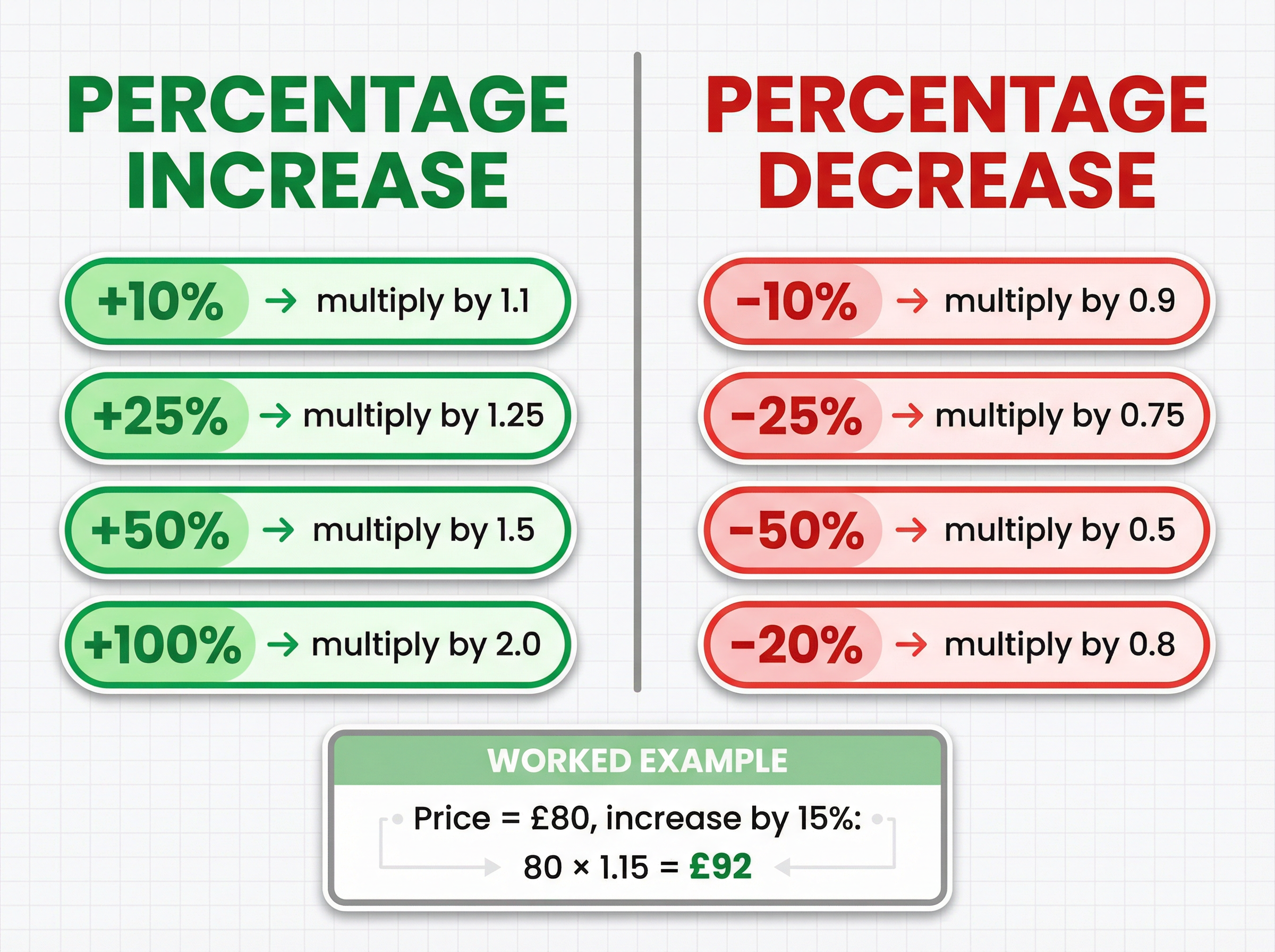
This is a crucial technique that examiners love to see because it demonstrates mathematical maturity. Instead of finding a percentage of an amount and then adding or subtracting it, you use a single multiplier.
Percentage Increase: The multiplier is 1 + (\text{percentage as a decimal}).
Example: To increase £80 by 15%, the multiplier is 1 + 0.15 = 1.15. The calculation is 80 \times 1.15 = £92.
Percentage Decrease: The multiplier is 1 - (\text{percentage as a decimal}).
Example: To decrease £80 by 20%, the multiplier is 1 - 0.20 = 0.80. The calculation is 80 \times 0.80 = £64.
Why this works: The original amount represents 100% (or 1). A 15% increase means you want 115% of the original amount. 115% as a decimal is 1.15.
Concept 3: Ordering Mixed Types
When asked to order a list containing fractions, decimals, and percentages, the most reliable method is to convert all values to decimals first. Decimals are the easiest format to compare because they align neatly by place value.
Example: Order \frac{3}{5}, 62%, and 0.615 from smallest to largest.
Step 1: Convert to decimals.
\frac{3}{5} = 3 \div 5 = 0.6
62% = 62 \div 100 = 0.62
0.615 is already a decimal.
Step 2: Add placeholder zeros to make them the same length.
0.600, 0.620, 0.615
Step 3: Order the decimals.
0.600 < 0.615 < 0.620
Step 4: Write the final answer in the original forms.
\frac{3}{5}, 0.615, 62%
Concept 4: Recurring Decimals to Fractions (Higher Tier)
A recurring decimal is a decimal that has a digit or group of digits that repeats infinitely. Higher tier candidates must know how to convert these into exact fractions using algebra.
Example: Convert 0.\dot{4}\dot{5} to a fraction.
Step 1: Let x = 0.454545...
Step 2: Because two digits recur, multiply by 100 to shift the decimal point past one repeating block. 100x = 45.454545...
Step 3: Subtract the original equation from the new one.
100x = 45.454545...
-\quad x = 0.454545...
99x = 45
Step 4: Solve for x and simplify.
x = \frac{45}{99} = \frac{5}{11}
Mathematical/Scientific Relationships
Percentage Multiplier Formula:
\text{New Value} = \text{Original Value} \times \text{Multiplier}
Where Multiplier = 1 \pm \left(\frac{\text{Percentage}}{100}\right)
Must memorise. Used for percentage increase/decrease and compound interest.
Reverse Percentage Formula:
\text{Original Value} = \frac{\text{New Value}}{\text{Multiplier}}
Must memorise. Used when you are given the final amount after a percentage change and need to find the starting amount.
Practical Applications
Compound Interest: Bank accounts use percentage multipliers repeatedly. If you invest £500 at 3% interest per year for 4 years, the calculation is simply 500 \times 1.03^4.
Depreciation: The value of cars decreases over time. If a £10,000 car depreciates by 15% each year, its value after 3 years is 10,000 \times 0.85^3.
Retail Discounts: Shops often advertise "20% off, plus an extra 10% off at the till". This is NOT a 30% discount! The multipliers are 0.8 and 0.9. The combined multiplier is 0.8 \times 0.9 = 0.72, which represents a 28% discount.
Audio Revision
Listen to this 10-minute podcast to reinforce these concepts, hear common examiner pitfalls, and test your recall.

Visual Resources
2 diagrams and illustrations
Interactive Diagrams
2 interactive diagrams to visualise key concepts
Conceptual Flow Outline
The foolproof algorithm for ordering mixed number types.
Conceptual Flow Outline
The relationship between percentage change and reverse percentages using multipliers.
Worked Examples
3 worked examples — open one to explore the question and available guidance.
Practice Questions
Test your understanding — click to reveal model answers
Write 0.08 as a fraction in its simplest form.
Hint: What place value does the 8 represent? Hundredths or tenths?
A car is bought for £15,000. It depreciates in value by 12% in the first year and 8% in the second year. Calculate the value of the car at the end of the second year.
Hint: Use two separate multipliers. Do not add the percentages together.
In a school, \frac{3}{8} of the students are in Key Stage 3. 40% of the students are in Key Stage 4. The rest of the students are in the Sixth Form. What fraction of the students are in the Sixth Form?
Hint: Convert everything to fractions with a common denominator, or convert everything to percentages.
After a 15% pay rise, Sarah's salary is £28,750. Calculate her salary before the pay rise.
Hint: This is a reverse percentage question. What multiplier represents a 15% increase?
Convert the recurring decimal 0.5\dot{1} to a fraction in its simplest form.
Hint: Notice that only the 1 is recurring. The 5 does not repeat.