Pearson Edexcel · GCSE · Mathematics
Algebra
Sequences are the heartbeat of algebraic patterns, testing your ability to spot relationships and express them mathematically. Mastering term-to-term and position-to-term rules is essential for unlocking high marks in your GCSE Mathematics exam.
- 4 min read
- 3 worked examples
- 5 practice questions
- 6 key terms
Study Notes
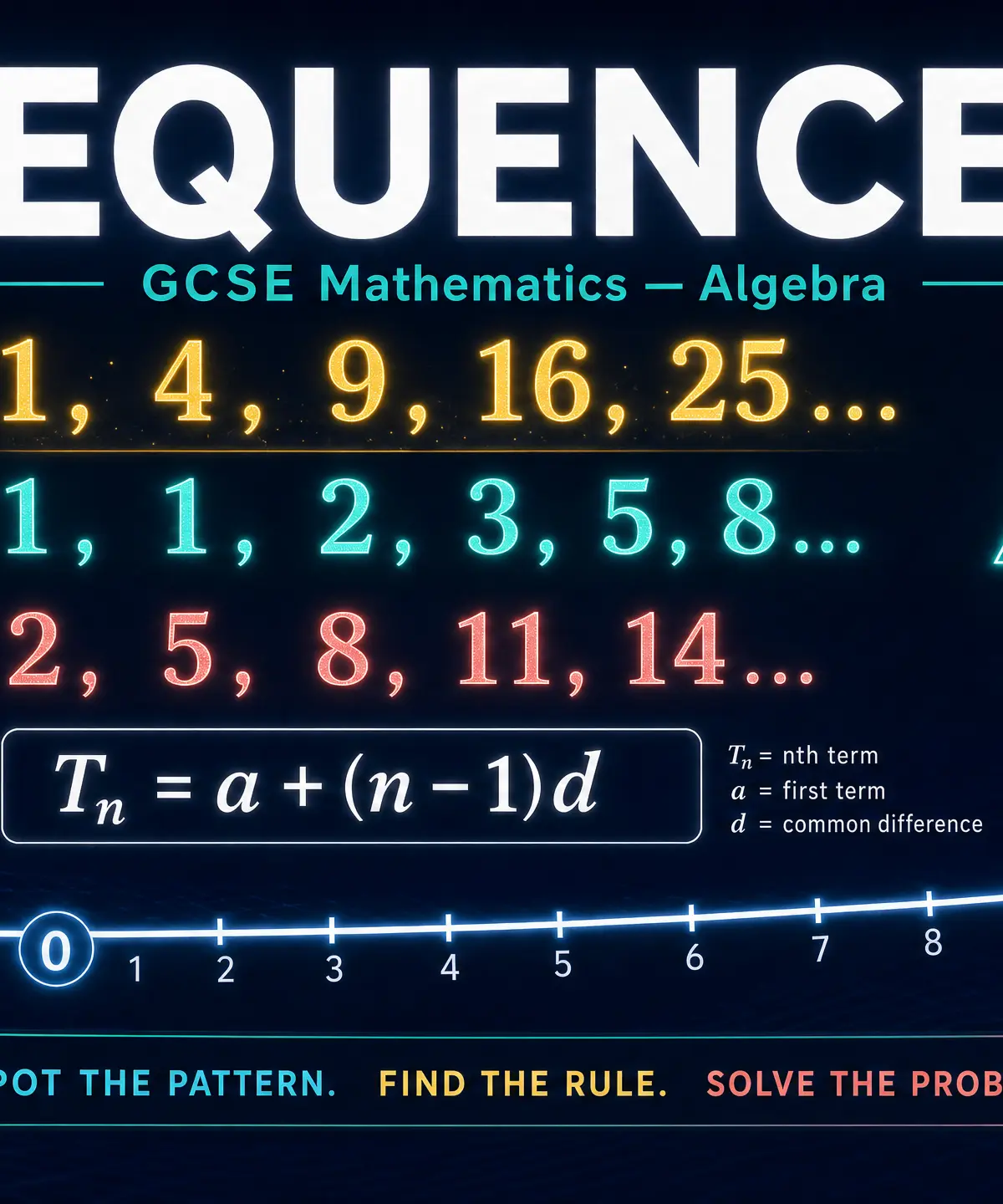
Overview
Sequences are a fundamental topic in GCSE Mathematics that bridge the gap between simple number patterns and complex algebra. A sequence is simply an ordered list of numbers, but the power lies in finding the rule that governs it. Examiners love sequences because they test multiple skills at once: pattern recognition, algebraic notation, and problem-solving. This topic connects heavily to linear graphs (where the common difference is the gradient) and functions.
In your exam, you can expect a range of question styles. Foundation tier often focuses on generating terms from a rule or identifying special sequences. Higher tier demands finding the nth term of quadratic sequences or proving whether a specific number belongs to a sequence. Let's break it all down.
Key Concepts
Concept 1: Term-to-Term Rules
A term-to-term rule tells you how to get from one number in the sequence to the very next number. You must know the previous term to find the next one.
Example: The sequence 3, 7, 11, 15... has a term-to-term rule of "add 4".
This is simple but limited. If an examiner asks for the 100th term, using a term-to-term rule would take forever! This is why we need position-to-term rules.
Concept 2: Position-to-Term Rules (The nth Term)
The "nth term" is an algebraic formula that links the position of a number (n) to its actual value.
Example: If the nth term is 3n + 2:
- The 1st term (n=1) is 3(1) + 2 = 5
- The 10th term (n=10) is 3(10) + 2 = 32
This is incredibly powerful because it allows you to calculate any term instantly without knowing the previous ones.
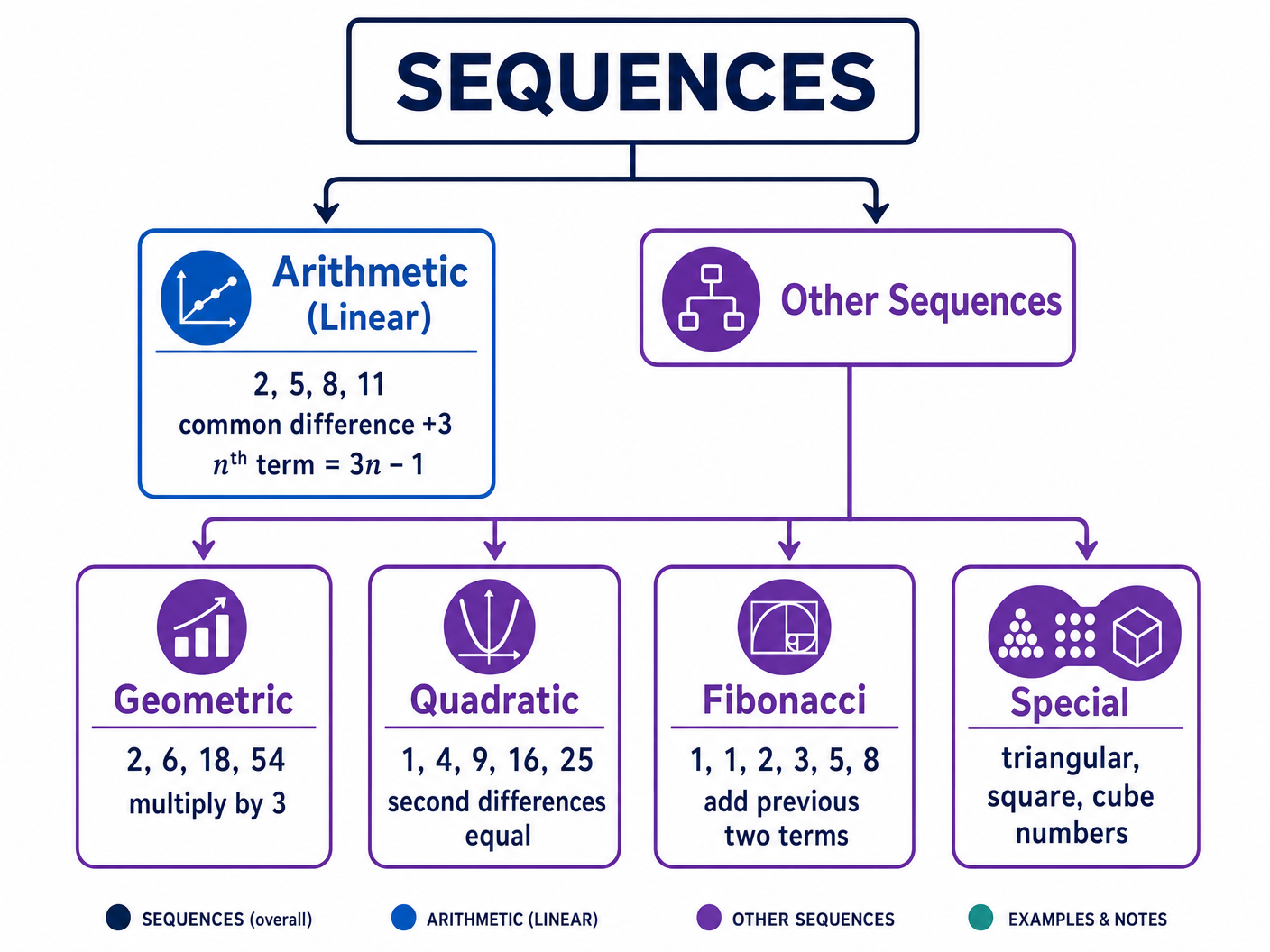
Concept 3: Special Sequences
Examiners expect you to instantly recognise certain famous sequences. Committing these to memory is an easy way to secure marks.
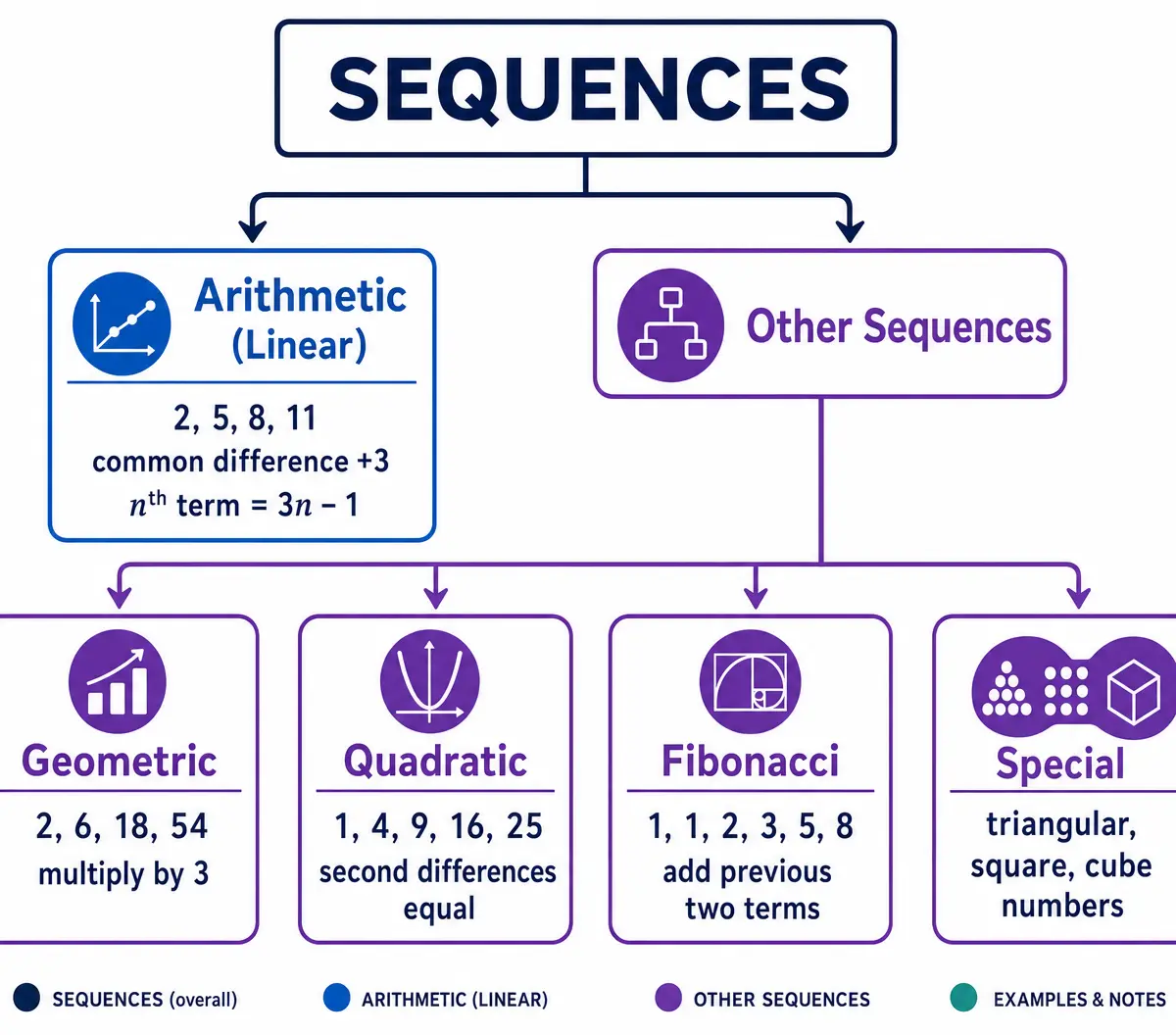
- Square Numbers: 1, 4, 9, 16, 25... (n^2)
- Cube Numbers: 1, 8, 27, 64, 125... (n^3)
- Triangular Numbers: 1, 3, 6, 10, 15... (Add 2, then 3, then 4...)
- Fibonacci Sequence: 1, 1, 2, 3, 5, 8... (Add the two previous terms together)
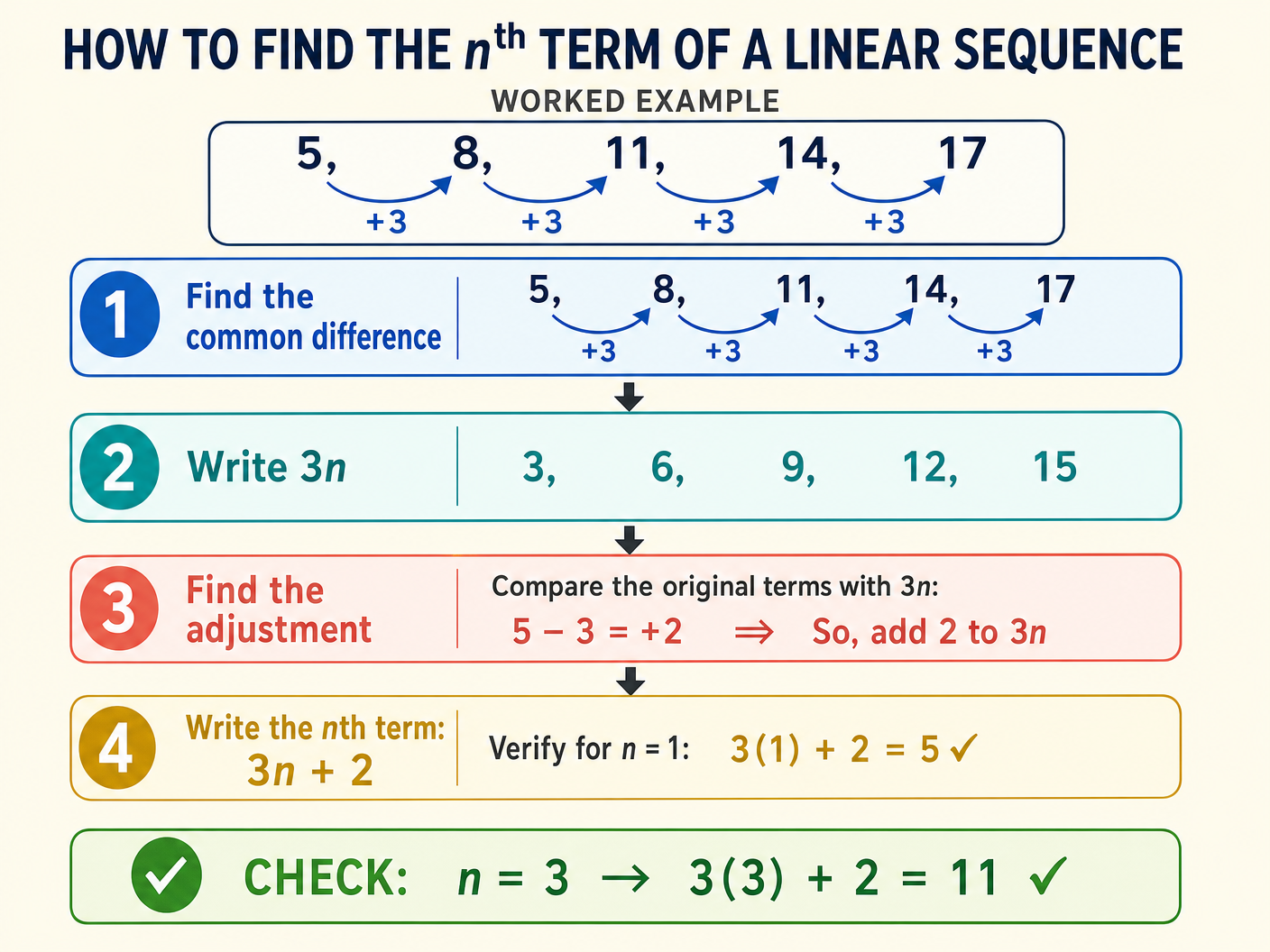
Concept 4: Linear (Arithmetic) Sequences
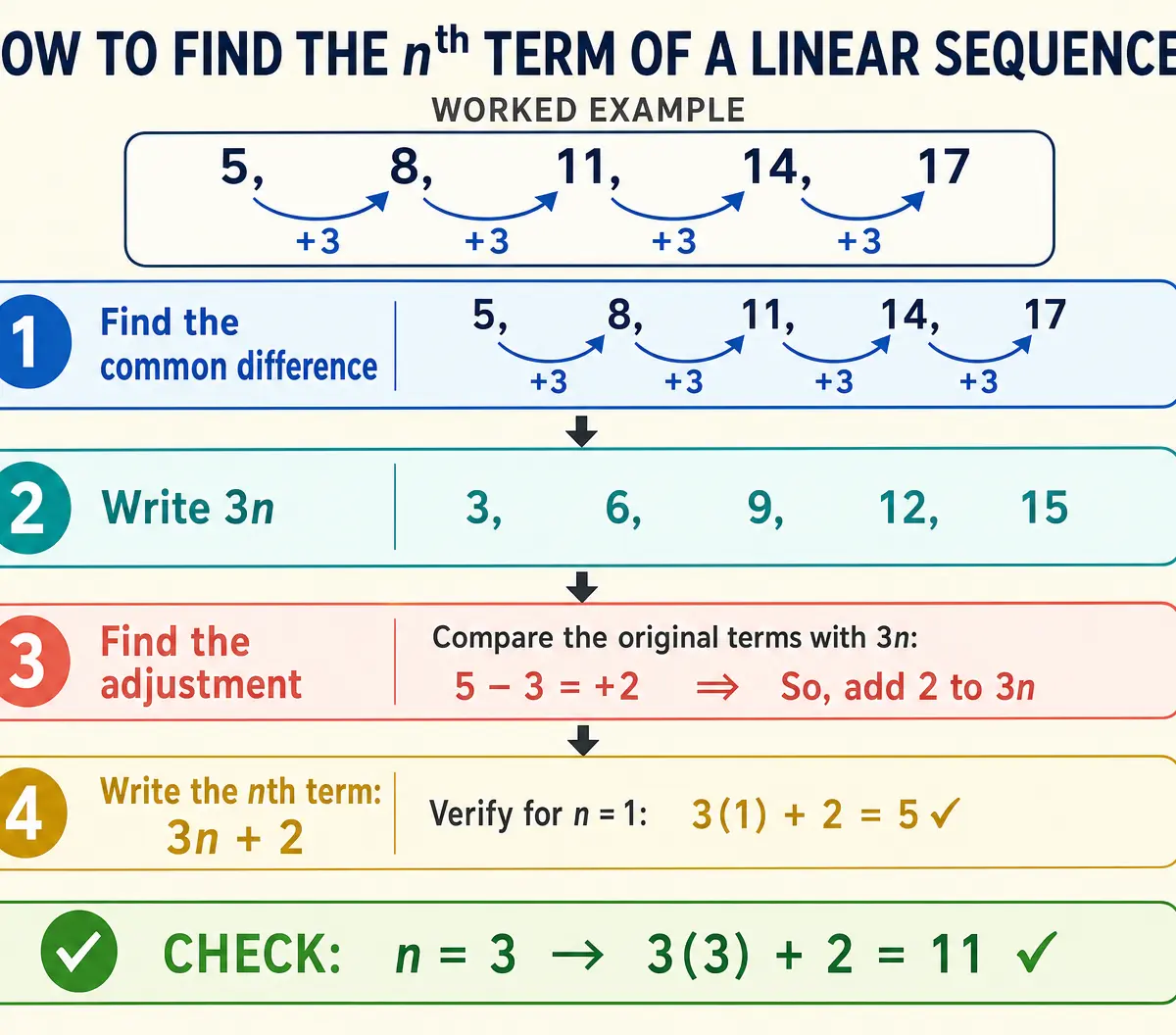
A linear sequence increases or decreases by the same amount every time. This constant amount is called the "common difference".
To find the nth term:
- Find the common difference (this is the number in front of n).
- Write out the times table for that number.
- Find what you need to add or subtract to get to your sequence.
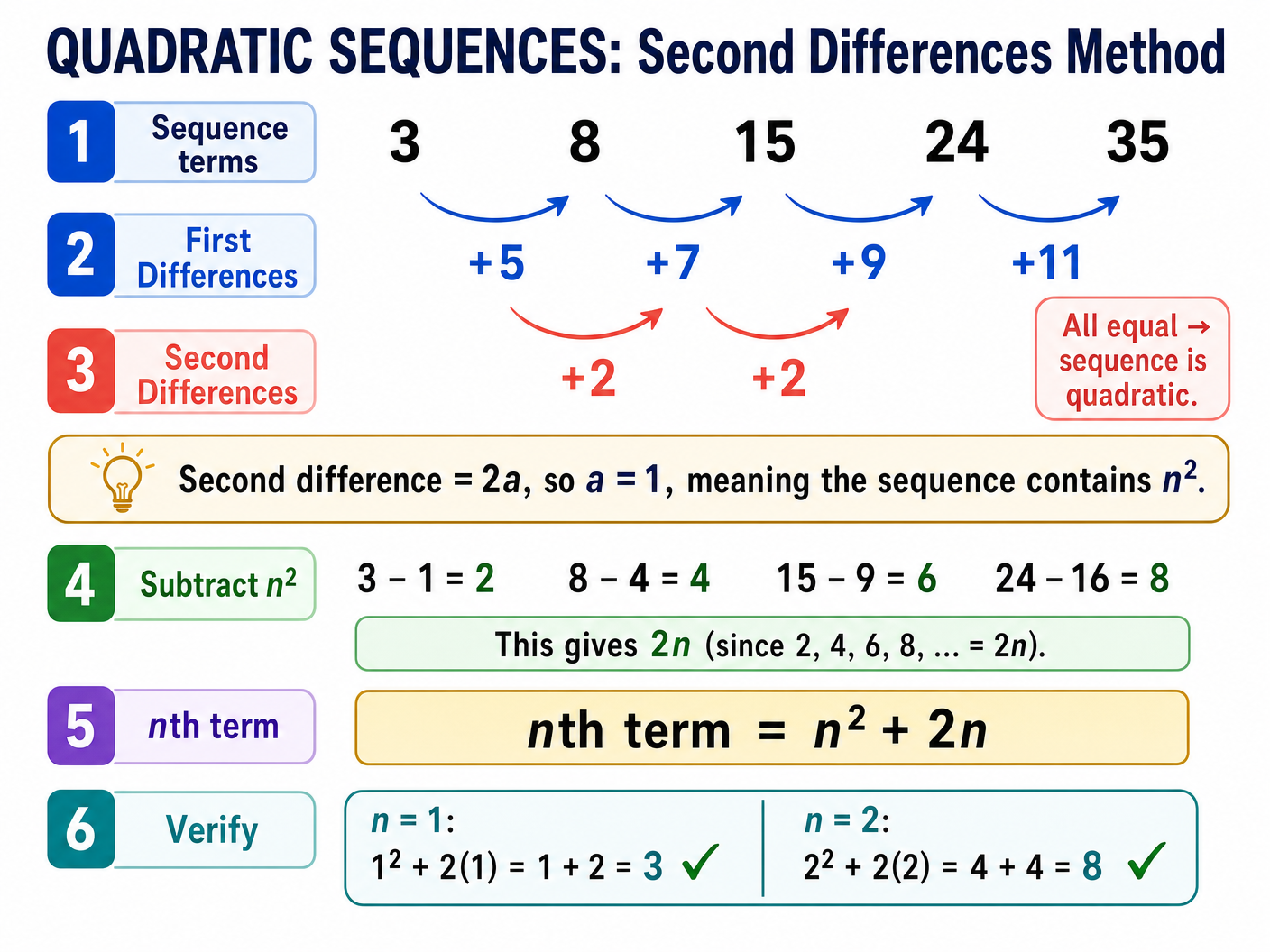
Concept 5: Quadratic Sequences (Higher Tier)
Quadratic sequences have an n^2 in their rule. The key feature is that the first differences are not equal, but the second differences are constant.
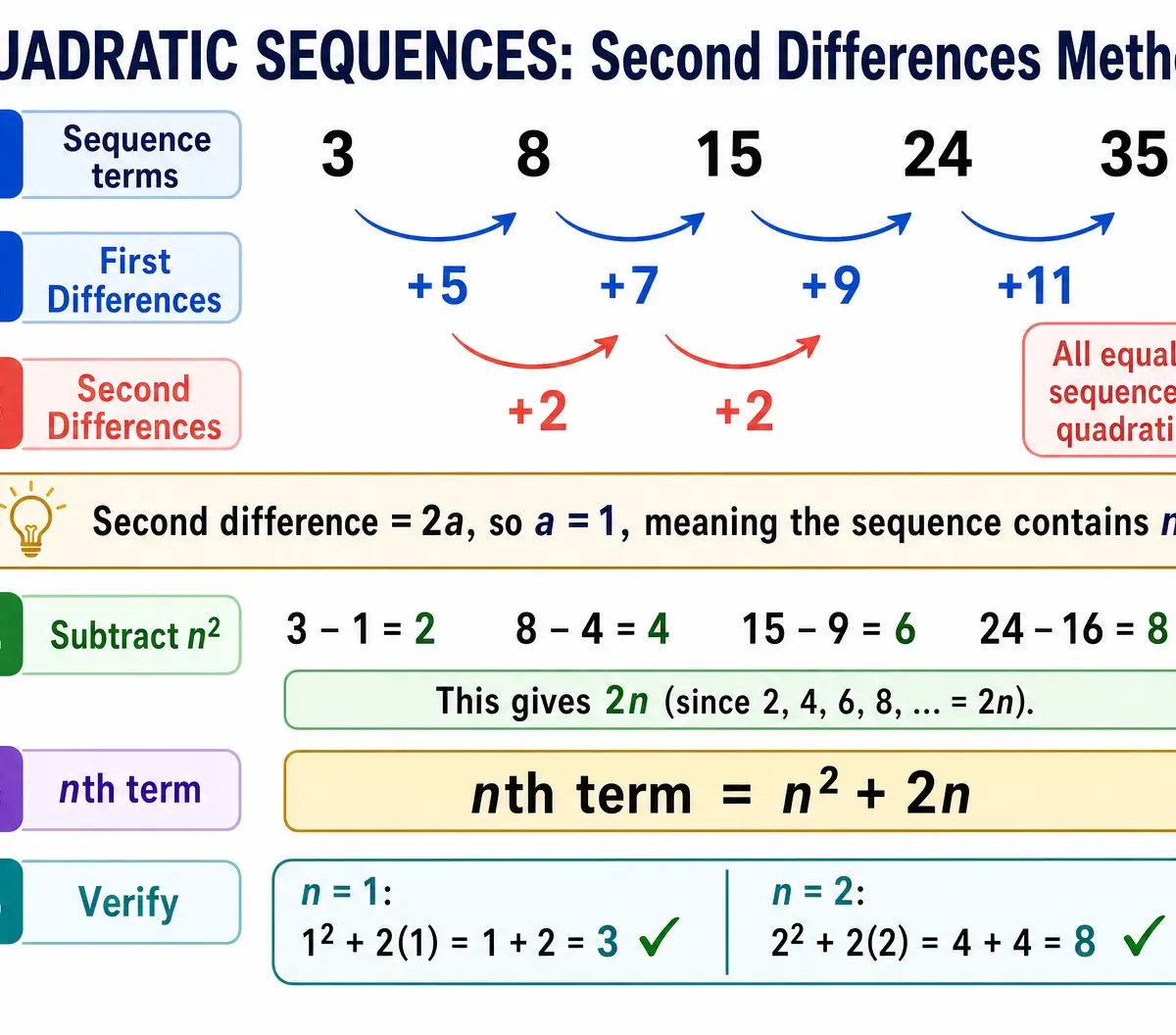
To find the nth term:
- Find the first differences, then the second differences.
- Halve the second difference. This is the coefficient of n^2.
- Subtract the n^2 sequence from your original sequence.
- Find the linear nth term of the remaining numbers.
- Combine them.
Mathematical Relationships
- Linear nth term: an + b (where a is the common difference)
- Quadratic nth term: an^2 + bn + c (where 2a is the second difference)
- Geometric sequences: ar^{n-1} (where r is the common ratio)
Listen to the Podcast
Review these concepts on the go with our audio guide:

Visual Resources
3 diagrams and illustrations
Interactive Diagrams
2 interactive diagrams to visualise key concepts
Conceptual Flow Outline
Flowchart for identifying sequence types
Conceptual Flow Outline
The relationship between position and value
Worked Examples
3 worked examples — open one to explore the question and available guidance.
Practice Questions
Test your understanding — click to reveal model answers
Here are the first four terms of a number sequence: 4, 11, 18, 25. Write down the next two terms.
Hint: What is the difference between 4 and 11?
Find an expression, in terms of n, for the nth term of this sequence: 6, 10, 14, 18
Hint: Find the common difference first. This is the number that goes in front of n.
The nth term of a sequence is 5n - 2. Work out the 20th term.
Hint: Substitute n = 20 into the expression.
A sequence has the nth term n^2 + 3. Is 85 a term in this sequence? Explain your answer.
Hint: Set up an equation: n^2 + 3 = 85 and solve for n.
[Higher Tier] Here are the first five terms of a quadratic sequence: 1, 6, 15, 28, 45. Find an expression, in terms of n, for the nth term.
Hint: Find the first differences, then the second differences. Halve the second difference to find the n^2 coefficient.