Study Notes
Overview
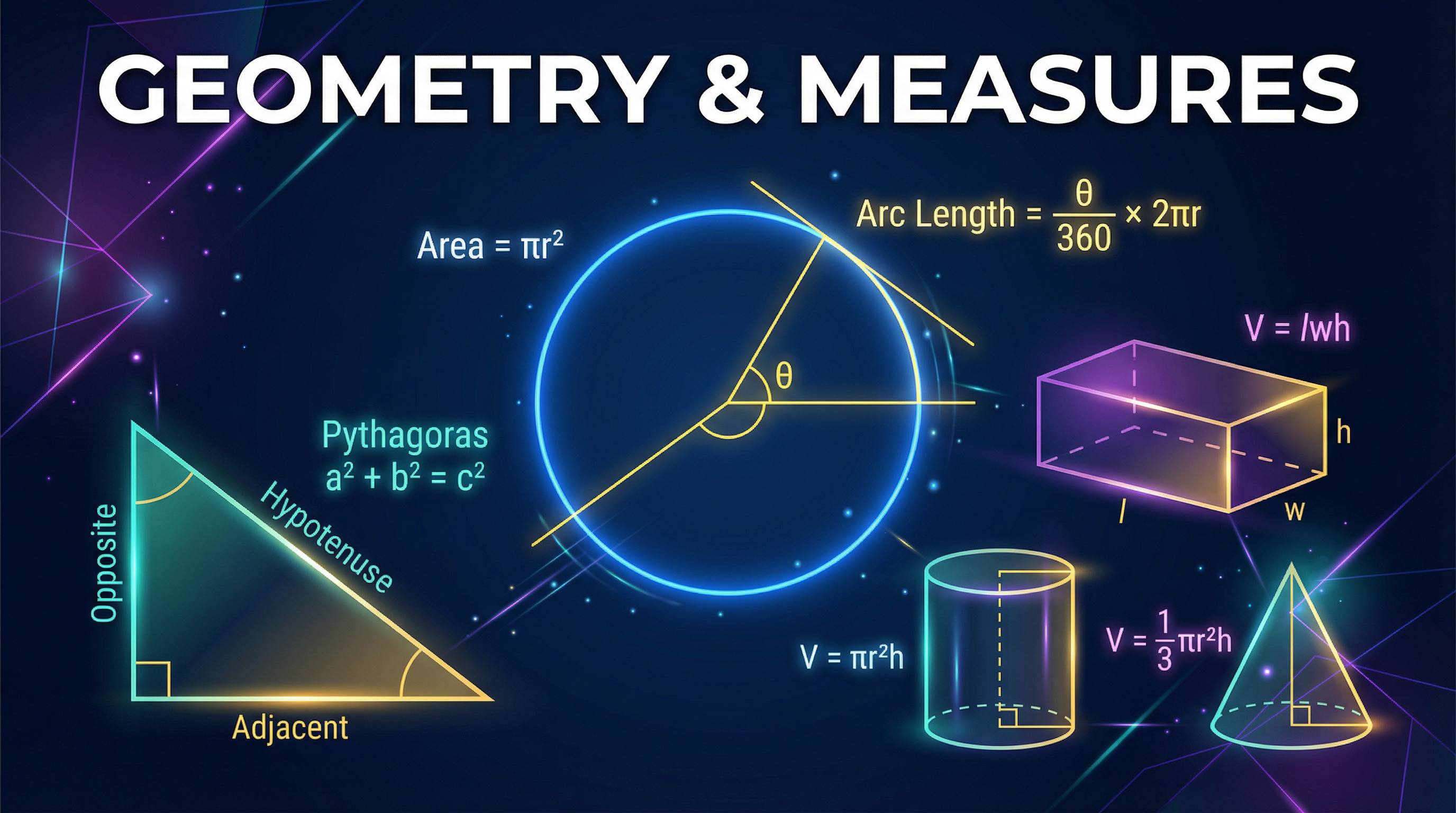
Geometry and Measures is one of the most substantial and rewarding areas of the GCSE Mathematics specification. It requires candidates to move beyond simple arithmetic and apply algebraic reasoning to spatial problems. This topic is critically important because it tests multiple Assessment Objectives simultaneously: recalling facts (AO1), reasoning mathematically (AO2), and solving unstructured problems (AO3).
Examiners frequently use Geometry and Measures to construct synoptic questions. For instance, you might need to use Pythagoras' theorem to find a missing length before applying trigonometry, or use algebraic expressions to represent the perimeter of a shape. Typical exam questions range from simple 1-mark recall of angle facts to complex 5-6 mark unstructured problems involving circle theorems or the volume of composite solids.
Key Concepts
Concept 1: Angle Properties and Reasoning
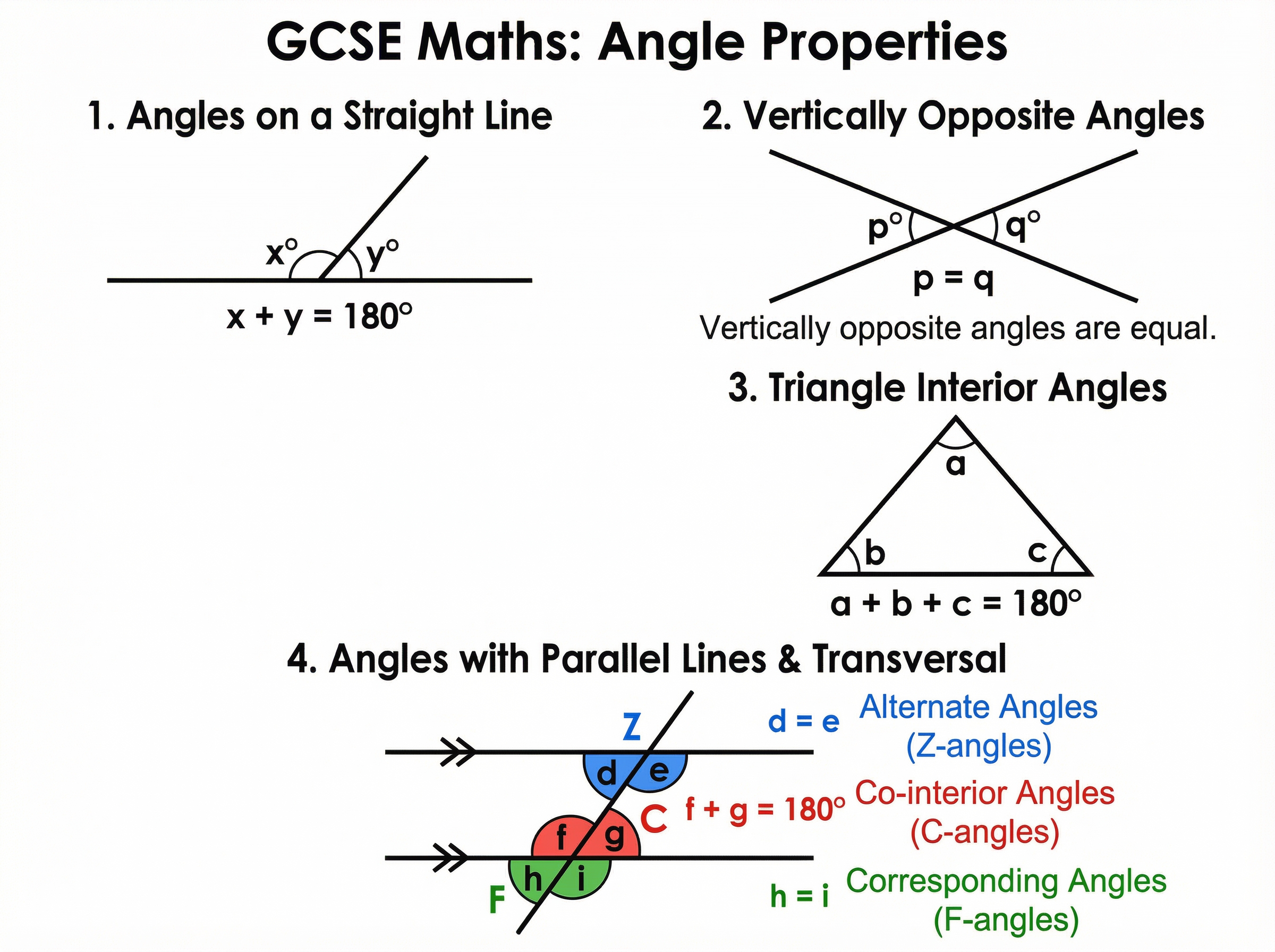
The foundation of geometry lies in understanding how angles interact. Candidates must know the basic rules: angles on a straight line sum to 180°, angles around a point sum to 360°, and vertically opposite angles are equal. More complex reasoning involves parallel lines cut by a transversal, creating alternate (Z), corresponding (F), and co-interior (C) angles.
Examiners are strict on terminology. When asked to "give a reason" for an angle calculation, you must use the exact geometric phrase. Writing "because it makes an F shape" will score zero marks; you must write "corresponding angles are equal."
Concept 2: Pythagoras' Theorem and Trigonometry
Pythagoras' theorem (a^2 + b^2 = c^2) applies strictly to right-angled triangles. The most common error candidates make is forgetting to square root their final value to find the length of the hypotenuse.
Trigonometry (SOH CAH TOA) links the side lengths of a right-angled triangle to its interior angles. The key to success is correctly labelling the triangle (Hypotenuse, Opposite, Adjacent) relative to the given angle before selecting the appropriate ratio.
Example: Find the length of the hypotenuse in a right-angled triangle with shorter sides of 5cm and 12cm.
c^2 = 5^2 + 12^2
c^2 = 25 + 144 = 169
c = \sqrt{169} = 13cm
Concept 3: Area, Surface Area, and Volume
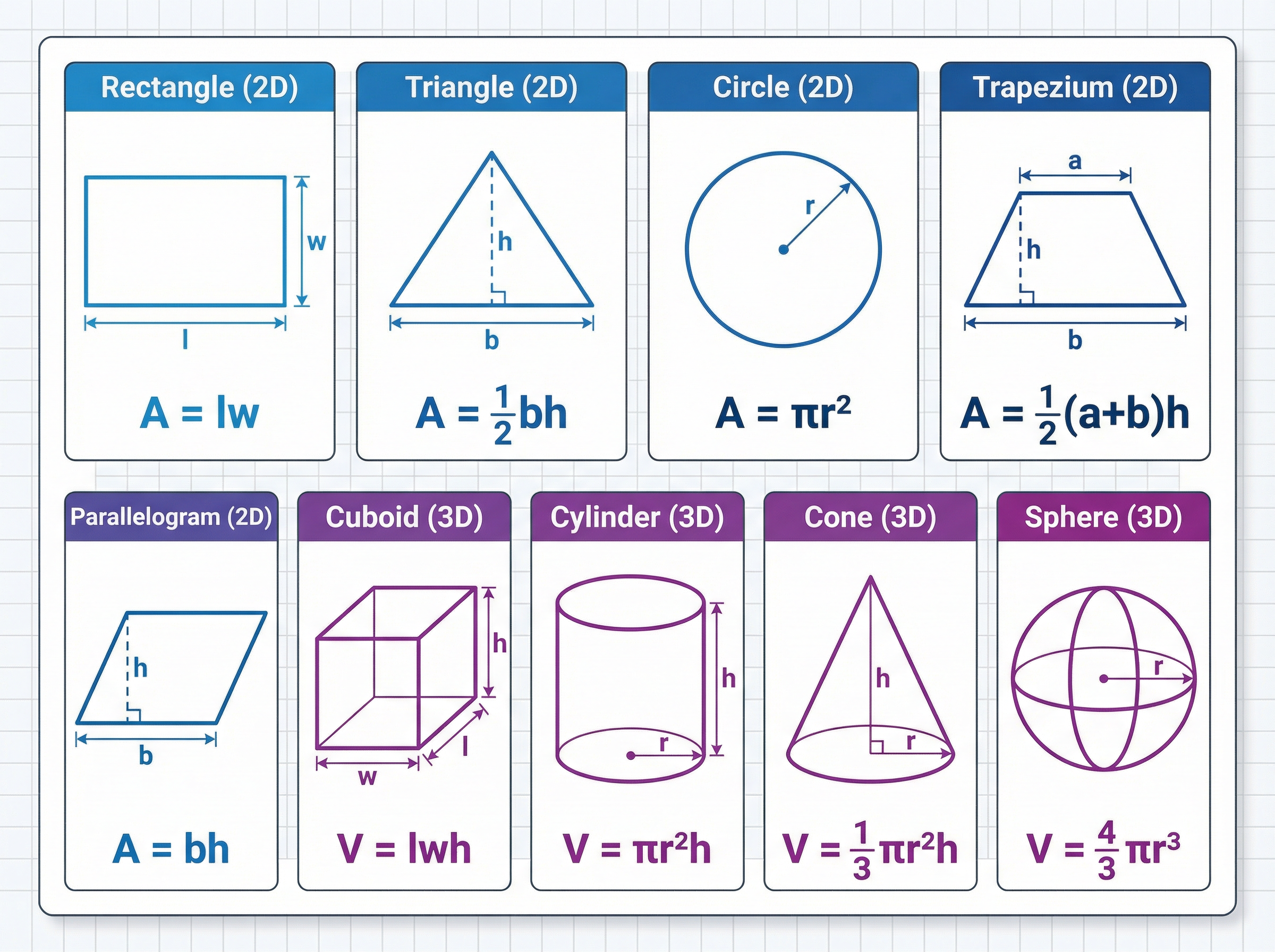
Candidates must distinguish between perimeter (1D), area (2D), and volume (3D). Surface area is the total area of all the 2D faces that make up a 3D solid. A classic pitfall is calculating volume when surface area is requested, or forgetting the hidden faces of a composite solid.
Concept 4: Circle Theorems (Higher Tier)
Circle theorems require candidates to identify complex geometric relationships within circles. Key theorems include: the angle at the centre is twice the angle at the circumference, the angle in a semicircle is a right angle, and opposite angles in a cyclic quadrilateral sum to 180°.
Like basic angle facts, the reasoning marks in circle theorem questions demand precise terminology. "Angle at the centre is twice the angle at the circumference" is required; "the middle one is double" is not accepted.
Mathematical/Scientific Relationships
- Pythagoras' Theorem: a^2 + b^2 = c^2 (Used to find a missing side in a right-angled triangle when two sides are known).
- Trigonometry: \sin(\theta) = \frac{O}{H}, \cos(\theta) = \frac{A}{H}, \tan(\theta) = \frac{O}{A} (Used to find missing sides or angles in right-angled triangles).
- Sine Rule: \frac{a}{\sin A} = \frac{b}{\sin B} = \frac{c}{\sin C} (Used for non-right-angled triangles).
- Cosine Rule: a^2 = b^2 + c^2 - 2bc \cos A (Used for non-right-angled triangles).
- Area of a Circle: A = \pi r^2
- Circumference of a Circle: C = \pi d or C = 2\pi r
Practical Applications
Geometry and Measures has profound real-world applications. Architects use trigonometry to calculate roof pitches, engineers use volume formulas to determine the amount of concrete needed for foundations, and navigators use bearings (measured clockwise from North) to plot ship and aircraft courses.
Visual Resources
2 diagrams and illustrations
Interactive Diagrams
2 interactive diagrams to visualise key concepts
Conceptual Flow Outline
Decision tree for right-angled triangle problems
Conceptual Flow Outline
Relationship between scale factors for similar shapes
Worked Examples
3 detailed examples with solutions and examiner commentary
Practice Questions
Test your understanding — click to reveal model answers
Calculate the area of a circle with a diameter of 14cm. Give your answer to 1 decimal place. (3 marks)
Hint: Remember that the area formula uses the radius, not the diameter.
A ladder is 6m long. It leans against a vertical wall. The base of the ladder is 1.5m from the base of the wall. Calculate the angle the ladder makes with the ground. Give your answer to 1 decimal place. (3 marks)
Hint: Draw a quick sketch. Label the hypotenuse and the adjacent side.
Two mathematically similar cylinders have heights of 4cm and 10cm. The volume of the smaller cylinder is 50cm³. Calculate the volume of the larger cylinder. (3 marks)
Hint: First find the linear scale factor, then find the volume scale factor.
Describe fully the single transformation that maps triangle A onto triangle B, where A has vertices at (1,1), (3,1), (1,4) and B has vertices at (-1,-1), (-3,-1), (-1,-4). (3 marks)
Hint: Check the orientation of the shape. If it's turned upside down, what kind of rotation is it?
A, B and C are points on a circle, centre O. AT is a tangent to the circle at A. Angle BAT = 65°. Find the size of angle ACB. (2 marks)
Hint: Look for the Alternate Segment Theorem.