Eduqas · GCSE · Mathematics
Probability
Mastering Probability is essential for securing high marks in your GCSE Mathematics exams. This guide covers everything from the basic probability scale and relative frequency to complex tree diagrams and Venn diagrams, ensuring you know exactly what examiners are looking for.
- 7 min read
- 3 worked examples
- 5 practice questions
- 6 key terms
Study Notes
Overview
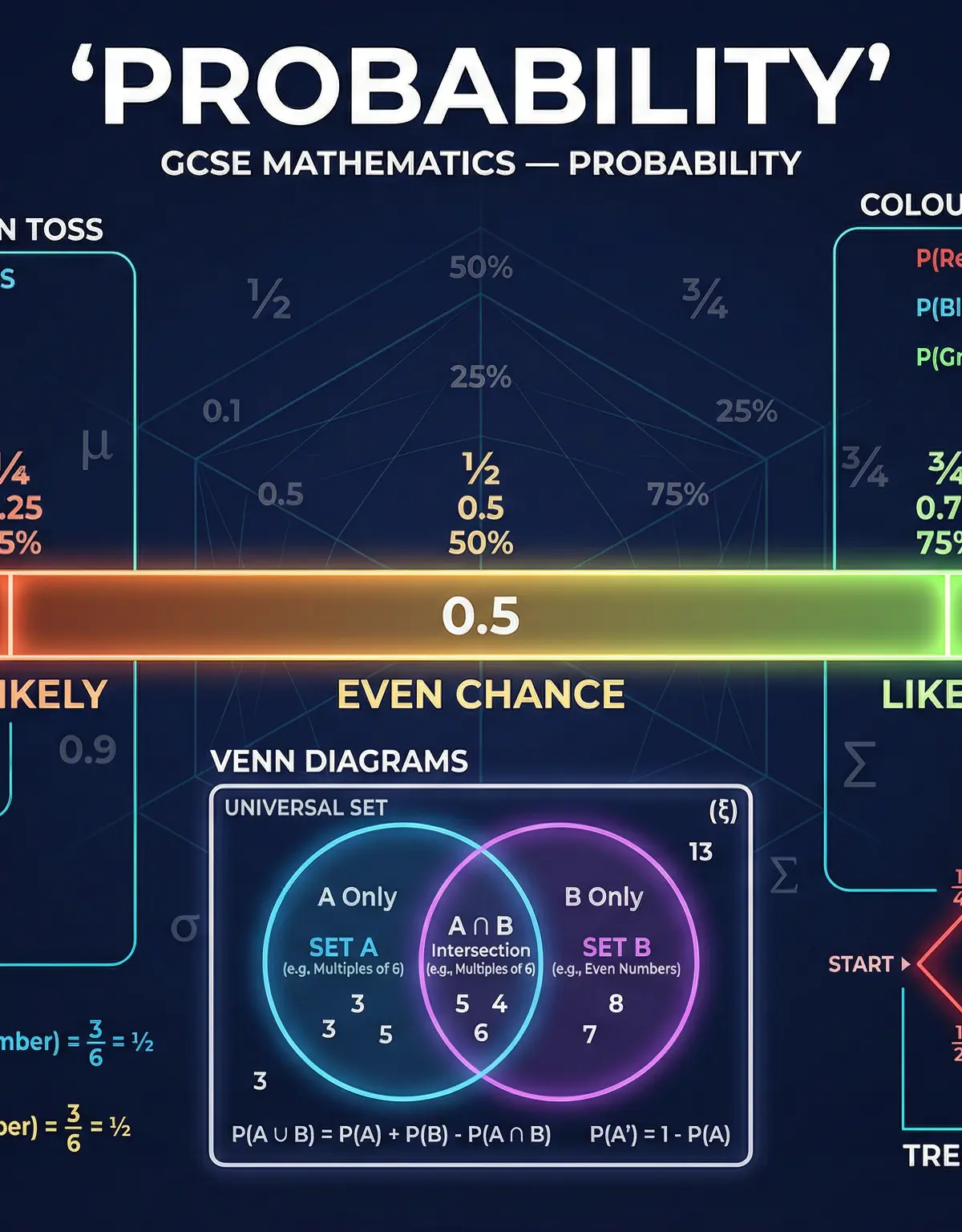
Probability is the mathematical language of chance and uncertainty. In GCSE Mathematics, it forms a crucial part of the curriculum, frequently appearing in both calculator and non-calculator papers. Understanding probability allows us to quantify how likely an event is to occur, ranging from impossible to certain.
Examiners test this topic extensively because it requires a combination of logical thinking, arithmetic skills (particularly with fractions and decimals), and the ability to interpret real-world scenarios. It connects heavily to other areas of mathematics, particularly fractions, percentages, ratio, and data handling.
Typical exam questions range from simple 1-mark questions asking you to place an event on a probability scale, to complex 4-6 mark questions requiring you to construct and interpret tree diagrams for dependent events (sampling without replacement). By mastering the core rules and practicing the standard question types, you can reliably secure these marks.
Key Concepts
Concept 1: The Probability Scale and Basic Probability
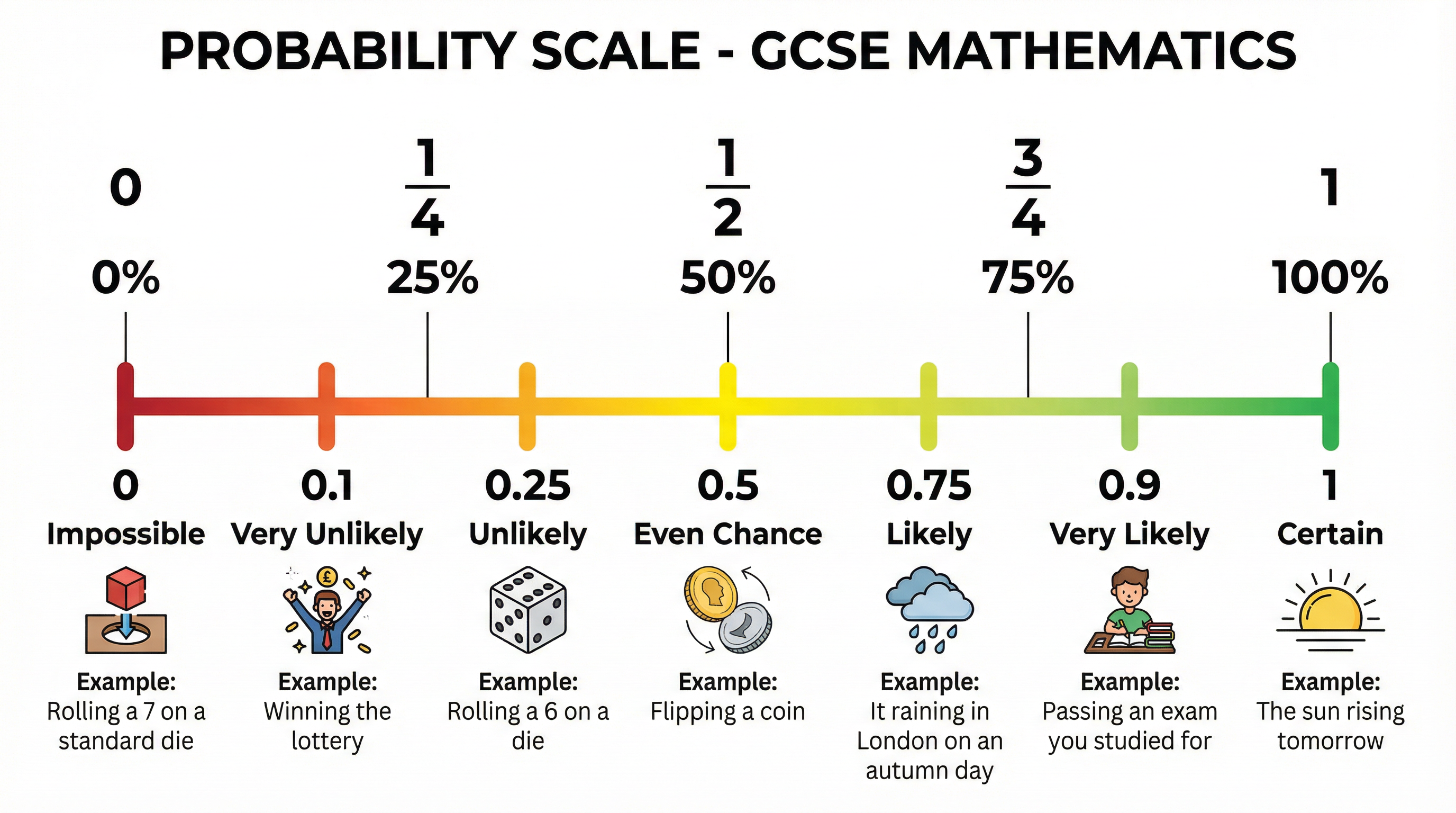
The foundation of probability is the scale from 0 to 1. An event with a probability of 0 is impossible, while an event with a probability of 1 is certain. All other probabilities lie between these two extremes. Probabilities can be expressed as fractions, decimals, or percentages, but fractions are often the most precise and easiest to calculate with.
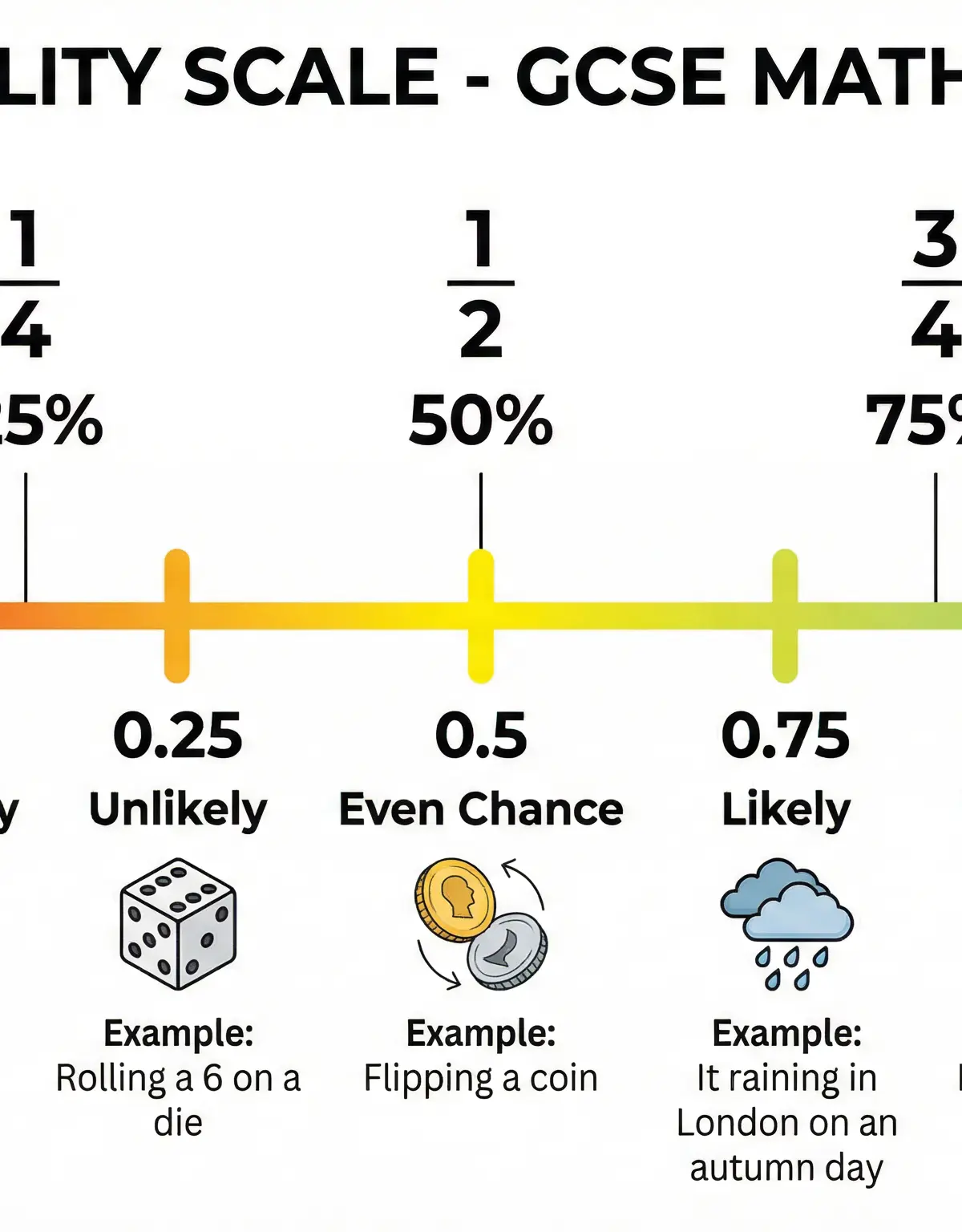
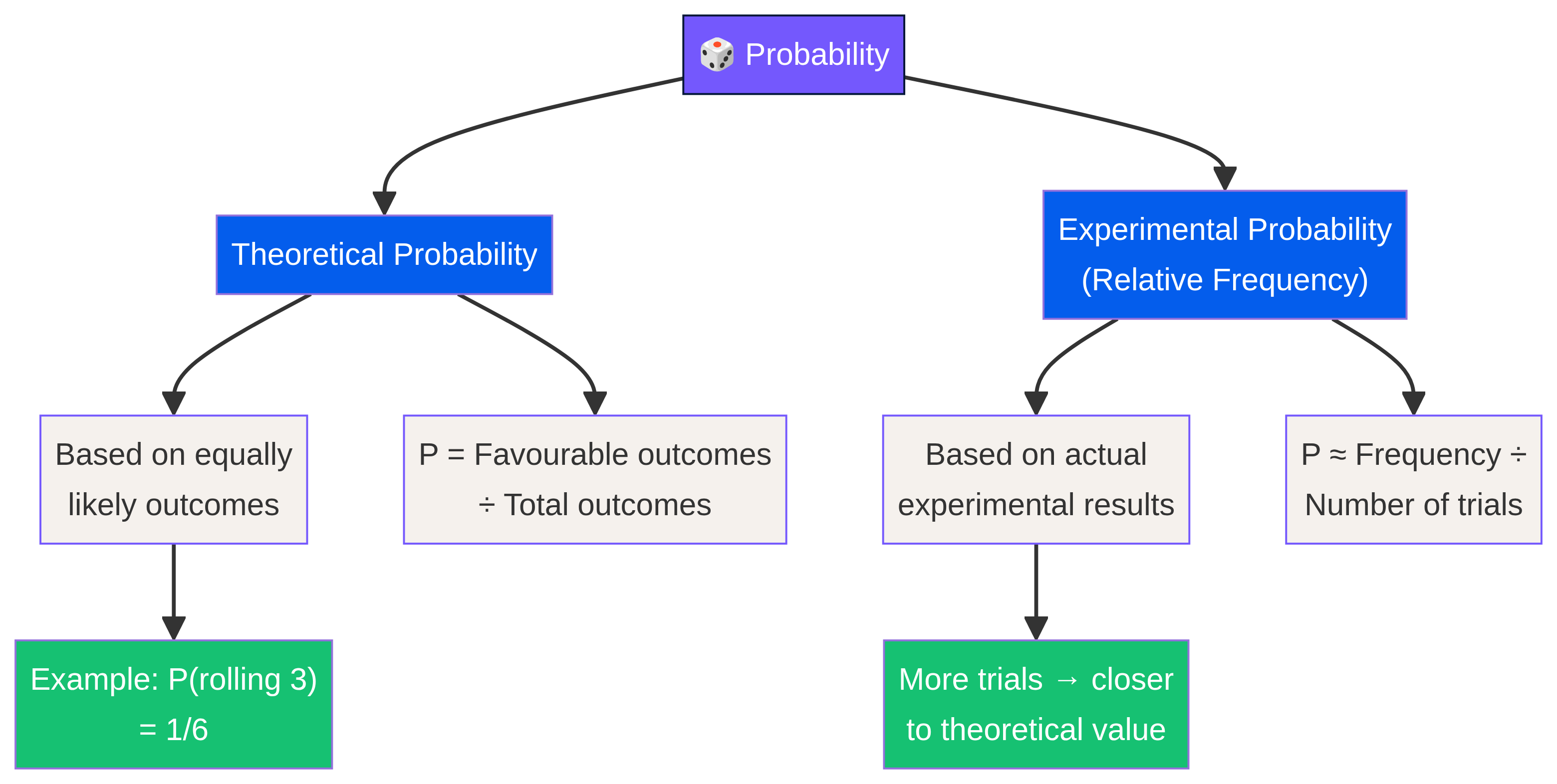
The theoretical probability of an event is calculated when all outcomes are equally likely. The formula is the number of favourable outcomes divided by the total number of possible outcomes. For example, the probability of rolling a 4 on a fair six-sided die is 1/6.
Example: A bag contains 3 red, 4 blue, and 5 green counters. The probability of picking a blue counter is 4/12, which simplifies to 1/3.
Concept 2: The Sum of Probabilities and the Complement Rule
A fundamental rule that examiners frequently test is that the sum of the probabilities of all mutually exclusive, exhaustive outcomes is exactly 1.
From this, we derive the complement rule: the probability of an event not happening is 1 minus the probability of it happening. In examiner terminology, if the probability of event A is P(A), then the probability of 'not A' (written as A') is 1 - P(A).
Example: If the probability that it rains tomorrow is 0.35, the probability that it does not rain is 1 - 0.35 = 0.65.
Concept 3: Experimental Probability (Relative Frequency)
While theoretical probability tells us what should happen in an ideal world, experimental probability (or relative frequency) tells us what actually happened in an experiment or survey. It is calculated by dividing the number of times an event occurred by the total number of trials.
Examiners often ask you to estimate the probability of a future event based on experimental data. A crucial point to remember is that as the number of trials increases, the experimental probability (relative frequency) gets closer to the theoretical probability.
Example: A biased coin is flipped 200 times and lands on heads 130 times. The relative frequency of heads is 130/200 = 13/20 or 0.65. This is our best estimate for the probability of getting a head on the next flip.
Concept 4: Combined Events and Tree Diagrams
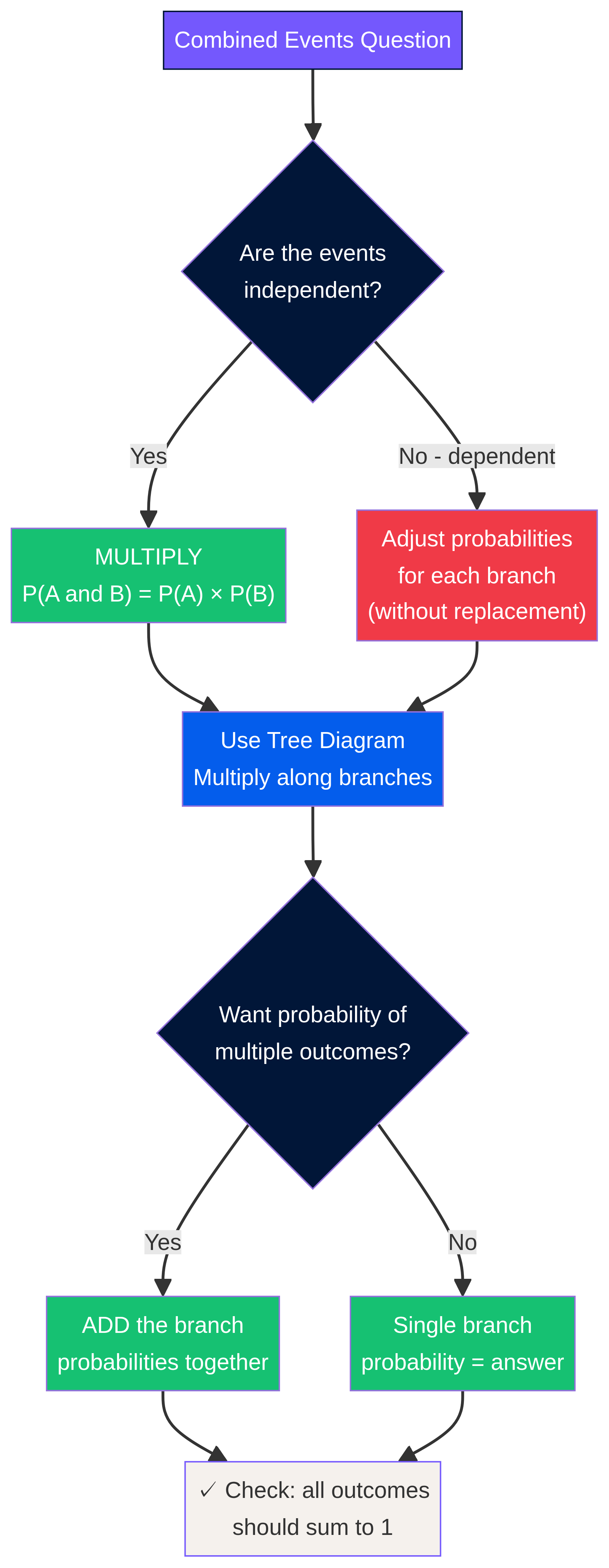
When dealing with two or more events, we must determine if they are independent (the outcome of one does not affect the other) or dependent (the outcome of one affects the other).
For independent events, we use the multiplication rule: the probability of event A and event B occurring is P(A) × P(B). For mutually exclusive events, we use the addition rule: the probability of event A or event B occurring is P(A) + P(B).
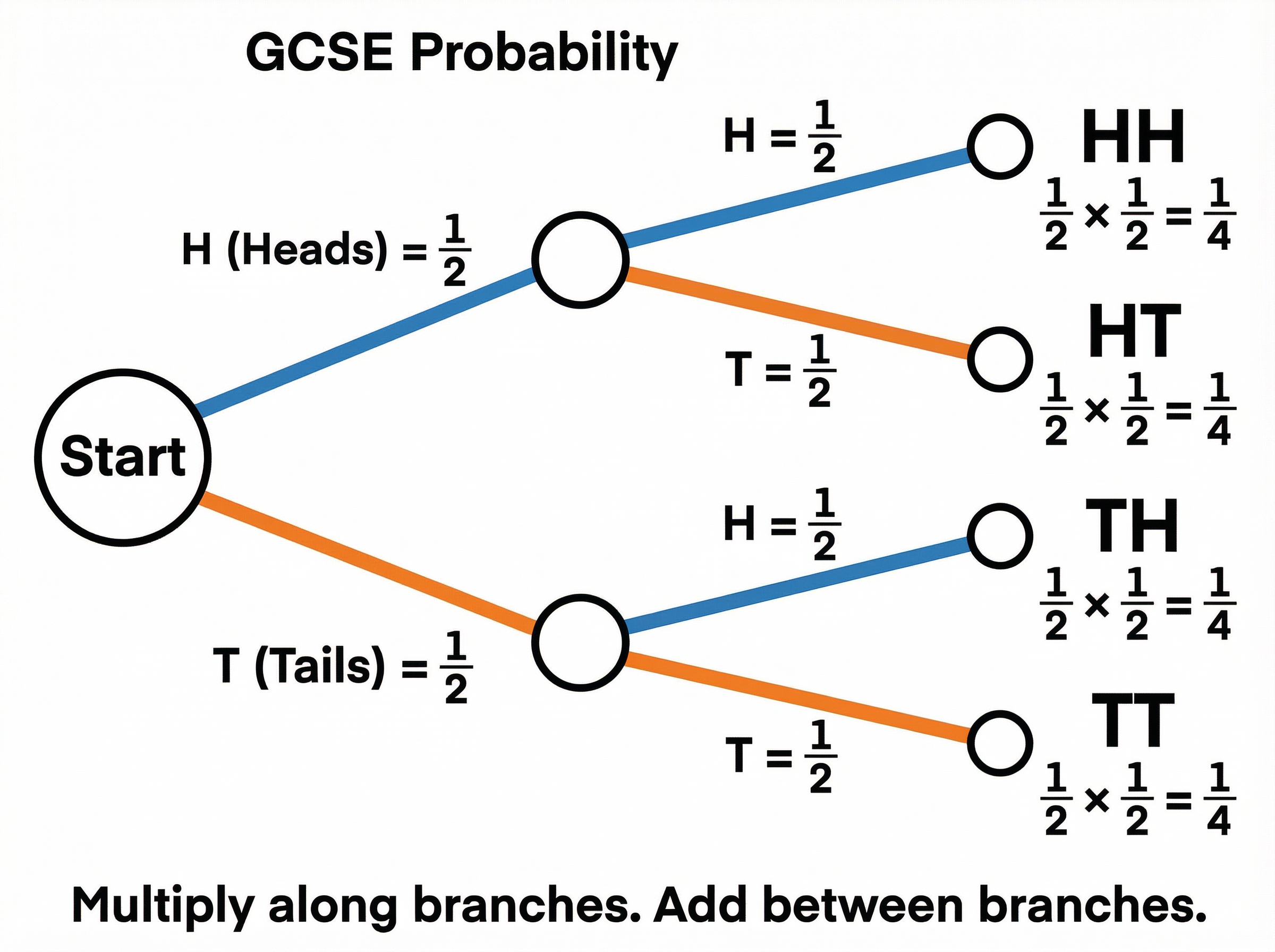
Tree diagrams are the most powerful tool for solving combined probability problems.
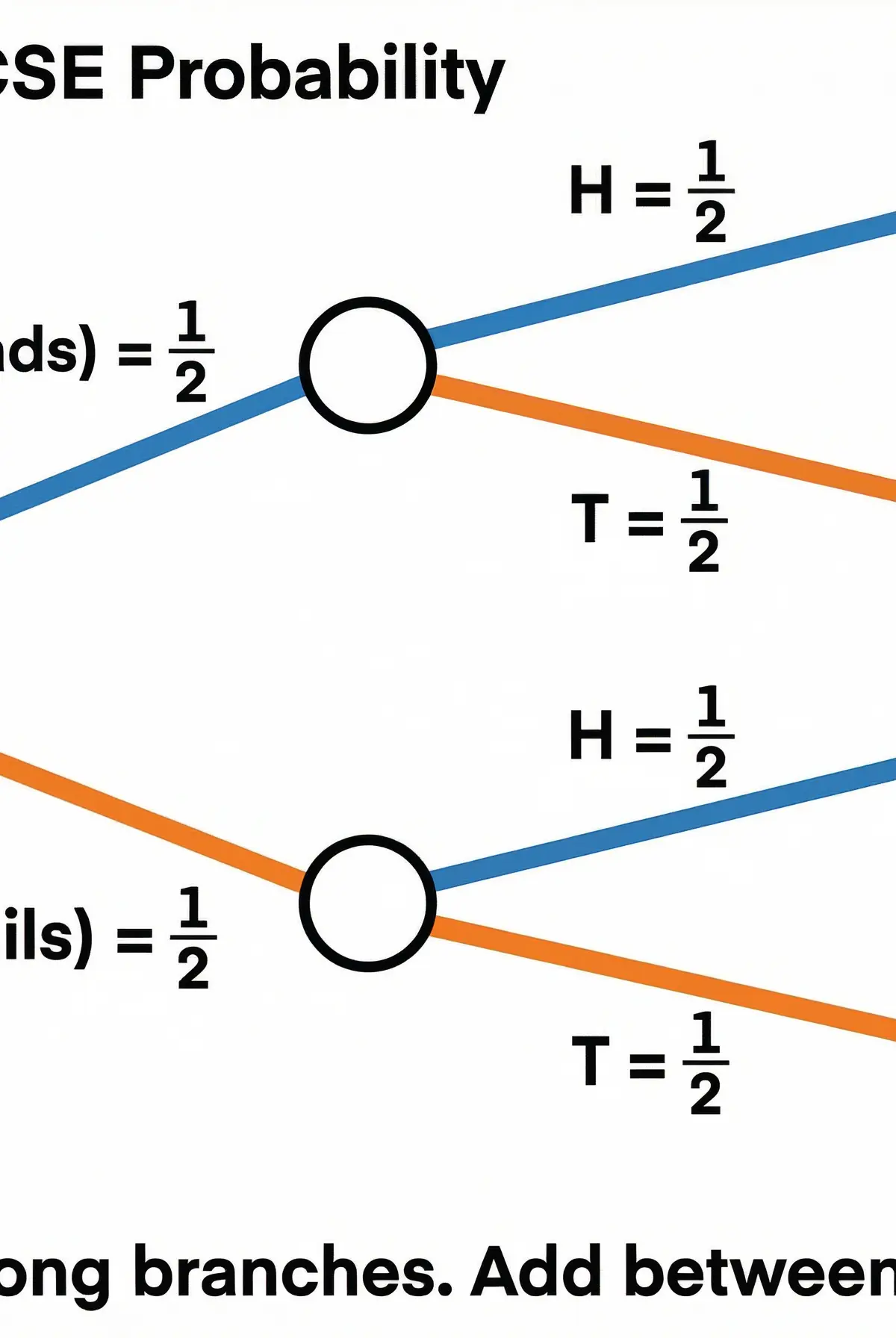
The key rules for tree diagrams are:
- Multiply along the branches to find the probability of a specific combined outcome.
- Add the probabilities of different combined outcomes (the ends of the branches) if multiple paths satisfy the question's condition.
Example: You flip a fair coin twice. The probability of getting two heads is 1/2 × 1/2 = 1/4.
Concept 5: Conditional Probability (Without Replacement)
This is a Higher Tier topic where the events are dependent. The classic example is picking counters from a bag without replacing them. When the first counter is removed, the total number of counters in the bag decreases by 1, and the number of that specific colour also decreases by 1. You must adjust the fractions on the second set of branches in your tree diagram accordingly.
Example: A bag has 4 red and 3 blue balls. You pick two without replacement. The probability of picking two reds is (4/7) × (3/6) = 12/42 = 2/7.
Concept 6: Venn Diagrams
Venn diagrams visually represent sets of data and their overlaps. The rectangle represents the universal set (all possible outcomes, denoted by ε or ξ). The overlapping region between two circles represents the intersection (outcomes in both set A and set B, denoted A ∩ B). The entire area covered by both circles represents the union (outcomes in set A or set B or both, denoted A ∪ B).
When filling in a Venn diagram from given data, always start with the intersection and work your way outwards, subtracting the intersection from the individual set totals to find the 'A only' and 'B only' regions.
Listen to our comprehensive audio guide for a deeper dive into these topics:

Mathematical Relationships
- Theoretical Probability: P(Event) = (Number of favourable outcomes) / (Total number of possible outcomes)
- Complement Rule: P(Not A) = 1 - P(A)
- Relative Frequency: Relative Frequency = (Frequency of event) / (Total number of trials)
- Multiplication Rule (Independent Events): P(A and B) = P(A) × P(B)
- Addition Rule (Mutually Exclusive Events): P(A or B) = P(A) + P(B)
- Expected Frequency: Expected number of successes = P(Event) × (Number of trials)
- Venn Diagram Union Rule: P(A ∪ B) = P(A) + P(B) - P(A ∩ B)
Practical Applications
Probability is used extensively in the real world:
- Insurance: Actuaries calculate the probability of accidents or claims to set insurance premiums.
- Weather Forecasting: Meteorologists use complex models to determine the probability of rain or extreme weather events.
- Quality Control: Manufacturers test a sample of products and use relative frequency to estimate the probability of a defective item in the entire batch.
- Medical Testing: Evaluating the probability of false positives and false negatives in diagnostic tests.
Visual Resources
4 diagrams and illustrations
Interactive Diagrams
2 interactive diagrams to visualise key concepts
Conceptual Flow Outline
The difference between Theoretical and Experimental Probability
Conceptual Flow Outline
Decision flowchart for tackling Combined Events questions
Worked Examples
3 worked examples — open one to explore the question and available guidance.
Practice Questions
Test your understanding — click to reveal model answers
A fair ordinary dice is rolled once. Write down the probability that it lands on a number greater than 4.
Hint: List the numbers on a dice that are strictly greater than 4.
The probability that a biased coin lands on heads is 0.6. The coin is flipped 150 times. Work out an estimate for the number of times the coin lands on heads.
Hint: Use the expected frequency formula: Probability × Number of trials.
A bag contains 7 red discs and 3 green discs. A disc is chosen at random, its colour noted, and then replaced. A second disc is then chosen. Calculate the probability that both discs are different colours.
Hint: Draw a tree diagram. What are the two different paths that give 'different colours'?
There are 12 sweets in a box. 5 are lemon, 4 are strawberry, and 3 are orange. Sarah takes two sweets at random from the box without replacing the first one. Work out the probability that she takes exactly one strawberry sweet.
Hint: This is without replacement. 'Exactly one strawberry' means (Strawberry, Not Strawberry) OR (Not Strawberry, Strawberry).
ξ = {integers from 1 to 10}. A = {prime numbers}. B = {odd numbers}. Draw a Venn diagram to represent this. A number is chosen at random from the universal set. Find the probability that the number is in the set A ∪ B.
Hint: List the elements of set A and set B first. Which numbers are in both? Put them in the intersection.