Eduqas · GCSE · Mathematics
Ratio, proportion and rates of change
Master Ratio, Proportion, and Rates of Change to unlock significant marks across your GCSE Mathematics papers. This topic connects deeply with geometry, algebra, and real-world problem-solving, making it essential for achieving top grades.
- 6 min read
- 3 worked examples
- 5 practice questions
- 6 key terms
Study Notes
Overview
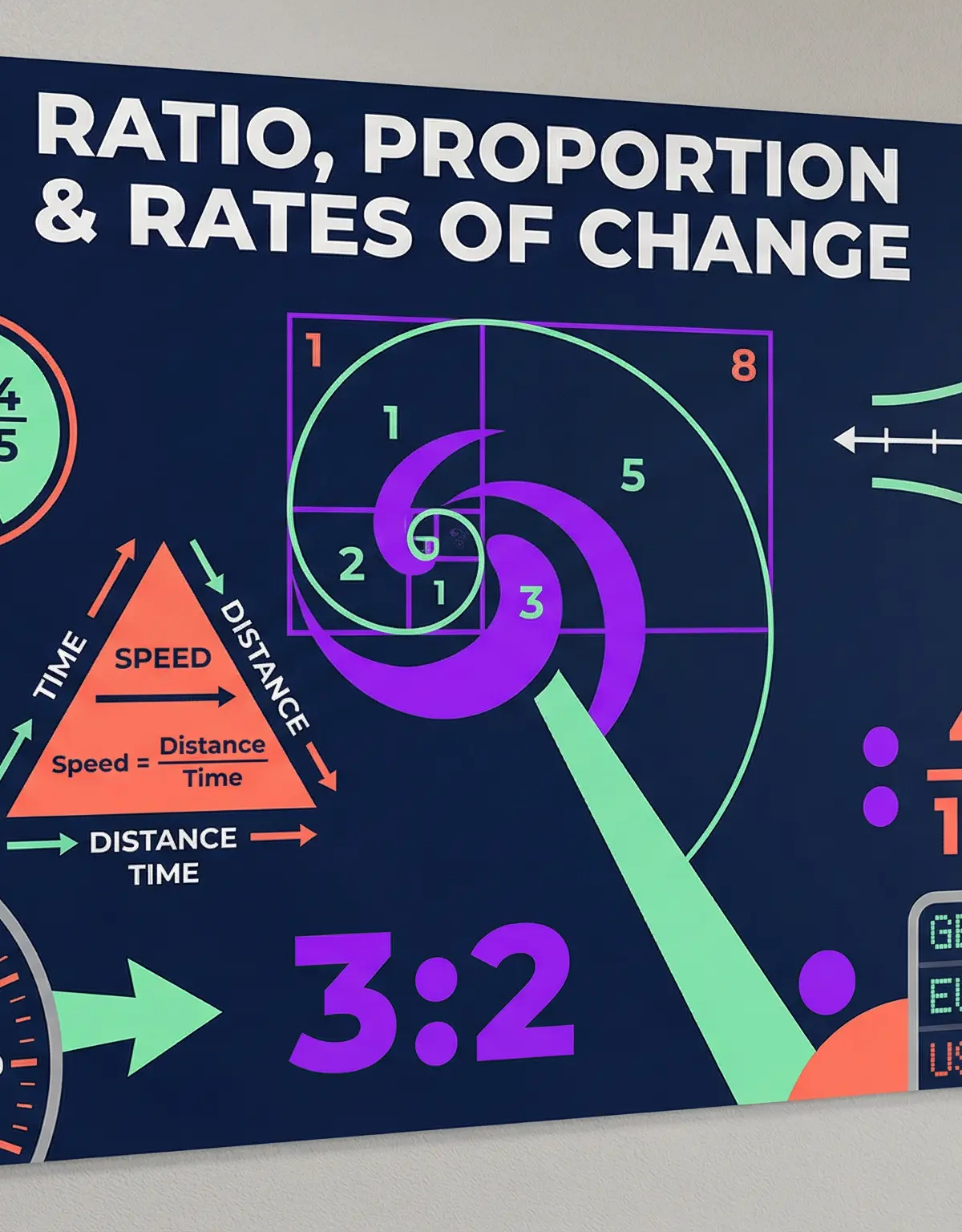
Ratio, Proportion, and Rates of Change form a cornerstone of the GCSE Mathematics specification. This topic is not just about isolated calculations; it is the mathematical language we use to compare quantities, scale models, and understand how variables interact in the real world. Examiners frequently use this topic to test your synoptic understanding, blending ratio problems with geometry (such as similar shapes) or algebra (such as solving equations with algebraic fractions).
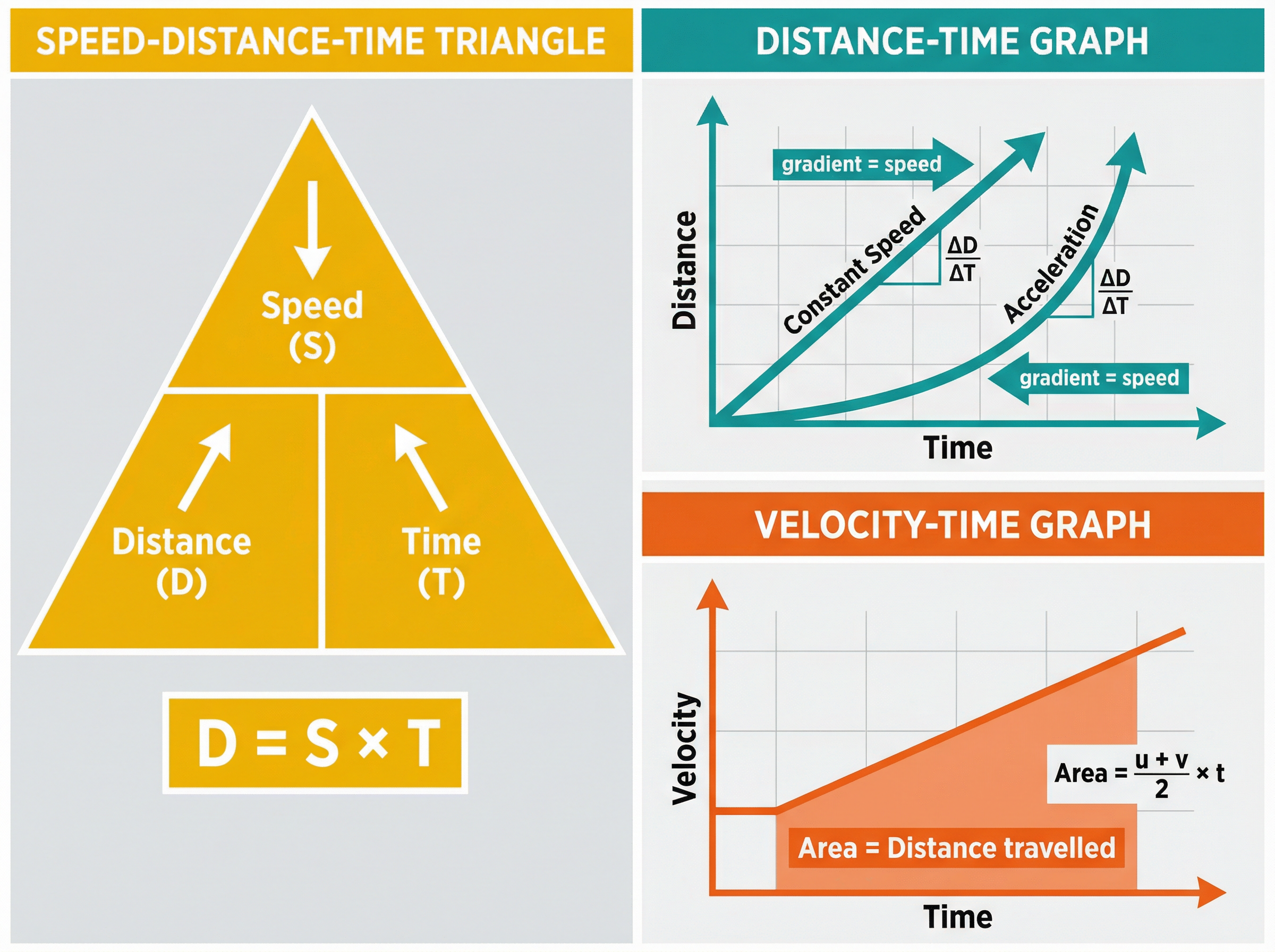
Securing a strong grasp of these concepts is crucial. Whether you are calculating the best value in a supermarket, predicting the time needed for a journey using the Speed-Distance-Time triangle, or interpreting the gradient of a velocity-time graph, these skills are highly transferable. In the exam, you will encounter a variety of question styles, from straightforward 'simplify this ratio' prompts to complex, multi-step problems involving inverse proportion and compound interest.
Listen to the companion podcast below for an audio walkthrough of the key concepts and examiner tips:

Key Concepts
Concept 1: Simplifying and Sharing in a Ratio
A ratio compares the size of one part to another part. Just like fractions, ratios must always be presented in their simplest form. To simplify a ratio, you must find the Highest Common Factor (HCF) of all the parts and divide through. When sharing an amount in a given ratio, the most reliable method is to calculate the value of one 'share'.
Why it works: By adding the parts of the ratio together, you determine the total number of equal shares the whole amount has been divided into. Dividing the total amount by this number gives the value of a single share, allowing you to scale up to find any required part.
Example: Share £350 in the ratio 2:5.
- Total shares = 2 + 5 = 7
- Value of one share = £350 ÷ 7 = £50
- The parts are 2 × £50 = £100, and 5 × £50 = £250.
(Check: £100 + £250 = £350)
Concept 2: Direct and Inverse Proportion
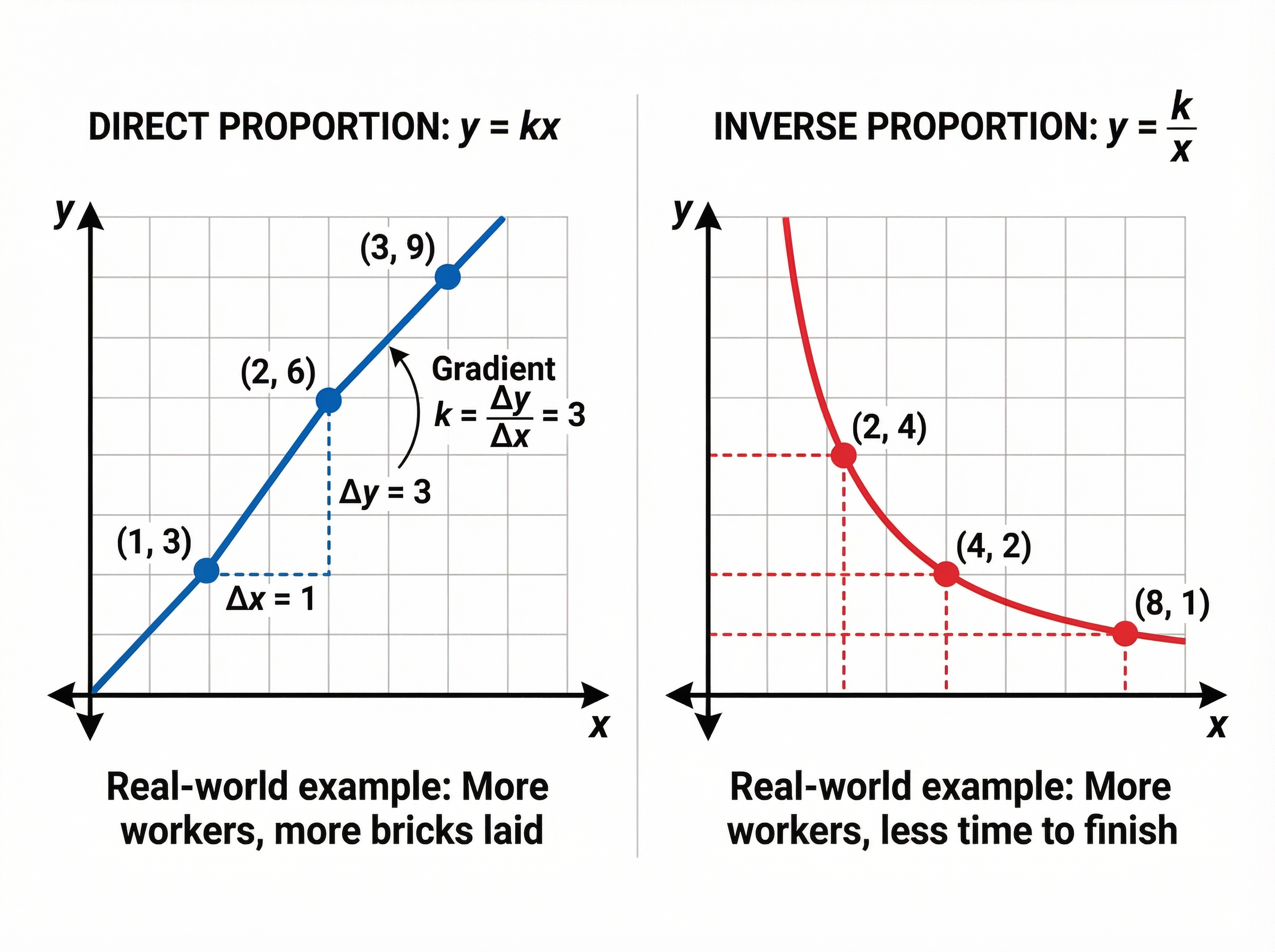
Proportion describes how two variables change in relation to each other. In direct proportion, as one variable increases, the other increases at the same constant rate (y = kx). In inverse proportion, as one variable increases, the other decreases (y = \frac{k}{x}).
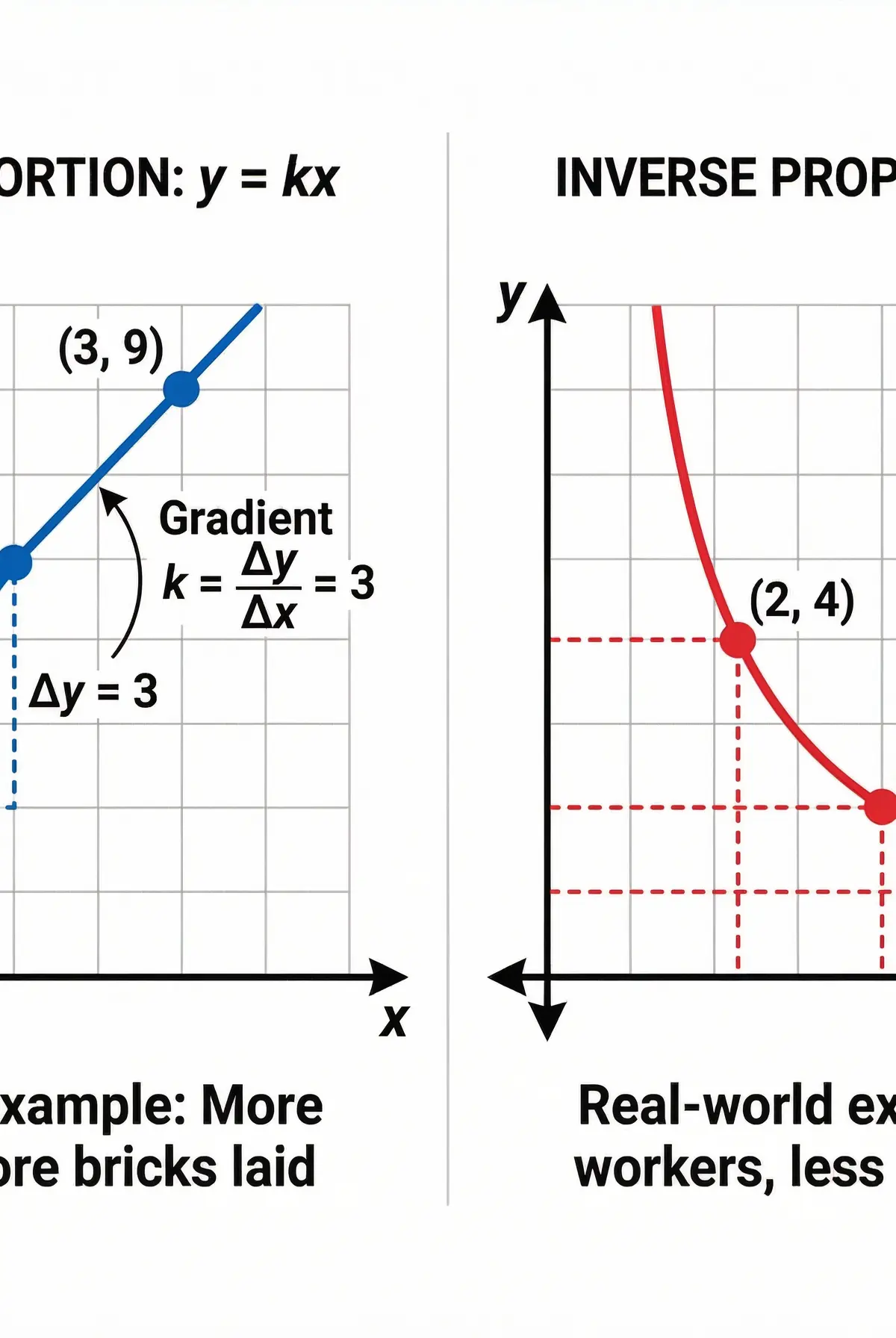
Why it works: The constant of proportionality, k, represents the underlying rule connecting the two variables. Once you use the given values to find k, you have unlocked the formula for that specific relationship and can calculate any missing value.
Example: y is directly proportional to x. When x = 4, y = 20. Find y when x = 7.
- Write the relationship: y = kx
- Substitute known values to find k: 20 = k \times 4, so k = 5
- Write the full equation: y = 5x
- Substitute to find the unknown: y = 5 \times 7 = 35
Concept 3: Rates of Change and Compound Measures
A rate of change measures how one quantity alters in relation to another, most commonly time. The most frequently tested compound measure is speed, calculated using the Speed-Distance-Time formula. Other key rates include density (mass ÷ volume) and pressure (force ÷ area).
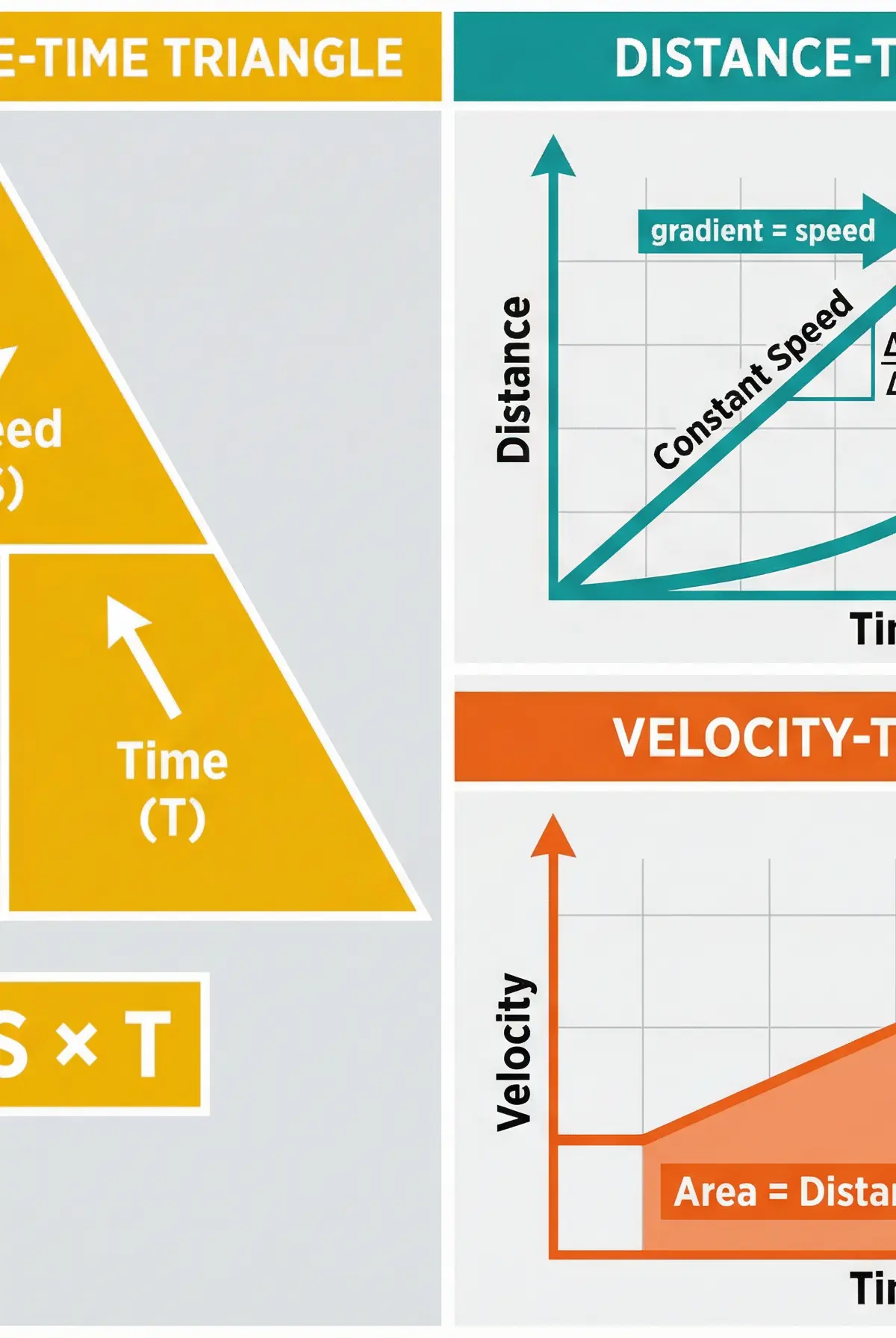
Why it works: Compound measures combine two different units into a single rate. By using formula triangles, you can easily rearrange the equation to make any of the three variables the subject.
Example: A car travels 120 km in 1 hour 30 minutes. Calculate its average speed in km/h.
- Convert time to a decimal: 1 hour 30 mins = 1.5 hours
- Use the formula: Speed = Distance ÷ Time
- Calculate: 120 \div 1.5 = 80 km/h
Concept 4: Percentages and Compound Growth/Decay
Percentages represent a proportion out of 100. For GCSE, you must master percentage change, reverse percentages, and compound interest. Compound interest involves recalculating the interest on the new total amount at the end of each period, leading to exponential growth or decay.
Why it works: Using a decimal multiplier is the most efficient way to handle percentage changes. For a 15% increase, the multiplier is 1.15. For compound interest, raising the multiplier to the power of the number of time periods (n) accounts for the repeated application of the percentage change.
Example: £500 is invested at 4% compound interest per annum. Calculate the total amount after 3 years.
- Identify the multiplier: 100% + 4% = 104% = 1.04
- Use the formula: \text{Amount} = \text{Principal} \times (\text{multiplier})^n
- Calculate: 500 \times 1.04^3 = £562.43 (to 2 decimal places)
Mathematical/Scientific Relationships
- Speed, Distance, Time: S = \frac{D}{T} (Must memorise)
- Density, Mass, Volume: D = \frac{M}{V} (Must memorise)
- Pressure, Force, Area: P = \frac{F}{A} (Must memorise)
- Direct Proportion: y = kx (Must memorise)
- Inverse Proportion: y = \frac{k}{x} (Must memorise)
- Percentage Change: \frac{\text{Change}}{\text{Original}} \times 100 (Must memorise)
- Compound Interest: A = P(1 + \frac{r}{100})^n (Must memorise)
Practical Applications
Ratio and proportion are used daily in fields ranging from architecture (creating scale models and reading maps) to finance (calculating exchange rates and compound interest on loans). Understanding inverse proportion is crucial in project management—knowing how adding more workers reduces the time required to complete a task is a fundamental business skill.
Visual Resources
2 diagrams and illustrations
Interactive Diagrams
2 interactive diagrams to visualise key concepts
Conceptual Flow Outline
Decision flowchart for tackling ratio and proportion problems.
Conceptual Flow Outline
Concept map showing the connections between key topics.
Worked Examples
3 worked examples — open one to explore the question and available guidance.
Practice Questions
Test your understanding — click to reveal model answers
Simplify the ratio 24 : 36 : 60 fully.
Hint: Find the highest number that divides exactly into all three parts.
Alice, Bob, and Charlie share £450 in the ratio 2 : 3 : 4. Calculate how much more Charlie receives than Alice.
Hint: First, find the value of one share by dividing the total amount by the total number of shares.
The time, T hours, taken to paint a house is inversely proportional to the number of painters, p. It takes 4 painters 15 hours to paint the house. Calculate how long it would take 6 painters to paint the same house.
Hint: Set up the equation $T = k/p$ and use the initial values to find $k$.
A solid metal cylinder has a mass of 4.5 kg and a volume of 1500 cm³. Calculate the density of the metal in g/cm³.
Hint: Check the units carefully. You need the mass in grams before using the density formula.
y is directly proportional to the cube of x. When x = 2, y = 40. Find the value of x when y = 625.
Hint: Write the relationship as $y = kx^3$. Find $k$, then rearrange to solve for $x$.