Eduqas · GCSE · Mathematics
Statistics
Statistics is the mathematics of collecting, analysing, and interpreting data to make informed decisions. Mastering this topic is essential for your exams, as it appears heavily on both calculator and non-calculator papers and rewards methodical working.
- 6 min read
- 3 worked examples
- 5 practice questions
- 6 key terms
Study Notes
Overview
Welcome to Statistics, a core component of the GCSE Mathematics specification. This topic is about understanding the world through data. From predicting weather patterns to analysing medical trials, statistics allows us to find meaning in numbers. In your mathematics exam, statistics is highly rewarding because the methods are logical and consistent. If you learn the procedures for calculating averages, drawing charts, and interpreting scatter graphs, you can secure a significant number of marks.
Statistics connects closely with probability, fractions, and percentages. You will often be asked to calculate the probability of an event using a frequency table, or to express a proportion of data as a percentage. Typical exam questions range from simple 1-mark data classification tasks to complex 6-mark questions requiring you to compare two data sets using measures of central tendency and spread, or to draw and interpret a histogram from a grouped frequency table.

Key Concepts
Concept 1: Types of Data
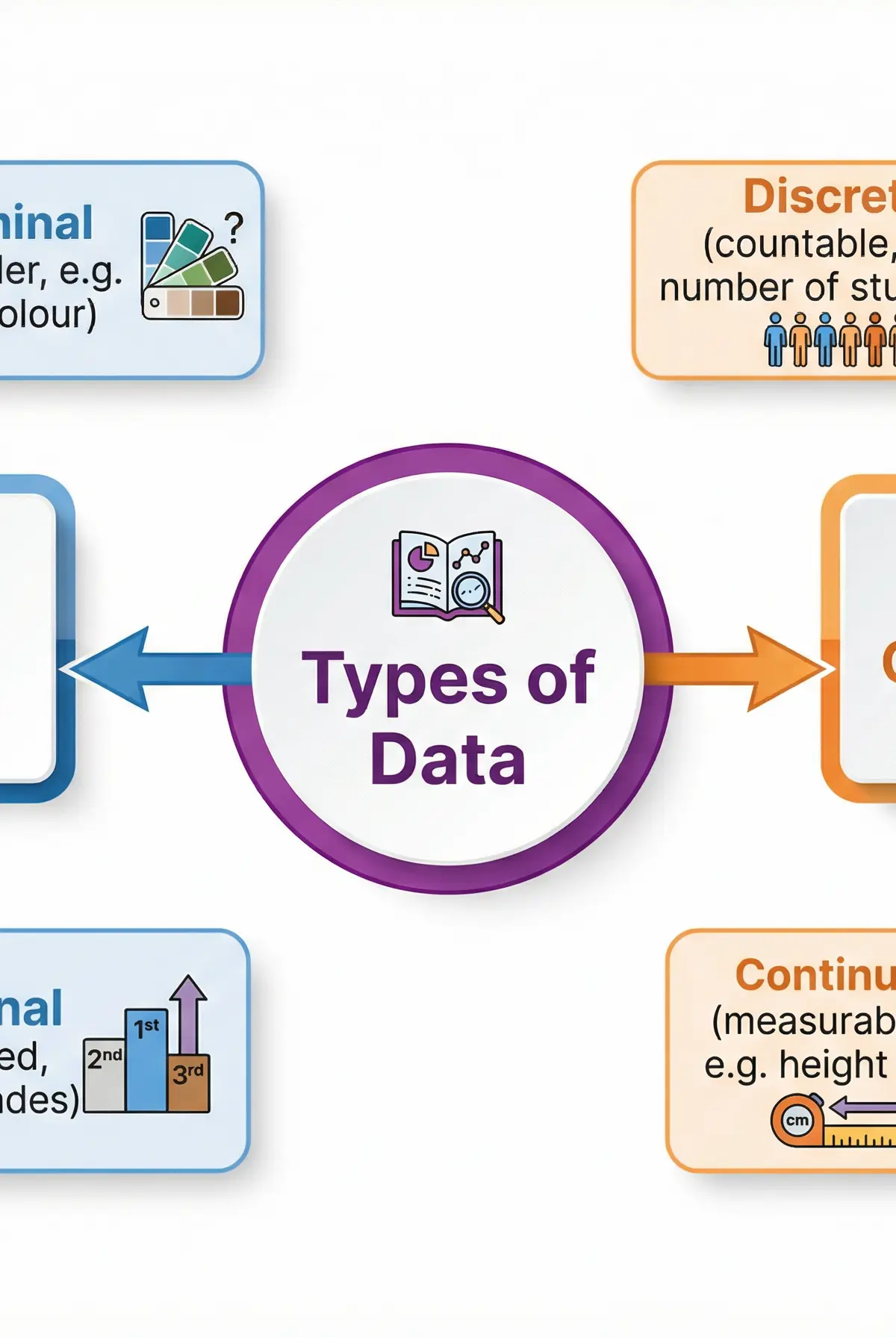
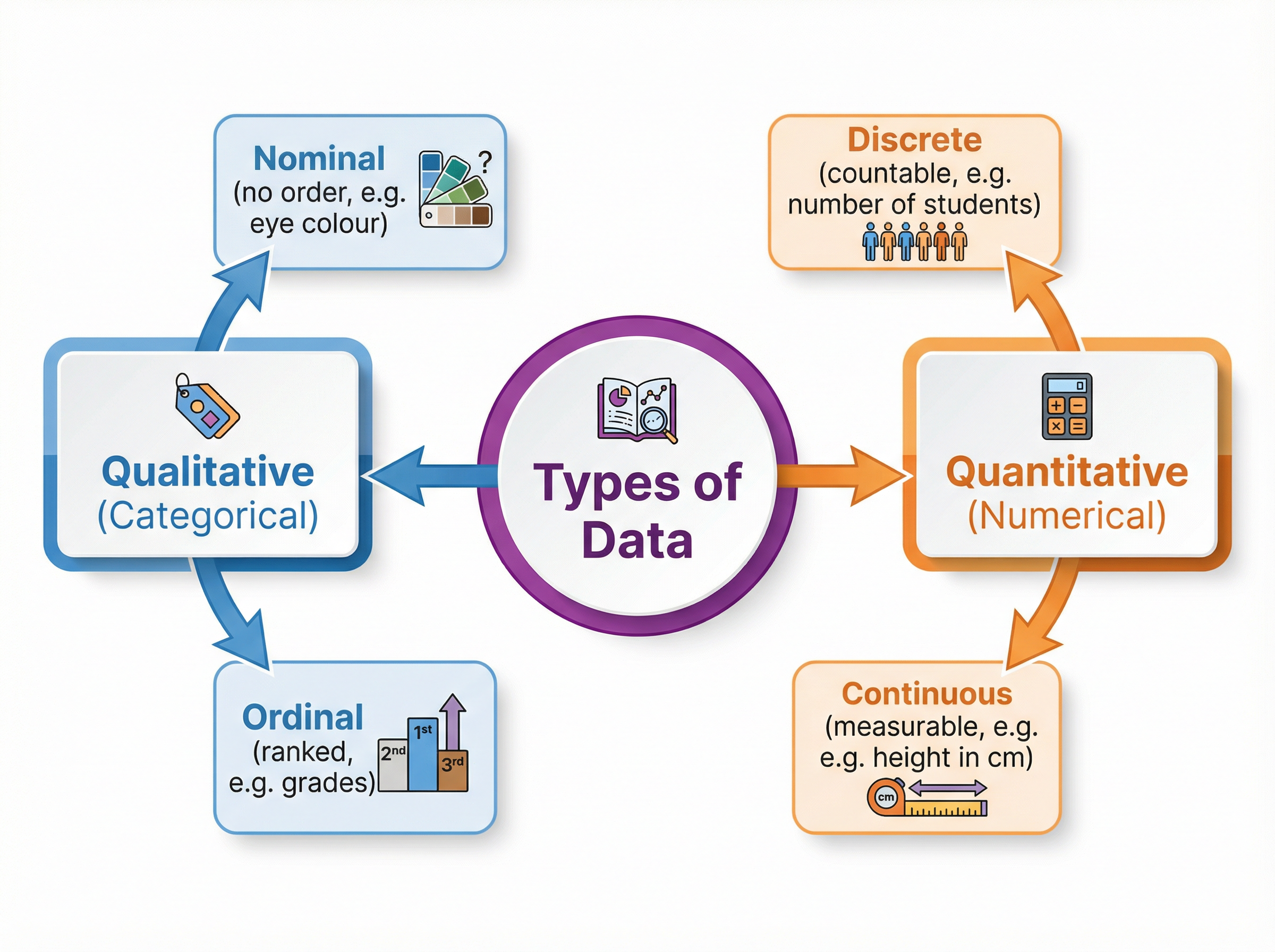
Before you can analyse data, you must know what type of data you are dealing with. Data is broadly split into two categories: qualitative and quantitative. Qualitative data is descriptive and categorical, such as eye colour or favourite subject. Quantitative data is numerical and is further divided into discrete and continuous data.
Discrete data can only take specific, exact values. It is typically counted. For example, the number of students in a classroom or the number of goals scored in a match. You cannot score 2.5 goals. Continuous data can take any value within a range and is typically measured. Examples include height, weight, and time. A person's height could be 165 cm, 165.2 cm, or 165.24 cm, depending on the precision of your measuring instrument.
Example: Classify the following data: "The time taken to run 100 metres."
This is quantitative (it is numerical) and continuous (time is measured and can take any value, e.g., 12.34 seconds).
Concept 2: Measures of Central Tendency (Averages)
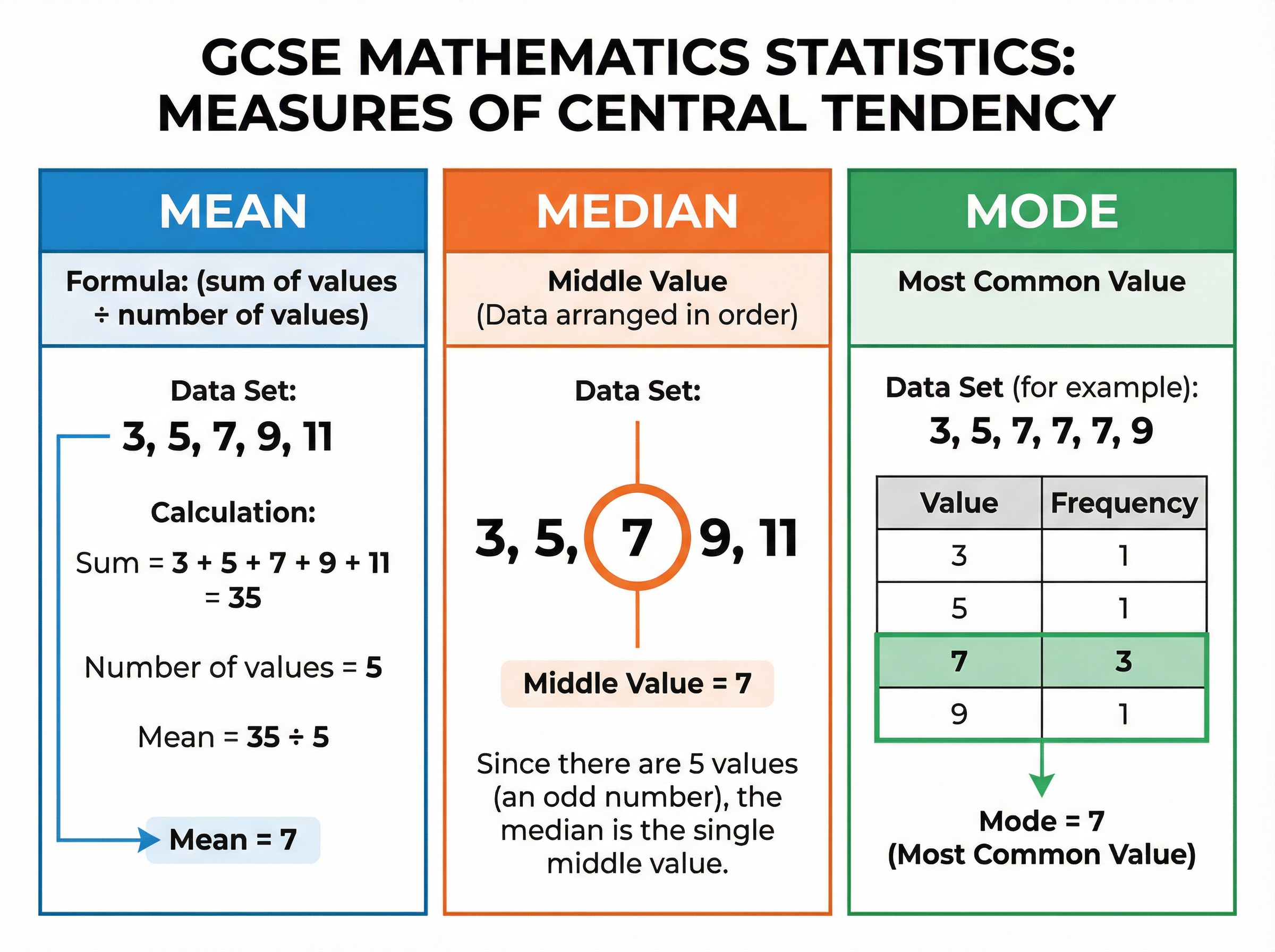
An average is a single value that represents a whole set of data. You must know three types: the mean, the median, and the mode.
- The Mean: Calculated by adding all the values together and dividing by the total number of values. It uses every piece of data, making it mathematically strong, but it is easily skewed by extreme values (outliers).
- The Median: The middle value when the data is ordered from smallest to largest. If there is an even number of values, the median is the mean of the two middle values. It is excellent for skewed data, such as salaries, because it ignores outliers.
- The Mode: The most frequently occurring value. It is the only average that can be used for qualitative data.
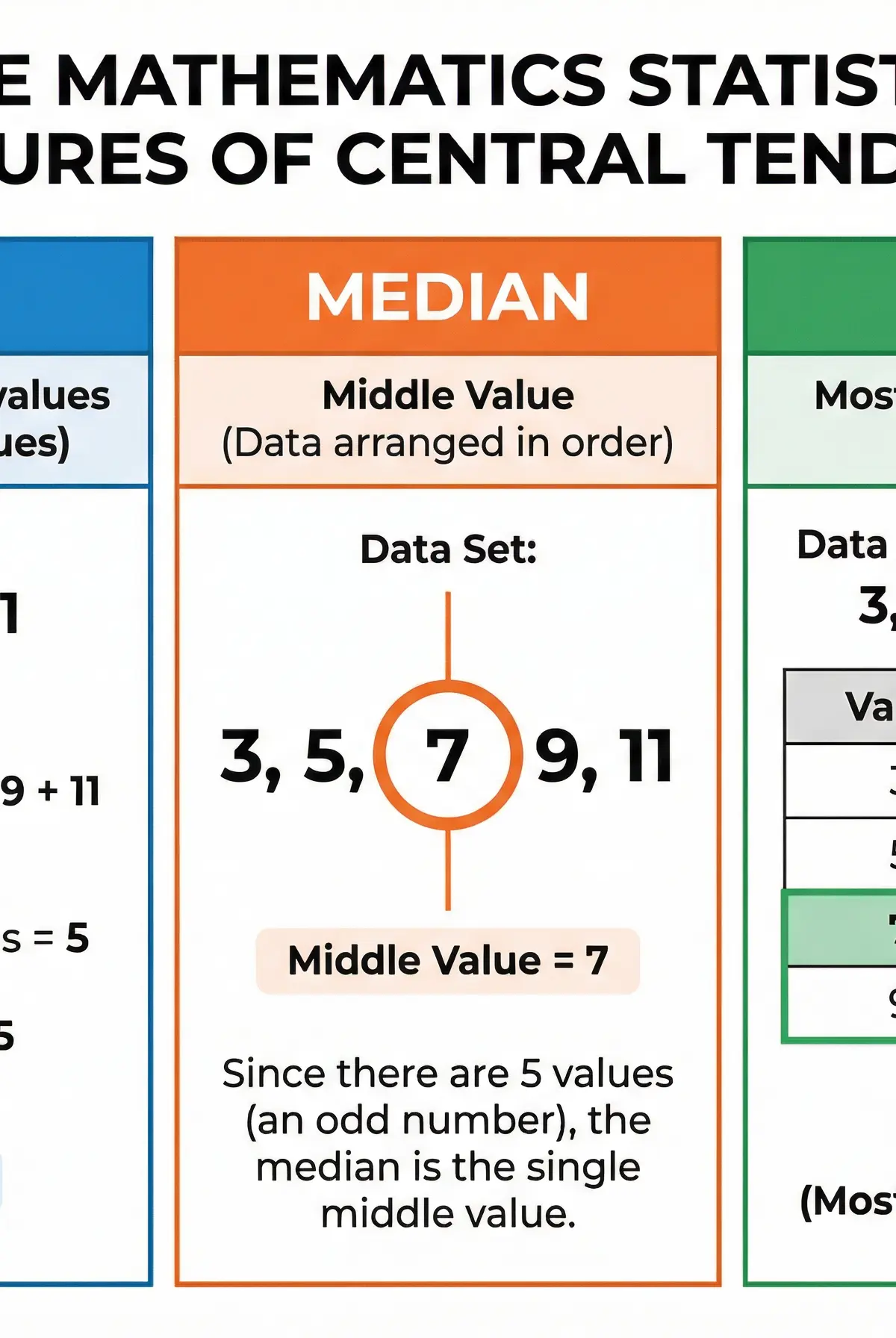
Example: Find the median of the data set: 4, 1, 7, 2, 9, 4, 8.
First, order the data: 1, 2, 4, 4, 7, 8, 9. There are 7 values, so the middle value is the 4th one. The median is 4.
Concept 3: Measures of Spread
An average only tells half the story; you also need to know how spread out the data is. A small spread means the data is consistent; a large spread means it is varied.
- The Range: The difference between the highest and lowest values (Highest - Lowest). Like the mean, it is heavily affected by outliers.
- The Interquartile Range (IQR): The difference between the upper quartile (the value 75% of the way through the ordered data) and the lower quartile (the value 25% of the way through). IQR = UQ - LQ. It measures the spread of the middle 50% of the data and is not affected by outliers.
Concept 4: Statistical Diagrams
Examiners will test your ability to both draw and interpret various charts.
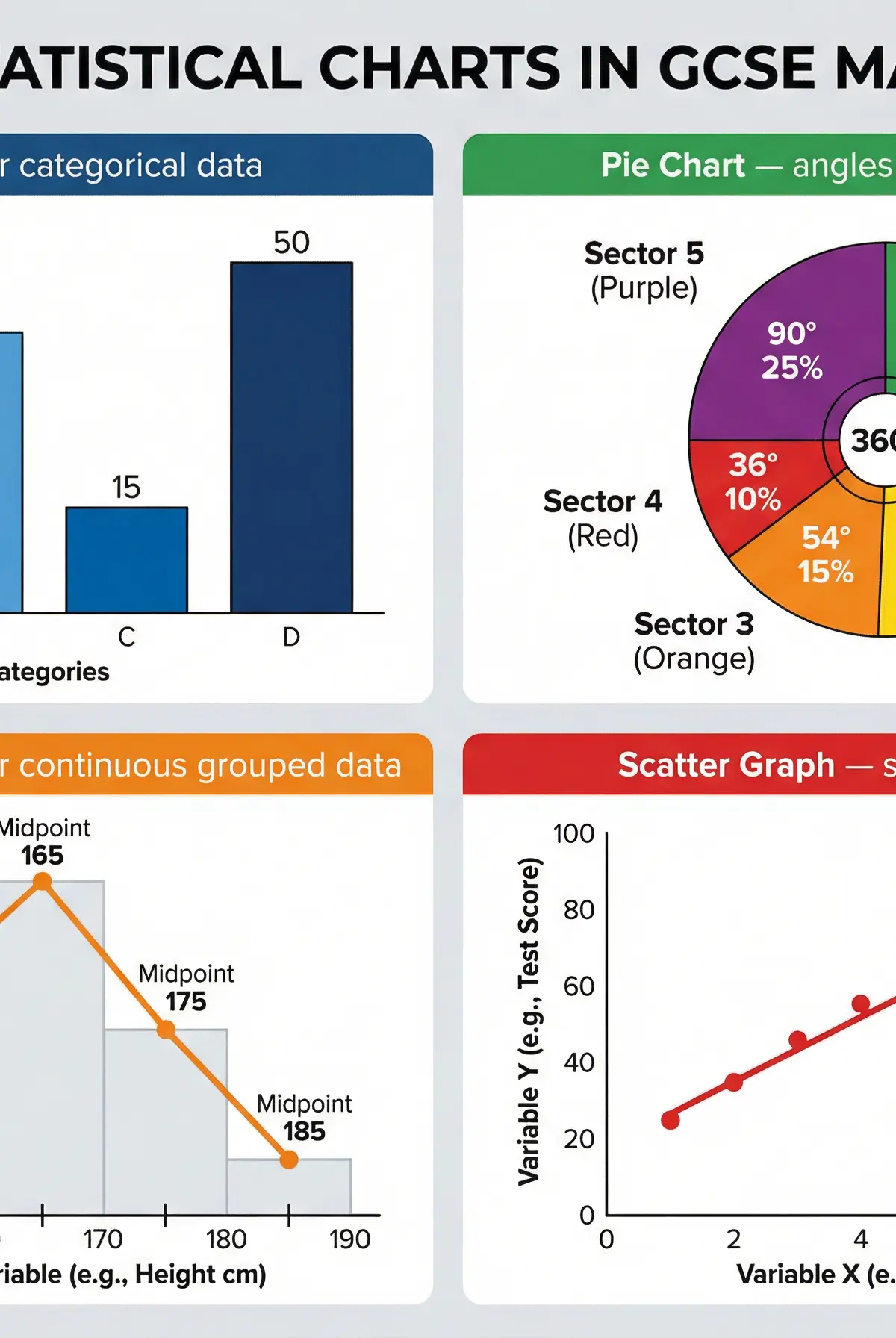
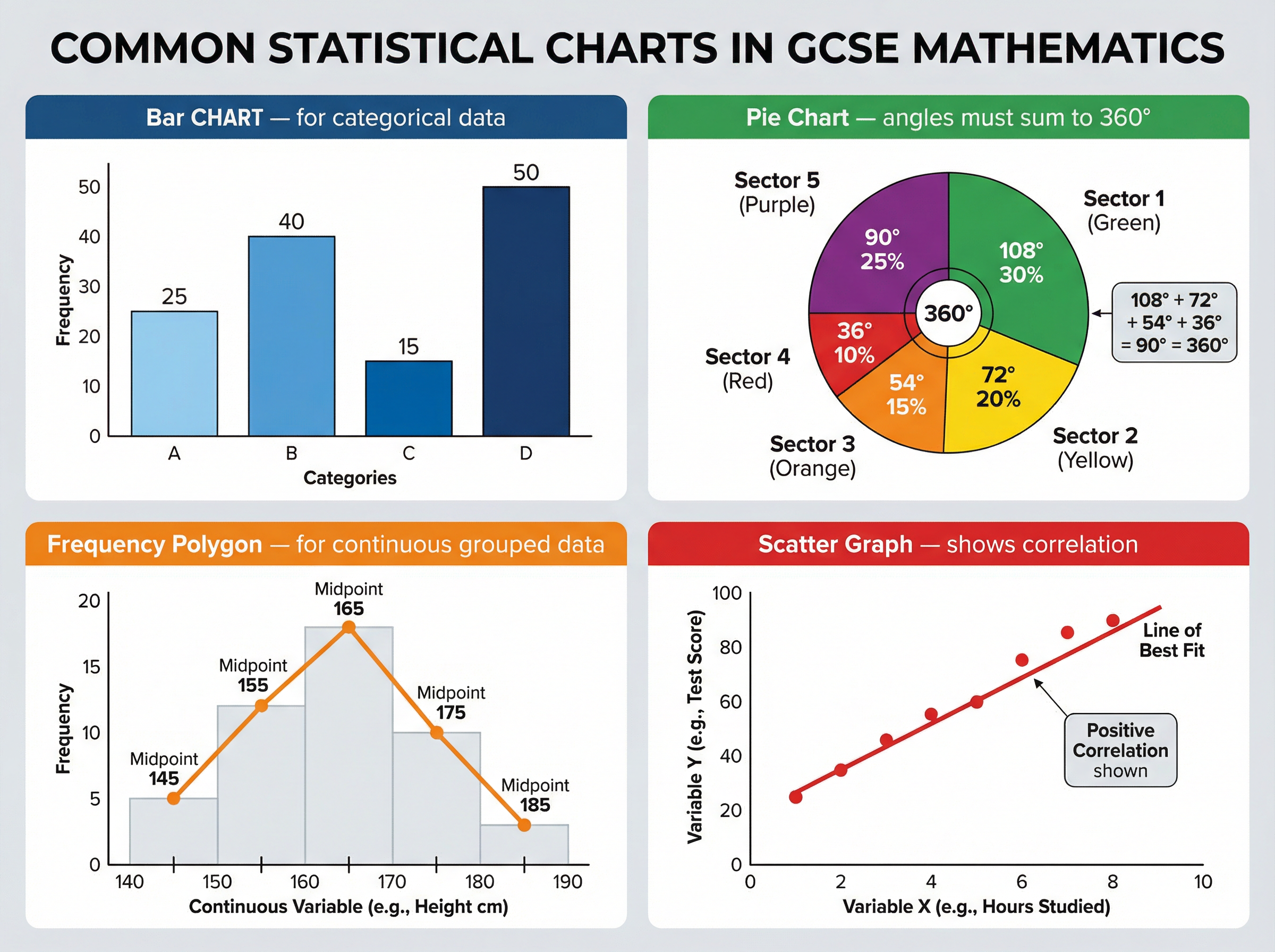
- Bar Charts: Used for discrete or qualitative data. Bars must have equal width and equal gaps between them.
- Pie Charts: Used to show proportions of a whole. The total angle is 360°. To find the angle for a sector, use the formula: (Frequency ÷ Total Frequency) × 360°.
- Histograms (Higher Tier): Used for continuous grouped data. Crucially, the area of the bar represents the frequency. The vertical axis is Frequency Density, calculated as Frequency ÷ Class Width.
- Scatter Graphs: Used to plot bivariate data (two variables) to identify correlation. You may need to draw a line of best fit, which should be a single straight line passing through the middle of the data points.
Mathematical Relationships
- Mean from a Frequency Table: \bar{x} = \frac{\sum fx}{\sum f} (Sum of frequency × value, divided by sum of frequencies)
- Frequency Density (Histograms): FD = \frac{\text{Frequency}}{\text{Class Width}}
- Pie Chart Sector Angle: \text{Angle} = \frac{\text{Frequency}}{\text{Total Frequency}} \times 360^\circ
Practical Applications
Statistics is used extensively in the real world. Actuaries use it to calculate insurance premiums based on risk probabilities. Quality control inspectors use sampling and averages to ensure manufactured products meet standards without testing every single item. In sports, analysts use scatter graphs and correlation to determine which training metrics lead to the highest performance on match day.
Visual Resources
3 diagrams and illustrations
Interactive Diagrams
2 interactive diagrams to visualise key concepts
Conceptual Flow Outline
Flowchart showing how data types determine the correct statistical diagram to use.
Conceptual Flow Outline
Decision process for handling grouped frequency tables.
Worked Examples
3 worked examples — open one to explore the question and available guidance.
Practice Questions
Test your understanding — click to reveal model answers
A set of five numbers has a mean of 6, a median of 5, and a mode of 4. What could the five numbers be?
Hint: Start with the median, then use the mode. Finally, use the mean to find the total sum needed.
Explain why the line of best fit on a scatter graph should not be extended far beyond the plotted data points to make predictions.
Hint: Think about what might happen to the trend outside the data you have actually measured.
The mean weight of 10 boys is 65 kg. The mean weight of 15 girls is 58 kg. Calculate the mean weight of all 25 students.
Hint: Find the total weight of the boys and the total weight of the girls first.
In a histogram, the class interval 0 < x \le 20 has a frequency of 40. The bar drawn for this interval has a height of 2 cm. For the interval 20 < x \le 50, the frequency is 90. Calculate the height of the bar for this second interval.
Hint: First, find the frequency density for both intervals. Then, determine the scale factor between frequency density and the height in cm.
A bag contains only red, blue, and green counters. A pie chart is drawn to show the number of each colour. The angle for red is 120°. The angle for blue is 150°. There are 15 green counters. How many counters are in the bag in total?
Hint: Find the angle for the green counters first, then use it to find what one degree represents.