Pearson Edexcel · A-Level · Music
Technical Proficiency
This guide provides a comprehensive breakdown of Technical Proficiency for Edexcel A-Level Music (Component 1). It details the five core assessment areas, offering examiner insights and practical strategies to help candidates achieve 'Assured' technical control and maximise their performance marks.
- 8 min read
- 3 worked examples
- 4 practice questions
- 6 key terms
Study Notes
Overview
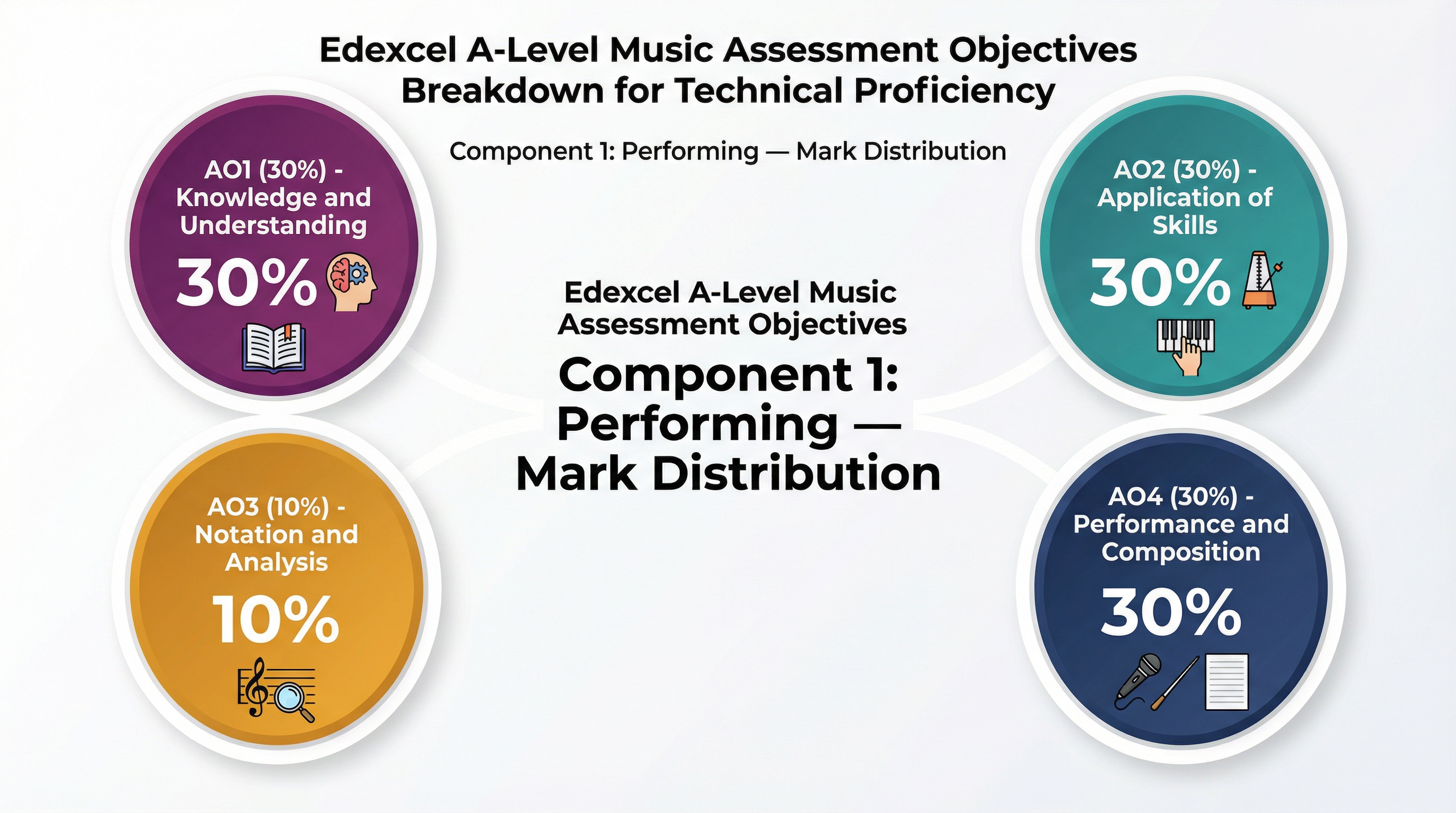
Technical Proficiency is the bedrock of your performance marks in Edexcel A-Level Music. Assessed under the 'Technical Control' criteria in Component 1, it accounts for a significant portion of your 30% weighting for the performing component. Examiners are not just listening for correct notes; they are evaluating the quality, precision, and musicality of your instrumental or vocal control. This guide will deconstruct the assessment criteria, providing a clear roadmap to help you move from 'Developing' or 'Secure' control into the top 'Assured' mark band.

Key Knowledge & Theory
Core Concepts
Mastering Technical Proficiency requires understanding the five pillars upon which your performance is judged. These are not just abstract ideas but concrete, assessable skills.
- Pitch Accuracy: Playing the correct notes as written in the score. Examiners differentiate between momentary slips (minor errors) and systematic errors (consistent mistakes), with the latter being penalised more heavily as it suggests a fundamental misunderstanding or poor learning of the repertoire.
- Rhythm Accuracy: The precision of note durations, rests, and the overall rhythmic pulse. This includes maintaining a steady tempo, executing complex rhythmic patterns accurately, and conveying the correct metrical feel of the piece.
- Tone Quality (Sonority): The character and quality of the sound produced. An 'Assured' performance demonstrates a rich, varied, and expressive tone across the full dynamic and registral range of the instrument. The tone should never sound forced, thin, or uncontrolled, even at dynamic extremes.
- Intonation: The accuracy of tuning, both in relation to a fixed reference (like a piano) and within the context of an ensemble or accompaniment. For instruments with variable pitch (strings, wind, brass, voice), this requires constant aural awareness and physical adjustment.
- Fluency: The smoothness, continuity, and confidence of the performance. A fluent performance is free from hesitations, stumbles, or breakdowns, allowing the musical narrative to unfold without interruption. It is not about speed, but about control at the chosen tempo.
Key Practitioners/Artists/Composers
While Technical Proficiency is about your own skills, understanding how great performers exemplify these qualities is crucial. When analysing performance, reference to these artists can provide excellent models.
| Name | Instrument/Voice | Key Attribute | Relevance |
|---|---|---|---|
| Jascha Heifetz | Violin | Flawless Intonation & Fluency | Heifetz was legendary for his seemingly effortless technical command. His recordings are a masterclass in maintaining perfect intonation even in the most demanding passages of concertos by Tchaikovsky and Sibelius. |
| Martha Argerich | Piano | Dynamic Control & Sonority | Argerich is celebrated for her incredible dynamic range, from the most delicate pianissimo to thunderous fortissimo, all without sacrificing tonal beauty. Her interpretations of Prokofiev and Ravel showcase supreme sonority. |
| Joyce DiDonato | Mezzo-Soprano | Expressive Tone & Agility | A leading opera singer whose control over vocal colour and agility (coloratura) is exemplary. Her performances of Rossini and Handel demonstrate how technical skill serves emotional expression. |
| Glenn Gould | Piano | Rhythmic Precision & Articulation | Famed for his highly individual and rhythmically incisive interpretations of Bach. His recordings highlight how precise articulation and rhythmic drive can illuminate complex contrapuntal textures. |
Technical Vocabulary
Using precise terminology is essential for high-level analysis and will be rewarded by examiners in both performance commentary and written exams.
- Tessitura: The most comfortable and commonly used vocal or instrumental range in a piece.
- Sonority: The overall quality and resonance of the sound produced.
- Intonation: The accuracy of pitch, or 'tuning'.
- Articulation: The manner in which notes are begun, sustained, and ended (e.g., legato, staccato, accent).
- Rubato: The temporary disregarding of strict tempo to allow for expressive nuance.
- Coloratura: Elaborate ornamentation of a vocal line, often involving rapid scales and trills.
- Embouchure: The shaping of the lips and facial muscles used by wind and brass players to produce a sound.
Practical Skills
Techniques & Processes
- Slow Practice with a Metronome: This is non-negotiable. Set the metronome to a very slow tempo where you can play a difficult passage with 100% accuracy in pitch, rhythm, and intonation. Only once you can do this flawlessly multiple times should you gradually increase the speed. This builds secure muscle memory.
- Dynamic Isolation: Practice a single phrase or even a single note at the extremes of the dynamic range. Can you play a long note at fortissimo without the tone becoming harsh? Can you play it at pianissimo without the sound disappearing? Record and listen back.
- Intonation Droning: For non-fixed-pitch instruments, practice scales and passages against a drone (a sustained note, often the tonic or dominant). This forces your ear to become highly sensitive to tuning discrepancies.
- Recording & Critical Auditing: Your ears can deceive you in the heat of performance. Regularly record your practice sessions and listen back with the score. Be your own harshest critic. Where did the rhythm rush? Where did the intonation slip? Where did the tone weaken?
Materials & Equipment
- A High-Quality Recording Device: Your smartphone is a good start, but a dedicated audio recorder (like a Zoom H1n or similar) will provide a much clearer and more honest representation of your sound.
- A Reliable Metronome: Use a physical metronome or a reputable app. Ensure it has features for subdivision to help with complex rhythms.
- Tuning Drone Generator: Apps or websites can produce a stable pitch for intonation practice.
- Your Instrument in Good Condition: Ensure your instrument is properly maintained. Old strings, sticky valves, or leaking pads are a direct impediment to technical control.
Portfolio/Coursework Guidance
Assessment Criteria
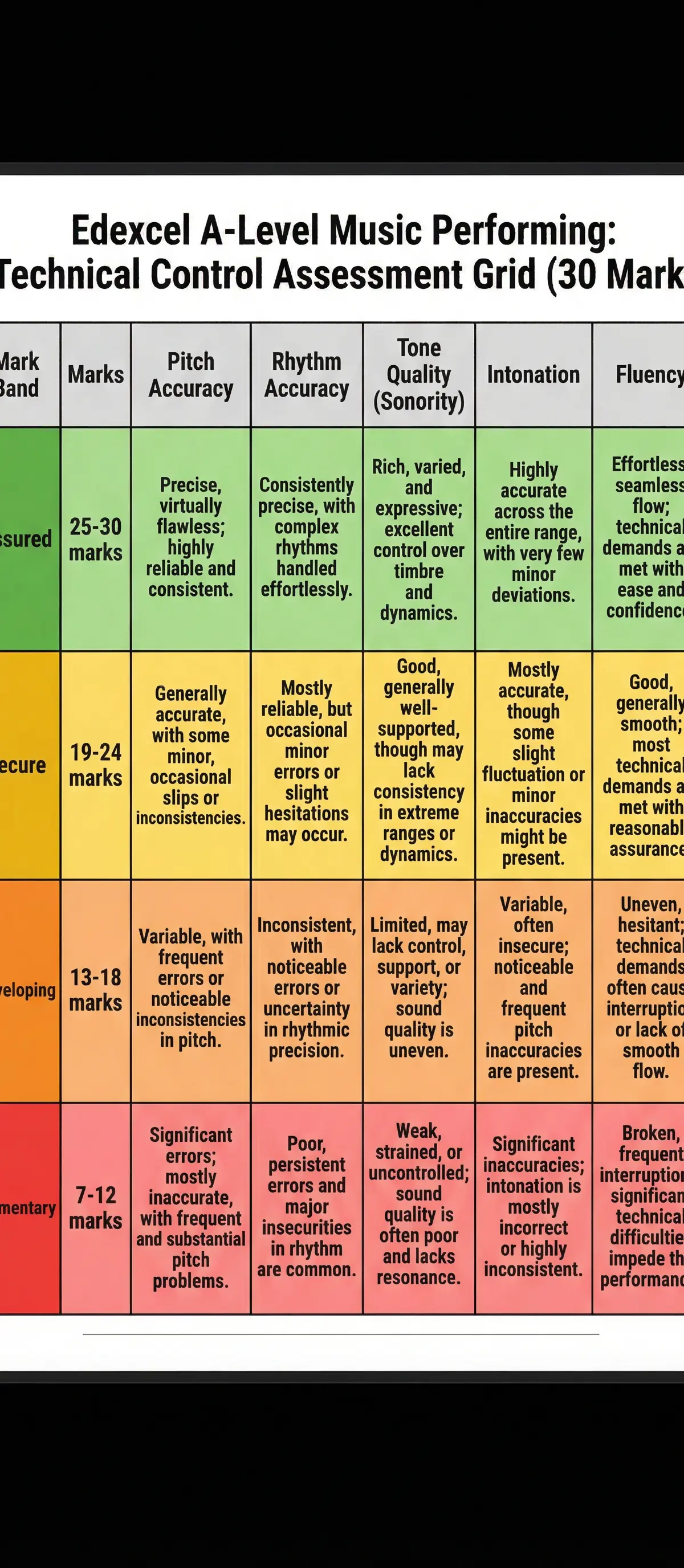
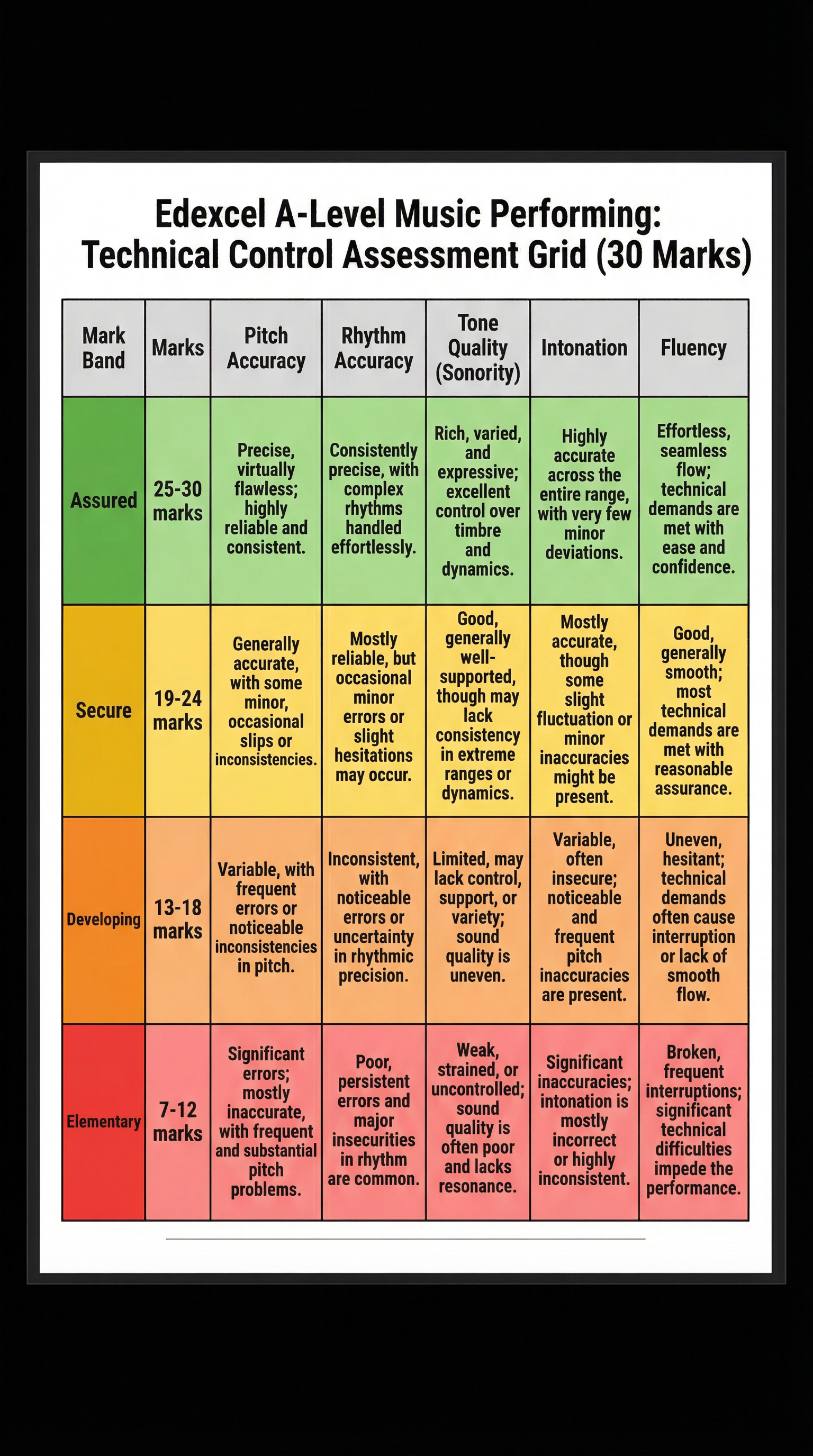
For your Component 1 recital, examiners are marking you against the grid below. To hit the top bands, you must demonstrate 'assured' control across all criteria. Notice how the language intensifies: 'virtually flawless' and 'effortless' are descriptors for the highest marks.
Building a Strong Portfolio
Your portfolio is your performance recording. The quality of this recording is paramount.
- Repertoire Selection: Choose pieces that showcase your strengths but do not push you beyond your reliable technical limit. A polished performance of a slightly less difficult piece is always better than a flawed performance of a more ambitious one.
- Recording Environment: Choose a room with a flattering but clear acoustic. Avoid rooms that are too 'live' (echoey) or too 'dead' (dry and unflattering). Do a test recording.
- Microphone Placement: The microphone(s) should be positioned to capture a realistic and balanced sound. The examiner needs to hear your part clearly, but also in context with any accompaniment. A common mistake is placing the mic too close, which can create a harsh and unforgiving sound.
- Take Selection: You are allowed to record multiple takes. Listen back to them all carefully. Choose the take that best represents your technical control and musicality, even if it has a tiny slip but is otherwise more fluent and expressive than another.
Exam Component
Written Exam Knowledge
While Technical Proficiency is assessed in performance, your understanding of it is tested in the written exam (Component 3: Appraising). You may be asked to:
- Analyse an unfamiliar extract, commenting on the technical demands placed on the performers.
- Compare two different recordings of the same piece, evaluating the performers' approaches to technical challenges.
- Justify how a performer has used technical skills to create a specific musical or emotional effect.
Practical Exam Preparation
Your performance exam is your recording. Preparation involves three stages:
- Technical Preparation: The slow, methodical practice described above to build accuracy and control.
- Musical Preparation: Moving beyond the notes to shape phrases, plan dynamics, and make interpretative decisions.
- Performance Preparation: Practicing performing the entire programme without stopping, to build stamina and simulate performance conditions. Record these run-throughs to identify where fluency breaks down under pressure.
Visual Resources
2 diagrams and illustrations
Interactive Diagrams
1 interactive diagram to visualise key concepts
Conceptual Flow Outline
The Iterative Practice Cycle for Technical Proficiency
Worked Examples
3 worked examples — open one to explore the question and available guidance.
Practice Questions
Test your understanding — click to reveal model answers
Identify three distinct aspects of 'sonority' that an examiner would be listening for.
Hint: Think about the quality of sound at different volumes and in different registers.
Explain how poor microphone placement during a performance recording could negatively impact the assessment of a pianist's technical proficiency.
Hint: Consider how the microphone placement might obscure or distort key details the examiner needs to hear.
A string quartet is performing a piece by Haydn. Evaluate the potential challenges to their collective technical proficiency in terms of intonation and fluency.
Hint: Think about the interplay between the four instruments. What new challenges arise when playing in a small ensemble compared to playing solo?
Analyse how a performer might use technical control to convey a sense of growing excitement in a piece of music.
Hint: Connect specific technical skills to the desired emotional effect. How do you make music sound 'exciting'?