OCR · A-Level · Music
Popular Music
This essential guide covers Area of Study 2: Popular Song, focusing on the evolution of Blues, Jazz, Swing, and Big Band music from 1900 to the 1950s. Mastering this topic requires understanding the 12-bar blues structure, improvisation techniques, key rhythmic features like swing and syncopation, and the roles of instruments in large ensembles.
- 7 min read
- 3 worked examples
- 4 practice questions
- 6 key terms
Study Notes
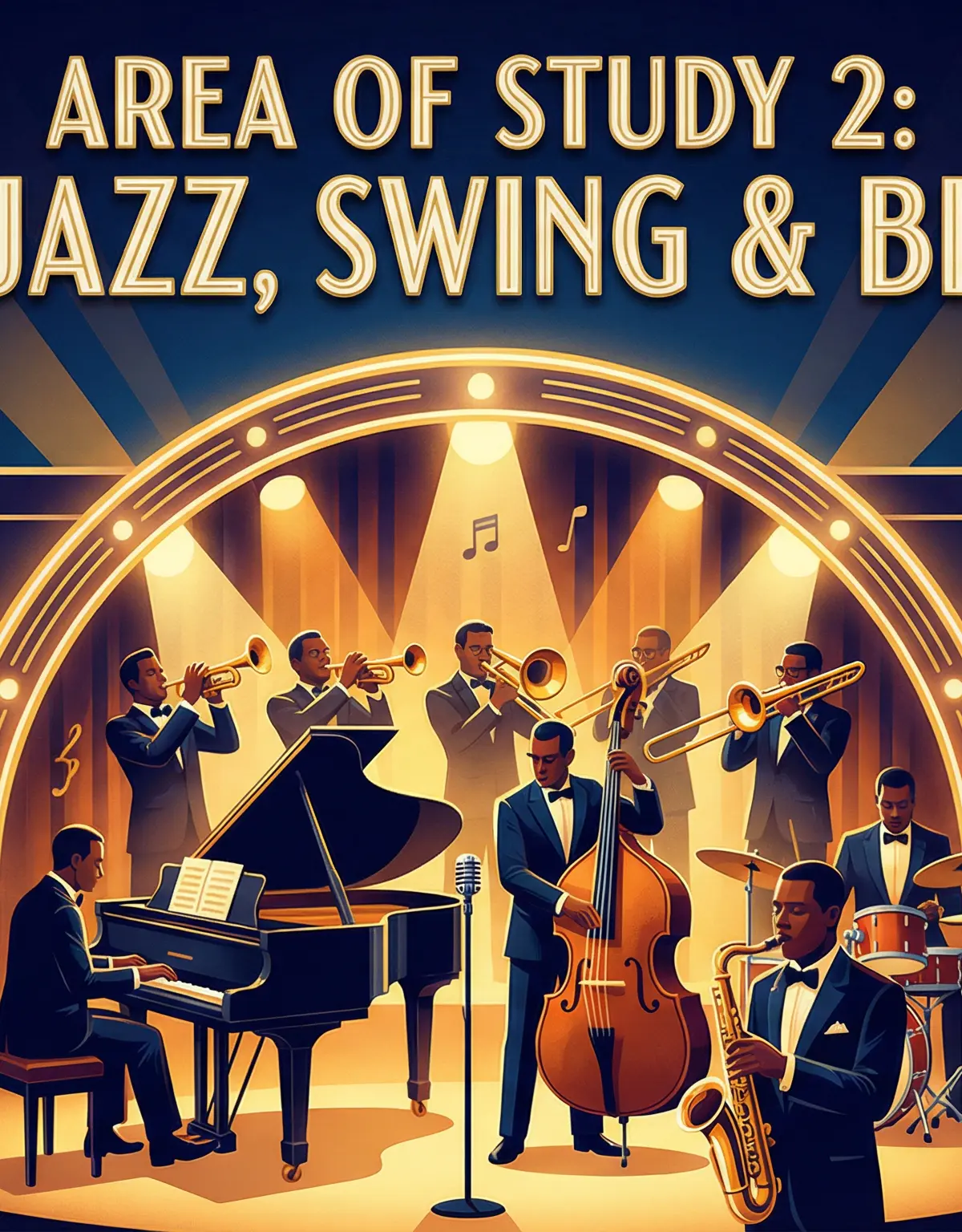
Overview
Area of Study 2 explores the vibrant and influential world of popular song, tracing its roots from the raw emotion of the Blues in the American South to the sophisticated arrangements of Big Band Swing. This topic is not just about history; it's about understanding the musical DNA of nearly all modern popular music. You will learn how African and European musical traditions collided to create entirely new forms of expression.
Key themes include the development of harmony (the 12-bar blues), the art of improvisation, the evolution of rhythm (swing and syncopation), and the changing role of instruments from small combo jazz to large orchestras. Success in this unit depends on your ability to identify these features by ear and explain their effect using precise musical vocabulary.

Key Knowledge & Theory
Core Concepts
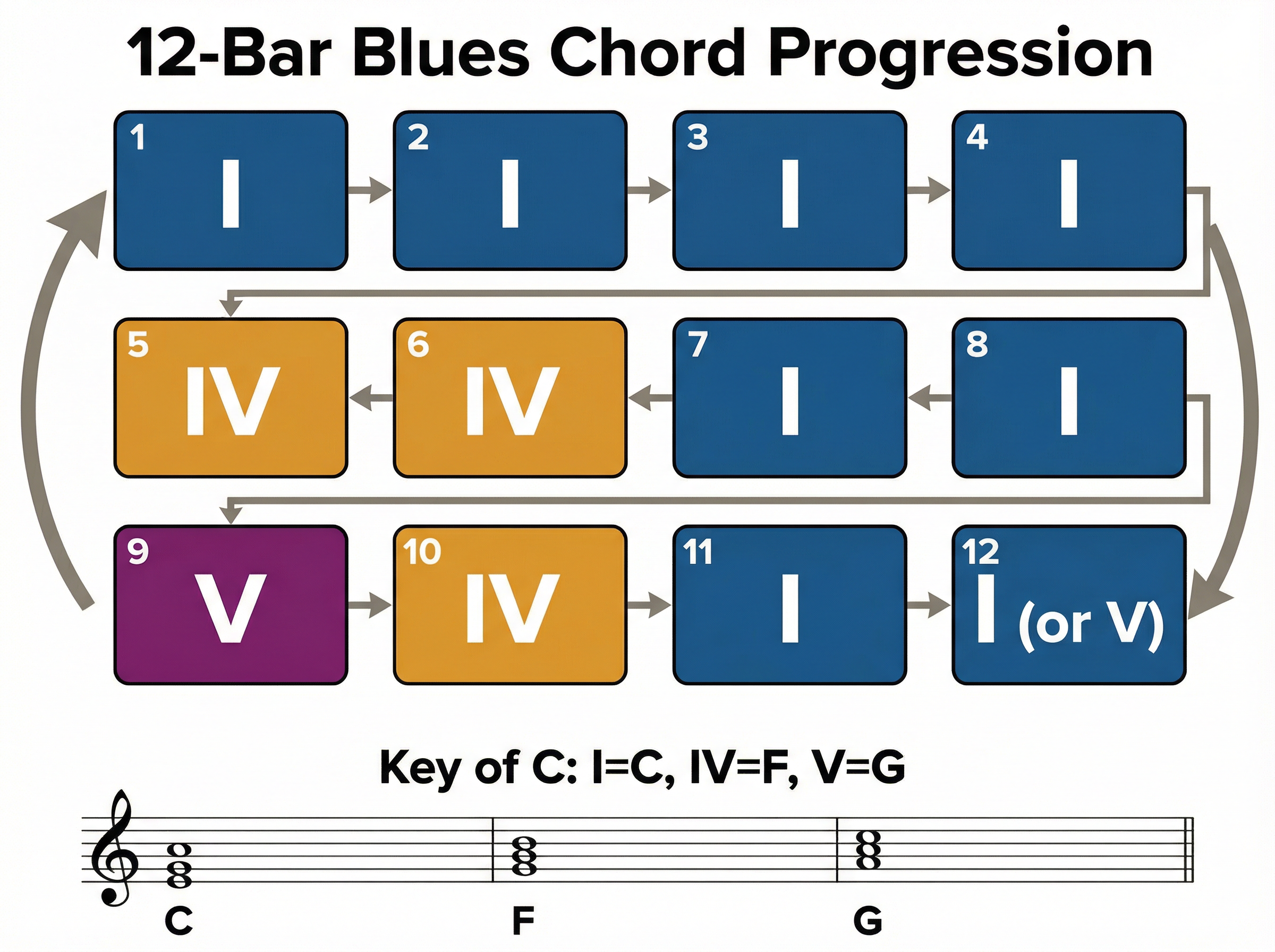
The BluesOriginating in the late 19th century, the Blues is the foundation of jazz and rock. Its defining feature is the 12-bar blues chord progression, a cyclic pattern using chords I, IV, and V. Melodically, it uses the blues scale, which incorporates flattened 3rds, 5ths, and 7ths (blue notes) to create expressive tension. Lyrically, it often follows an AAB structure.
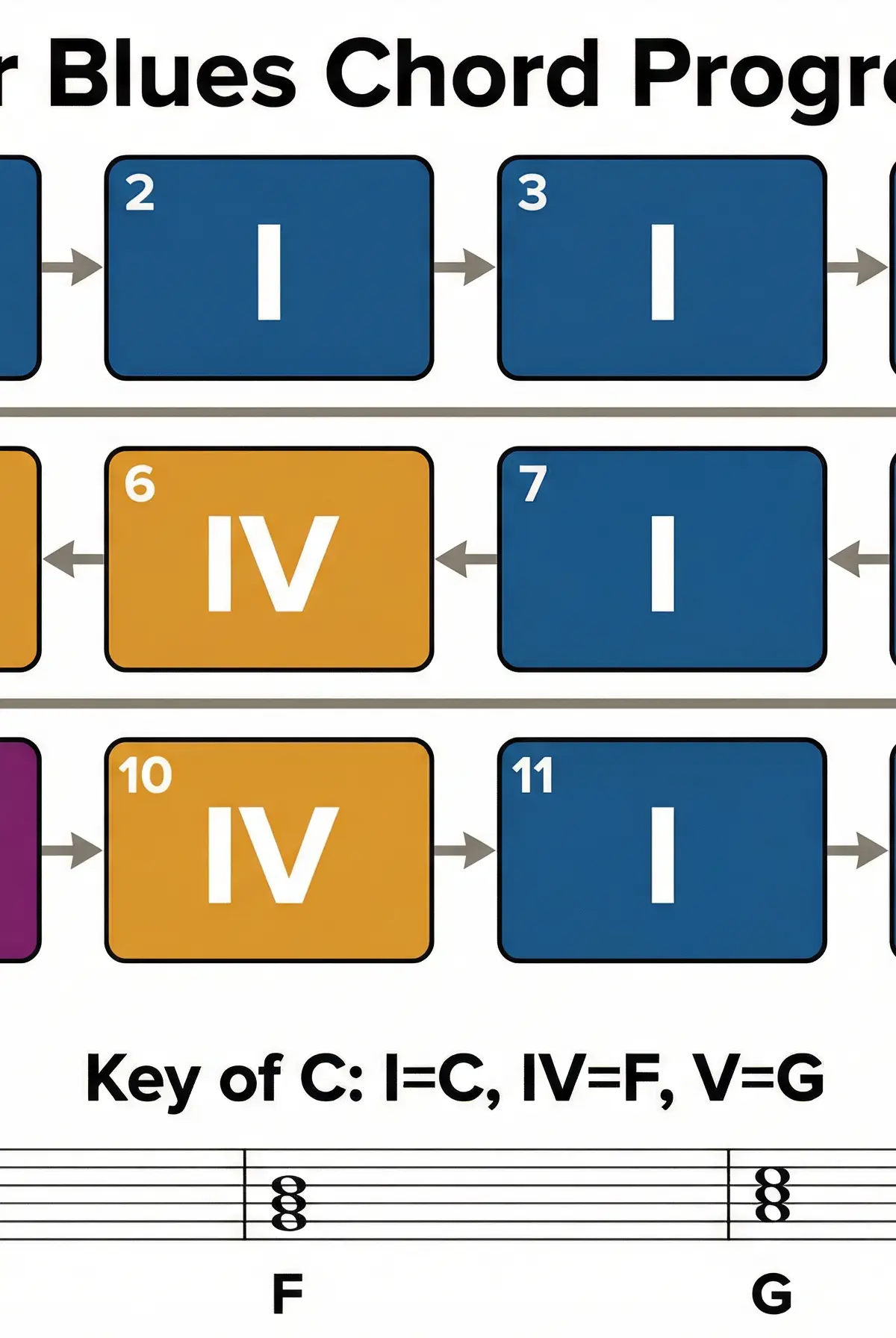
Jazz & ImprovisationJazz emerged in New Orleans, blending blues with ragtime and brass band music. A central element is improvisation—creating music spontaneously over a chord sequence. Early jazz (Dixieland) featured collective improvisation, where multiple instruments improvised simultaneously. Later styles focused more on individual solos.
Swing & Big BandIn the 1930s, jazz evolved into Swing—dance music played by large ensembles known as Big Bands. These bands relied on written arrangements (charts) rather than pure improvisation. The rhythm section (piano, bass, drums, guitar) provided a driving beat, while brass and reed sections played call-and-response riffs. The rhythm is characterised by a swing feel, where pairs of quavers are played long-short.
Key Practitioners/Artists/Composers
| Name | Period/Style | Key Works | Relevance |
|---|---|---|---|
| Robert Johnson | Delta Blues | Cross Road Blues | Seminal blues guitarist/singer; master of the 12-bar form and slide guitar technique. |
| Bessie Smith | Classic Blues | St. Louis Blues | The 'Empress of the Blues'; demonstrated powerful vocal delivery and expressive phrasing. |
| Louis Armstrong | Early Jazz | West End Blues | Trumpet virtuoso and vocalist; pioneered the extended improvised solo and scat singing. |
| Duke Ellington | Swing/Big Band | Take the 'A' Train | Prolific composer/arranger who wrote idiomatically for specific band members; elevated jazz to art music. |
| Glenn Miller | Swing/Big Band | In the Mood | Popularised the polished, commercial Big Band sound; famous for tight arrangements and catchy riffs. |
| Miles Davis | Cool Jazz/Modal | So What | Innovator who moved jazz away from complex bebop harmonies towards modal improvisation. |
Technical Vocabulary
- 12-Bar Blues: A standard chord progression using chords I, IV, and V (e.g., C, F, G in C major).
- Blue Note: A note flattened by a semitone (usually the 3rd, 5th, or 7th) for expressive effect.
- Improvisation: Creating melody and rhythm spontaneously during performance.
- Syncopation: Emphasising the weak or off-beats to create rhythmic interest.
- Swing Rhythm: A rhythmic feel where quavers are played unevenly (long-short), often notated as straight quavers.
- Riff: A short, repeated melodic or rhythmic phrase, often played by the brass section in Big Bands.
- Walking Bass: A bass line that moves on every beat, typically in stepwise motion or arpeggios, outlining the chords.
- Comping: The rhythmic chordal accompaniment played by piano or guitar to support a soloist.
- Call and Response: A musical conversation where a phrase played by one instrument/section is answered by another.
- Front Line: The melody instruments in a jazz band (trumpet, clarinet, trombone) as opposed to the rhythm section.
Practical Skills
Techniques & Processes
1. Improvising a Solo
- Start Simple: Begin with the root notes of the chord progression to anchor your ear.
- Use the Blues Scale: Apply the minor blues scale (1, b3, 4, b5, 5, b7) over the changes. It works over almost all chords in a blues.
- Rhythmic Variety: Don't just play constant notes. Use space (rests) and syncopation to make your phrases 'speak'.
- Motific Development: Play a short idea (motif), then repeat it with a slight variation (sequence) or change the ending.
2. Comping (Accompaniment)
- Rhythm: Avoid playing on every beat. Aim for the 'and' of beats (e.g., '1 and 2 AND 3 4').
- Voicing: Don't play full triads. Use 'shell voicings' (root and 3rd/7th) or rootless voicings if there is a bass player.
- Interaction: Listen to the soloist. If they leave a gap, fill it. If they are busy, leave space.
Materials & Equipment
- Instruments: Authentic performance requires understanding the role of your instrument. Drummers should master the swing ride pattern. Bassists must lock in the walking line. Pianists need to separate left hand (chords) from right hand (melody/improv).
- Notation: Be comfortable reading lead sheets (melody + chord symbols) for jazz standards, and full scores for Big Band arrangements.
- Listening: Your most important tool is your ears. Listen to the set works and reference tracks repeatedly to internalise the 'feel'.
Portfolio/Coursework Guidance
Assessment Criteria
Examiners are looking for stylistic accuracy. In a performance, are you just playing the notes, or are you capturing the feel? For composition, have you used appropriate harmonic language (extended chords like 7ths, 9ths) and structural devices (32-bar AABA form or 12-bar blues)?
Building a Strong Portfolio
- Evidence of Listening: Show that your performance or composition is informed by listening to key practitioners. Annotate your score with 'in the style of...' notes.
- Development: Don't just loop a 12-bar blues. Show development by adding passing chords, substitutions (e.g., ii-V-I progressions), or varying the texture.
- Ensemble Skills: If performing in a group, demonstrate interaction. Eye contact, physical cues, and dynamic balance are crucial marks for ensemble performance.
Exam Component
Written Exam Knowledge
In the listening exam, you will hear unfamiliar extracts. You must be able to identify:
- Instruments: Can you distinguish a clarinet from a soprano sax? A trumpet from a trombone?
- Texture: Is it homophonic (melody and accompaniment) or polyphonic (collective improvisation)?
- Structure: Is it 12-bar blues? 32-bar song form (AABA)? Verse-chorus?
- Rhythmic Features: Is it swung? Is it syncopated? Is there a walking bass?
Practical Exam Preparation
For the practical component (performance), choose a piece that allows you to demonstrate technical control AND stylistic understanding. A simple piece played with authentic swing feel and dynamic nuance will score higher than a complex piece played mechanically. Record yourself and listen back—is the swing feel consistent? Is the balance between melody and accompaniment correct?
Visual Resources
2 diagrams and illustrations
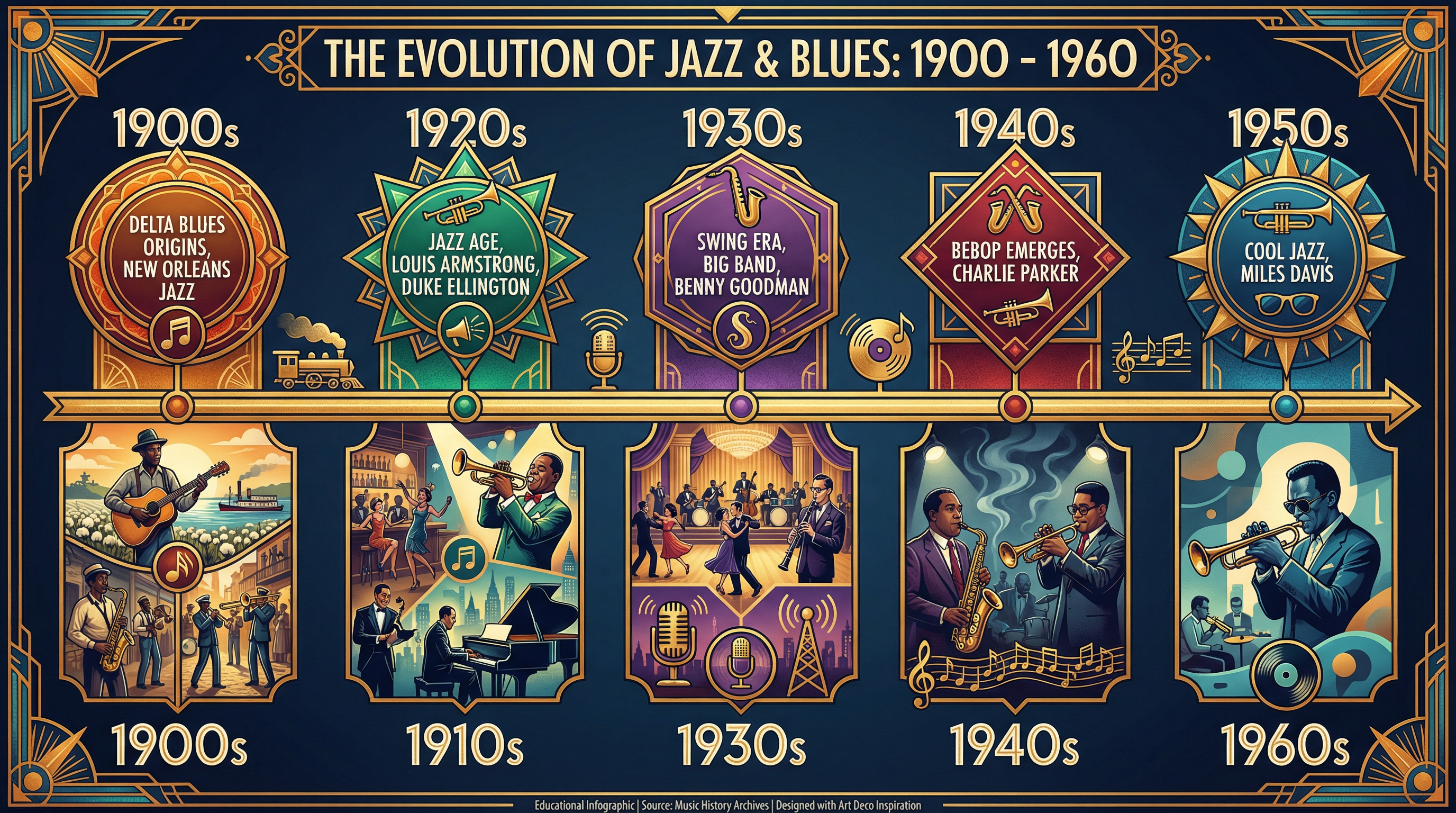
Interactive Diagrams
1 interactive diagram to visualise key concepts
Conceptual Flow Outline
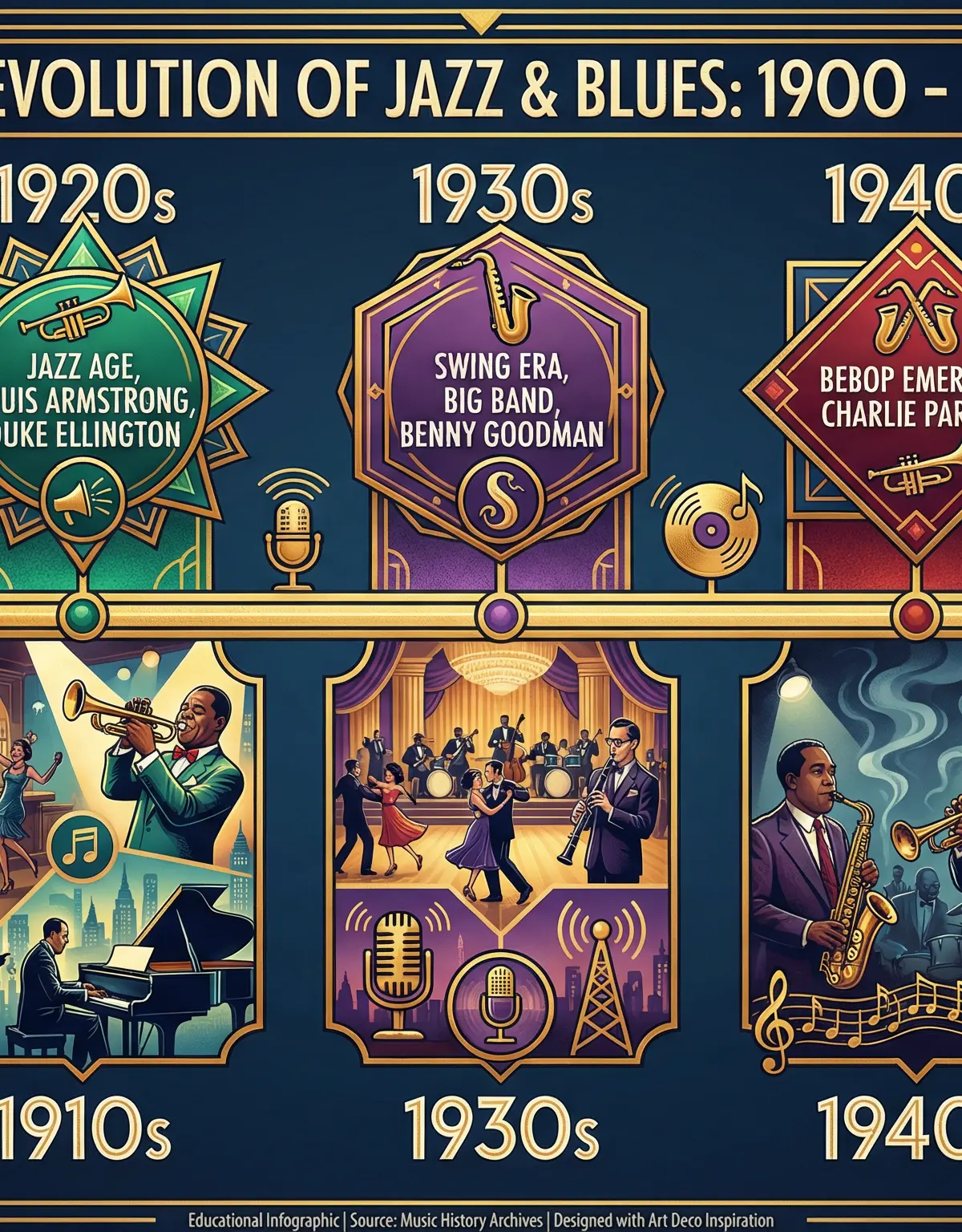
Evolution of Jazz Styles
Worked Examples
3 worked examples — open one to explore the question and available guidance.
Practice Questions
Test your understanding — click to reveal model answers
Describe the role of the rhythm section in a Big Band.
Hint: Think about the specific instruments (drums, bass, piano, guitar) and what they do.
Compare the features of early Delta Blues with Big Band Swing.
Hint: Consider instrumentation, texture, and structure.
Define the term 'call and response' and give an example of how it might be used in a jazz piece.
Hint: Think of a conversation.
Listen to the opening of 'All Blues' by Miles Davis. Identify the time signature and describe the bass line.
Hint: Count the beats in the bar. Is it 4 or 3 (or 6)?