Analyzing Musical Structures — OCR GCSE Study Guide
Exam Board: OCR | Level: GCSE
This guide provides a comprehensive overview of analyzing musical structures for OCR GCSE Music. It covers key classical and popular forms, essential terminology, and exam techniques to help students excel in the Component 03 listening paper.
## Overview
Understanding musical structure is fundamental to success in the OCR GCSE Music listening exam (Component 03). It involves identifying the architectural blueprint of a piece of music – how composers organize their ideas into sections. This guide will equip you with the knowledge to not only label these sections but to analyze how musical elements define them, a key skill for achieving high marks.
{{asset:analyzing_musical_structures_podcast.mp3}}
## Key Knowledge & Theory
### Core Concepts
At its heart, musical structure is about repetition and contrast. Composers create interest by repeating ideas to make them memorable and introducing new ideas to provide variety. The main forms you need to know fall into two categories: Western Classical and Popular Music.
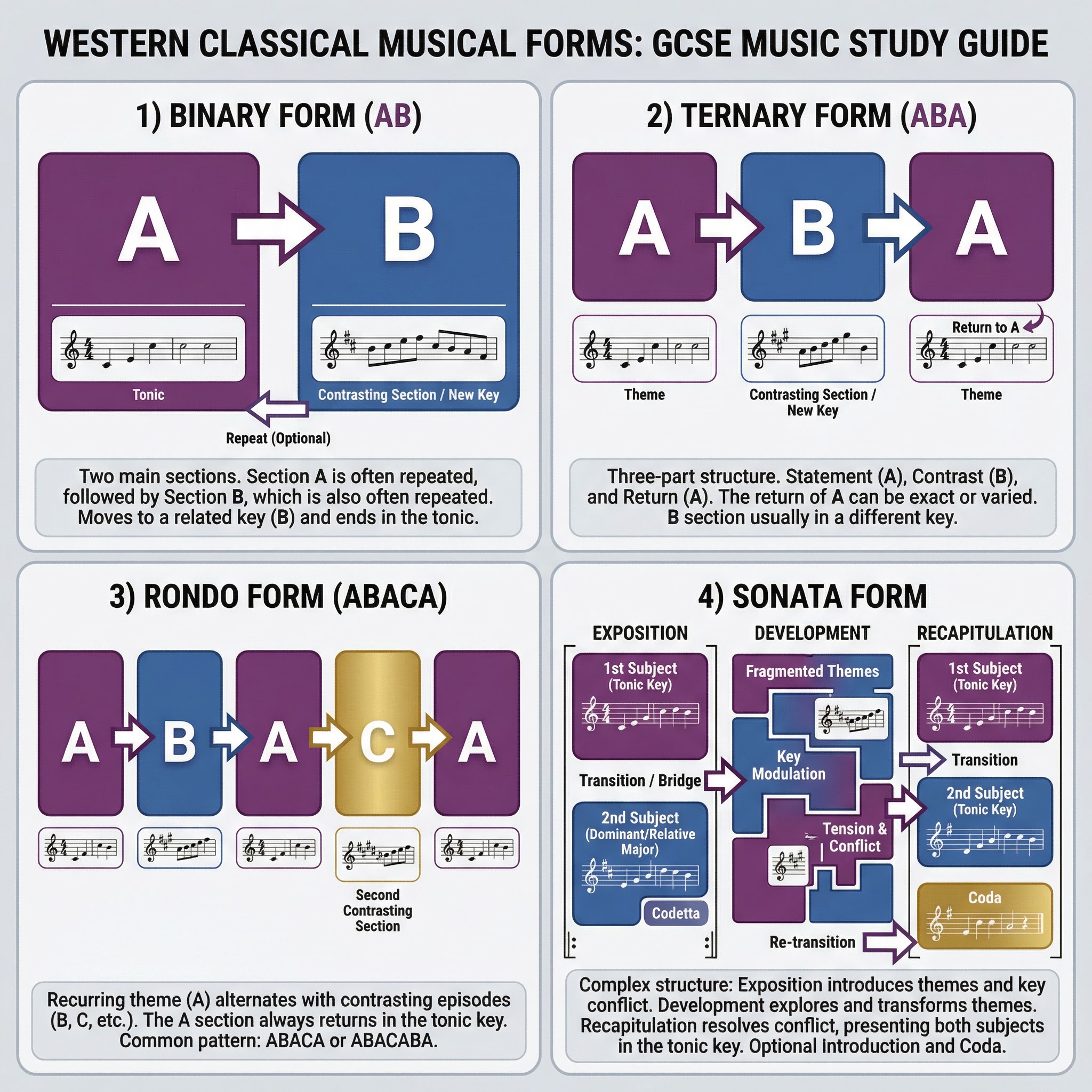
**Western Classical Forms:**
* **Binary Form (AB):** The simplest form, consisting of two contrasting sections. Section A starts in the tonic and modulates to a related key (usually the dominant). Section B starts in the new key and returns to the tonic. Both sections are often repeated.
* **Ternary Form (ABA):** A three-part form: Statement, Contrast, Return. Section A is the main theme, Section B provides contrast in a different key, and then Section A returns, often with added ornamentation.
* **Rondo Form (ABACA):** Characterized by a recurring theme (A), known as the refrain, which always returns in the tonic key. The refrain is interspersed with contrasting episodes (B, C, etc.).
* **Sonata Form:** The most complex of the four, it is a large-scale structure with three main sections: Exposition, Development, and Recapitulation. It is a cornerstone of the Classical period and is frequently found in the first movement of sonatas, symphonies, and concertos.
**Popular Music Forms:**
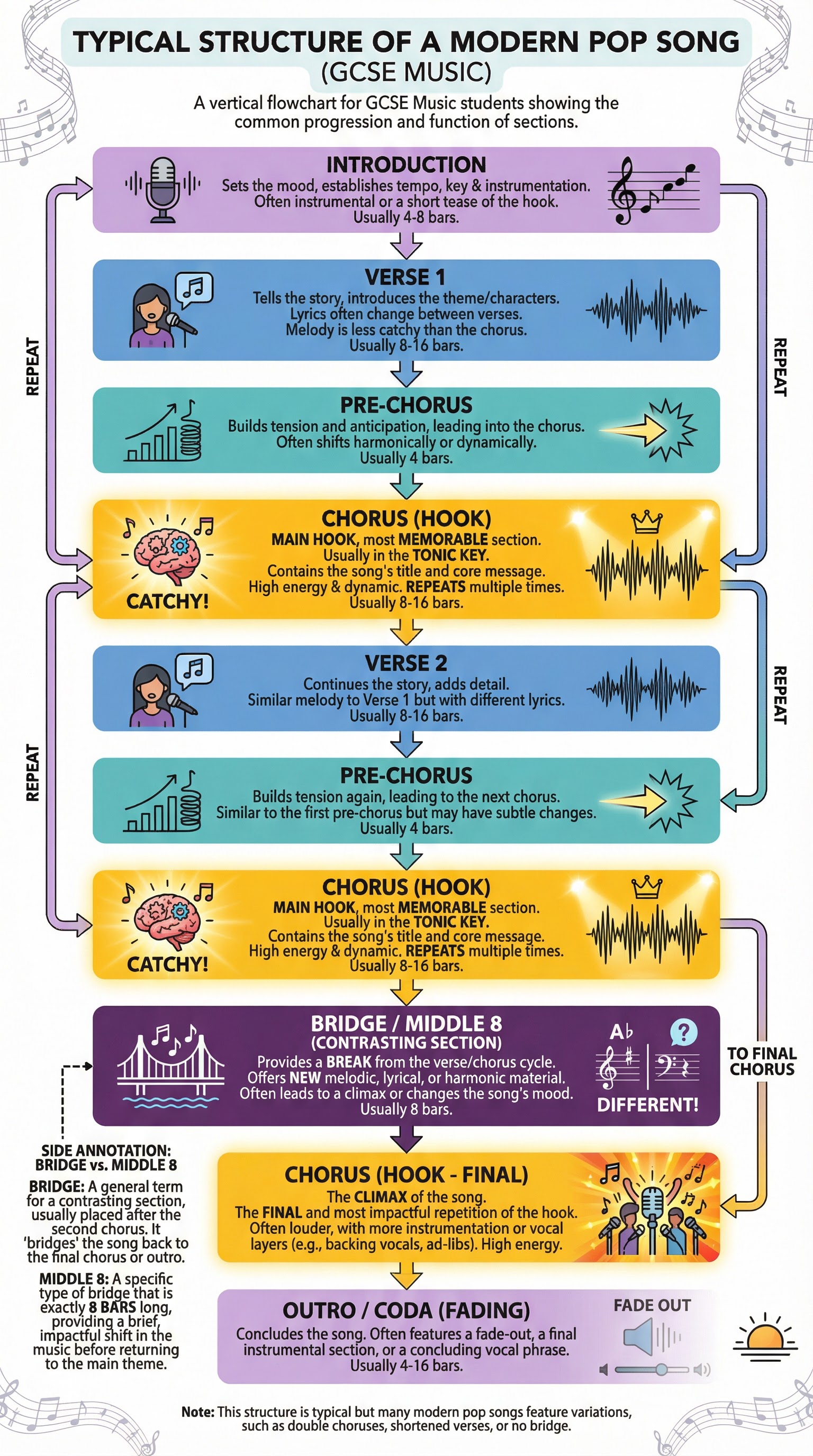
* **Verse-Chorus Form:** The bedrock of modern pop music. It consists of verses that develop the narrative, a memorable and repeated chorus (the hook), often a pre-chorus to build tension, a contrasting bridge, and an introduction/outro.
* **32-Bar Song Form (AABA):** Common in jazz standards and early pop, this form consists of four eight-bar sections. The B section, or middle 8, provides the contrast.
### Key Practitioners/Artists/Composers
| Name | Period/Style | Key Works | Relevance |
|---|---|---|---|
| J.S. Bach | Baroque | Brandenburg Concertos | Master of complex polyphonic textures and forms like Ritornello and Fugue. |
| W.A. Mozart | Classical | Symphony No. 40 in G minor | A perfect example of Sonata Form in the first movement. |
| Ludwig van Beethoven | Classical/Romantic | Piano Sonata No. 8 "Pathétique" | Pushed the boundaries of Sonata Form, expanding the Coda and Development sections. |
| The Beatles | Pop/Rock | "Yesterday" | Exemplifies AABA song form, influencing countless popular artists. |
### Technical Vocabulary
Using precise terminology is crucial for gaining marks. Here are some key terms you must know and use:
* **Structure-related:** Binary, Ternary, Rondo, Sonata Form, Verse-Chorus, Strophic, Through-composed, Ritornello, Fugue, Theme and Variations.
* **Section Labels:** Introduction, Exposition, Development, Recapitulation, Coda, Outro, Verse, Chorus, Pre-Chorus, Bridge, Middle 8, Refrain, Episode.
* **Transitional Devices:** Modulation, Cadence (Perfect, Plagal, Imperfect, Interrupted), Transition/Bridge Passage, Link.
* **Italian Terms:** *Da Capo* (D.C. - from the beginning), *Dal Segno* (D.S. - from the sign), *Fine* (the end), *Coda* (the concluding passage).
## Practical Skills
### Techniques & Processes
Active listening is your most important practical skill. When analyzing a piece in the exam:
1. **First Listen (The Big Picture):** Get a feel for the overall mood, style, and instrumentation. Try to identify the main sections and any obvious repetitions.
2. **Second Listen (Structural Signposts):** Use the provided skeleton score. Look for double bar lines, repeat marks, changes in key signature, tempo, or instrumentation. These are your clues.
3. **Third Listen (Detailed Analysis):** Focus on specific musical elements. How does the melody change between sections? What is the harmony doing? Is there a modulation? How does the texture change? Use this evidence to justify your structural analysis.
### Materials & Equipment
In the exam, your key materials are your ears and the skeleton score. Practice annotating scores as you listen. Develop a shorthand system:
* Circle changes in key signature.
* Box repeat marks.
* Underline Italian terms like *D.C. al Fine*.
* Write brief notes in the margin about the character of each section (e.g., "Lyrical melody in violins" or "Aggressive, syncopated rhythm").
## Portfolio/Coursework Guidance
While structure is primarily assessed in the listening exam, it is also relevant to your own compositions (Component 02). A well-structured composition is more effective and engaging.
### Assessment Criteria
Examiners look for compositions that show a clear and logical structure. This doesn't mean you must use a classical form, but your piece should have a sense of journey and coherence. Marks are awarded for how you develop your musical ideas, and structure is a key part of that development.
### Building a Strong Portfolio
When composing:
* **Plan your structure:** Before you start writing notes, map out your intended structure. Will it be a simple Verse-Chorus song? Or a more complex Ternary form piece?
* **Signpost your sections:** Use changes in instrumentation, dynamics, or harmony to make the divisions between sections clear to the listener.
* **Annotate your score:** In your commentary, explain your structural choices. Why did you decide to bring the chorus back at that point? How does the bridge provide contrast?
## Exam Component
### Written Exam Knowledge
Component 03, the Listening and Appraising exam, is where your knowledge of structure will be most rigorously tested. You will be asked to:
* Identify the structure of an unfamiliar piece.
* Comment on how musical elements are used to create structure.
* Compare the structure of two pieces in the 8-mark comparative essay.
### Practical Exam Preparation
There is no practical exam for this component, but you can practice the skill of analysis under timed conditions. Choose an unfamiliar piece of music, give yourself a set amount of time (e.g., 10 minutes), and try to write a detailed analysis of its structure, using the three-step listening process described above.