OCR · GCSE · Music
Instrumentation/Arrangement
This guide provides a comprehensive overview of Instrumentation and Arrangement for OCR GCSE Music (2.5), focusing on aural recognition, analytical vocabulary, and exam technique. It is designed to help candidates secure maximum marks in the Component 03 Listening and Appraising paper by mastering instrument identification and the analysis of musical layers.
- 10 min read
- 3 worked examples
- 4 practice questions
- 6 key terms
Study Notes
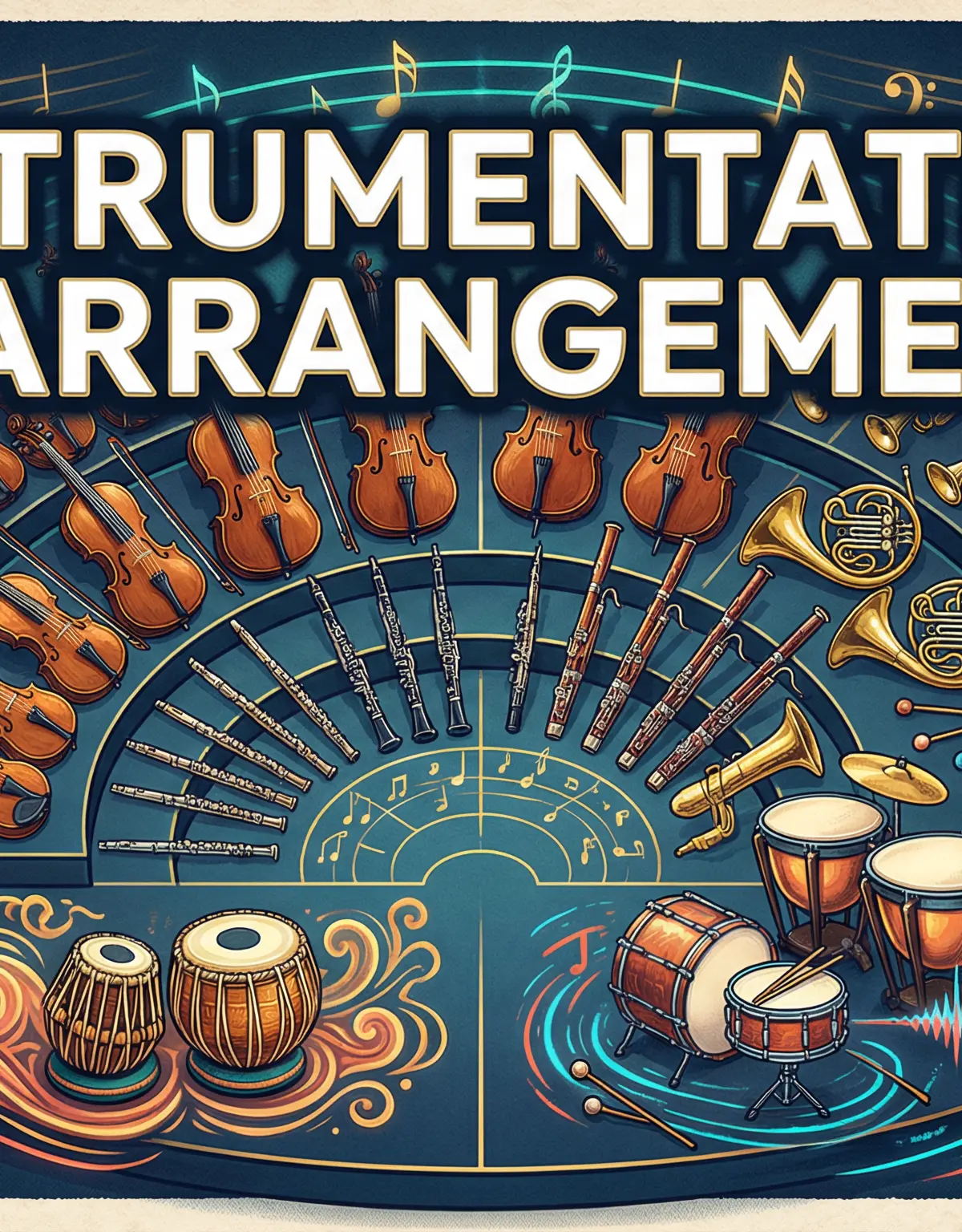
Overview
Instrumentation and Arrangement are fundamental concepts in music that define the sonic character and structure of a piece. For the OCR GCSE Music course, a deep understanding of these elements is crucial for success in the Listening and Appraising exam (Component 03). Instrumentation refers to the specific choice of instruments and voices used in a piece of music, while Arrangement refers to how these instrumental and vocal parts are organised and combined. Examiners award significant credit to candidates who can move beyond generic descriptions (e.g., 'strings') to identify specific instruments (e.g., 'cello') and playing techniques (e.g., 'pizzicato'), and then explain how these choices contribute to the music's style, mood, and narrative.
This guide will equip you with the detailed theoretical knowledge, practical listening skills, and precise vocabulary required to analyse any piece of music you might encounter in the exam, from a Beethoven symphony to a Brazilian Samba.
Key Knowledge & Theory
Core Concepts
To analyse instrumentation effectively, you must be able to aurally identify instruments from the four main families of the Western Classical Tradition, as well as key instruments from popular music and World Music traditions.
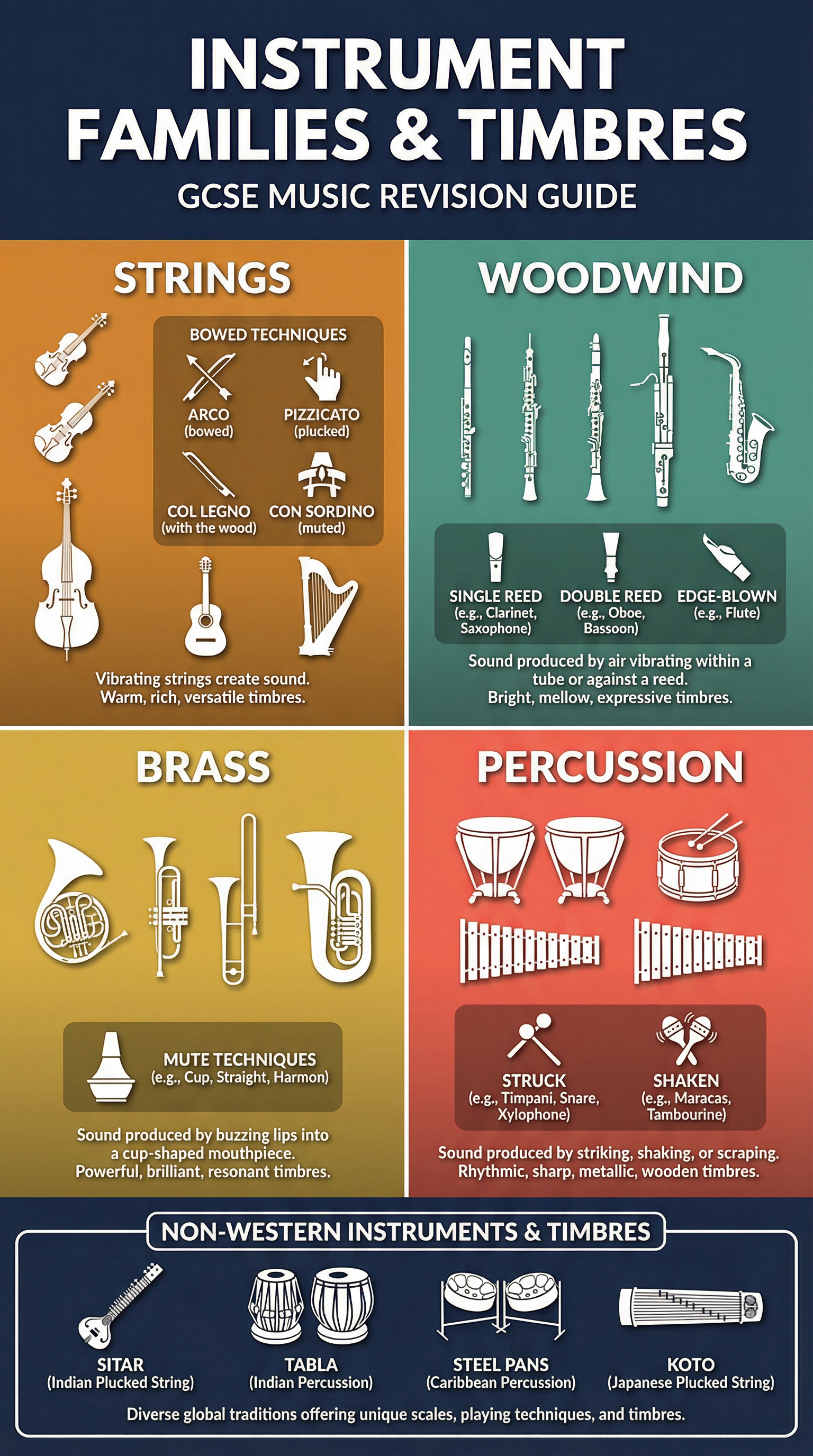
The Four Instrument Families:
- Strings: This family produces sound by bowing or plucking strings. They form the core of the orchestra and are incredibly versatile. Key members include the Violin, Viola, Cello, and Double Bass. The Harp and Guitar are also part of this family.
- Woodwind: This family produces sound by blowing air across a reed or an edge. They provide a wide range of timbres, from the pure tone of the flute to the reedy sound of the oboe. Key members include the Flute, Oboe, Clarinet, Bassoon, and Saxophone.
- Brass: This family produces sound when the player buzzes their lips into a metal mouthpiece. They are powerful instruments, often used for fanfares and heroic melodies. Key members include the Trumpet, French Horn, Trombone, and Tuba.
- Percussion: This family includes any instrument that is struck, shaken, or scraped. It is divided into two categories:
- Tuned Percussion: Can play specific pitches (e.g., Timpani, Xylophone, Glockenspiel, Marimba).
- Untuned Percussion: Produces sounds of indefinite pitch (e.g., Snare Drum, Bass Drum, Cymbals, Tambourine).
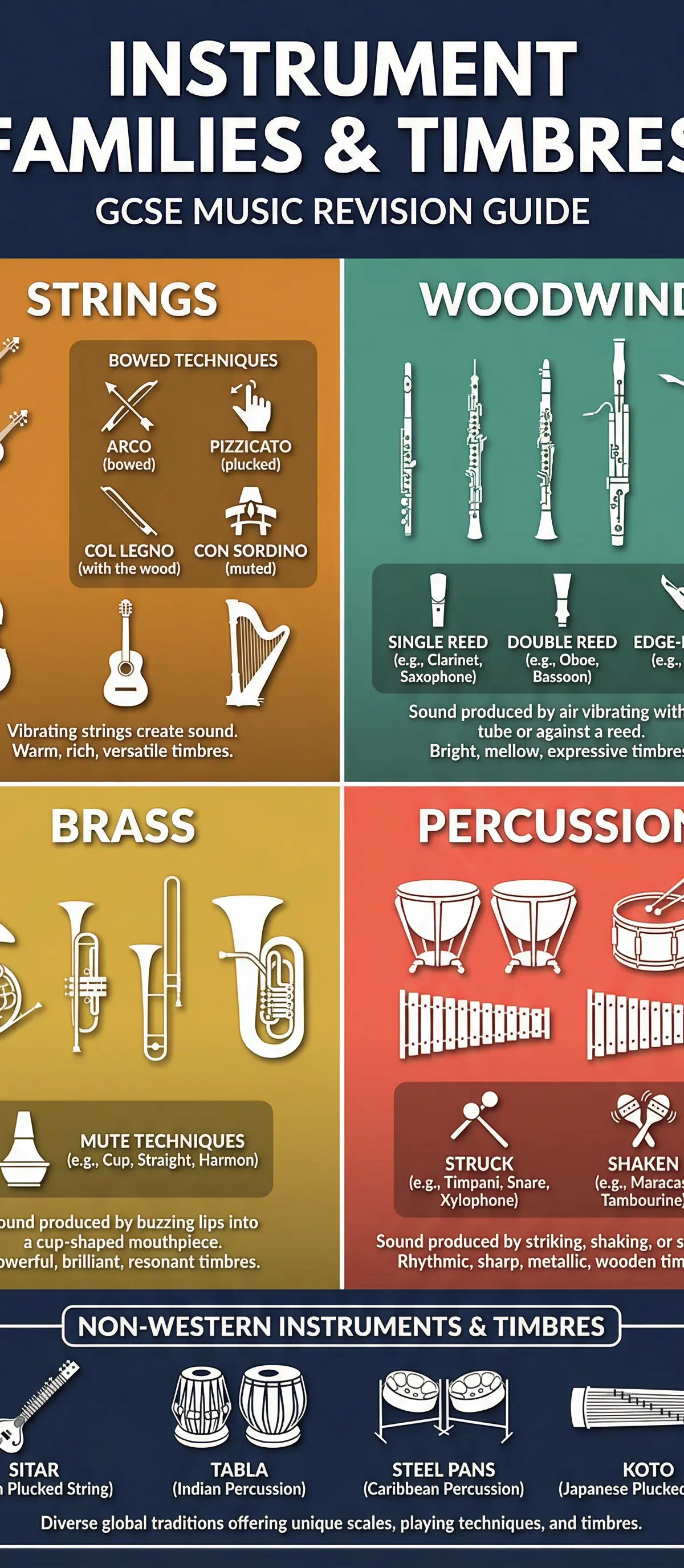
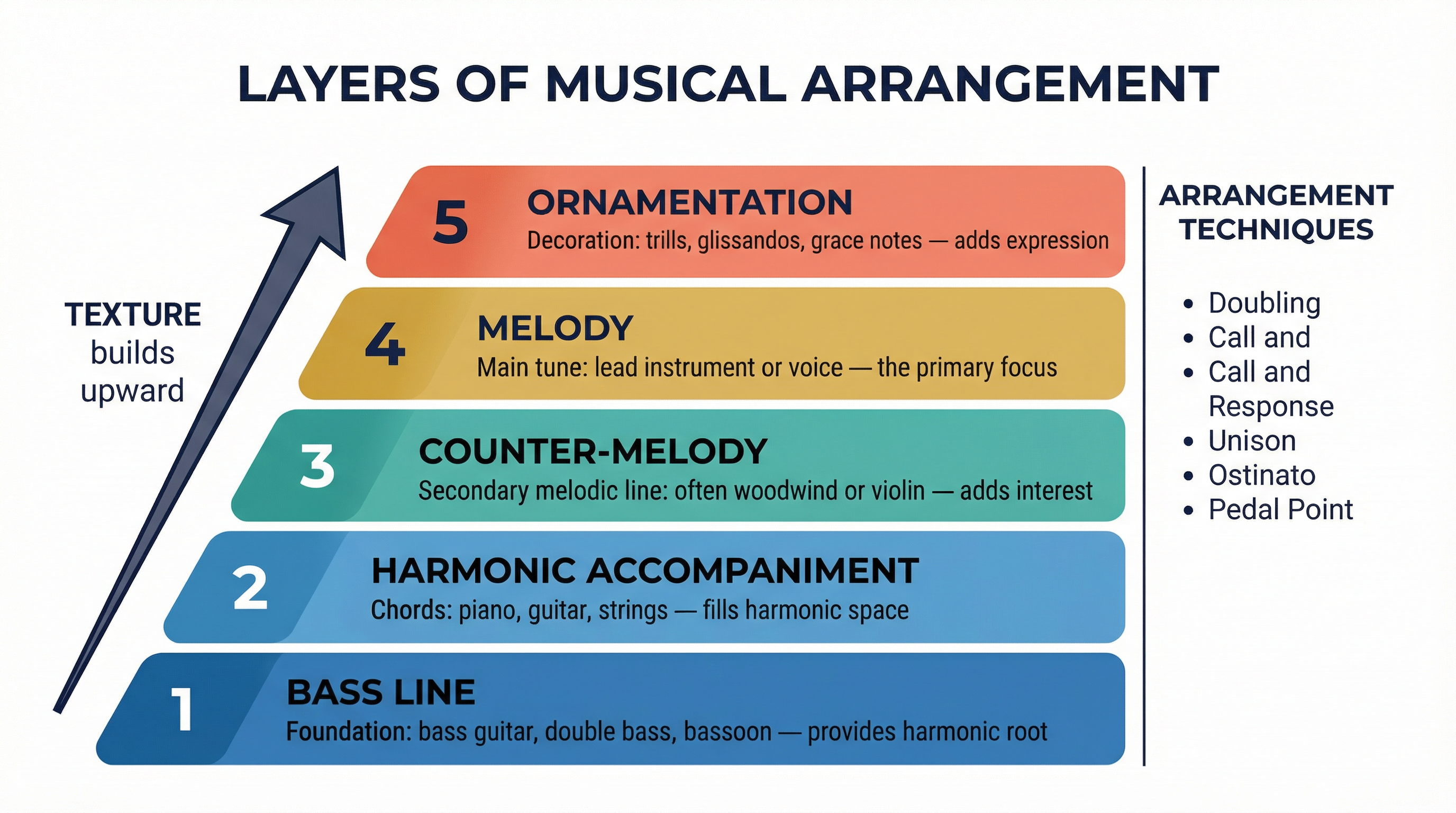
**Arrangement & Texture:**Arrangement is about the interplay of different musical lines. Think of it as a vertical stack of layers, each with a specific role. A typical arrangement might include:
- Melody: The main tune.
- Counter-melody: A secondary tune that complements the main melody.
- Accompaniment: Chords and rhythmic patterns that support the melody.
- Bassline: The lowest part, providing the harmonic foundation.
These layers combine to create the overall texture of the music. Key arrangement techniques that you must be able to identify include:
- Unison/Octaves: Multiple instruments playing the exact same line together.
- Doubling: Two or more instruments playing the same part, often to strengthen a melodic line.
- Call and Response: A musical conversation, where one part plays a phrase (the 'call') and another answers (the 'response').
- Ostinato/Riff: A short, repeated melodic or rhythmic pattern.
- Pedal/Drone: A long, sustained or repeated note, usually in the bass.
Key Practitioners/Artists/Composers
| Name | Period/Style | Key Works | Relevance |
|---|---|---|---|
| Ludwig van Beethoven | Classical/Romantic | Symphony No. 5, Symphony No. 6 'Pastoral' | Master of orchestral instrumentation; expanded the size and role of the brass and woodwind sections. |
| John Williams | 20th/21st Century Film | Star Wars, Jaws, Harry Potter | Expertly uses leitmotifs and specific instrumental timbres to represent characters and create atmosphere. |
| The Beatles | 1960s Pop/Rock | Sgt. Pepper's Lonely Hearts Club Band | Pioneered the use of studio technology and non-standard rock instruments (e.g., sitar, string quartet). |
| Astor Piazzolla | Nuevo Tango | Libertango, Adiós Nonino | Revolutionised the tango orchestra (orquesta típica), giving prominence to the bandoneon and electric guitar. |
Technical Vocabulary
Using precise terminology is essential for gaining marks. You MUST know the meaning of these terms and be able to identify them aurally.
- Timbre: The specific tone quality or 'colour' of an instrument or voice.
- Articulation: How a note is played or 'spoken'. Key terms include staccato (short, detached), legato (smooth, connected), and accent (played with emphasis).
- String Playing Techniques: Arco (bowed), Pizzicato (plucked), Tremolo (rapid repetition of a note), Con Sordino (with a mute).
- Guitar Techniques: Distortion, Reverb, Wah-wah, Pitch Bend.
- Vocal Techniques: Falsetto (high male voice), Vibrato (a slight, rapid fluctuation in pitch).
- Texture: The way different musical layers are combined (e.g., Monophonic, Homophonic, Polyphonic).
Practical Skills
Techniques & Processes
Developing Aural Skills: The single most important skill for this topic is active listening. You cannot succeed by simply memorising lists of instruments.
- Isolate and Identify: When listening to a piece, try to focus on a single instrumental line. Hum it. What is its role? (Melody? Bassline?). What is its timbre? (Bright? Mellow? Reedy? Brassy?).
- Use Elimination: If you hear a high-pitched woodwind instrument, ask yourself: is it pure and airy like a flute, or reedy and nasal like an oboe? This process of elimination is vital under exam pressure.
- Vocabulary Association: Create flashcards or use an app to link the sound of an instrument to its name and key vocabulary. Listen to a short clip of a French horn, and say: French Horn. Brass family. Mellow, rounded timbre. Often used for heroic themes.
- Listen Across Genres: Do not just listen to the set works. Explore film scores, rock anthems, jazz standards, and world music. The more diverse your listening, the stronger your aural analysis skills will become.
Materials & Equipment
While this is primarily a listening topic, understanding the physical nature of instruments helps in identifying them.
- Sound Production: How is sound made? By striking (percussion), bowing/plucking (strings), buzzing lips (brass), or blowing across a reed/edge (woodwind). This is a primary clue to identification.
- Mutes: Understand that mutes are not just for brass instruments. String instruments can also use mutes (con sordino) to create a softer, darker, more mysterious sound. This is a common exam question.
- Technology: In pop music (AoS 2), be aware of how technology shapes timbre. A synthesiser can imitate any instrument, while effects like distortion, chorus, and reverb fundamentally change the sound of an electric guitar or voice.
Portfolio/Coursework Guidance
While Instrumentation is primarily assessed in the listening exam, your understanding of it is crucial for your own Composition (Component 02).
Assessment Criteria
Examiners look for an idiomatic use of instruments in your compositions. This means writing music that is well-suited to the chosen instruments and uses their capabilities effectively.
- AO2 (Composing): Marks are awarded for creating musically effective and coherent compositions. A key part of this is choosing instruments that fit your intended style and using them authentically.
- Annotation: In your composition log, you must justify your instrumental choices. Explain why you chose a flute for the melody or a cello for a melancholic counter-melody. Link your choices to the mood and style of the piece.
Building a Strong Portfolio
- Experiment: Don't just stick to piano and voice. Use notation software (like Sibelius or Musescore) to experiment with different orchestral instruments. Hear what a melody sounds like on a clarinet versus a trumpet.
- Research: If you are composing in the style of a specific genre (e.g., Samba), research its traditional instrumentation. Using a Surdo drum and Agogô bells will make your composition far more authentic than just using a standard drum kit.
- Show Development: Your composition log should show how your ideas about instrumentation evolved. Perhaps you initially wrote a melody for violin, but then realised its character was better suited to the oboe. Documenting this change shows critical reflection and will be credited by the examiner.
Exam Component
Written Exam Knowledge
Component 03, the Listening and Appraising exam, is where this topic is directly and heavily assessed. You will face:
- Short Answer Questions: Identifying specific instruments, playing techniques, or arrangement features from a short extract.
- Extended Response: Analysing the use of instrumentation and other musical elements within a longer extract.
- Comparative Question (Q8): Comparing and contrasting the use of instrumentation and arrangement between two different pieces of music, one of which will be an unfamiliar extract.
Practical Exam Preparation
There is no practical exam for this topic, but the skills are practical. Your preparation should be active listening.
- Timed Practice: Find unfamiliar pieces of music on YouTube and give yourself 30 seconds to identify as many instruments and techniques as you can. This simulates exam conditions.
- Focused Listening: Listen to your set works with a specific focus. On first listen, only identify the string instruments and their techniques. On second listen, focus only on the brass. This deepens your aural perception.
- Create Mind Maps: For each set work, create a mind map for instrumentation. Put the piece title in the centre and branch out with instrument names, playing techniques, and their effect on the music.
Visual Resources
2 diagrams and illustrations
Interactive Diagrams
1 interactive diagram to visualise key concepts
Conceptual Flow Outline
A decision-making flowchart for identifying instruments by ear under exam conditions.
Worked Examples
3 worked examples — open one to explore the question and available guidance.
Practice Questions
Test your understanding — click to reveal model answers
Identify the solo woodwind instrument playing the main melody in the extract. [1 mark]
Hint: Listen for the timbre. Is it bright and airy, or reedy and nasal?
Describe the role and playing style of the bass guitar in this pop song extract. [3 marks]
Hint: What is the bass doing? Is it playing long notes or a repeated pattern? Is the rhythm simple or complex?
Explain how the composer uses instrumentation to create a sense of drama and tension in this film music cue. [4 marks]
Hint: Focus on specific techniques. Listen for strings, brass, and percussion. Link each technique to the emotional effect.
Analyse the arrangement of the different instrumental layers in this jazz extract. [5 marks]
Hint: Identify the instrument playing each layer: melody, harmony, bassline, rhythm. Describe how they interact.