OCR · GCSE · Music
Melody Writing (e.g., contour, range, motif development)
This guide explores the defining musical characteristics of Pop music from the 1950s to the present day, focusing on structure, instrumentation, technology, and production techniques. It is essential for both the listening exam and composition coursework, providing the vocabulary needed to analyse commercial music effectively.
- 7 min read
- 3 worked examples
- 4 practice questions
- 6 key terms
Study Notes

Overview
Pop music is more than just "popular" music; it is a commercially driven genre with specific musical conventions designed to be accessible, memorable, and radio-friendly. For GCSE Music students, understanding these conventions is crucial for success in the listening exam (Appraising) and for creating authentic-sounding compositions. This topic covers the evolution of pop from rock 'n' roll to modern electronic pop, focusing on how musical elements are used to create catchy, polished tracks.
Key Knowledge & Theory
Core Concepts
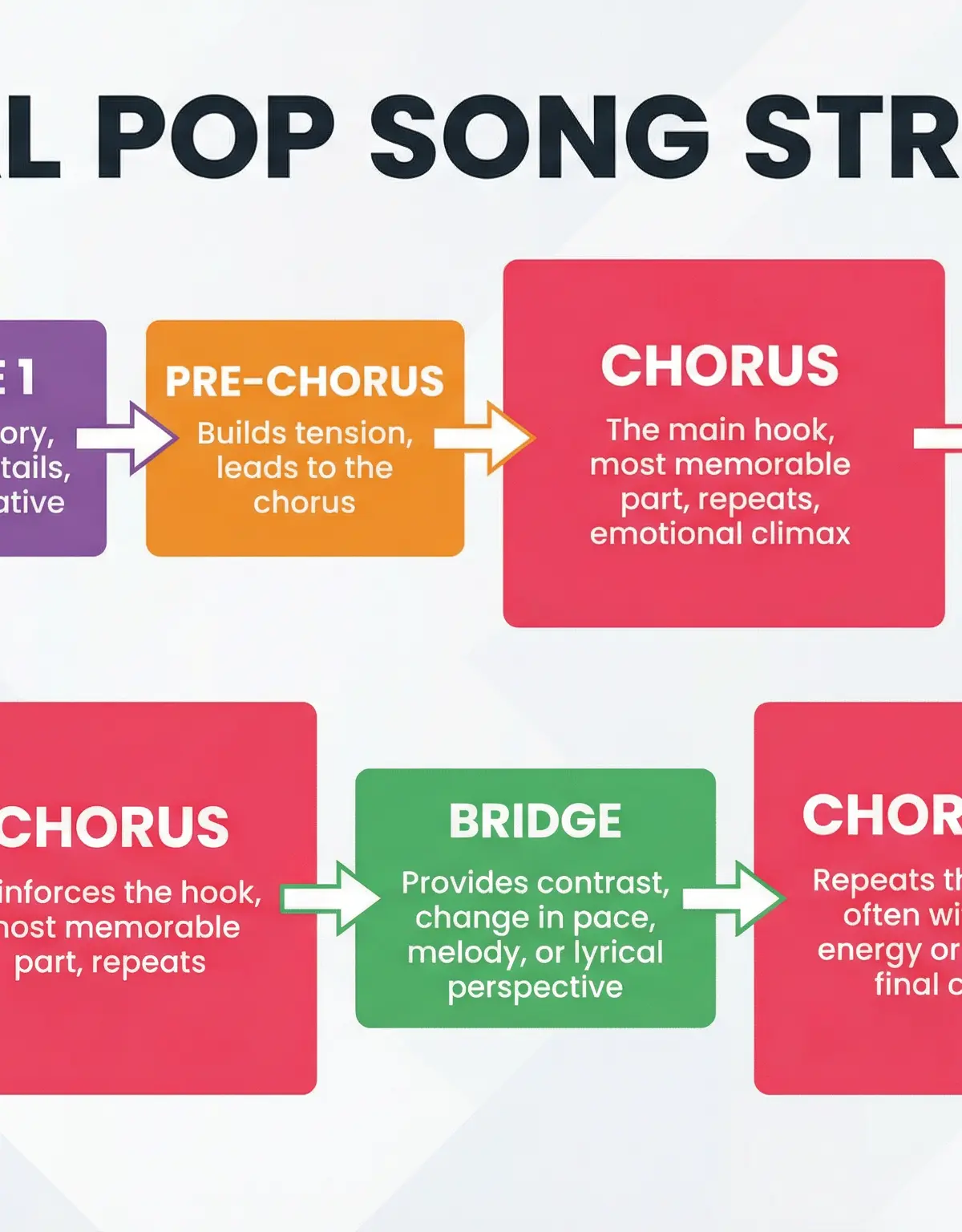
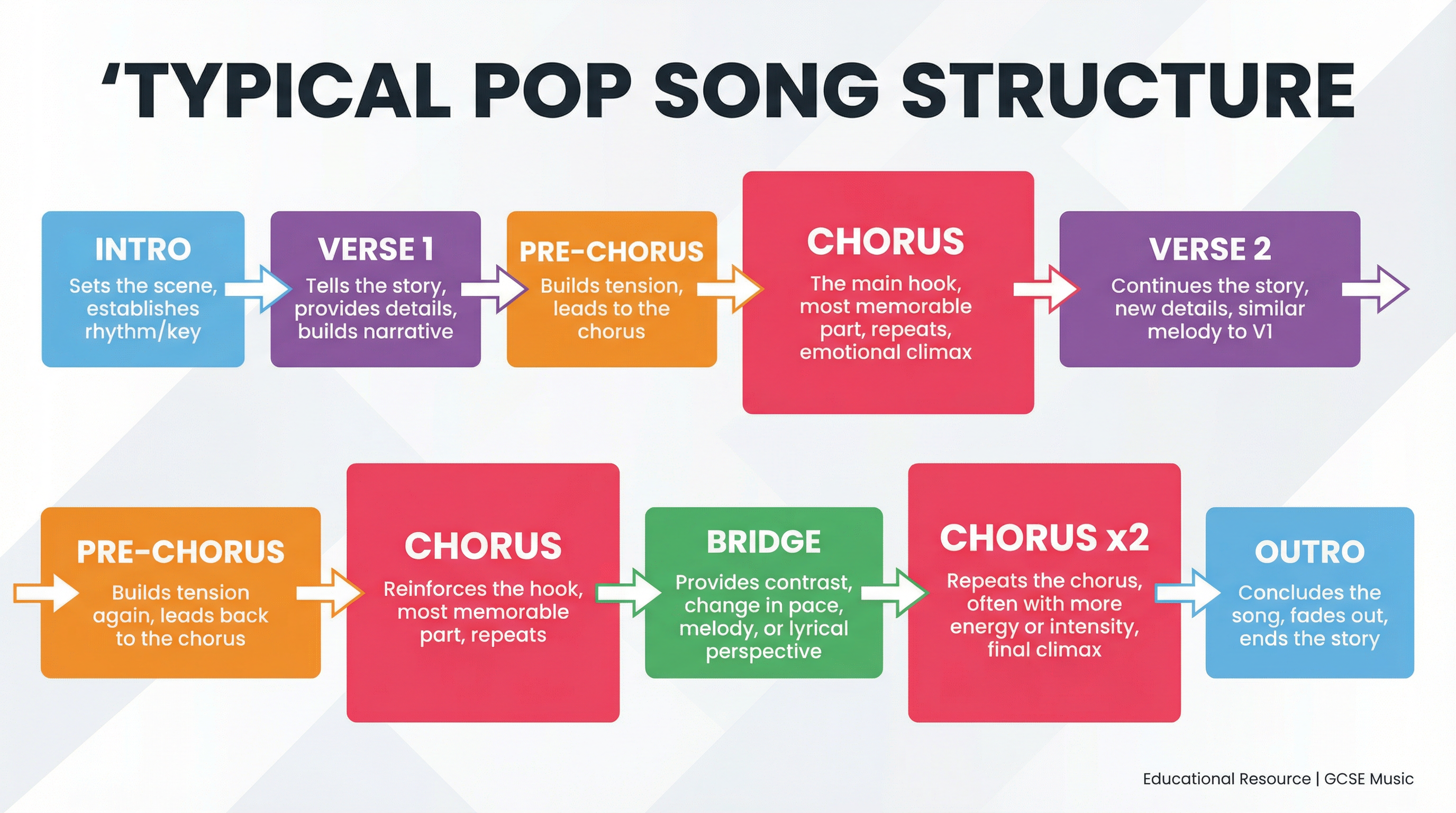
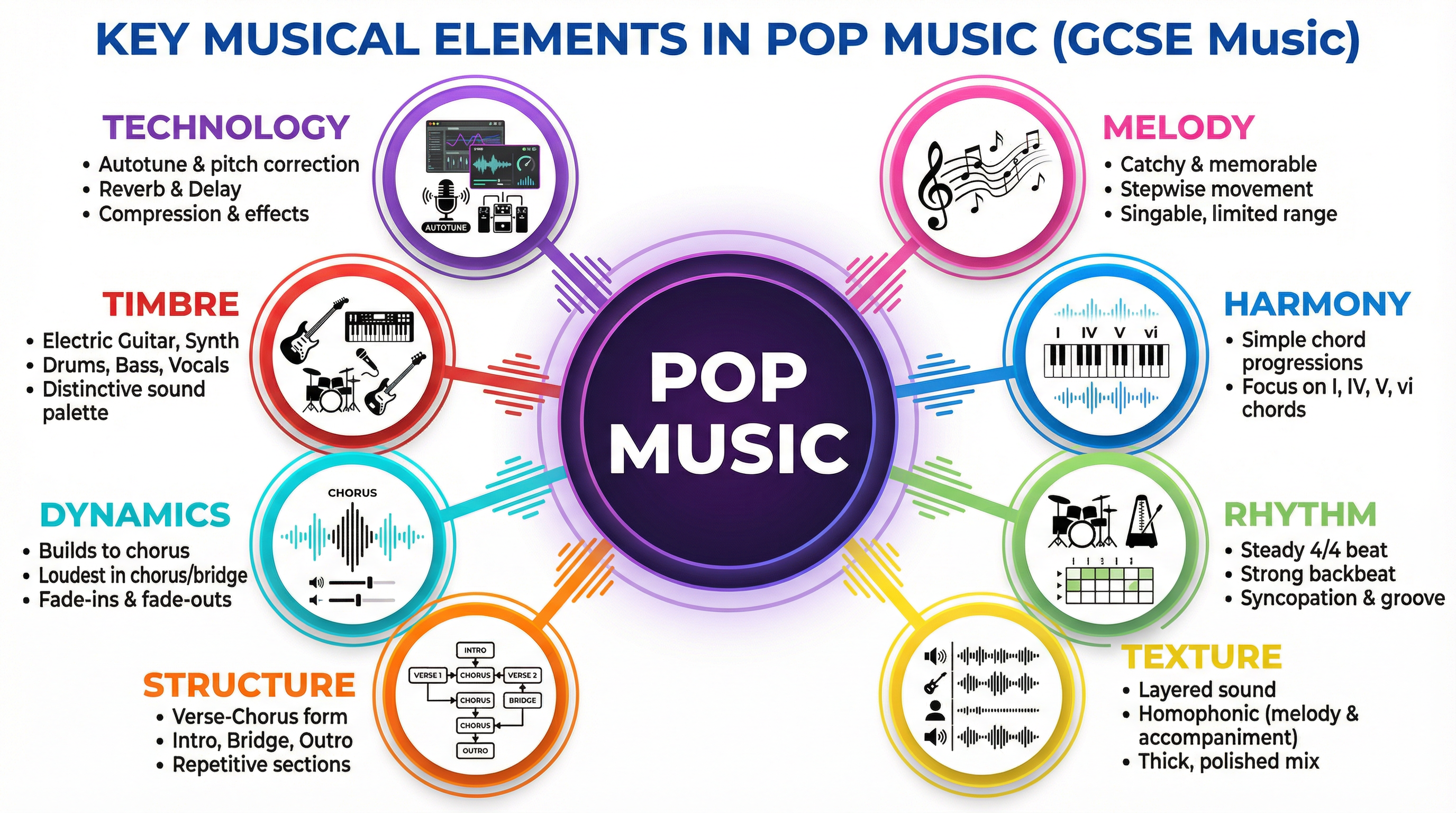
Structure: The most defining feature of pop music is its structure. Almost all pop songs follow a Verse-Chorus form. The chorus contains the main hook and message, while verses tell the story. Bridges (or Middle 8s) provide contrast before the final choruses.
Harmony: Pop harmony is typically diatonic (notes belong to the key) and uses simple, repetitive chord progressions. The most common progression is I–V–vi–IV (e.g., C–G–Am–F in C major). Harmonic rhythm (how often chords change) is usually regular, often changing every bar or half-bar.
Melody: Melodies are designed to be conjunct (stepwise), syllabic (one note per syllable), and repetitive. They have a narrow vocal range to encourage singing along. The hook is the most memorable part of the melody, usually found in the chorus.
Rhythm & Metre: Pop is almost exclusively in 4/4 time with a steady tempo (100–130 BPM). A strong backbeat on beats 2 and 4 (usually on the snare drum) is a key characteristic. Syncopation in the vocal melody or accompaniment adds groove and interest.
Texture: The texture is predominantly homophonic (melody and accompaniment). It is often layered, starting thin in the intro/verse and building up to a thick, full texture in the chorus (a technique known as a "build").
Key Practitioners/Artists
| Name | Period/Style | Key Works | Relevance |
|---|---|---|---|
| The Beatles | 1960s Pop/Rock | She Loves You, Yesterday | Pioneers of the pop group format; early use of studio technology; classic verse-chorus structures. |
| Michael Jackson | 1980s Pop/Funk | Billie Jean, Thriller | Use of synthesisers, drum machines, and polished production; distinct bass riffs and rhythmic vocal delivery. |
| Madonna | 1980s/90s Pop | Like a Prayer, Vogue | Evolution of female pop vocals; integration of dance and electronic elements into mainstream pop. |
| Max Martin | 1990s–Present (Producer) | ...Baby One More Time, Shake It Off | The master of the "melodic math" formula; creates globally successful hits using precise structural and melodic rules. |
| Adele | 2010s Ballad Pop | Someone Like You, Hello | Focus on piano-led ballads; emotional vocal delivery; simple but effective diatonic harmony. |
Technical Vocabulary
- Hook: A short, catchy melodic or rhythmic phrase that is the focal point of the song.
- Riff: A repeated pattern (usually on guitar or bass) that drives the song.
- Fill: A short musical passage (often on drums) that bridges gaps between sections.
- Panning: The placement of sound in the stereo field (left or right speaker).
- Reverb: An effect that creates a sense of space or echo.
- Compression: A production technique that evens out the dynamic range, making the track sound louder and punchier.
- Falsetto: A method of voice production used by male singers to sing notes higher than their normal range.
- Melisma: Singing multiple notes for one syllable of text (common in R&B-influenced pop).

Practical Skills
Techniques & Processes
Composing a Pop Song (Step-by-Step):
- Choose a Chord Progression: Start with a 4-chord loop (e.g., I–V–vi–IV). Play it on a piano or guitar with a steady rhythm.
- Create a Beat: Program a drum beat in 4/4 time. Ensure the kick is on beats 1 and 3, and the snare is on the backbeat (2 and 4). Add hi-hats on quavers (eighth notes).
- Write the Hook: Hum melodies over your chords until you find something catchy. Keep it simple and repetitive. This will be your chorus.
- Develop Verses: Write a melody for the verses that is lower in pitch and less rhythmic than the chorus. This saves energy for the main hook.
- Structure the Track: Arrange your sections: Intro -> Verse 1 -> Chorus -> Verse 2 -> Chorus -> Bridge -> Chorus -> Outro.
- Layer the Texture: Add a bass line that follows the root notes of the chords. Add a pad or synth line in the chorus to thicken the texture.
Materials & Equipment
- DAW (Digital Audio Workstation): Software like Logic Pro, Cubase, GarageBand, or Soundtrap is essential for modern pop composition.
- MIDI Controller: A keyboard for inputting notes and controlling software instruments.
- Audio Interface: To record real instruments (vocals, guitars) into your computer.
- Microphone: A dynamic mic (e.g., Shure SM58) is good for loud vocals; a condenser mic is better for capturing detail in studio recordings.
Portfolio/Coursework Guidance
Assessment Criteria
Examiners award marks for:
- Creativity and Development: How well you develop your initial ideas. Do you vary the melody? Do you change the texture?
- Technical Control: Is the performance accurate? Is the recording clean (no distortion or background noise)?
- Stylistic Coherence: Does it sound like a pop song? Have you used the correct conventions (structure, instruments, production)?
Building a Strong Portfolio
- Evidence of Refining: Don't just submit your first attempt. Show how you improved a melody line or changed a drum beat to make it more effective.
- Use of Technology: In pop, production is composition. Show that you understand how to use EQ, reverb, and panning to create a professional mix. A "muddy" mix where instruments clash will lose marks.
- Annotation: If submitting a score or lead sheet, ensure it is accurate. If submitting a screenshot of your DAW, annotate it to explain your production choices (e.g., "I added automation to the volume here to create a build-up").
Exam Component
Written Exam Knowledge
In the listening exam, you will hear an unfamiliar pop track. You may be asked to:
- Identify the instruments (e.g., "synthesiser," "drum machine," "electric guitar").
- Describe the texture (e.g., "melody and accompaniment," "layered").
- Identify the structure (e.g., "verse-chorus form").
- Describe the use of technology (e.g., "use of reverb on the vocals," "panning of the hi-hats").
Practical Exam Preparation
For practical performance exams:
- Choose the Right Piece: Pick a song that shows off your skills but isn't too difficult to perform under pressure. Pop songs can be deceptively simple—ensure you capture the feel and groove, not just the notes.
- Ensemble Performance: If playing in a band, listen to each other. Balance is key. The vocalist should be the loudest element; the drummer shouldn't drown everyone out.

Visual Resources
2 diagrams and illustrations
Interactive Diagrams
1 interactive diagram to visualise key concepts
Conceptual Flow Outline
Standard Pop Song Structure Flowchart
Worked Examples
3 worked examples — open one to explore the question and available guidance.
Practice Questions
Test your understanding — click to reveal model answers
Listen to the excerpt. Identify the texture of the opening 4 bars.
Hint: Is there just one line, or melody with chords?
Explain the role of the bass guitar in a typical pop song.
Hint: Think about pitch and rhythm.
Evaluate the use of technology in modern pop production. Refer to at least two specific techniques.
Hint: Think about how songs are recorded and polished.
Compare the Verse and the Chorus in terms of melody and dynamics.
Hint: How do they differ to keep the listener interested?