WJEC · A-Level · Music
Melodic Dictation
This guide provides a comprehensive overview of Melodic Dictation for WJEC A-Level Music, focusing on the core skills of aural perception and accurate notation required to excel in Component 3. It is designed to help candidates secure maximum marks by mastering exam technique and avoiding common pitfalls.
- 7 min read
- 3 worked examples
- 4 practice questions
- 6 key terms
Study Notes

Overview
Melodic Dictation is a critical aural skills assessment within Component 3 (Appraising) of the WJEC A-Level Music specification. It directly tests your ability to perceive and notate a melodic line from a given musical excerpt, typically drawn from the Western Classical tradition. This is a 100% AO3 task, meaning all marks are awarded for your ability to apply your knowledge of musical notation in a practical, aural context. Success in this area demonstrates a high level of musical literacy and is essential for achieving a top grade.

Key Knowledge & Theory
Core Concepts
Mastering melodic dictation requires a synthesis of several core music theory concepts. Candidates must have a fluent understanding of:
- Pitch Notation: The ability to accurately place note heads on the stave (lines and spaces) in both treble and bass clefs.
- Rhythmic Notation: A secure knowledge of note durations (from semibreves to semiquavers, including dotted values), rests, and their relationship within a given time signature.
- Key & Tonality: The ability to identify the tonic and dominant of a key quickly, recognise major and minor tonalities, and understand the function of the leading note in minor keys.
- Interval Recognition: The foundational skill of identifying the distance between two pitches, both melodically (one after the other) and harmonically (played together). This is the single most important skill for accurate pitch transcription.
- Beaming Rules: Understanding the conventions of grouping notes (particularly quavers and semiquavers) correctly according to the time signature. This is a key area where marks are lost.
- Accidentals: Correctly identifying and notating chromatic notes that fall outside the established key signature, and knowing when and how to use cancellation (natural) signs.
Key Practitioners/Composers
The excerpts used in the exam are typically from the Classical and early Romantic periods. A strong familiarity with the melodic style of these composers will significantly aid your ability to anticipate and recognise common melodic patterns.
| Name | Period/Style | Key Works | Relevance |
|---|---|---|---|
| W.A. Mozart | Classical | Symphonies No. 40 & 41, String Quartets | Clear, balanced phrasing; frequent use of diatonic scales and arpeggios; elegant chromaticism. |
| Joseph Haydn | Classical | 'Surprise' Symphony, 'Emperor' String Quartet | Often features folk-like melodies; clear-cut structures; playful use of rests and dynamics. |
| L.v. Beethoven | Late Classical / Early Romantic | Symphonies No. 3 & 5, Pathétique Sonata | More dramatic and dynamic melodies; wider melodic range; increased use of chromaticism and sudden changes in mood. |
Technical Vocabulary
Using precise terminology is crucial. Examiners expect you to understand and apply these terms.
- Contour: The overall shape of a melodic line (e.g., ascending, descending, arched, wave-like).
- Conjunct/Disjunct: A melody that moves primarily by step (conjunct) versus one that moves by leap (disjunct).
- Passing Note: A non-harmony note that moves by step between two different harmony notes.
- Auxiliary Note: A non-harmony note that moves by step from a harmony note and returns to it.
- Enharmonic Equivalent: Two notes that sound the same but are written differently (e.g., B natural and C flat).
- Leading Note: The seventh degree of the scale, a semitone below the tonic. In minor keys, this requires a raised 7th to be written as an accidental.
Practical Skills
Techniques & Processes
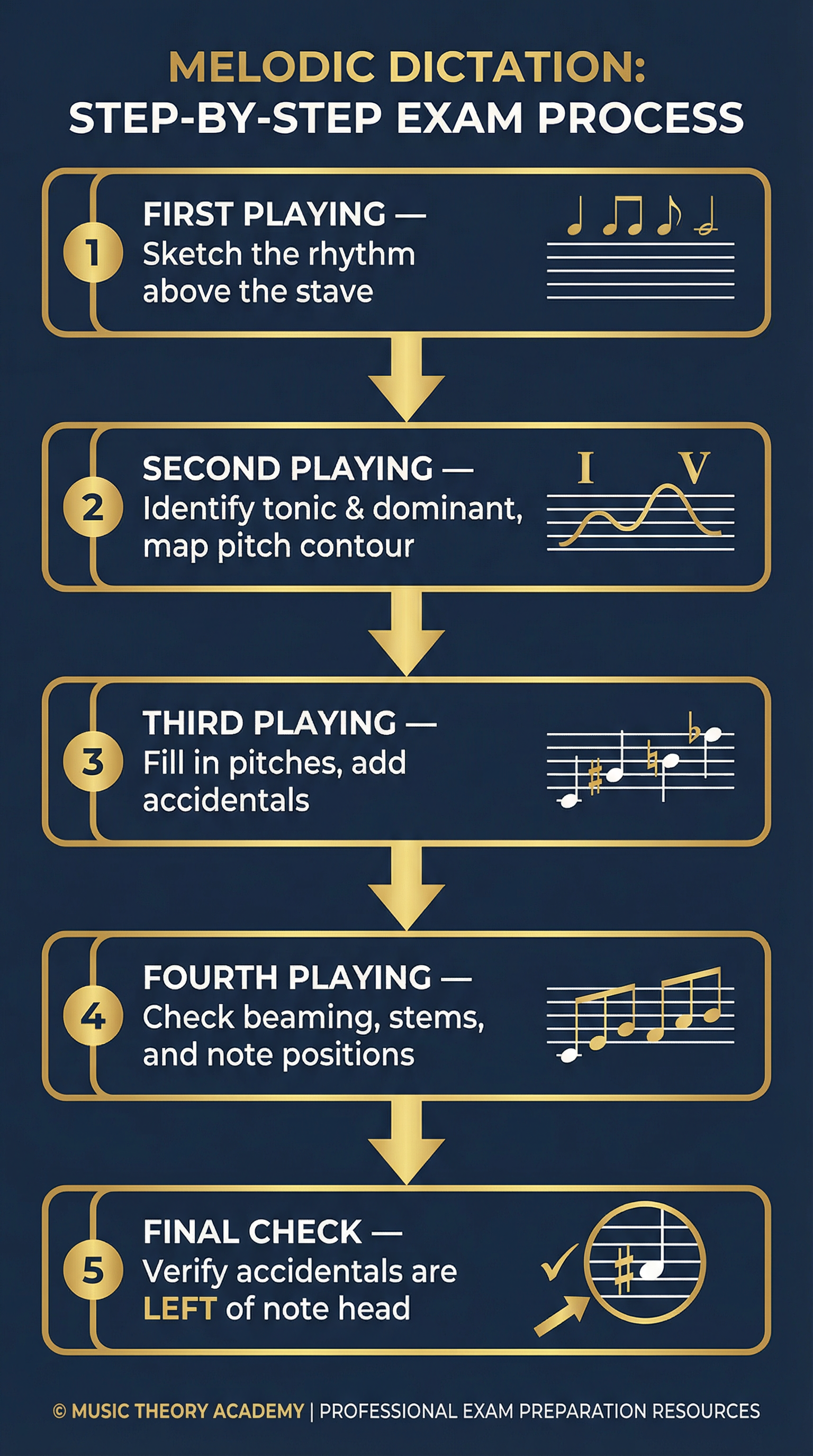
Success in melodic dictation relies on a systematic process. Do not try to capture everything in the first hearing. The diagram below outlines the recommended approach for the multiple playings you will be given in the exam.
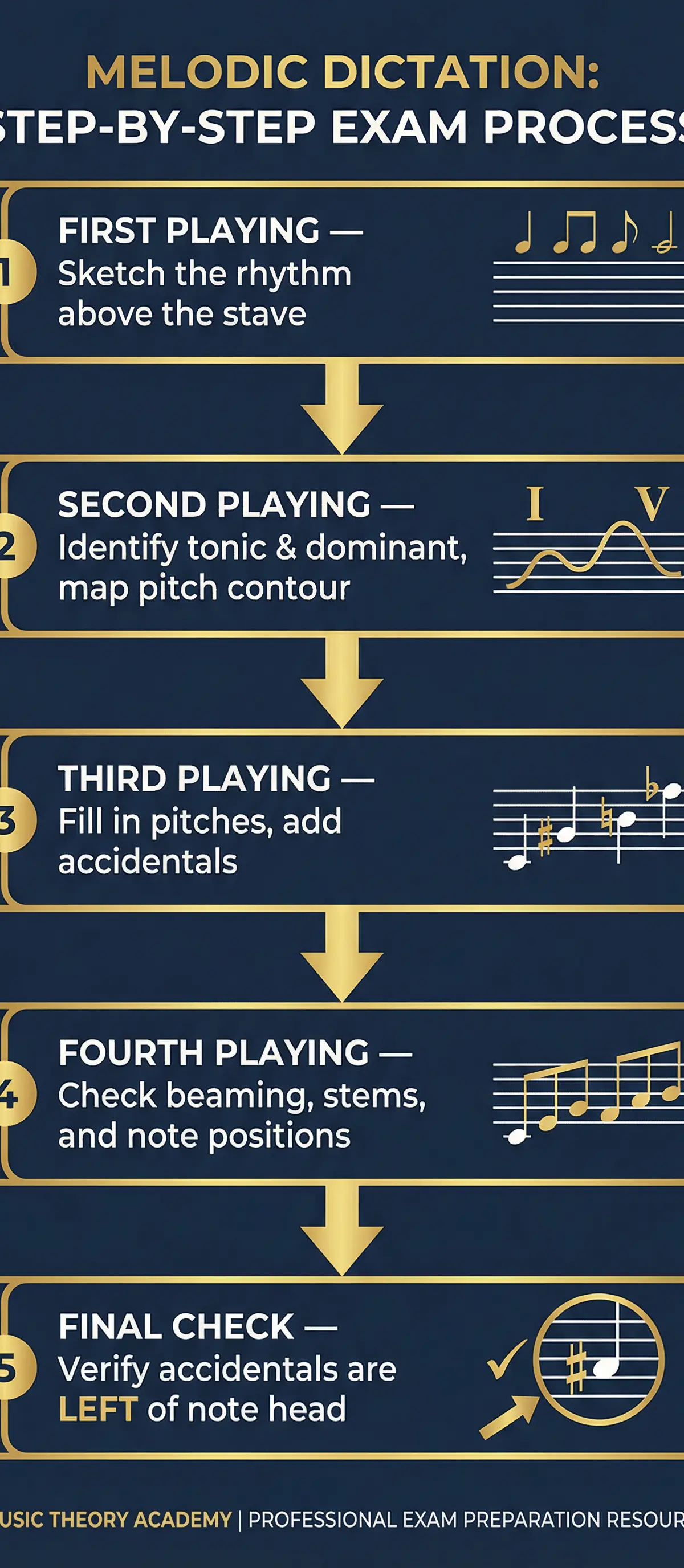
- First Playing: Rhythm & Pulse: Your sole focus should be on the rhythm. Tap your foot to establish the pulse. Use a pencil to sketch the rhythm above the given stave. Use lines for longer notes and dots for shorter ones. This creates a rhythmic framework.
- Second Playing: Contour & Anchors: Listen for the overall shape. Is the melody rising or falling? Where are the highest and lowest points? Identify the tonic and dominant pitches to act as your harmonic anchors.
- Third Playing: Pitch Detail: Begin filling in the note heads onto your rhythmic framework. Focus on the intervals between notes. Is it a step, a third, a fifth? Work methodically from your anchor points.
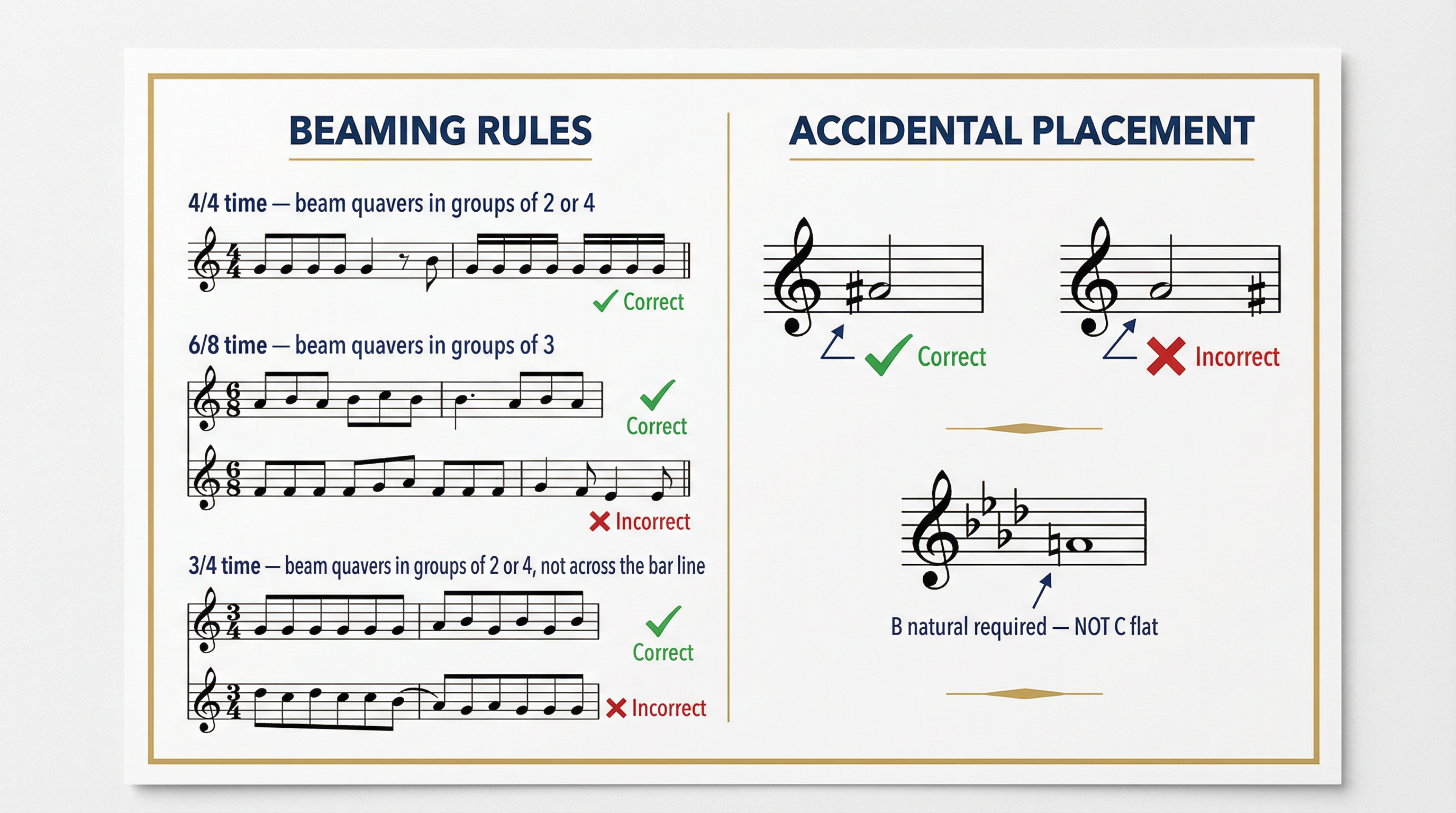
- Fourth Playing: Refinement & Notation Rules: Check your work. Add stems (up for notes below the middle line, down for notes above). Group notes according to beaming rules. Add in any accidentals you identified.
- Final Check: Verification: In the final moments, scan for errors. Are all accidentals placed before the note head? Have you used the correct enharmonic spelling for the leading note in a minor key? Does each bar add up correctly?
Materials & Equipment
In the exam, you will be provided with manuscript paper. You should use a sharp HB pencil and have a good quality eraser to hand. Using a pencil allows for corrections without creating messy, illegible work. Illegible notation will not be credited.
Exam Component
Written Exam Knowledge
This task appears in the Component 3: Appraising exam. It is a purely practical application of your theoretical knowledge. There is no extended writing required, only accurate notation. The entire task is assessed under AO3: Demonstrate and apply musical knowledge, including the use of musical vocabulary and notation.
Practical Exam Preparation
Consistent practice is the only way to improve. Aim for at least three dictation exercises per week in the run-up to the exam.
- Use Aural Training Apps: Apps like 'Tenuto', 'Good-Ears', or 'Teoria.com' provide endless interval and dictation exercises.
- Transcribe from Recordings: Choose simple melodies from Classical or folk music and try to notate them. Start with just the first phrase.
- Sing Everything: Singing intervals and melodic fragments out loud strengthens the connection between hearing and understanding. If you can sing it, you can notate it.
- Focus on Weaknesses: If you always confuse perfect 4ths and 5ths, drill that specific interval until it is secure. If you struggle with compound time, do three 6/8 dictations in a row.
Visual Resources
2 diagrams and illustrations
Interactive Diagrams
1 interactive diagram to visualise key concepts
Conceptual Flow Outline
The 5-Step Melodic Dictation Process
Worked Examples
3 worked examples — open one to explore the question and available guidance.
Practice Questions
Test your understanding — click to reveal model answers
Notate a 2-bar melody in G major, 4/4 time, that starts on the tonic and ends on the supertonic. The rhythm is: crotchet, two quavers, crotchet, crotchet.
Hint: Remember to beam the two quavers together. The melody should be entirely diatonic.
Notate a 1-bar melody in D minor, 3/4 time. The melody contains a raised leading note. The rhythm is: crotchet, crotchet, crotchet.
Hint: What is the leading note of D minor? You will need to add an accidental.
Notate a 2-bar melody in A major, 6/8 time. The melody contains a chromatic passing note.
Hint: The chromatic note is a G natural. Remember your beaming rules for 6/8 time.
Listen to the provided audio excerpt (a short melody played on the piano) and transcribe it onto the stave.
Hint: This is a full exam-style question. Use the 5-step process. The key is F major and the time signature is 4/4.