AQA · A-Level · Physical Education
Learning Theories
This study guide provides a comprehensive analysis of the three core Learning Theories in AQA A-Level Physical Education: Operant Conditioning, Cognitive Theory, and Social Learning Theory. It is designed to equip candidates with the detailed knowledge and exam technique required to achieve high marks in this crucial area of the specification."
- 8 min read
- 3 worked examples
- 4 practice questions
Study Notes
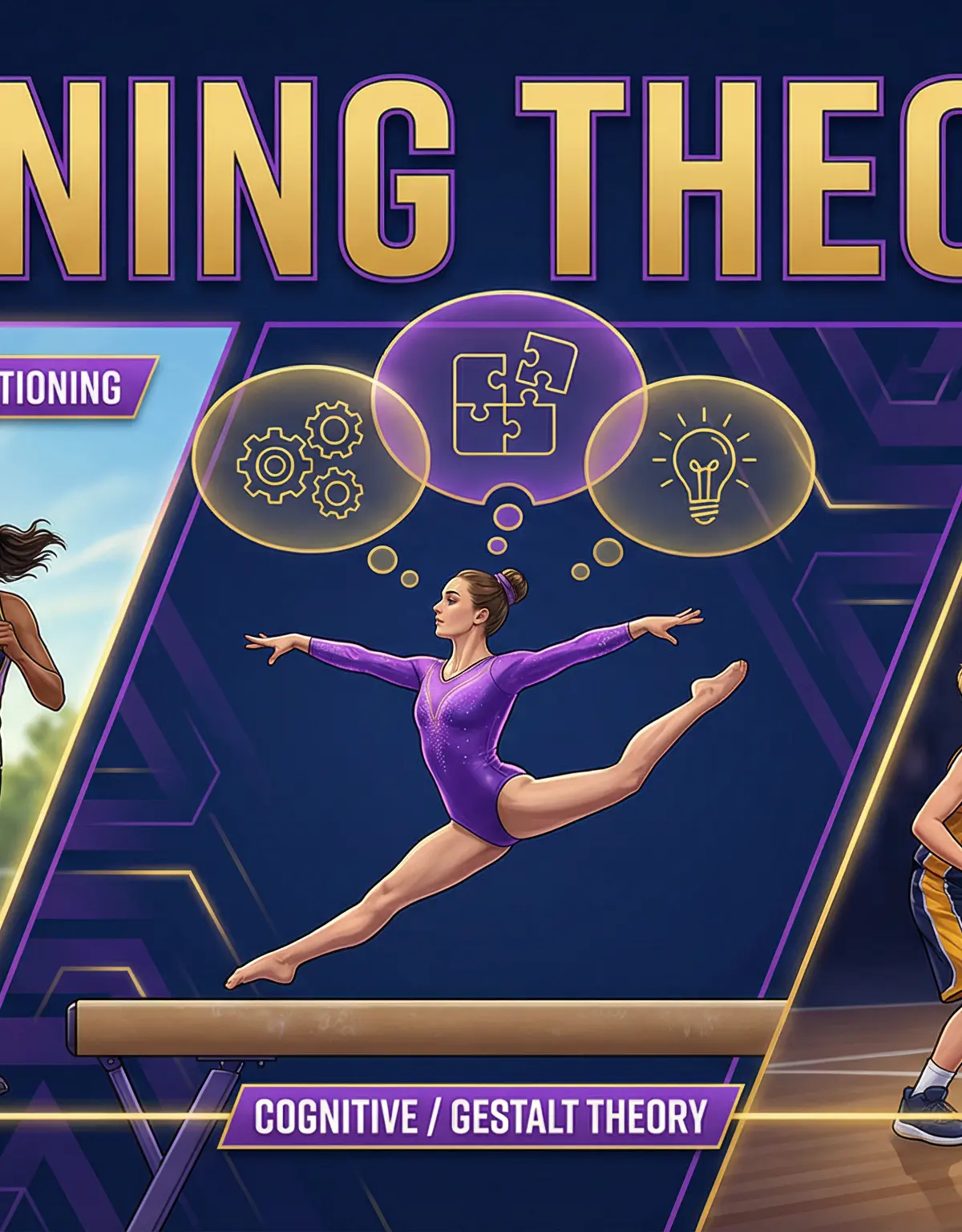
Overview
Welcome to your deep dive into the Learning Theories topic for AQA A-Level PE. Understanding how we learn and acquire skills is fundamental to physical education and sport. Examiners place significant emphasis on this area, testing your ability to define, apply, and evaluate the three core theories. This guide will break down each theory, provide you with the language examiners want to see, and show you how to apply your knowledge in an exam context to maximise your marks.

Key Knowledge & Theory
Core Concepts
The study of skill acquisition is dominated by three main theoretical perspectives. Each offers a different explanation for how a performer moves from being a novice to an expert. A strong candidate can not only explain each theory but also contrast them effectively.
-
Operant Conditioning: This is a behaviourist theory, primarily associated with B.F. Skinner. It posits that learning is a process of forming and strengthening a Stimulus-Response (S-R) bond. The bond is shaped by the consequences of an action, through reinforcement or punishment. The coach's role is to manipulate the environment to ensure desired responses are repeated and strengthened.
-
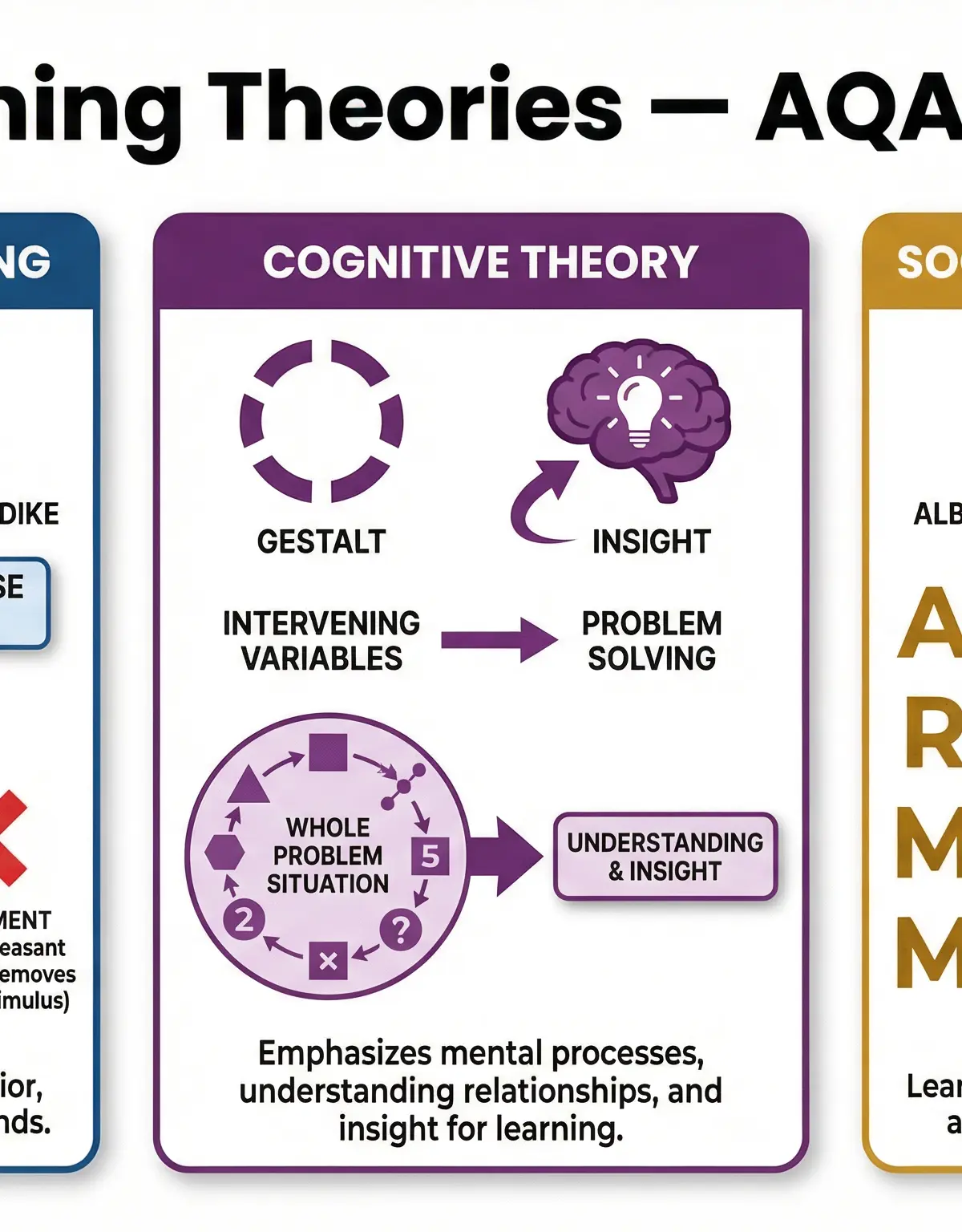
Cognitive Theory: In direct contrast to the mechanistic view of Operant Conditioning, Cognitive Theory (rooted in Gestalt psychology) argues that learning involves insight and whole-problem solving. The performer is not a passive recipient of information but an active processor who uses perception, intelligence, and past experience to understand the task. Key concepts include intervening variables (the mental processes that come between stimulus and response) and insight learning.
-
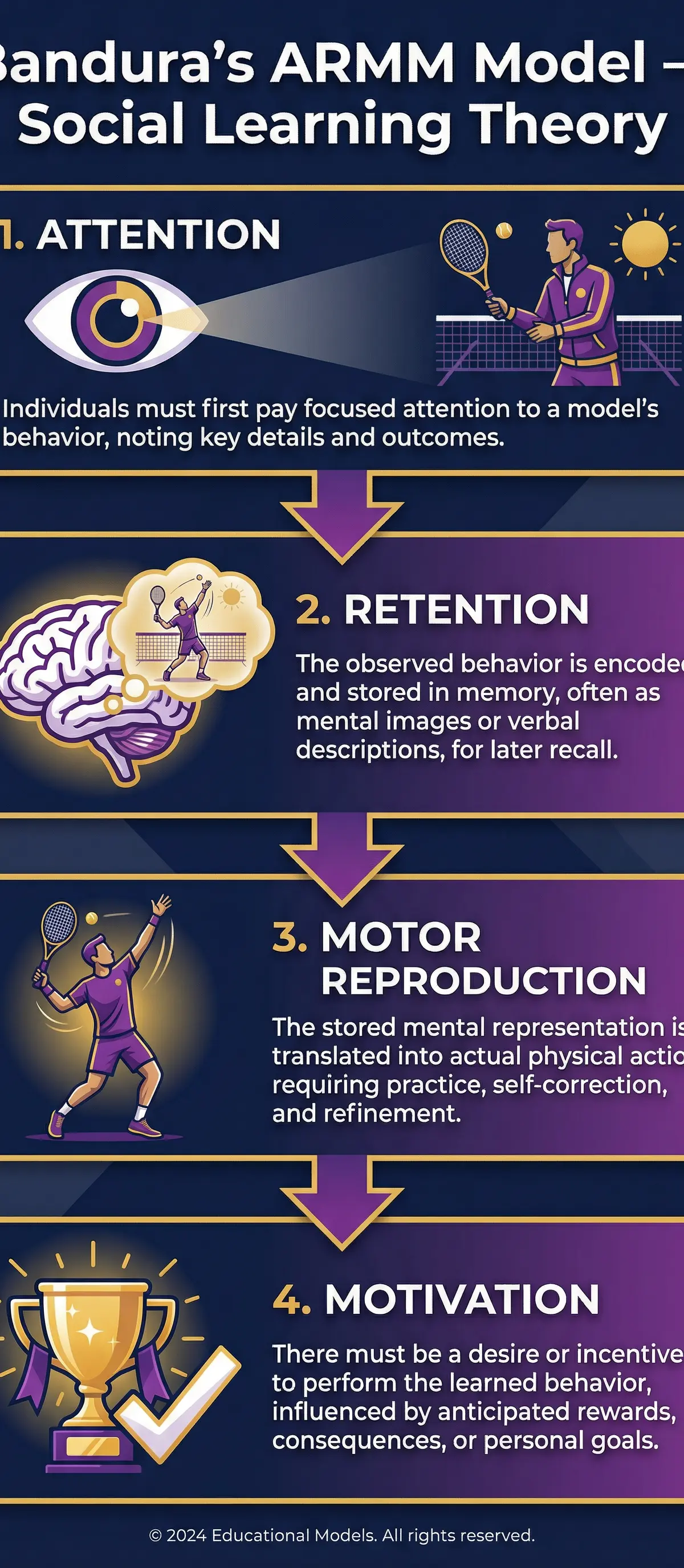
Social Learning Theory (Observational Learning): Proposed by Albert Bandura, this theory suggests that we learn by watching and imitating others. The person we watch is the model, and the process of imitation is more likely if the model is of high status (e.g., an elite athlete) and the observer is motivated. This is not simple mimicry; it involves a four-stage cognitive process.
Key Practitioners/Artists/Composers
| Name | Period/Style | Key Works | Relevance |
|---|---|---|---|
| B.F. Skinner | 1930s-1970s | The 'Skinner Box' experiments | Developed the theory of Operant Conditioning, emphasising the role of reinforcement in shaping behaviour. His work provides the foundation for using praise, rewards, and feedback in coaching. |
| Edward Thorndike | Early 20th Century | 'Law of Effect', 'Law of Exercise', 'Law of Readiness' | A key behaviourist whose laws provide a framework for understanding how S-R bonds are formed and strengthened. His 'Law of Effect' is central to Operant Conditioning. |
| Albert Bandura | 1960s-1980s | The Bobo Doll Experiment | The father of Social Learning Theory. He introduced the four-stage ARMM model (Attention, Retention, Motor Reproduction, Motivation) and highlighted the importance of observation and vicarious reinforcement. |
| Gestalt Psychologists (e.g., Köhler) | 1920s-1940s | Experiments with apes solving problems | Provided the foundation for Cognitive Theory, arguing that learning is a holistic process of perception and insight, not just trial and error. Their work is crucial for understanding complex decision-making in sport. |
Technical Vocabulary
- S-R Bond: The connection or association between a specific stimulus and a specific response.
- Reinforcement: A process that increases the likelihood of a behaviour being repeated. Can be positive (adding a pleasant stimulus) or negative (removing an unpleasant stimulus).
- Punishment: A process that decreases the likelihood of a behaviour being repeated by applying an unpleasant stimulus.
- Satisfier/Annoyer: Thorndike's terms for the pleasant or unpleasant consequences of an action, which determine whether the S-R bond is strengthened or weakened.
- Insight Learning: The 'aha!' moment; a sudden understanding of a problem's solution, central to Cognitive Theory.
- Intervening Variables: The mental processes (e.g., perception, thought, decision-making) that occur between the stimulus and the response.
- Vicarious Reinforcement: Observing a model being rewarded for their behaviour, which increases the observer's motivation to imitate that behaviour.
- Self-Efficacy: An individual's belief in their own capability to successfully perform a specific task.
Practical Skills
Techniques & Processes
Applying these theories is a key practical skill for any coach or performer. Here’s how they translate into practice:
-
Applying Operant Conditioning: A coach might use drills that repeatedly expose a performer to a specific stimulus to groove a response. For example, a basketball coach using a machine to fire passes at a player to perfect their catching technique. Praise is given for every successful catch (Positive Reinforcement). If a player is consistently fumbling, the coach might introduce a forfeit like push-ups (Punishment) to weaken the incorrect response.
-
Applying Cognitive Theory: A coach would encourage a performer to think about the whole situation. For example, in hockey, instead of just drilling a pass, the coach would set up a game scenario and ask the player: 'Where is the space? What are the defenders doing? What is the best option here?'. This encourages the player to use perception and insight, rather than just executing a pre-programmed response.
-
Applying Social Learning Theory: This is the most common method. A coach demonstrates a perfect technique (e.g., a golf swing). The demonstration must be clear and highlight key points (Attention). The performer is then encouraged to mentally rehearse the swing (Retention). They then attempt the swing themselves (Motor Reproduction). If the attempt is good, the coach gives praise, and the performer feels successful, boosting their Motivation.
Materials & Equipment
- Operant Conditioning: Often involves equipment that allows for high levels of repetition, such as ball machines, cones for drills, or targets.
- Cognitive Theory: Requires varied and adaptable equipment to create realistic game-like scenarios. This could include bibs to differentiate teams, multiple goals, or different types of balls.
- Social Learning Theory: Video analysis software is an excellent tool. A performer can watch a video of an elite athlete (the model) and then watch a video of themselves to compare and identify areas for improvement.
Portfolio/Coursework Guidance
While PE A-Level has a large practical component, the 'portfolio' is your bank of theoretical knowledge. For your Non-Exam Assessment (NEA), you will be assessed on your ability to analyse and evaluate performance, which requires a deep understanding of these learning theories.
Assessment Criteria
When analysing performance (either your own or someone else's), examiners look for:
- AO1: Accurate knowledge of the learning theories.
- AO2: Application of these theories to explain how a performer learned (or could learn) a skill.
- AO3: Evaluation of the effectiveness of different coaching methods based on these theories. For example, you might argue that a coach's reliance on Operant Conditioning is limiting the performer's decision-making ability.
Building a Strong Portfolio
Keep a 'theory log'. After a practical session, make notes:
- What skills did you learn?
- How did the coach teach it? (Demonstration? Drill? Game situation?)
- Which learning theory does this relate to?
- How effective was it? Could a different approach have been better?
This log will be invaluable for your NEA and for revising for the written exam.
Exam Component
Written Exam Knowledge
All three learning theories are explicitly on the specification and are frequently tested in the written papers. You can expect anything from short-answer definition questions (2-3 marks) to extended 8 or 15-mark essay questions that require you to compare and contrast the theories.
Practical Exam Preparation
In your practical assessment, you are not just performing skills; you are demonstrating your understanding of performance. An examiner will be impressed by a candidate who can, if asked, articulate how they learned a skill, referencing the theories. For example, 'I learned the tennis serve by watching my coach and then breaking it down into stages, which relates to Bandura's theory.'"
Worked Examples
3 worked examples — open one to explore the question and available guidance.
Practice Questions
Test your understanding — click to reveal model answers
Identify the three laws of learning proposed by Thorndike.
Hint: Think about what makes practice effective, what the outcome of the action is, and the state of the learner.
A coach is teaching a young gymnast a forward roll. Describe how the coach could use Social Learning Theory to teach this skill.
Hint: Use the four stages of Bandura's ARMM model and apply each one to the gymnastics scenario.
Compare and contrast the Cognitive and Operant Conditioning theories of learning.
Hint: For 'compare', find similarities (e.g., both explain skill learning). For 'contrast', find differences (e.g., role of the learner, type of skill, S-R bond vs insight).
'The use of punishment is the best way to eliminate errors in performance.' Discuss this statement.
Hint: 'Discuss' requires you to look at both sides of the argument. Consider the pros and cons of punishment, and compare it to other methods like negative reinforcement or providing positive reinforcement for the correct action.