AQA · A-Level · Physical Education
Skill Classification and Transfer of Learning
This study guide provides a comprehensive overview of Skill Classification and Transfer of Learning for AQA A-Level Physical Education. It breaks down the six skill continuums and the different types of learning transfer, providing exam-focused advice, worked examples, and multi-modal resources to help candidates achieve top marks.
- 8 min read
- 3 worked examples
- 4 practice questions
- 6 key terms
Study Notes
Overview
Welcome to your AQA A-Level PE study guide for Topic 2.1: Skill Classification and Transfer of Learning. This is a fundamental area of the specification that underpins your understanding of how motor skills are learned and performed. Mastery of this topic is essential, as the concepts are frequently tested in both short-answer and extended-essay questions. Examiners are looking for candidates who can not only define the key terms but also apply them accurately to a wide range of sporting contexts. This guide will equip you with the theoretical knowledge, practical application skills, and exam technique required to excel.
Key Knowledge & Theory
Core Concepts
The core of this topic revolves around two key areas: how we classify skills and how learning one skill influences another. For skill classification, you must be proficient in using the six key continuums. For transfer of learning, you must be able to identify the different types of transfer and explain their impact on performance.
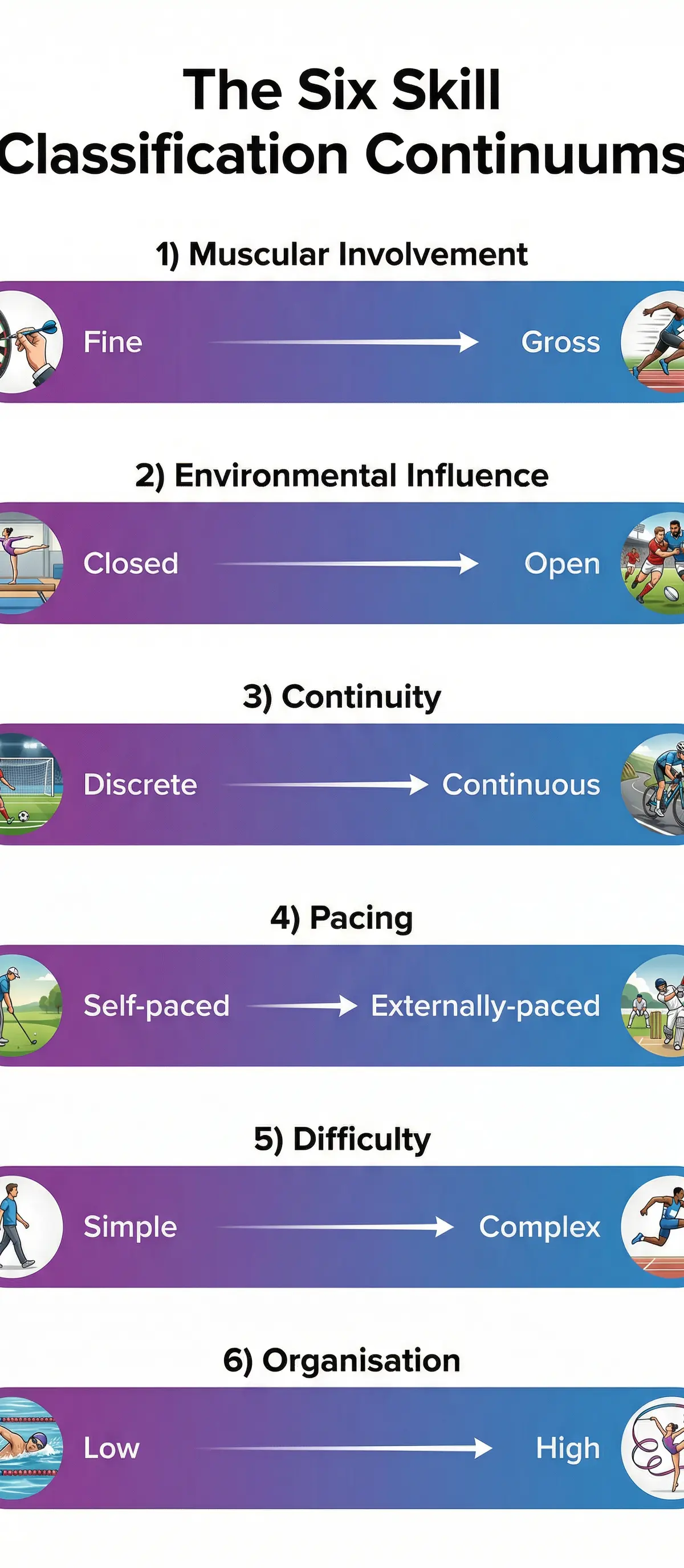
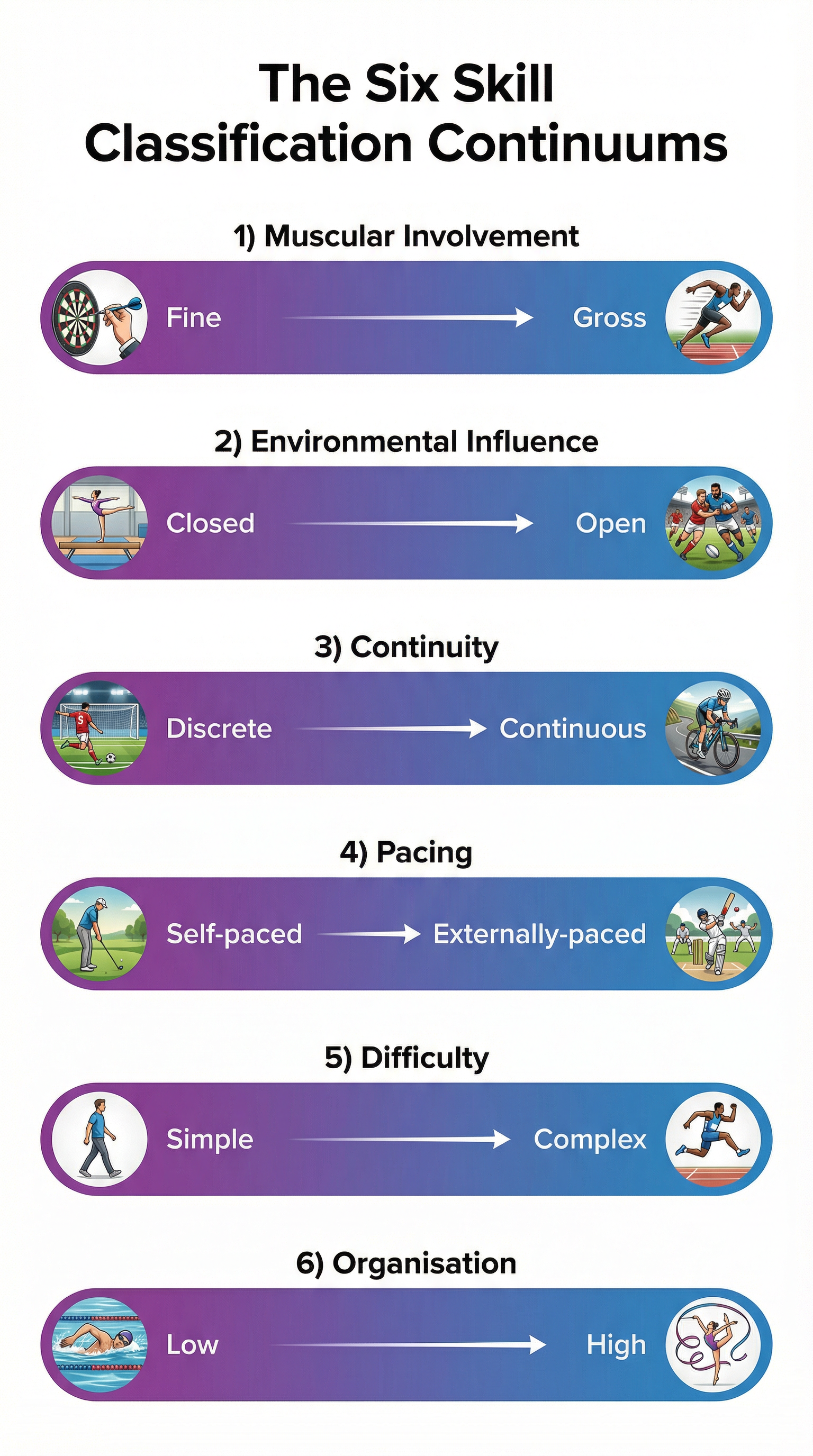
The Six Skill Classification ContinuumsSkills are not simply 'one thing or another'; they exist on a sliding scale or continuum. Your ability to place a skill on each of the six continuums and justify its position is a high-level skill that examiners reward. The six continuums are:
- Muscular Involvement: Gross ↔ Fine
- Environmental Influence: Open ↔ Closed
- Continuity: Discrete ↔ Serial ↔ Continuous
- Pacing: Self-paced ↔ Externally-paced
- Difficulty: Simple ↔ Complex
- Organisation: Low ↔ High
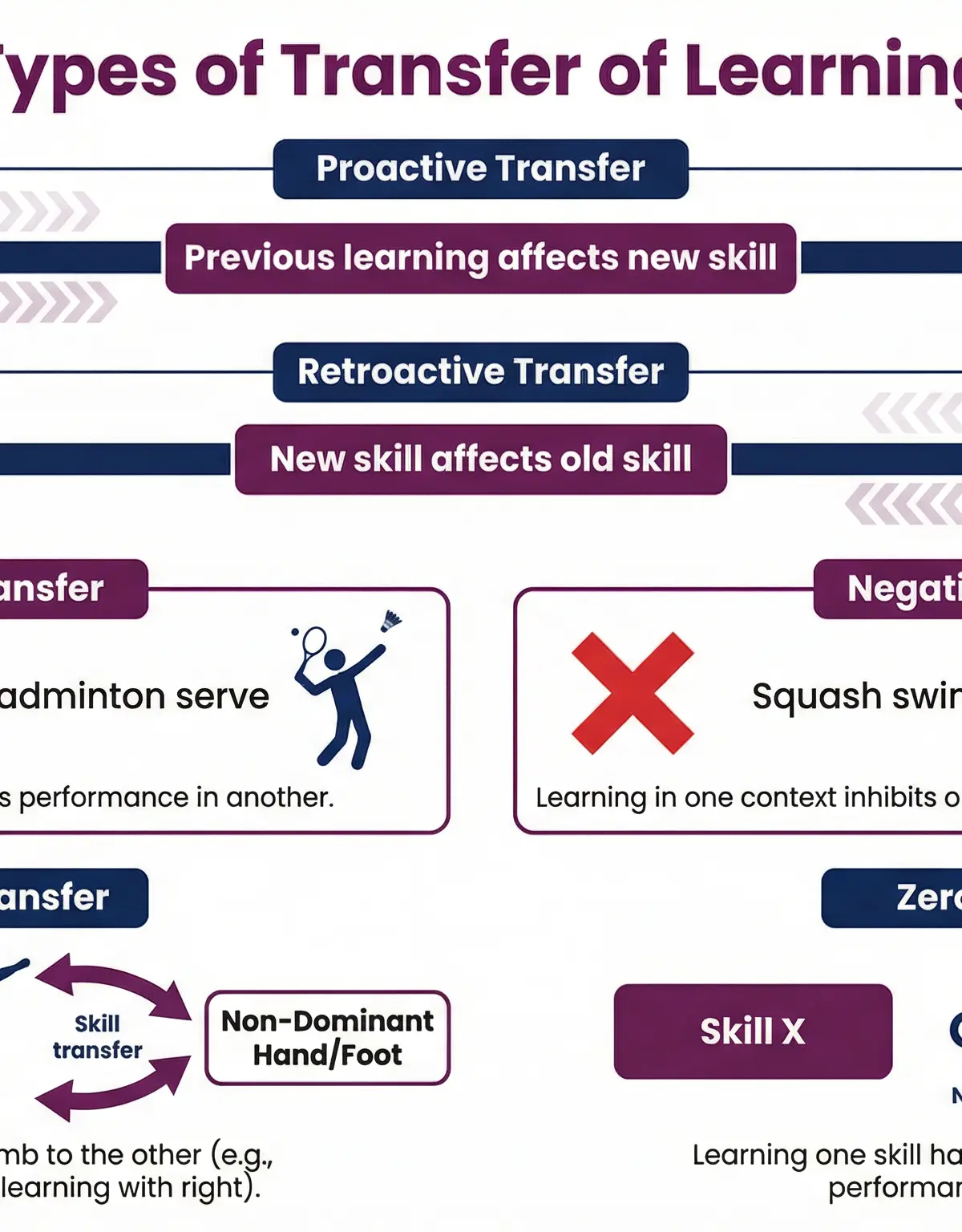
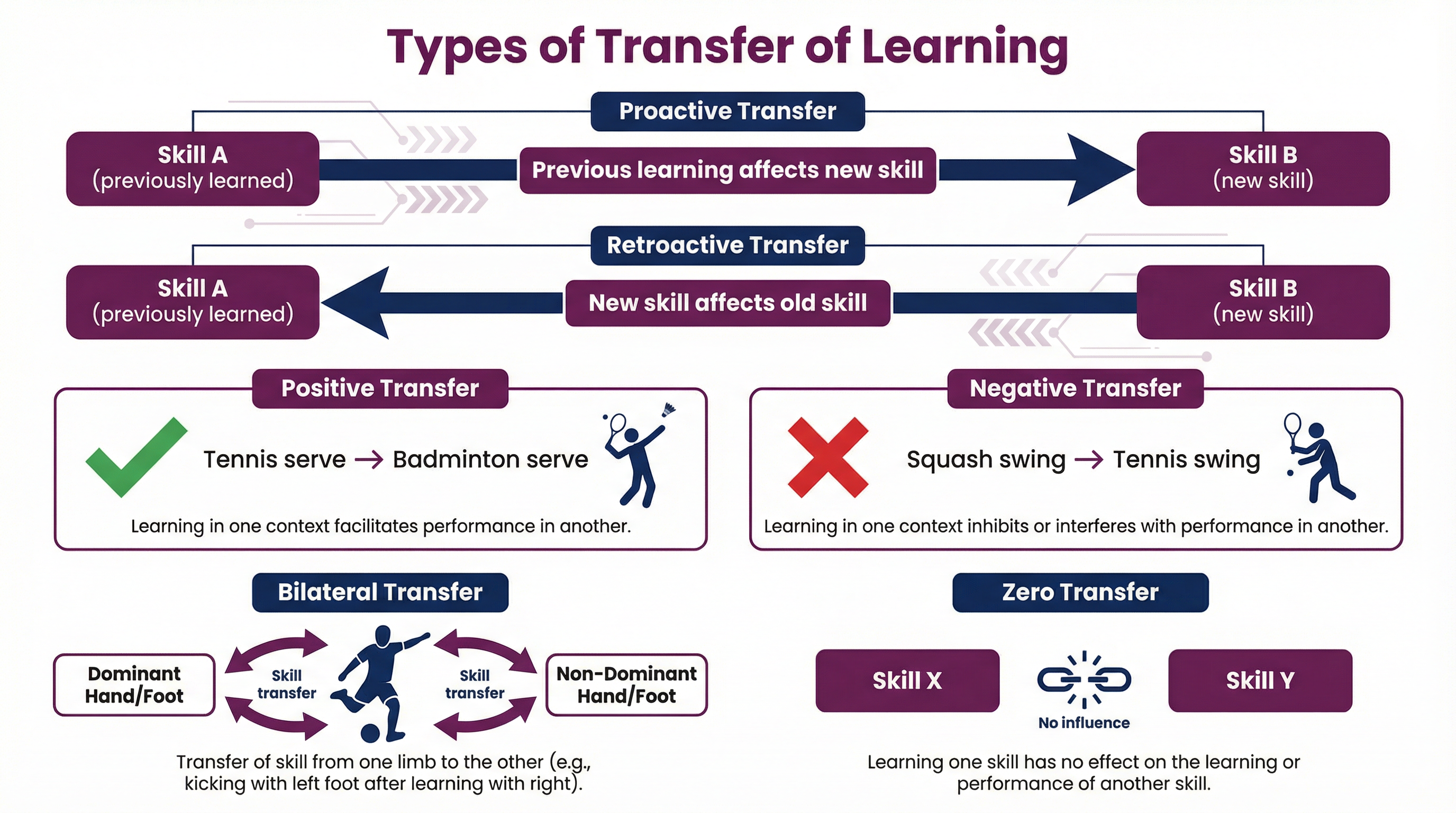
Transfer of LearningTransfer of learning examines the effect of learning one motor skill on the subsequent learning or performance of another. This can be positive, negative, or have no effect at all. A key theory to understand here is Thorndike's Identical Elements Theory, which states that the more similar the elements (stimuli and responses) of two skills are, the greater the amount of positive transfer. Coaches use this theory to design effective practice sessions.
The main types of transfer are:
- Positive Transfer: Learning of one skill facilitates the learning of another.
- Negative Transfer: Learning of one skill inhibits or interferes with the learning of another.
- Zero Transfer: Learning of one skill has no effect on the learning of another.
- Bilateral Transfer: Transfer of learning from one limb to another.
- Proactive Transfer: The influence of a previously learned skill on a new skill.
- Retroactive Transfer: The influence of a new skill on a previously learned skill.
Key Practitioners/Artists/Composers
While PE doesn't have 'artists' in the traditional sense, we do have influential theorists whose work you must know.
| Name | Period/Style | Key Works | Relevance |
|---|---|---|---|
| E.L. Thorndike | Early 20th Century | Identical Elements Theory | His theory is the primary explanation for positive transfer. Candidates must reference it when explaining why skills with similar components aid each other's learning. |
| Paul Fitts & Michael Posner | Mid 20th Century | Stages of Learning (Cognitive, Associative, Autonomous) | While not directly part of this topic, their work is a crucial synoptic link. The stage of learning a performer is in will directly affect the type and amount of transfer that can occur. |
Technical Vocabulary
Using precise terminology is critical for gaining marks. You MUST use the following terms in your exam answers:
- Motor Skill: An action or task with a goal that requires voluntary body and/or limb movement to be performed correctly.
- Continuum: A scale or range between two extremes.
- Sub-routine: The component parts of a more complex skill.
- Perceptual Load: The amount of information the performer needs to process.
- Motor Programme: A stored plan of movement in the long-term memory.
- Grooved: A skill that is well-learned and stored in the autonomous stage of learning.
Practical Skills
Techniques & Processes
Applying Skill Classification in a Practical SettingA coach's ability to accurately classify a skill is not just an academic exercise; it dictates how they structure training. For example:
- Open Skills: To develop open skills, a coach must create varied, unpredictable practice environments that force the performer to make decisions under pressure (e.g., small-sided games in football).
- Closed Skills: To develop closed skills, a coach can use repetitive drills in a stable environment to allow the performer to groove the motor programme (e.g., a basketball player taking 100 free throws).
- Serial Skills: These can be taught using 'chaining' (linking sub-routines one by one) or 'part-whole' practice (practising components in isolation before combining them).
- High Organisation Skills: These cannot be broken down, so they must be taught and practised as a whole (e.g., a golf swing).
Optimising Transfer of LearningA coach can manipulate practice to maximise positive transfer and minimise negative transfer:
- To Maximise Positive Transfer: Ensure practice conditions are as realistic as possible (identical elements). Point out similarities between skills to the performer. Ensure the first skill is well-learned.
- To Minimise Negative Transfer: Make the performer aware of the differences between the skills. Ensure the first skill is grooved before introducing the second. Avoid teaching conflicting skills close together.
Materials & Equipment
While this topic is theoretical, the application relates directly to the equipment used in sport. For example, when considering negative transfer, a coach might use different coloured balls or bibs to help a performer distinguish between two similar but conflicting drills. The choice of equipment can be a strategy to reduce interference between motor programmes.
Portfolio/Coursework Guidance
While this topic is primarily assessed in the written exam, a strong understanding of skill classification and transfer is essential for your practical performance and coursework (NEA - Non-Examined Assessment). When analysing your own or others' performance, you will be expected to use this terminology to justify your assessment and suggest effective practices for improvement. For example, in your evaluation, you could state: "My opponent's tennis serve is highly effective as it is a well-grooved, high-organisation skill. To improve my return, I need to treat it as an open, externally-paced skill and use variable practice to improve my reaction time."
Exam Component
Written Exam Knowledge
This topic is a staple of the written papers (Paper 1 and Paper 2). You can expect:
- Multiple Choice Questions: Asking for simple definitions or classifications.
- Short Answer Questions (2-4 marks): Requiring you to classify a skill and justify your answer using the 'State, Explain, Apply' method.
- Extended Answer Questions (8-15 marks): Asking you to analyse how a coach could use their knowledge of skill classification and transfer to improve a performer's skill level. These require you to make synoptic links to topics like Stages of Learning and Guidance.

Practical Exam Preparation
For your practical assessment, you need to demonstrate a high level of skill, which means your motor programmes must be in the autonomous stage. Your understanding of transfer will help you structure your own training. For example, if you are a footballer, you should be actively engaging in bilateral transfer by practising with your non-dominant foot. If you are a multi-sport athlete, you need to be aware of the potential for negative transfer between your sports and structure your training to minimise interference.
Visual Resources
2 diagrams and illustrations
Interactive Diagrams
1 interactive diagram to visualise key concepts
Conceptual Flow Outline
A flowchart showing the process of transfer of learning and potential coaching interventions.
Worked Examples
3 worked examples — open one to explore the question and available guidance.
Practice Questions
Test your understanding — click to reveal model answers
Classify a trampolining routine on the continuity and organisation continuums. (4 marks)
Hint: Think about whether the routine is one long movement or a series of linked parts. Can you break it down easily?
Explain, using Thorndike's theory, why a volleyball player might find it easy to learn the overarm throw in javelin. (3 marks)
Hint: What is Thorndike's theory called and what does it state?
Distinguish between proactive and retroactive transfer using a sporting example for each. (4 marks)
Hint: Remember: Proactive goes forward, Retroactive goes backward.
Evaluate the methods a coach could use to develop an open skill, such as passing in hockey, for an elite performer. (8 marks)
Hint: Think about how you make practice realistic and challenging for someone who is already an expert.