AQA · A-Level · Physical Education
Training Methods
This guide provides a comprehensive breakdown of Training Methods for AQA A-Level PE, focusing on the physiological adaptations, energy system links, and exam technique required to achieve top marks. It covers aerobic and anaerobic training, including HIIT, Plyometrics, and Weight Training, with a strong emphasis on applying knowledge to sporting contexts.
- 8 min read
- 3 worked examples
- 4 practice questions
- 6 key terms
Study Notes

Overview
Welcome to your deep dive into Training Methods, a cornerstone of the AQA A-Level PE specification (4.2). This topic is not just about listing different ways to train; it's about understanding the intricate physiological science that underpins performance enhancement. Examiners are looking for candidates who can dissect a training method, explain its impact on the body's energy systems and muscular-skeletal structures, and critically evaluate its suitability for a specific athlete. Mastery here is a direct route to securing high marks in both short-answer and extended-response questions.

Key Knowledge & Theory
Core Concepts
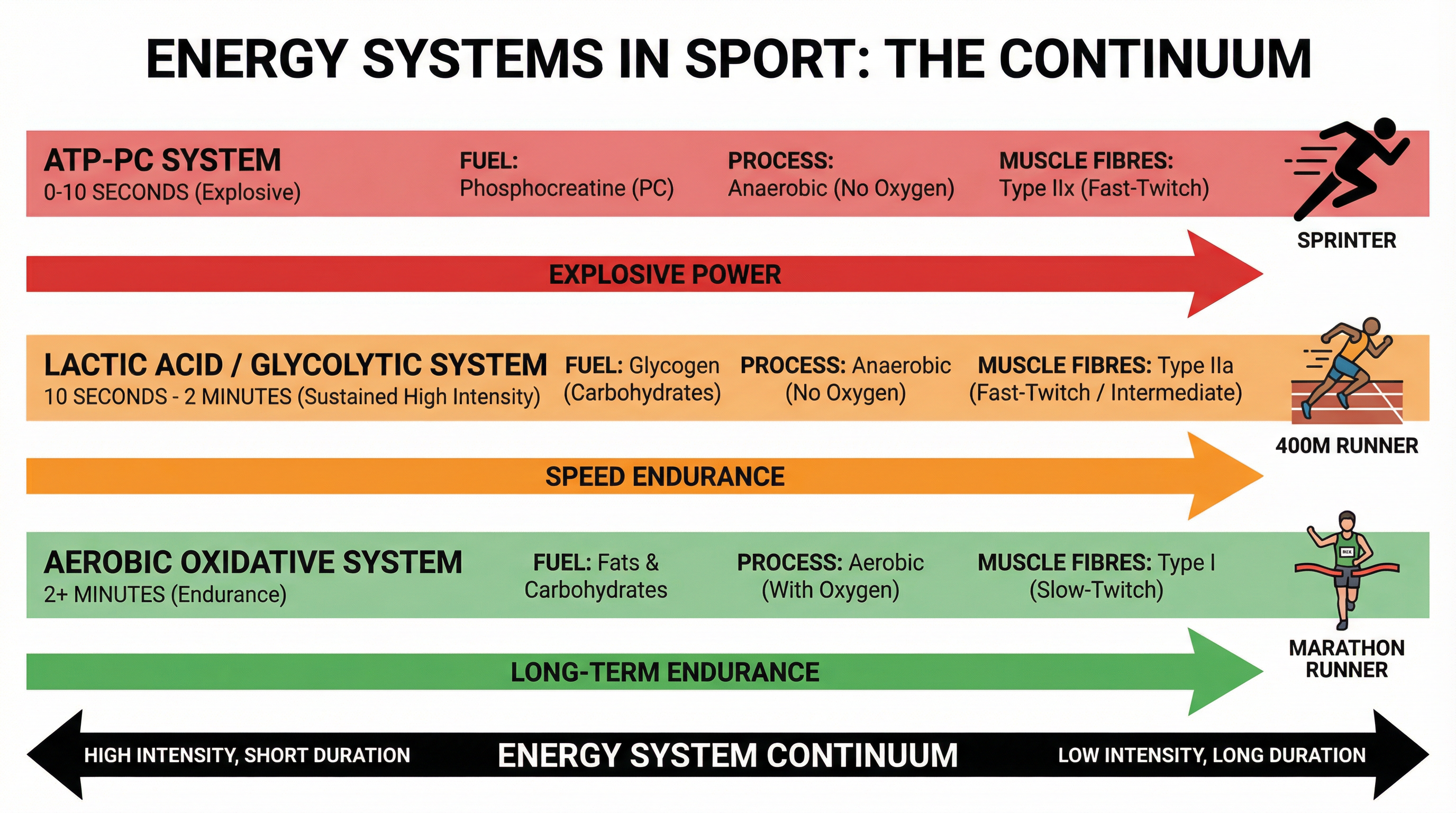
The fundamental division in training is between aerobic (with oxygen) and anaerobic (without oxygen) work. This distinction dictates which energy system is predominantly stressed and, therefore, which physiological adaptations are stimulated.
- Aerobic Training: Primarily targets the Aerobic Oxidative system. It involves sustained, low-to-moderate intensity exercise (60-80% MHR) for extended periods (20+ minutes). Its goal is to improve cardiovascular endurance and the body's ability to efficiently use oxygen.
- Anaerobic Training: Targets the ATP-PC system (0-10 seconds, maximal intensity) or the Glycolytic/Lactic Acid system (10 seconds - 2 minutes, high intensity). It involves short, intense bursts of effort followed by rest or recovery periods. Its goal is to improve power, speed, and muscular endurance.
Key Practitioners/Artists/Composers
In PE, our 'practitioners' are the pioneering coaches and scientists who shaped our understanding of training theory.
| Name | Period/Style | Key Works | Relevance |
|---|---|---|---|
| Dr. Woldemar Gerschler | 1930s-1960s | Interval Training | A German coach who pioneered interval training, demonstrating that breaking down work into intense bursts with recovery could dramatically improve middle-distance running performance. |
| Yuri Verkhoshansky | 1960s-1980s | Plyometric Training | A Soviet sports scientist known as the 'father of plyometrics'. He developed 'shock training' to improve explosive power in athletes by utilising the stretch-shortening cycle. |
| Dr. Izumi Tabata | 1990s | HIIT (Tabata Protocol) | A Japanese scientist whose research on high-intensity interval training led to the famous 'Tabata Protocol': 20 seconds of ultra-intense exercise followed by 10 seconds of rest, repeated for 4 minutes. |
| Tudor Bompa | 1960s-Present | Periodisation | A Romanian sports scientist who is credited with developing the modern theory of periodisation, structuring training into macro, meso, and microcycles to peak for competition. |
Technical Vocabulary
Using precise terminology is essential for gaining credit. Do not use generic terms; use the scientific language of the specification.
- 1 Rep Max (1RM): The maximum amount of weight an individual can lift for a single repetition.
- Heart Rate Max (MHR): The highest number of beats per minute your heart can pump under maximum stress.
- Stretch-Shortening Cycle (SSC): An eccentric contraction followed by an immediate concentric contraction, utilising stored elastic energy and the stretch reflex.
- Erythropoietin (EPO): A hormone produced by the kidneys that stimulates the production of red blood cells in response to hypoxia.
- Autogenic Inhibition: The relaxation of a muscle in response to high tension, mediated by the Golgi Tendon Organ (GTO).
- Periodisation: The organised division of training into specific blocks or cycles, each with a particular goal and time frame.
Practical Skills
Techniques & Processes
1. Continuous Training
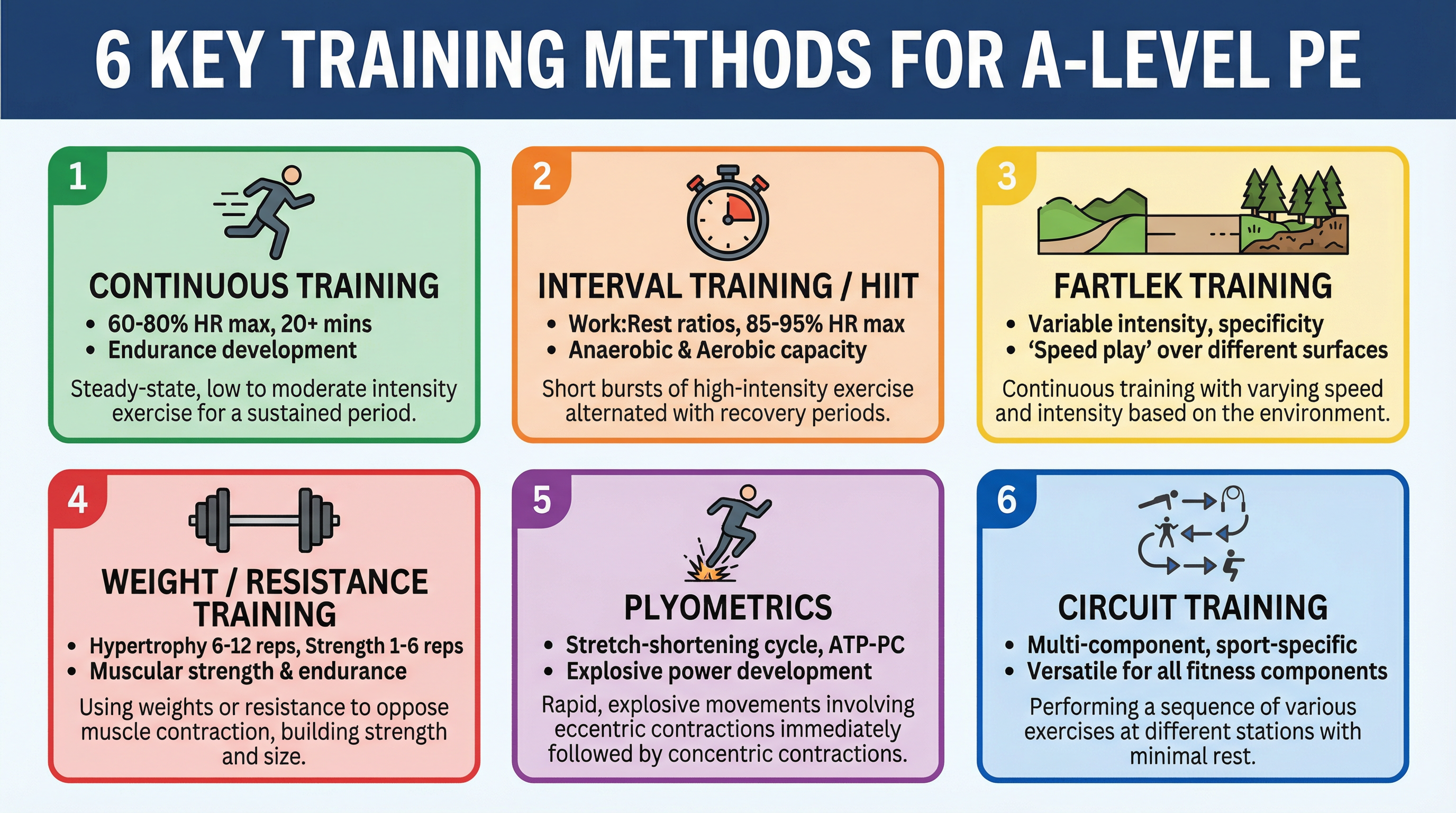
- How: Perform steady-state exercise (e.g., running, cycling) for a minimum of 20 minutes.
- Intensity: 60-80% of MHR.
- Physiology: Stresses the aerobic system, leading to cardiac hypertrophy (specifically left ventricular hypertrophy), increased stroke volume, bradycardia (lower resting heart rate), and increased muscle capillarisation.
2. High-Intensity Interval Training (HIIT)
- How: Alternate between short bursts of maximal or near-maximal work and periods of active recovery or complete rest.
- Intensity: 85-95% MHR during work intervals.
- Work:Rest Ratio: Varies by goal. 1:1 (e.g., 30s work, 30s rest) is common for improving anaerobic threshold.
- Physiology: Improves anaerobic and aerobic capacity, increases lactate tolerance, and enhances EPOC (Excess Post-exercise Oxygen Consumption).
3. Plyometric Training
- How: Involves explosive exercises like box jumps, depth jumps, and bounding. The key is minimal ground contact time.
- Intensity: Maximal effort for each jump.
- Physiology: Utilises the stretch-shortening cycle. The muscle spindle detects a rapid eccentric stretch, triggering a powerful concentric contraction (stretch reflex). This trains the neuromuscular system to produce force more rapidly, recruiting Type IIx fibres.
4. Weight Training
- Strength Protocol: 1-6 reps @ 80-100% 1RM, 3-5 mins rest. Primarily causes neural adaptations (improved motor unit recruitment).
- Hypertrophy Protocol: 6-12 reps @ 60-75% 1RM, 60-90s rest. Primarily causes an increase in the cross-sectional area of muscle fibres (sarcomeric hypertrophy).
Materials & Equipment
- Heart Rate Monitor: Essential for accurately gauging intensity during continuous and interval training. Marks are awarded for specifying its use.
- Free Weights (Barbells, Dumbbells): Allow for compound movements that recruit multiple muscle groups, enhancing functional strength.
- Plyometric Boxes: Used for depth jumps and box jumps. Must be sturdy and of appropriate height to ensure safety and effectiveness.
- Resistance Bands: Versatile tool for PNF stretching and adding variable resistance to exercises.
Portfolio/Coursework Guidance
While PE A-Level has a practical performance component, the 'portfolio' is your theoretical knowledge. You must build a strong internal portfolio of evidence in your notes, demonstrating you can link theory to practice.
Assessment Criteria
- AO1 (35%): Demonstrate knowledge and understanding of factors that underpin performance.
- AO2 (35%): Apply knowledge and understanding to practical examples.
- AO3 (30%): Analyse and evaluate factors that underpin performance.
Building a Strong Portfolio
- Mind Maps: Create detailed mind maps for each training method, linking it to energy systems, physiological adaptations, and sporting examples.
- Case Studies: Take an athlete (e.g., Mo Farah, Usain Bolt) and analyse the specific training methods they would use, justifying your choices with scientific principles.
- Evaluation Tables: For each method, create a table of advantages and disadvantages, considering both physiological benefits and practical risks (e.g., injury, DOMS).
Exam Component
Written Exam Knowledge
- You must be able to recall the specific parameters (intensity, duration, reps, sets, rest) for each training method.
- Be prepared to explain the physiological mechanisms, such as the stretch-shortening cycle or autogenic inhibition.
- Extended questions (8 and 15 marks) will almost always require you to design or evaluate a training programme for a specific athlete, demanding application (AO2) and evaluation (AO3).
Practical Exam Preparation
Your practical performance is assessed separately, but your theoretical knowledge of training methods is what allows you to improve that performance. You should be able to justify your own training programme using the principles and methods outlined in this guide. For example, if you are a netball player, you should be able to explain why a combination of HIIT, plyometrics, and circuit training is optimal for your performance.
Visual Resources
2 diagrams and illustrations
Interactive Diagrams
1 interactive diagram to visualise key concepts
Conceptual Flow Outline
The Principle of Progressive Overload: A flowchart showing how the body adapts to training stress, leading to performance improvements and the need for continued overload.
Worked Examples
3 worked examples — open one to explore the question and available guidance.
Practice Questions
Test your understanding — click to reveal model answers
Identify two physiological adaptations resulting from long-term aerobic training.
Hint: Think about how the heart and muscles change to become more efficient at using oxygen.
Using a sporting example, explain how Fartlek training demonstrates the principle of specificity.
Hint: Choose a sport with variable intensity and explain how Fartlek mimics the demands of that sport.
Analyse the role of the two anaerobic energy systems during a 200m sprint.
Hint: Break the race down. What happens in the first few seconds? What happens for the remainder of the race?
Design a six-week mesocycle for a shot putter aiming to increase their explosive power. Justify your choices.
Hint: This is an extended response. Structure your answer around periodisation principles (macro, meso, micro). Choose appropriate training methods (e.g., weights, plyometrics) and specify the parameters (reps, sets, intensity). Evaluate the effectiveness and risks.