Pearson Edexcel · A-Level · Physical Education
Personality, Anxiety, and Aggression
This study guide provides a comprehensive overview of Personality, Anxiety, and Aggression in A-Level Physical Education (Edexcel 5.1). It critically examines key psychological theories and their application to sporting performance, equipping candidates with the knowledge to excel in AO1, AO2, and AO3 assessment objectives.
- 7 min read
- 3 worked examples
- 4 practice questions
- 6 key terms
Study Notes

Overview
This topic delves into the core of sports psychology, exploring how an athlete's mental state can be the difference between winning and losing. A thorough understanding of personality, anxiety, and aggression is not just theoretical; it provides a framework for analysing performance, managing pressure, and explaining behaviour in a sporting context. Examiners are looking for candidates who can move beyond simple definitions and apply these complex theories to real-world athletes and scenarios, critically evaluating their strengths and weaknesses. Mastery of this section is crucial for success in Component 2.

Key Knowledge & Theory
Core Concepts
The primary theoretical battleground for this topic involves three main approaches to personality:
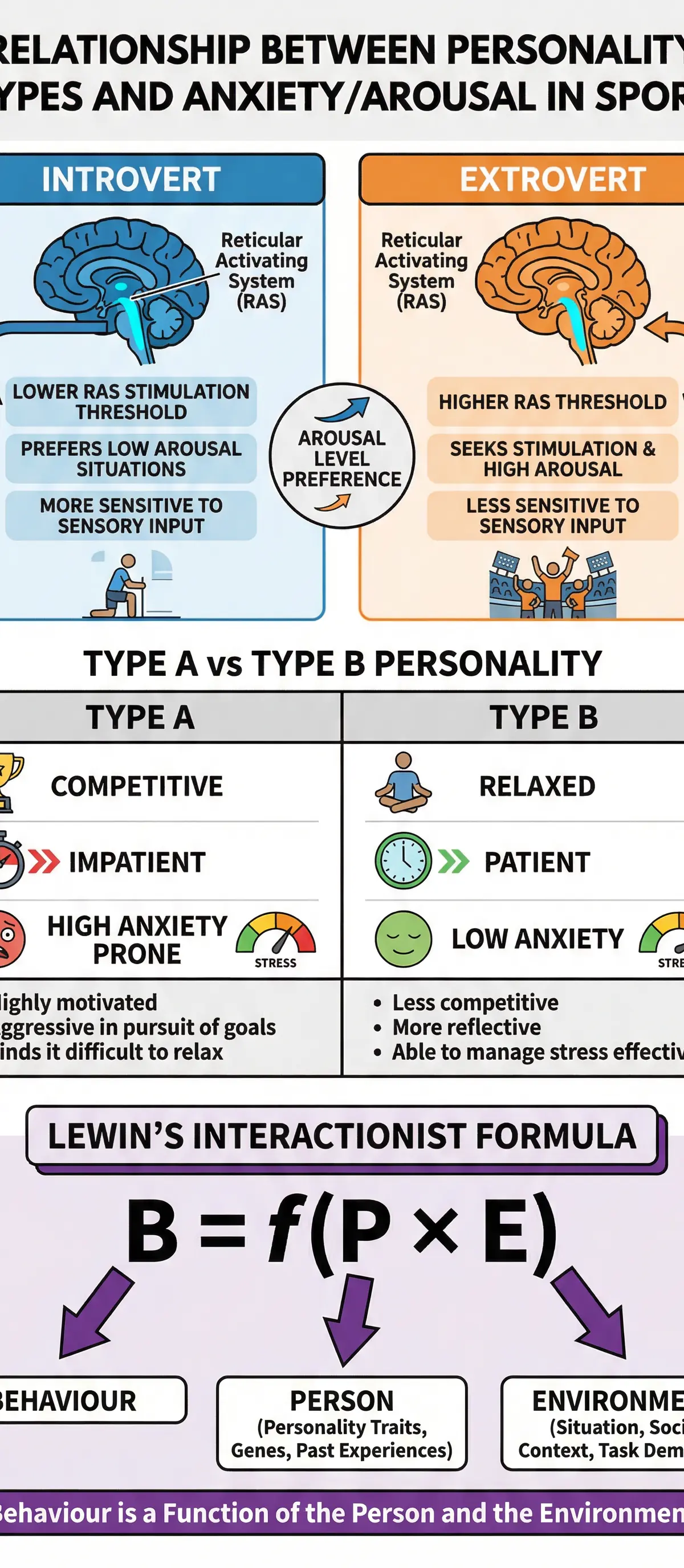
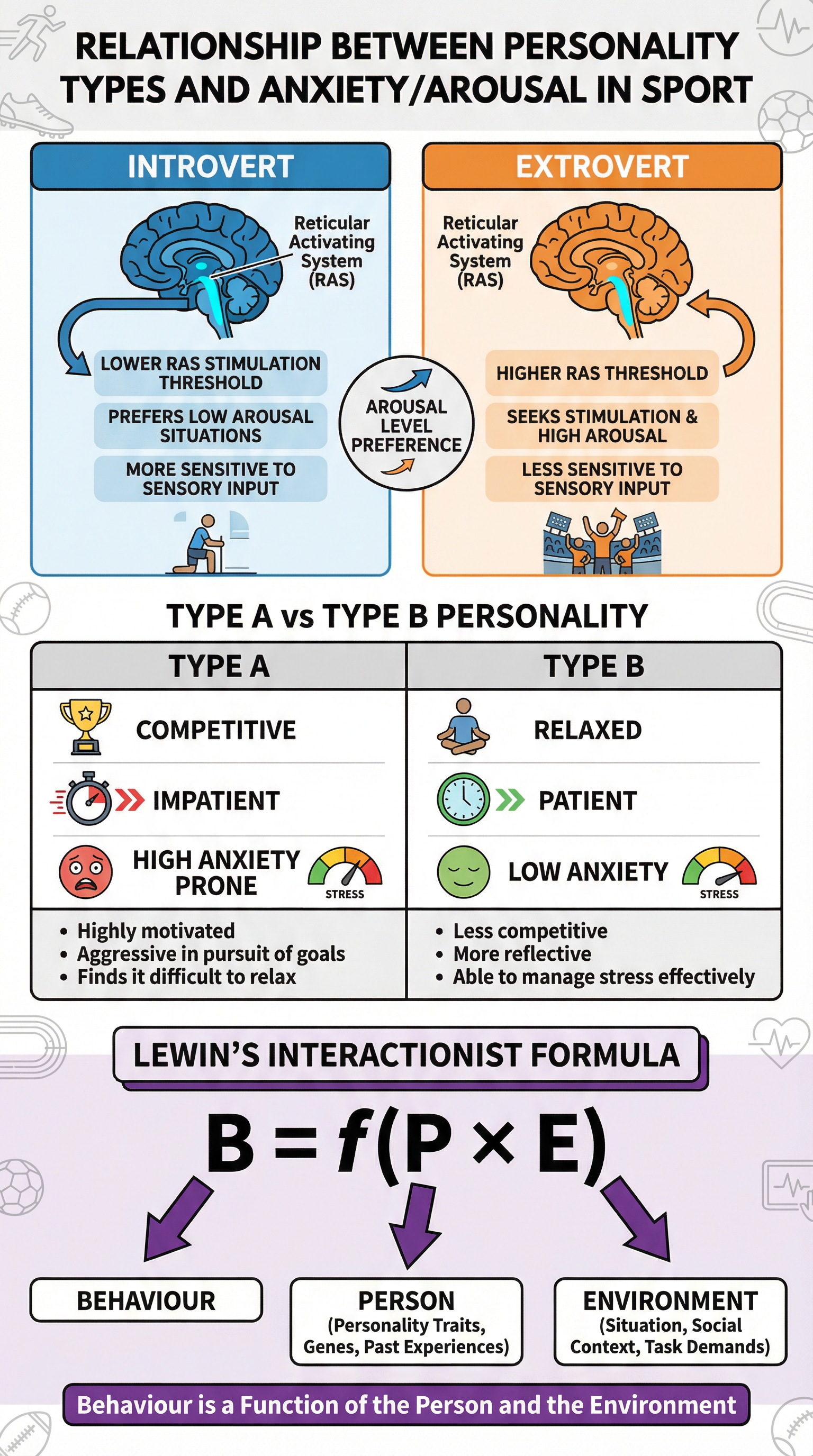
- Trait Theory: This perspective, championed by theorists like Eysenck, posits that personality is innate, stable, and enduring. An individual's behaviour is seen as consistent across different situations. A key concept here is the Reticular Activating System (RAS), which controls arousal. Introverts are said to have a highly sensitive RAS, leading them to avoid high-stimulation environments, whereas extroverts have a less sensitive RAS and actively seek out arousal.
- Social Learning Theory: In direct contrast to Trait Theory, Bandura's Social Learning Theory argues that personality is learned from our environment. We observe and imitate the behaviour of significant others (role models), and this process is strengthened through vicarious reinforcement (seeing others rewarded for their behaviour). Behaviour is not stable; it is situation-dependent.
- Interactionist Approach: This is the most widely accepted modern theory. It proposes that behaviour is a function of both the person and their environment, neatly summarised by Lewin's formula: B = f(P x E). This approach acknowledges that while we have core personality traits, they are modified by the specific situation we are in. A calm person might become aggressive in a high-stakes competitive environment.
When discussing anxiety, it is critical to distinguish it from arousal. Arousal is a neutral physiological and psychological state of readiness, whereas anxiety is a negative emotional state characterised by worry and apprehension. Anxiety can be further broken down:
- Cognitive Anxiety: The mental component (e.g., worry, fear of failure, loss of concentration).
- Somatic Anxiety: The physiological component (e.g., increased heart rate, sweating, muscle tension).
Key Practitioners/Theorists
| Name | Approach/Theory | Key Idea | Relevance |
|---|---|---|---|
| Eysenck | Trait Theory | Personality is innate; linked introversion/extroversion to the Reticular Activating System (RAS). | Provides a biological basis for personality traits and arousal preferences in athletes. |
| Bandura | Social Learning Theory | Behaviour is learned through observation, imitation, and vicarious reinforcement. | Explains how aggressive behaviours can be learned from role models in sport. |
| Lewin | Interactionist Approach | Behaviour is a function of the person and their environment (B = f(P x E)). | The most accepted theory, explaining why athletes behave differently in different situations. |
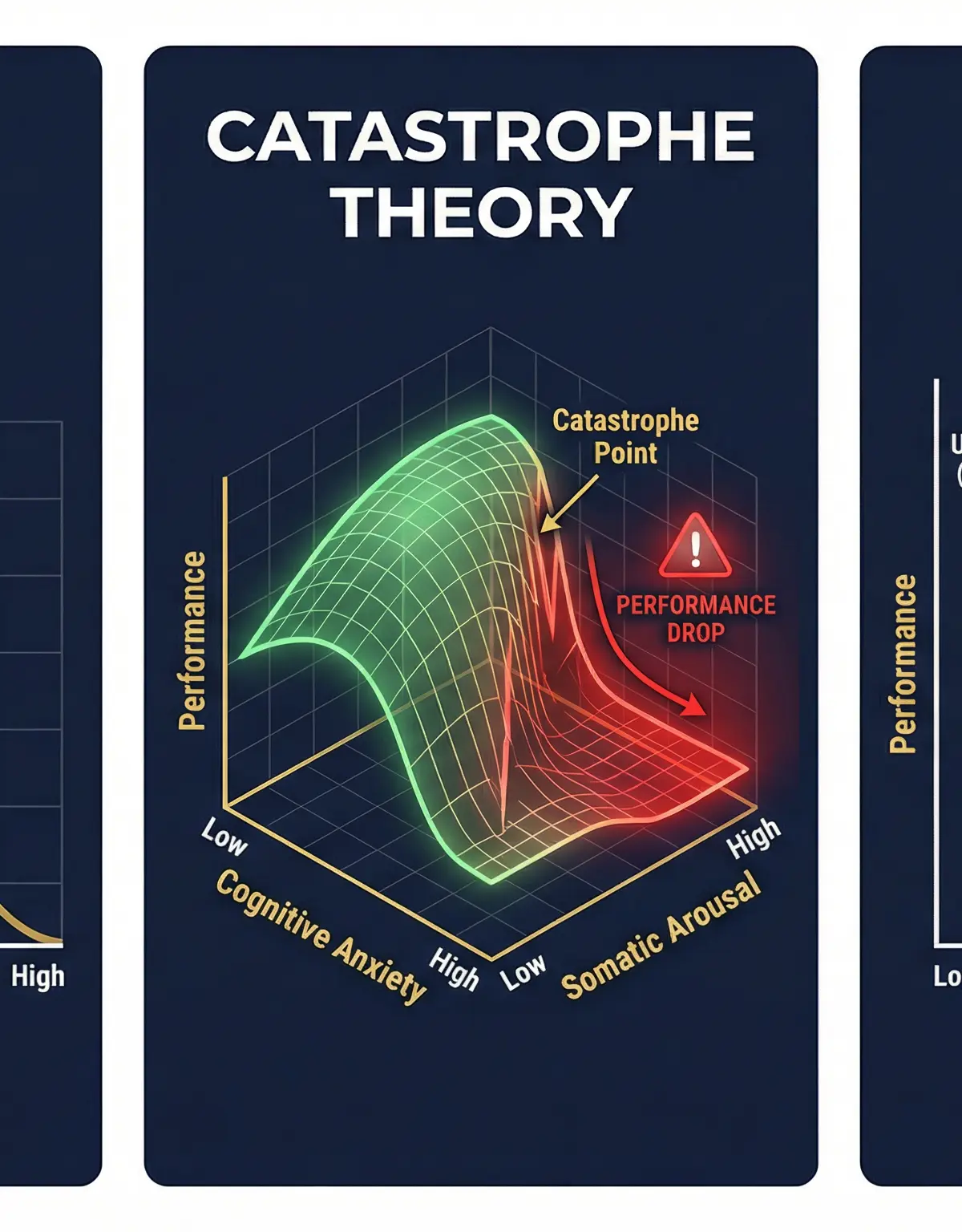
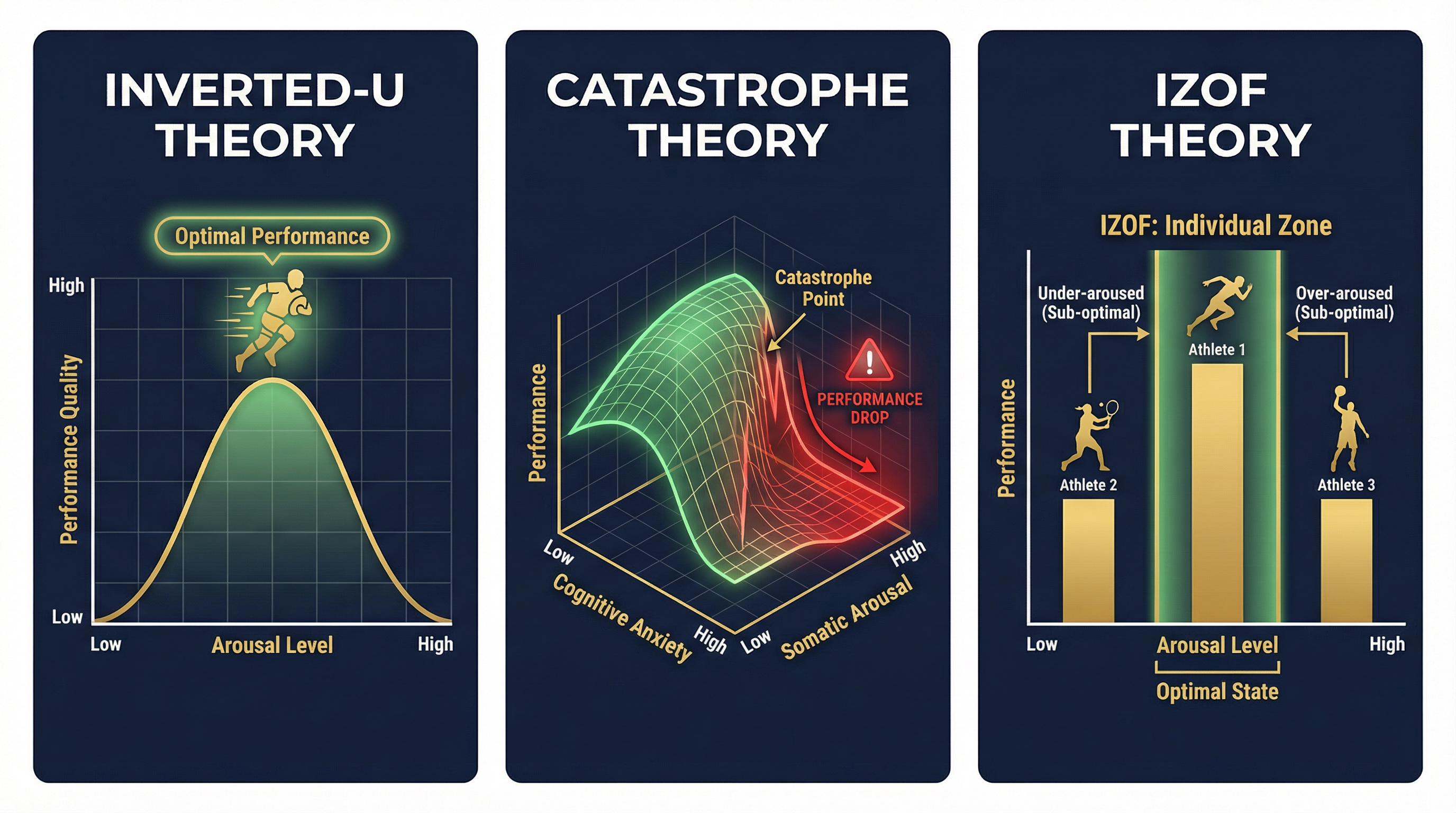
| Hardy & Fazey | Catastrophe Theory | High cognitive anxiety plus high somatic arousal can cause a sudden, dramatic drop in performance. | Critiques the Inverted-U hypothesis by providing a more realistic model for performance collapse under pressure. |
| Hanin | IZOF Theory | Each athlete has an Individual Zone of Optimal Functioning—a personal bandwidth of arousal for peak performance. | Moves beyond a single 'optimal point' and offers a more individualised, practical model for coaches. |
| Berkowitz | Aggressive Cue Hypothesis | Frustration creates a readiness for aggression, but an aggressive act will only occur if specific environmental cues are present. | Refines the Frustration-Aggression hypothesis, explaining why aggression is not an automatic response to frustration. |
Technical Vocabulary
- Reticular Activating System (RAS): A network of neurons in the brainstem that regulates arousal and sleep-wake transitions.
- Catharsis: The process of releasing, and thereby providing relief from, strong or repressed emotions (e.g., releasing aggressive energy through sport).
- Vicarious Reinforcement: Learning by observing others being rewarded for their behaviour.
- State Anxiety: A temporary emotional state in response to a specific situation.
- Trait Anxiety: A stable personality dimension that predisposes an individual to perceive situations as threatening.
- Assertive Behaviour: Goal-directed, forceful action within the rules, with no intent to harm.
Practical Skills
Techniques & Processes for Anxiety Management
Candidates must be able to categorise and describe anxiety management techniques. Credit is awarded for identifying whether a technique is somatic or cognitive.
-
Somatic Techniques (Targeting the body):
- Progressive Muscular Relaxation (PMR): Involves tensing and then relaxing specific muscle groups in sequence. This helps the athlete recognise and control muscle tension associated with somatic anxiety.
- Biofeedback: Uses electronic instruments to measure physiological responses like heart rate, muscle tension, and skin temperature. The athlete receives real-time feedback, allowing them to learn to control these responses.
- Breathing Control: Involves slow, deep, diaphragmatic breathing to reduce heart rate and promote a state of calm.
-
Cognitive Techniques (Targeting the mind):
- Imagery: The athlete creates a mental picture of a successful performance. This can involve visualising the perfect execution of a skill or imagining a calm, confident state of mind.
- Positive Self-Talk: Replacing negative, irrational thoughts with positive, constructive ones. This helps to reframe a threatening situation as a challenge.
- Goal Setting: Using SMART (Specific, Measurable, Achievable, Recorded, Timed) goals to focus attention, increase motivation, and reduce anxiety by breaking down a large task into manageable steps.
Exam Component
Written Exam Knowledge
The written exam will test your ability to define, apply, and evaluate the theories covered. For 15-mark questions, a balanced structure is essential. You must demonstrate AO1 (knowledge), AO2 (application), and AO3 (evaluation). A typical structure would be:
- Introduction: Briefly define the key terms in the question.
- Main Body Paragraph 1: Explain the first theory/concept, applying it to the sporting scenario provided.
- Main Body Paragraph 2: Explain a contrasting theory/concept, again applying it to the scenario.
- Evaluation/Critique: Discuss the strengths and weaknesses of the theories. Which is more applicable in this context and why? Use evidence and compare the models.
- Conclusion: Summarise your main points and provide a final judgement.
Visual Resources
2 diagrams and illustrations
Interactive Diagrams
1 interactive diagram to visualise key concepts
Conceptual Flow Outline
Berkowitz's Aggressive Cue Hypothesis Flowchart
Worked Examples
3 worked examples — open one to explore the question and available guidance.
Practice Questions
Test your understanding — click to reveal model answers
Identify two characteristics of a Type A personality. (2 marks)
Hint: Think about the personality traits associated with high stress and competitiveness.
Describe the difference between somatic and cognitive anxiety, providing a sporting example for each. (4 marks)
Hint: Somatic relates to the body, cognitive relates to the mind.
A talented young gymnast performs a clean routine in training but makes several errors when competing in front of a large crowd. Using Catastrophe Theory, explain why this might have occurred. (6 marks)
Hint: Focus on the interaction between cognitive anxiety and somatic arousal, leading to a sudden drop in performance.
Evaluate the Trait Theory of personality in sport. (8 marks)
Hint: Discuss the strengths and weaknesses of the theory, and compare it to the Interactionist Approach.