Pearson Edexcel · A-Level · Physical Education
Transfer of Skills and Memory Models
This guide provides a comprehensive breakdown of Transfer of Skills and Memory Models for A-Level PE (Edexcel 4.2). It explores how prior learning impacts skill acquisition and examines the cognitive frameworks, like the Multi-Store and Levels of Processing models, that govern memory in sport.
- 8 min read
- 3 worked examples
- 4 practice questions
- 6 key terms
Study Notes
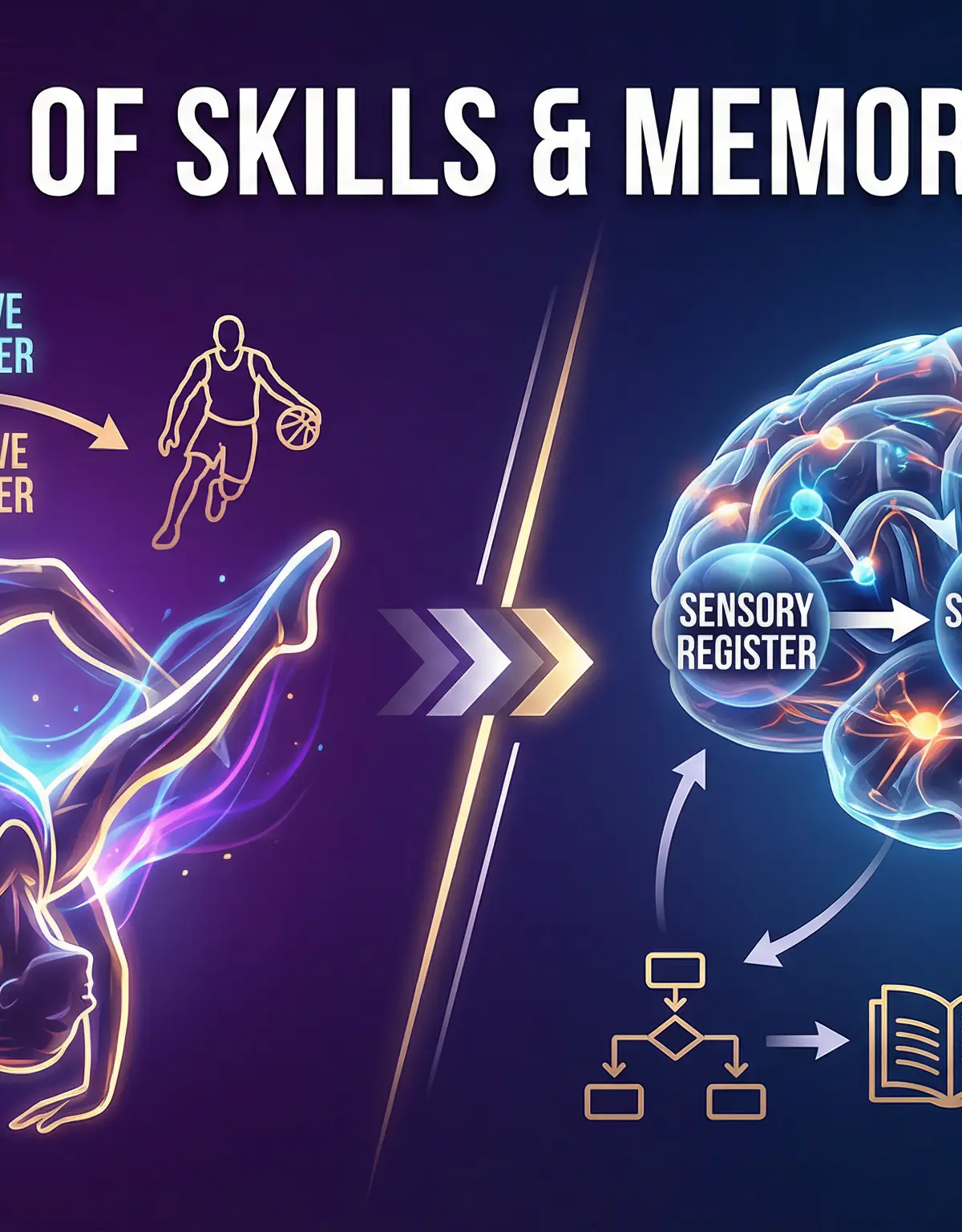
Overview
Welcome to your deep dive into Topic 4.2: Transfer of Skills and Memory Models. This is a critical area of the A-Level PE specification, blending cognitive psychology with practical sporting performance. A strong grasp of this topic is essential for high marks, as it underpins how athletes learn, adapt, and perform under pressure. Examiners frequently target this area in both short-answer and extended-response questions, making it a high-value revision priority. This guide will equip you with the theoretical knowledge (AO1), practical application skills (AO2), and analytical evaluation techniques (AO3) needed to excel.
Key Knowledge & Theory
Core Concepts
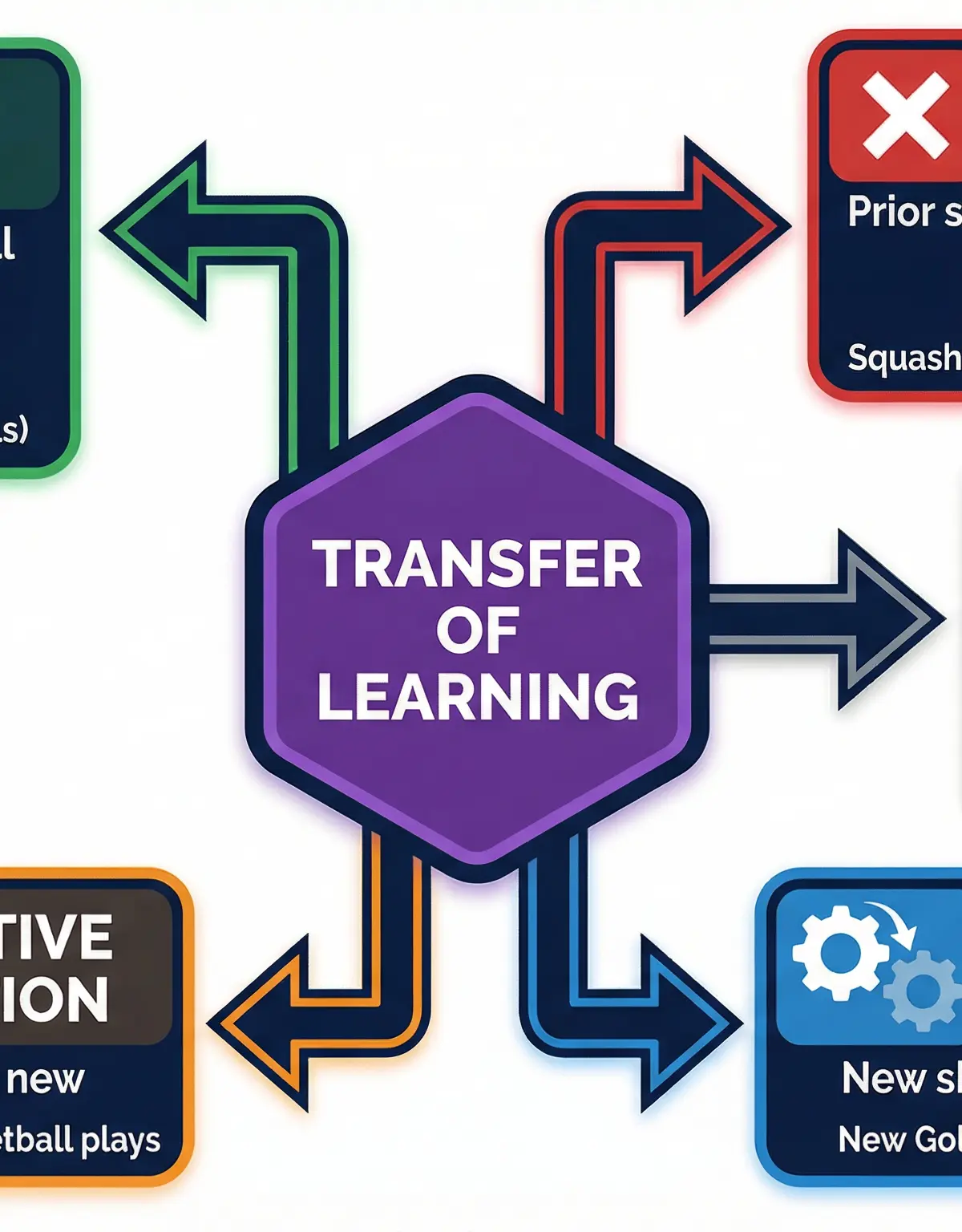
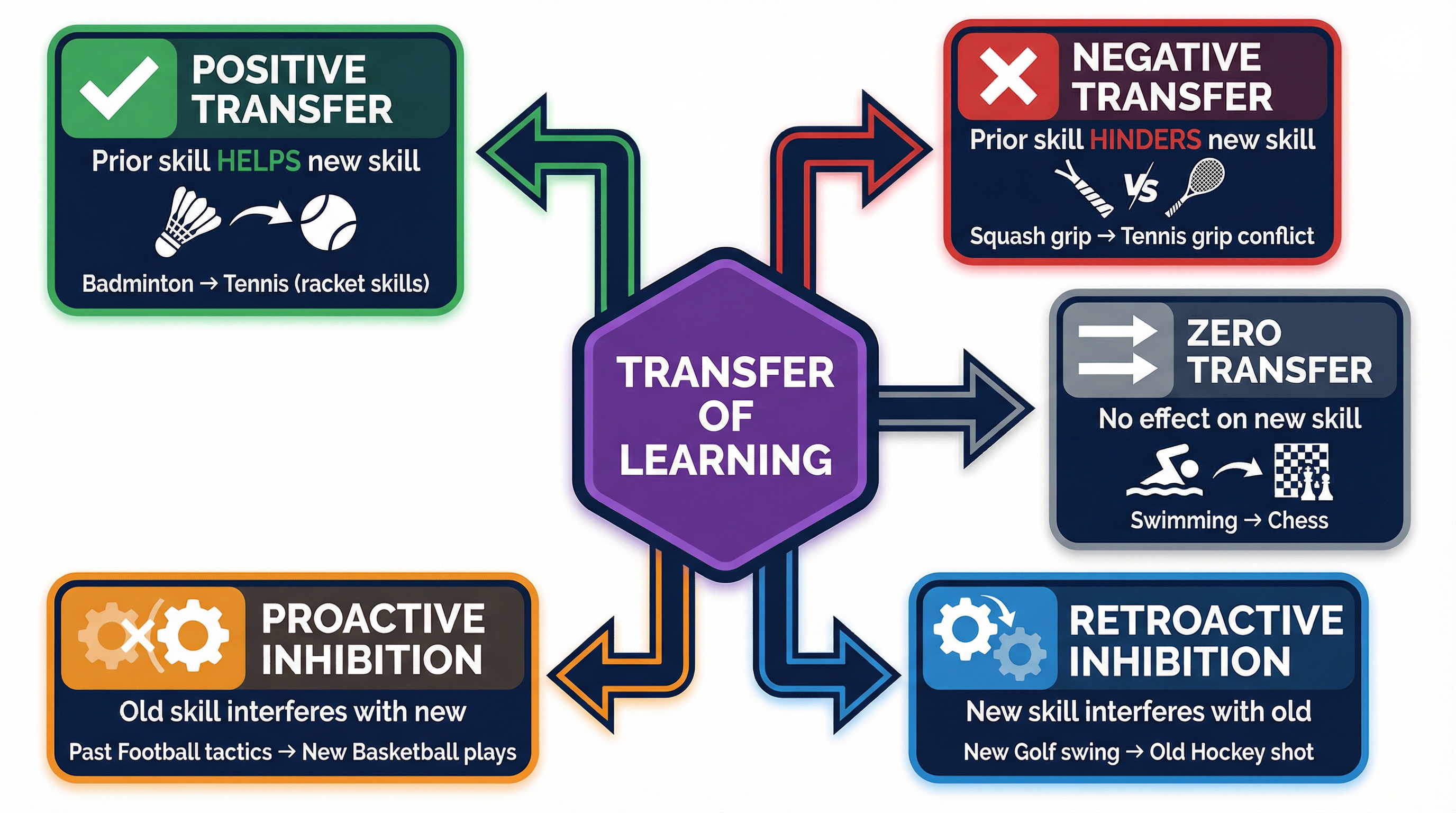
Transfer of LearningTransfer of learning examines the influence of one learned skill on the performance or learning of another. This influence can be positive, negative, or neutral. The ability to identify and manage transfer is a hallmark of effective coaching.
- Positive Transfer: Occurs when a previously learned skill facilitates the learning of a new skill. This is most common when skills share similar movement patterns, cognitive processes, or environmental cues. For example, the overarm throwing action learned in cricket positively transfers to the javelin throw.
- Negative Transfer: Occurs when a previously learned skill hinders the learning of a new skill. This often happens when skills appear similar but have fundamentally different technical requirements. For instance, the wrist action in badminton (flexion) negatively interferes with the firm wrist required for a tennis volley.
- Zero Transfer: Occurs when two skills are entirely unrelated, meaning the learning of one has no impact on the other (e.g., swimming and chess).
- Bilateral Transfer: This is transfer from one limb to another. For example, a footballer learning to pass with their non-dominant foot after mastering it with their dominant foot.
InhibitionInhibition is a form of negative transfer where one memory trace disrupts another. It's crucial to distinguish between proactive and retroactive inhibition.
- Proactive Inhibition: An old memory trace interferes with a new one. (Pro = forward-acting). Example: A hockey player who has used a specific penalty corner routine for years struggles to remember a new routine.
- Retroactive Inhibition: A new memory trace interferes with an old one. (Retro = backward-acting). Example: After learning a new, more complex golf swing, a player finds it difficult to recall their old, simpler swing.
Memory ModelsMemory is the process of encoding, storing, and retrieving information. Two key models are examined.
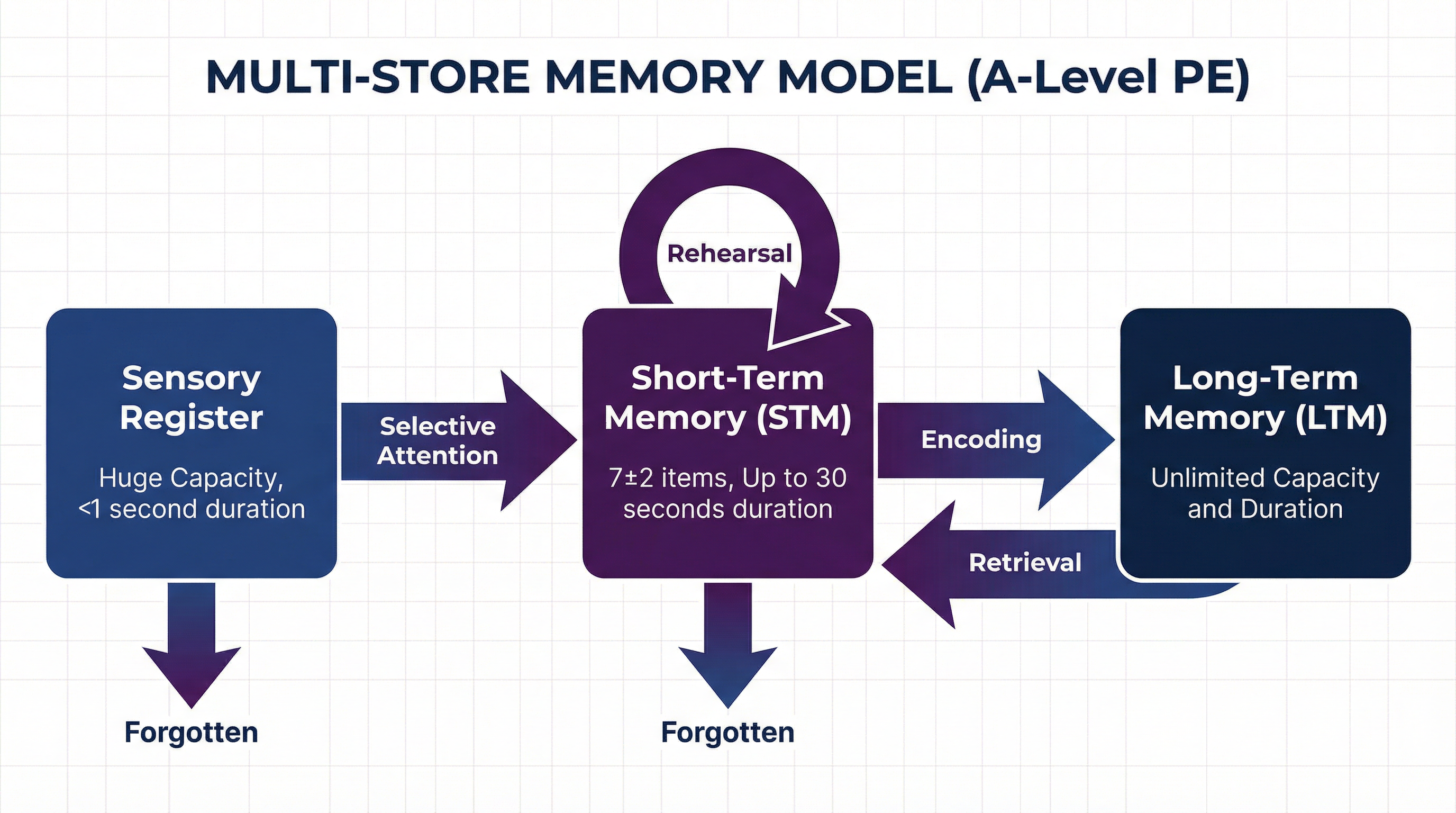
- The Multi-Store Memory Model (Atkinson & Shiffrin, 1968): This is a linear model proposing that memory consists of three distinct stores.
- Sensory Register: The initial point of contact for all sensory information. It has a vast capacity but a very brief duration (less than a second). Information is lost unless it captures our selective attention.
- Short-Term Memory (STM): The 'working memory'. It has a limited capacity of 7 +/- 2 items and a duration of up to 30 seconds without rehearsal. Information is kept in STM via maintenance rehearsal (repetition) and is lost through displacement or trace decay.
- Long-Term Memory (LTM): The permanent store for information. It has an unlimited capacity and duration. Information is transferred from STM to LTM via encoding and elaborative rehearsal.
- The Levels of Processing Model (Craik & Lockhart, 1972): This model argues that memory is not about stores, but about the depth at which information is processed. The deeper the processing, the stronger and more durable the memory trace.
- Shallow Processing: Structural (what it looks like) or phonetic (what it sounds like). Leads to weak memory traces.
- Deep (Semantic) Processing: Considering the meaning of the information and linking it to existing knowledge. This leads to strong, lasting memory traces.
Key Practitioners/Artists/Composers
| Name | Period/Style | Key Works | Relevance |
|---|---|---|---|
| Atkinson & Shiffrin | 1968, Cognitive | Multi-Store Memory Model | Provided the foundational, structural model of memory, introducing the concept of distinct storage units. |
| Craik & Lockhart | 1972, Cognitive | Levels of Processing Model | Challenged the structural view, arguing that the depth of processing is key to long-term memory formation. |
| Baddeley & Hitch | 1974, Cognitive | Working Memory Model | Offered a more detailed and accurate model of Short-Term Memory, crucial for evaluating the MSM. |
| George A. Miller | 1956, Cognitive | 'The Magical Number Seven, Plus or Minus Two' | Quantified the limited capacity of Short-Term Memory, a core component of the Multi-Store Model. |
Technical Vocabulary
- Selective Attention: The process of focusing on a particular stimulus in the environment while ignoring others.
- Encoding: The process of converting information into a construct that can be stored in memory.
- Retrieval: The process of getting information out of memory storage.
- Trace Decay: The gradual fading of a memory trace over time.
- Chunking: Grouping separate pieces of information into a single larger unit to increase STM capacity.
- Elaborative Rehearsal: Linking new information to existing knowledge in a meaningful way to enhance encoding.
Practical Skills
Techniques & Processes
Optimising Positive TransferCoaches can maximise positive transfer by:
- Highlighting Similarities: Explicitly pointing out the common elements between the old and new skill.
- Using Analogy: Comparing the new skill to a well-learned one (e.g., 'swing the golf club like a pendulum').
- Variable Practice: Practicing a skill in a wide variety of situations to build a robust schema.
**Mitigating Negative Transfer (The DCR Approach)**Examiners credit the use of the DCR model:
- Detect: The coach identifies the specific point of negative transfer (e.g., the wrist action).
- Compare: The coach explains the difference between the old and new technique.
- Remedy: The coach implements drills to isolate and correct the faulty part of the new skill, ensuring the new motor programme is established.
Applying Memory Models to Coaching
- Multi-Store Model Application: Coaches must ensure instructions are concise (to fit STM capacity), grab the athlete's selective attention, and incorporate repetition (rehearsal) to aid encoding.
- Levels of Processing Application: Coaches should move beyond simple instructions and ask 'why' questions. Forcing an athlete to explain the biomechanical principles behind a technique encourages deep, semantic processing.

Exam Component
Written Exam Knowledge
This topic is a staple of the written paper. You can expect:
- AO1 Questions: Define terms like 'proactive inhibition' or describe the components of the Multi-Store Model.
- AO2 Questions: Apply your knowledge to a given sporting scenario. E.g., 'Using a sporting example, explain how a coach could limit the effects of negative transfer.'
- AO3 Questions: Evaluate the models. E.g., 'Critically evaluate the Multi-Store Memory Model, making reference to an alternative model.' This is where you bring in the Levels of Processing or Working Memory models to highlight the MSM's limitations.
For 8 or 15-mark questions, a structured approach is vital. Each paragraph should ideally contain AO1 (knowledge), AO2 (application), and AO3 (evaluation) to ensure you are hitting all assessment objectives throughout your response.
Visual Resources
2 diagrams and illustrations
Interactive Diagrams
1 interactive diagram to visualise key concepts
Conceptual Flow Outline
Flowchart of the Multi-Store Memory Model
Worked Examples
3 worked examples — open one to explore the question and available guidance.
Practice Questions
Test your understanding — click to reveal model answers
Identify the type of transfer occurring when a skilled basketball player learns netball. (1 mark)
Hint: Consider the similarities in passing and footwork.
Describe the capacity and duration of the short-term memory store according to Atkinson and Shiffrin. (2 marks)
Hint: Recall George A. Miller's famous paper.
Explain how a coach could use 'chunking' to teach a complex gymnastics sequence. (4 marks)
Hint: Link your explanation to the limited capacity of the short-term memory.
A national-level swimmer decides to take up water polo. Analyse the potential for both positive and negative transfer in this situation. (6 marks)
Hint: Think about the different components of each sport: swimming technique, ball handling, and tactical awareness.