OCR · A-Level · Physical Education
Personality, Attitudes, and Motivation
This guide delves into the psychological factors underpinning athletic performance for OCR A-Level PE. It explores how personality, attitudes, and motivation interact to influence an athlete's behaviour, persistence, and ultimate success, providing a critical foundation for understanding sports psychology.
- 8 min read
- 3 worked examples
- 4 practice questions
- 6 key terms
Study Notes

Overview
Welcome to your deep dive into Topic 5.1: Personality, Attitudes, and Motivation. This area of the specification is crucial as it forms the bedrock of sports psychology, examining why athletes think, feel, and behave the way they do. A strong grasp of these concepts is essential for explaining sporting performance and is frequently tested in the written exam, carrying significant weight in the AO1 (Knowledge), AO2 (Application), and AO3 (Evaluation) assessment objectives.
This guide will equip you with the core theories, practical application skills, and exam techniques needed to achieve top marks. We will deconstruct personality theories, dissect the structure of attitudes, and analyse the drivers of motivation, ensuring you can apply this knowledge confidently in exam scenarios.
Key Knowledge & Theory
Core Concepts
1. Personality TheoriesPersonality is the unique set of psychological characteristics that make an individual who they are. In sport, understanding personality helps coaches predict how an athlete might respond to stress, competition, and training.
- Trait Theory: This perspective, associated with Eysenck, suggests that personality is innate, genetically determined, and stable. It proposes that individuals possess enduring traits (e.g., extroversion, neuroticism) that are consistent across all situations. For an examiner, the key evaluation point is that this theory is too simplistic as it fails to account for the influence of the environment.
- Social Learning Theory: Proposed by Bandura, this theory argues the opposite: personality is learned from our environment. We learn to behave by observing and imitating significant others (role models) and through social reinforcement (praise or punishment). Its main limitation is that it ignores the role of genetics and innate personality traits.
- Interactionist Perspective: This is the most accepted theory in modern sport psychology. Developed by Kurt Lewin, it proposes that behaviour is a product of the interaction between personality and the environment. This is perfectly summarised by the formula candidates MUST learn and use: B = f(P x E) (Behaviour is a function of Personality interacting with the Environment). This means a performer's behaviour can change dramatically from one situation to another. For example, a calm and introverted rugby player (P) may become aggressive and dominant during a high-stakes match (E).
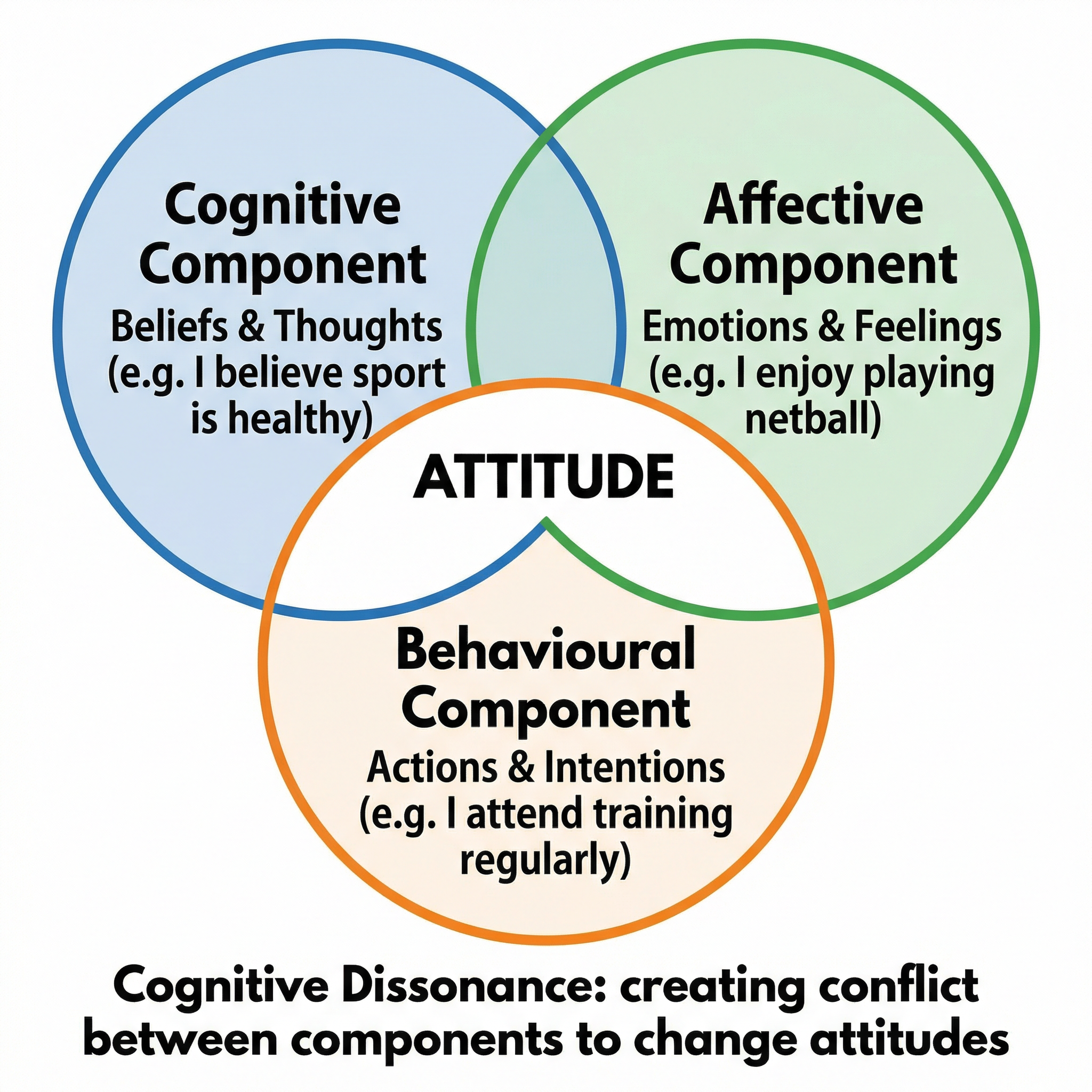
2. The Triadic Model of AttitudesAn attitude is a learned predisposition towards an attitude object (e.g., a person, a behaviour, a sport). The Triadic Model provides a framework for understanding the structure of an attitude, breaking it down into three components.
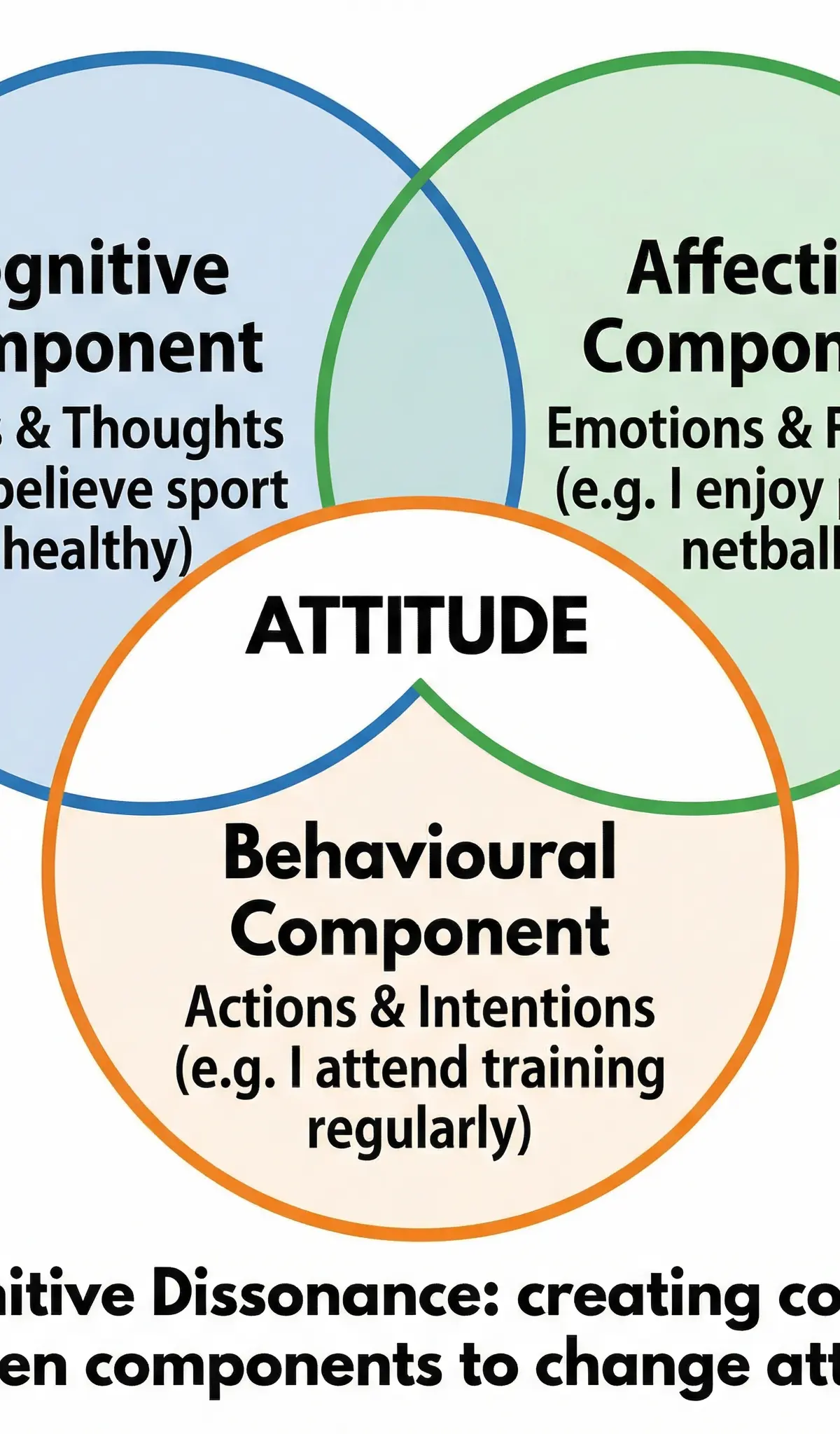
- Cognitive Component: This is what you believe or think about the attitude object. Example: "I believe that participating in a team sport develops communication skills."
- Affective Component: This relates to your feelings or emotions towards the attitude object. Example: "I enjoy the feeling of camaraderie when I play hockey."
- Behavioural Component: This is how you act or intend to act towards the attitude object. Example: "I attend hockey training twice a week and play matches on Saturdays."
To change a negative attitude, a coach might induce Cognitive Dissonance, creating a conflict between the components. For instance, if a player believes fitness is important (Cognitive) but dislikes training (Affective), a coach could provide a fun, game-based fitness session, changing the Affective component to align with the Cognitive one, thus encouraging a more positive overall attitude.
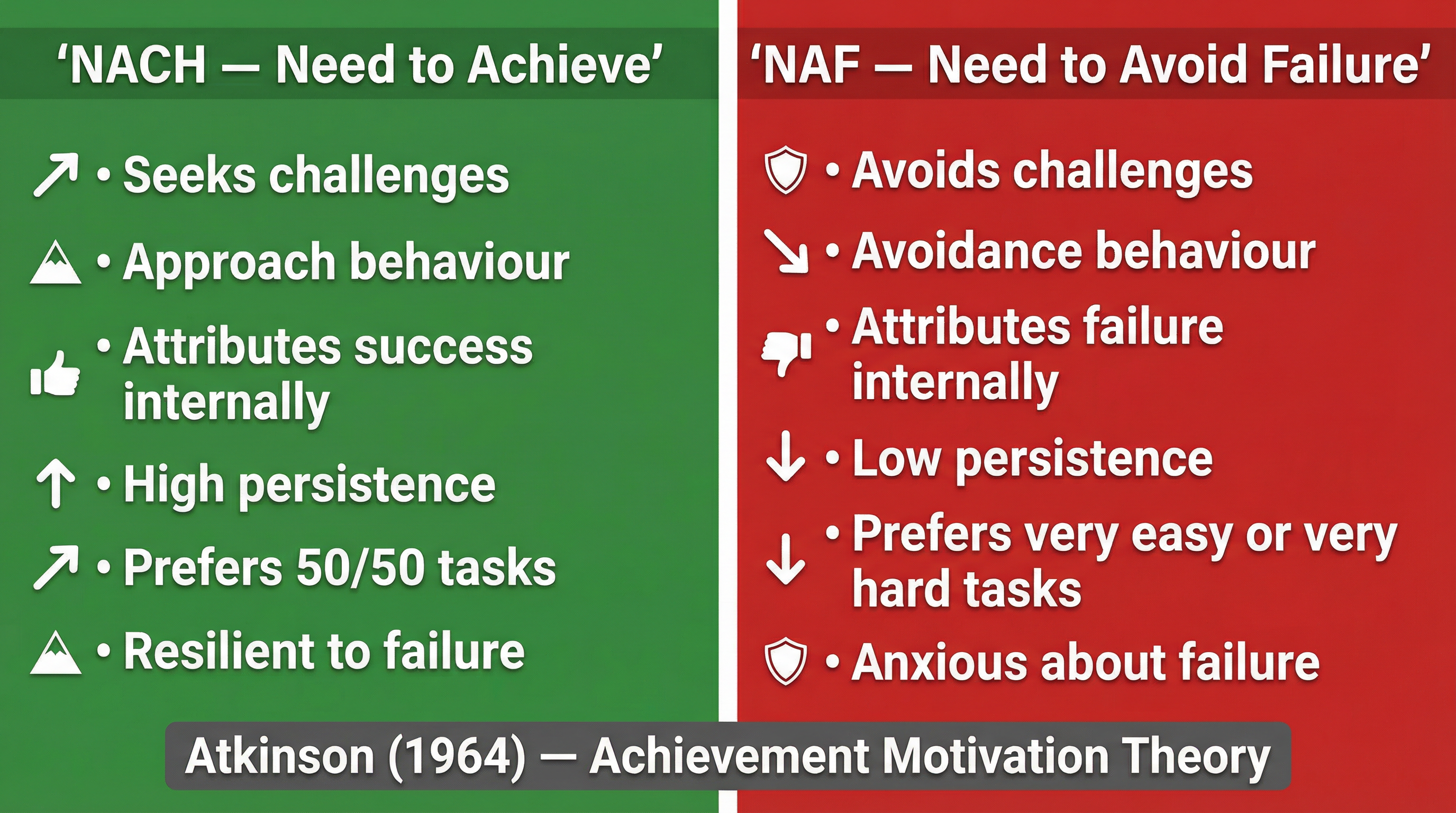
3. Achievement MotivationThis theory, developed by Atkinson, centres on an individual's motivation to succeed. It proposes that motivation is a balance between the Need to Achieve (NACH) and the Need to Avoid Failure (NAF).
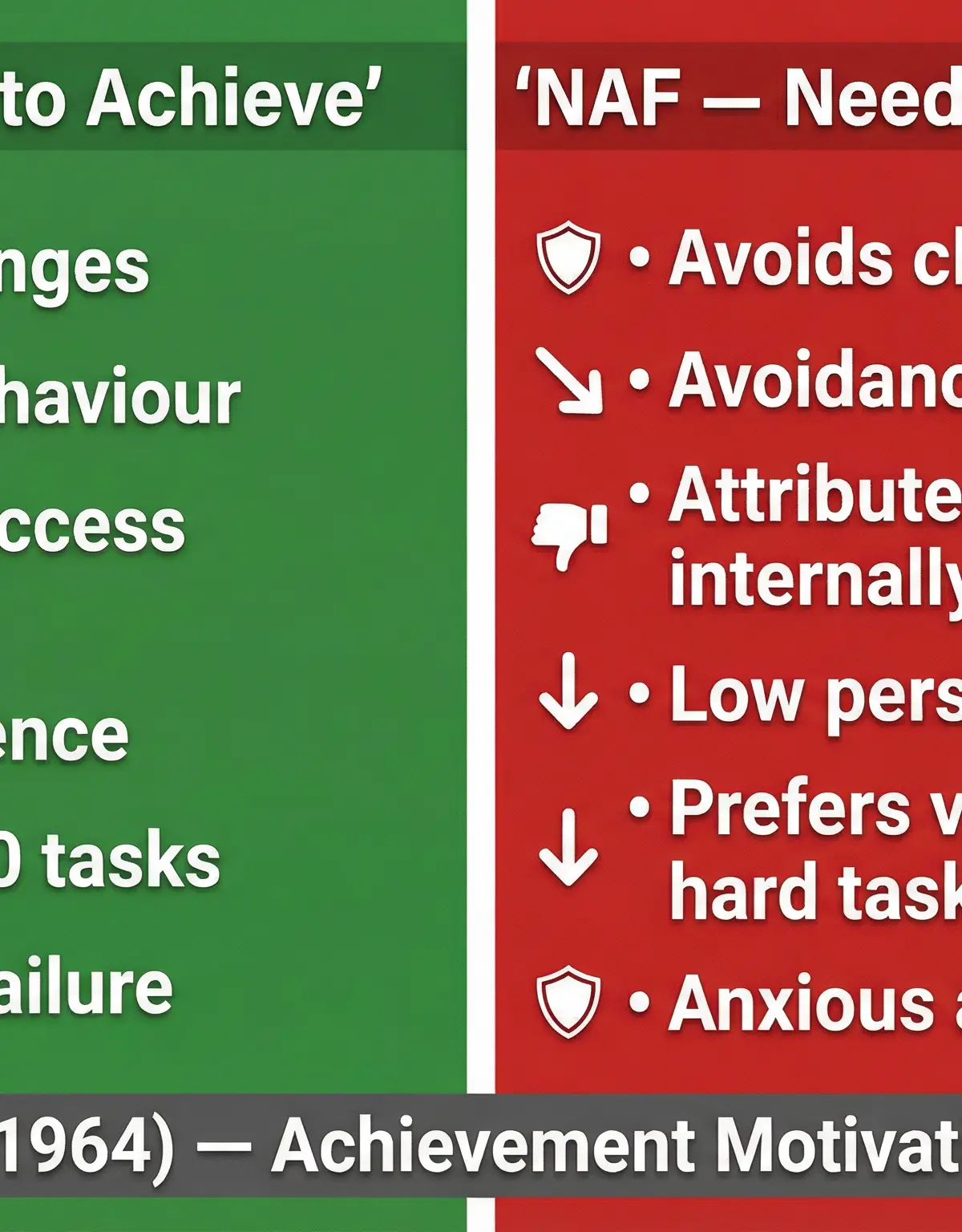
- NACH (Need to Achieve): These individuals are often described as 'high achievers'. They exhibit approach behaviour, meaning they seek out challenges, persist in the face of difficulty, and enjoy tasks with a 50/50 chance of success as this provides the greatest sense of accomplishment. They attribute success to internal factors like ability and effort.
- NAF (Need to Avoid Failure): These individuals are often described as 'low achievers'. They exhibit avoidance behaviour, opting for tasks that are either very easy (guaranteeing success) or very difficult (where failure is expected and carries no shame). They are anxious about failure and often attribute it to internal factors like a lack of ability, which can be detrimental to future motivation.
Key Practitioners/Artists/Composers
| Name | Period/Style | Key Works | Relevance |
|---|---|---|---|
| Kurt Lewin | 1930s-1940s | Field Theory in Social Science | Developed the Interactionist perspective of personality and the seminal equation B = f(P x E), which is fundamental to modern sport psychology. |
| Albert Bandura | 1960s-1980s | Social Learning Theory | His work on observation, imitation, and modelling provides the basis for understanding how athletes learn behaviours and develop personality traits from their environment and role models. |
| Atkinson & McClelland | 1950s-1960s | Achievement Motivation Theory | Their research into the Need to Achieve (NACH) and Need to Avoid Failure (NAF) provides a framework for understanding an athlete's motivational drive and risk-taking behaviour. |
Technical Vocabulary
- Personality: The unique psychological make-up of an individual.
- Trait: An innate, stable, and enduring personality characteristic.
- Interactionist: A perspective that considers the interplay of personality and environmental factors.
- Attitude: A learned predisposition towards an attitude object.
- Cognitive Dissonance: A state of psychological discomfort that occurs when attitude components are in conflict.
- Persuasive Communication: A method of changing attitudes by using a credible messenger and a clear message.
- Motivation: The internal and external forces that direct and energise behaviour.
- Intrinsic Motivation: Motivation that comes from within, for pride and satisfaction.
- Extrinsic Motivation: Motivation that comes from an external source, such as rewards or praise.
- Achievement Motivation: An individual's drive to succeed, balanced against their fear of failure.
- NACH: Need to Achieve; the drive to seek out challenges and succeed.
- NAF: Need to Avoid Failure; the drive to avoid situations where failure is a possibility.
Practical Skills
Techniques & Processes
**Developing NACH Characteristics in Athletes:**A key practical skill for a coach is to create a training environment that fosters a Need to Achieve (NACH) orientation. This is a common application question in exams.
- Use Reinforcement: Positively reinforce successful performance and effort. This builds self-esteem and links success with internal, controllable factors.
- Set Challenging but Realistic Goals: Use goal-setting principles (e.g., SMARTER goals) to create tasks that are achievable but stretch the performer. This provides a sense of accomplishment.
- Improve Attributions: Encourage athletes to attribute success to internal, stable factors (ability) and failure to internal, unstable factors (effort) or external factors (luck, task difficulty). This is known as attribution retraining.
- Reduce Punishment and Negative Feedback: Focus on constructive criticism and learning from mistakes, rather than punishing failure. This reduces anxiety and the fear associated with NAF tendencies.
Exam Component
Written Exam Knowledge
This topic is a staple of the written exam papers. Candidates must be prepared to:
- Define and explain the different personality theories (Trait, Social Learning, Interactionist).
- Apply the Triadic Model to explain the components of an attitude in a given sporting scenario.
- Analyse how attitudes can be changed, with a focus on Cognitive Dissonance and Persuasive Communication.
- Evaluate the characteristics of NACH and NAF performers and explain how a coach could develop achievement motivation.
Extended 10 and 20-mark questions are common. These require a balanced structure of AO1, AO2, and AO3. A typical structure would be: 1) Define the key terms (AO1), 2) Apply them to the sporting context in the question (AO2), and 3) Evaluate the theories/models, discussing strengths, weaknesses, and practical implications (AO3).

Visual Resources
2 diagrams and illustrations
Interactive Diagrams
1 interactive diagram to visualise key concepts
Conceptual Flow Outline
Flowchart demonstrating the Interactionist Perspective (B=f(PxE))
Worked Examples
3 worked examples — open one to explore the question and available guidance.
Practice Questions
Test your understanding — click to reveal model answers
Identify the three components of the Triadic Model of attitudes. (3 marks)
Hint: Remember the acronym C-A-B.
Describe the difference between intrinsic and extrinsic motivation, providing a sporting example for each. (4 marks)
Hint: Think about where the drive to perform comes from: inside or outside?
A tennis player is high in 'Need to Avoid Failure' (NAF). Explain two characteristics they are likely to display during a competitive match. (4 marks)
Hint: How does a NAF performer behave when faced with a challenge where they might fail?
Evaluate the Interactionist perspective of personality in sport. (10 marks)
Hint: Start by explaining the theory (B=f(PxE)). Then, discuss its strengths (e.g., explains why behaviour changes) and weaknesses (e.g., can be difficult to measure the interaction). Compare it to Trait and Social Learning theories.