OCR · A-Level · Physical Education
Routes to Sporting Excellence
This study guide provides a comprehensive overview of OCR A-Level PE Topic 7.3: Routes to Sporting Excellence. It explores the UK's structured system for identifying and developing elite athletes, from grassroots talent to Olympic podium, focusing on the roles of UK Sport, the EIS, and the World Class Programme.
- 7 min read
- 3 worked examples
- 4 practice questions
- 6 key terms
Study Notes

Overview
Welcome to your deep dive into the Routes to Sporting Excellence. This topic is crucial for your A-Level PE exam as it assesses your understanding of the entire high-performance sport system in the UK. It requires you to move beyond simple descriptions and engage in critical evaluation of the strategies, organisations, and funding models that have propelled Great Britain to the top of international medal tables. Marks are awarded for demonstrating a clear grasp of the interconnected roles of UK Sport, National Governing Bodies (NGBs), and the English Institute of Sport (EIS). A strong performance in questions on this topic often hinges on a candidate's ability to analyse the controversial 'No Compromise' funding strategy and apply the concept of the 'virtuous cycle' of sport.

Key Knowledge & Theory
Core Concepts
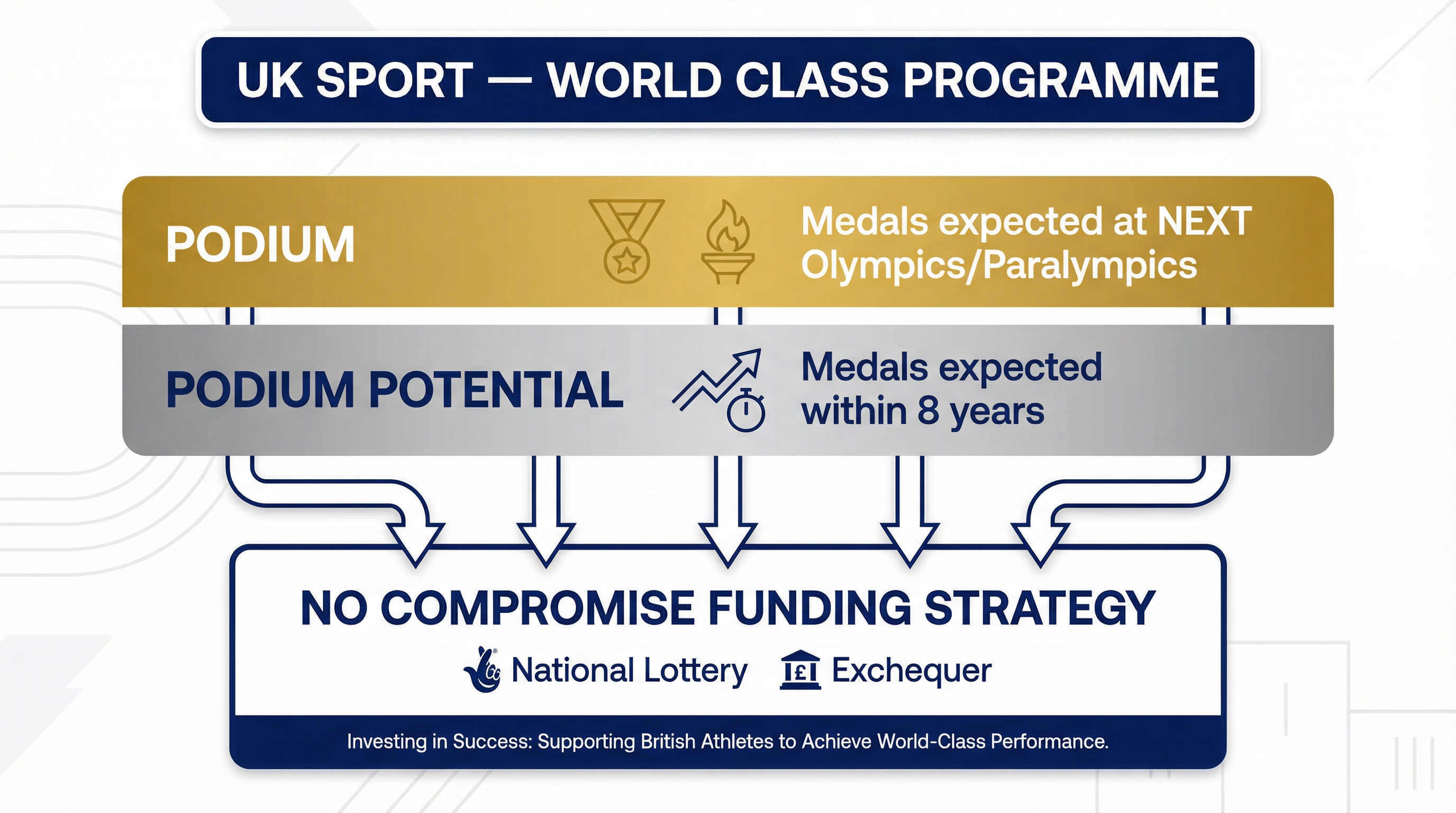
The UK's approach to elite sport is a highly structured and strategic system designed to maximise medal success. At its heart is UK Sport, the government agency responsible for investing in Olympic and Paralympic sport. It is vital that candidates do not confuse UK Sport with Sport England, whose remit is to increase grassroots participation. UK Sport's primary mission is to win medals, and it does this through the World Class Programme (WCP), funded by the National Lottery and the Exchequer (direct government funding).
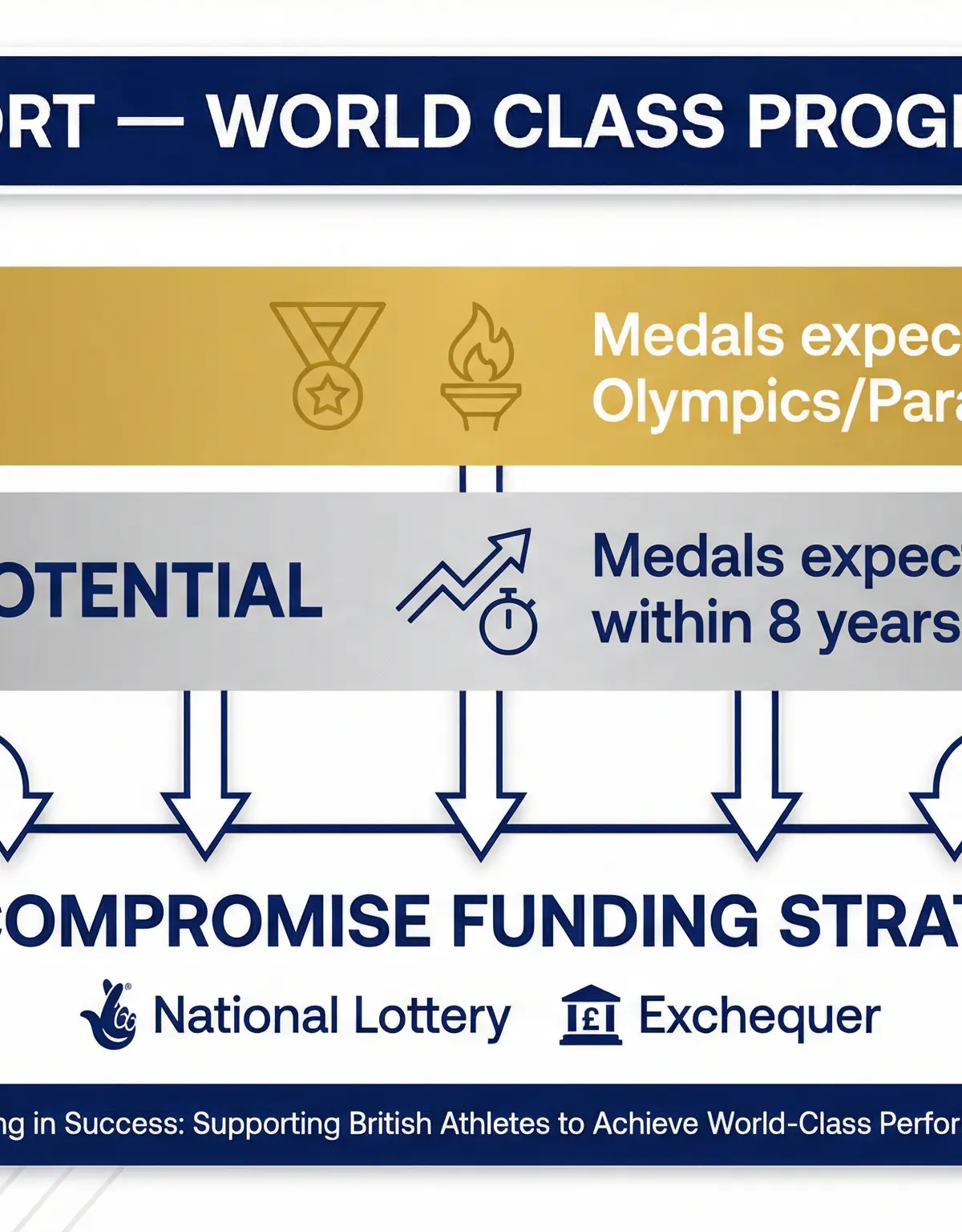
The WCP is divided into two distinct tiers:
- Podium: For athletes with a realistic chance of winning a medal at the next Olympic or Paralympic Games.
- Podium Potential: For athletes who have the potential to win a medal within 8 years (two Olympic cycles).
This system is underpinned by the 'No Compromise' funding strategy, which dictates that investment is targeted exclusively at sports and athletes who can demonstrate a credible path to the podium. While highly effective in terms of medal return, this approach is a key area for evaluation, as it can lead to underfunded or 'developmental' sports being cut off from elite funding.
Key Organisations & Their Roles
| Organisation | Role | Key Functions | Relevance to Athletes |
|---|---|---|---|
| UK Sport | The Funding Body | Distributes National Lottery & Exchequer funding; implements the 'No Compromise' strategy; sets performance targets for NGBs. | Determines the level of funding an athlete's sport receives, directly impacting their chances of being on the WCP. |
| National Governing Bodies (NGBs) | The Management Body | Develops the sport from grassroots to elite; creates and delivers a 'Whole Sport Plan' to secure UK Sport funding; selects athletes for squads. | The NGB is the athlete's direct link to the performance pathway, managing their progression and competition schedule. |
| English Institute of Sport (EIS) | The Service Provider | Delivers a suite of practical support services to athletes on the WCP; operates a network of high-performance centres. | Provides the day-to-day science and medical support that optimises an athlete's training and performance. |
Technical Vocabulary
- World Class Programme (WCP): UK Sport's funding programme for elite athletes.
- Podium / Podium Potential: The two tiers of the WCP.
- 'No Compromise' Strategy: The funding philosophy of investing only in medal contenders.
- Exchequer Funding: Direct government funding from the Treasury.
- Whole Sport Plan: An NGB's strategic plan for developing their sport, required to secure funding.
- Performance Lifestyle: EIS support that helps athletes balance sport with education, career, and personal life.
- Talent Transfer: A process where an athlete switches from one sport to another that may better suit their physiological and psychological profile.
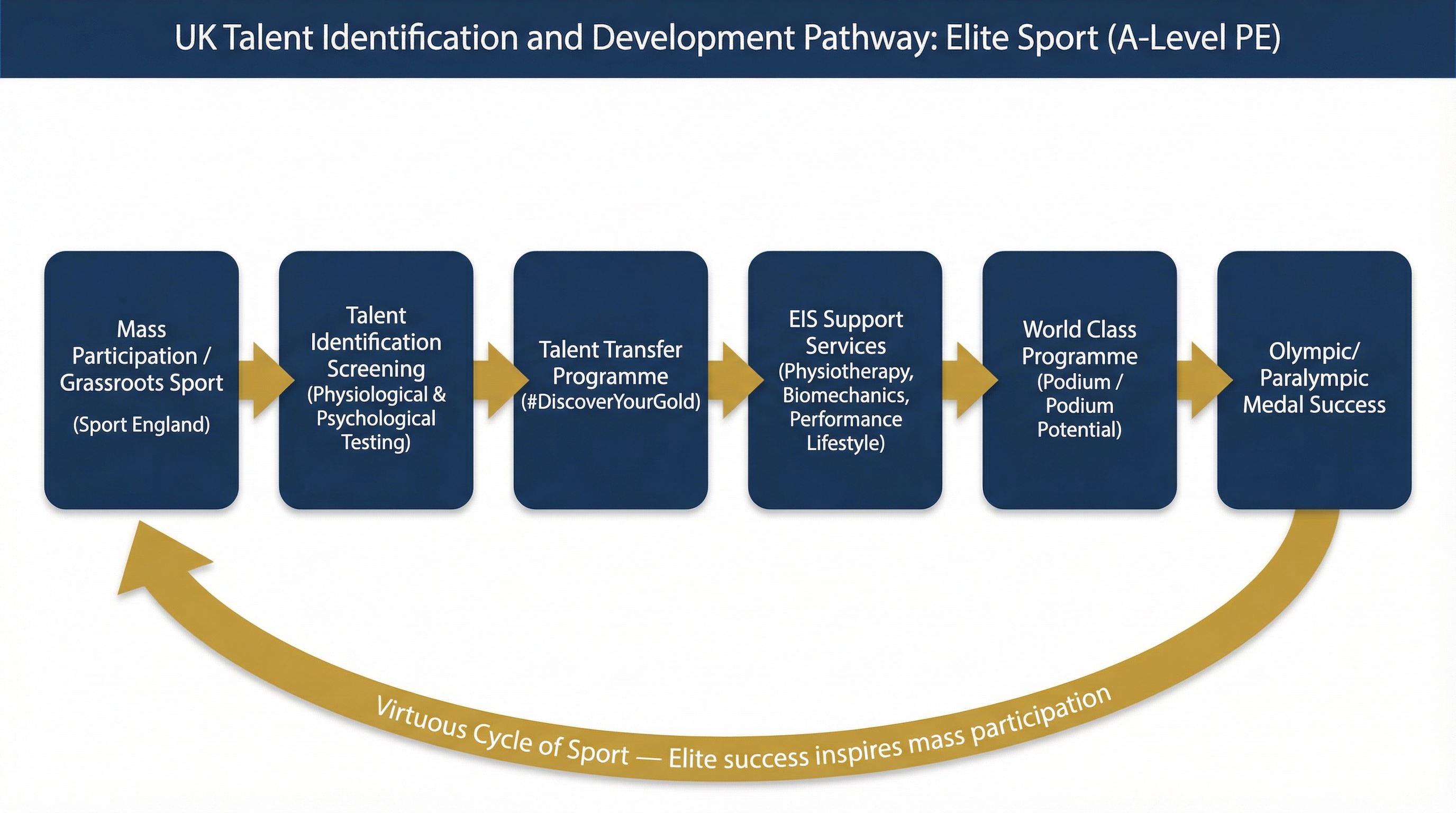
- Virtuous Cycle of Sport: The theory that elite success inspires mass participation, which in turn widens the talent pool.
Practical Skills
Techniques & Processes: Talent Identification
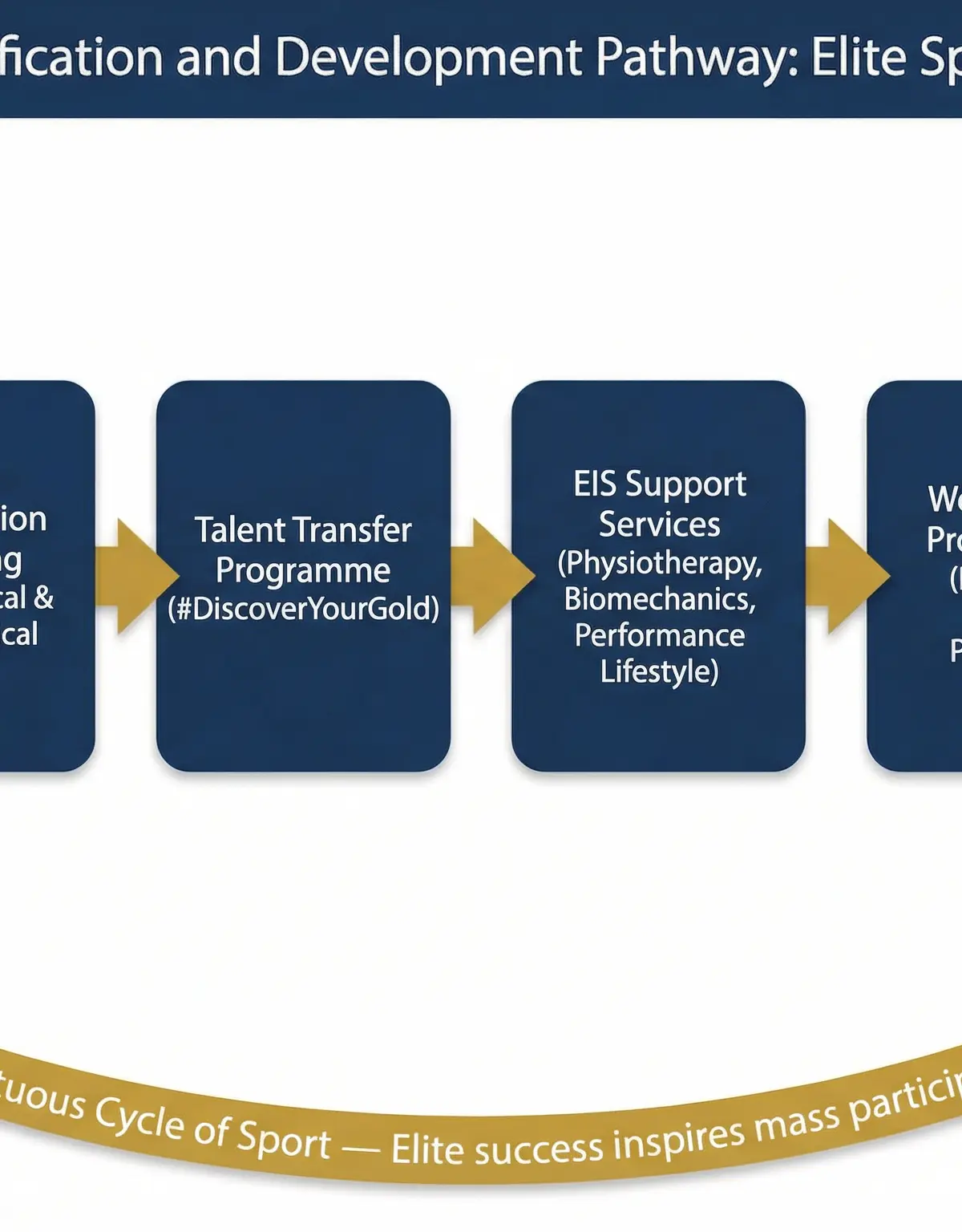
Talent Identification (Talent ID) is the process of identifying individuals with the potential to become elite performers. This is not just about spotting talent in a specific sport, but also about finding raw athletic ability that can be moulded. A key process here is Talent Transfer, exemplified by UK Sport's #DiscoverYourGold programme.
Phases of a Talent Transfer Programme:
- Phase 1: Generic Physical Screening: Large groups of athletes from various sports undertake a battery of physiological tests (e.g., sprint speed, vertical jump, endurance tests, power output on a Wattbike). This identifies raw physical potential.
- Phase 2: Sport-Specific Screening: Athletes who excel in Phase 1 are invited to test their aptitude for a specific new sport. For example, a powerful rugby player might be tested for their suitability for bobsleigh.
- Phase 3: Confirmation Phase: A small group of athletes enter a confirmation phase, which involves intensive training and immersion in the new sport's environment over several months to see if they can adapt and progress.
Materials & Equipment: EIS Support
The EIS provides athletes with access to cutting-edge equipment and expertise. Candidates should be aware of the types of support provided:
- Biomechanics: High-speed cameras, motion capture technology (like Vicon), and force plates are used to analyse and refine an athlete's technique for maximum efficiency and injury prevention.
- Physiology: Environmental chambers can simulate different altitudes, temperatures, and humidity levels to prepare athletes for competition anywhere in the world. VO2 max testing equipment measures an athlete's aerobic capacity.
- Strength & Conditioning: State-of-the-art gym equipment, including Olympic lifting platforms, electronic timing gates, and GPS tracking units (to monitor training load) are standard.
Exam Component
Written Exam Knowledge
This topic is a mainstay of the written theory paper. You can expect questions ranging from short 4-mark 'describe' questions to extended 10 or 20-mark 'evaluate' or 'discuss' questions. The key is to have a deep understanding of the relationships between the different organisations and to be able to form a balanced argument when evaluating the 'No Compromise' approach.
Answering Extended Questions
For a 10-mark 'evaluate' question on the 'No Compromise' strategy, a good structure would be:
- Paragraph 1 (AO1): Define the 'No Compromise' strategy and the World Class Programme. Explain that it is UK Sport's method for distributing National Lottery and Exchequer funding.
- Paragraph 2 (AO3 - Strengths): Argue that the strategy has been incredibly successful, providing evidence such as the dramatic increase in Team GB's medal count from Atlanta 1996 to London 2012 and Rio 2016. This demonstrates a clear return on investment.
- Paragraph 3 (AO3 - Weaknesses): Counter-argue that the strategy is brutal for sports that fail to meet medal targets. Use an example like basketball, which has had its funding cut, limiting opportunities for athletes in that sport. Discuss the ethical implications of prioritising medals over participation or athlete welfare.
- Conclusion (AO3): Summarise your points and offer a justified judgement. For example, 'While the 'No Compromise' approach is undeniably effective at producing medal success, its narrow focus creates an inequitable system that can be detrimental to the overall health of sport in the UK.'
Visual Resources
2 diagrams and illustrations
Interactive Diagrams
1 interactive diagram to visualise key concepts
Conceptual Flow Outline
The relationship between key organisations in UK elite sport.
Worked Examples
3 worked examples — open one to explore the question and available guidance.
Practice Questions
Test your understanding — click to reveal model answers
Identify two services provided by the English Institute of Sport (EIS).
Hint: Think about the practical, day-to-day support an elite athlete needs.
Explain the 'virtuous cycle of sport'.
Hint: How does winning medals link to grassroots sport?
Analyse the process of a Talent Transfer programme, using a specific example.
Hint: Break down the #DiscoverYourGold process into stages and apply it to a real-world example.
'The 'No Compromise' funding strategy is the single most important factor in the UK's modern Olympic success.' Discuss this statement.
Hint: This is an 'evaluate' question in disguise. Argue for the statement (it's very important) but also against it (what other factors are important?).