Axes of Movement: Sagittal, Frontal, Transverse — OCR GCSE Study Guide
Exam Board: OCR | Level: GCSE
This topic requires candidates to define and apply the three axes of movement — Sagittal, Frontal, and Transverse — as imaginary lines around which the body rotates during sporting actions. Mastery involves correctly pairing each axis with its corresponding plane and identifying them within real-world sporting contexts such as somersaults, cartwheels, and pirouettes. This is a high-value applied anatomy topic within OCR GCSE PE, assessed across all three assessment objectives and frequently appearing in both short-answer and extended-response questions.
## Overview
Axes of Movement is a core component of OCR GCSE Physical Education's applied anatomy unit (Topic 2.3). Candidates must understand that an **axis** is an imaginary line around which the body — or a body part — rotates. This is distinct from a plane of movement, which describes the flat surface through which movement occurs. The two concepts are inseparable in the exam: every axis is paired with a specific plane, and candidates who can confidently state both — alongside a sporting example — are positioned to achieve full marks on application and analysis questions.
This topic sits within the broader framework of movement analysis, which underpins performance understanding across all sports. Whether analysing a gymnast's somersault, a swimmer's dive, or a dancer's pirouette, the ability to identify the axis and plane of movement is a fundamental analytical skill that examiners reward at every tier.

---
## Key Knowledge & Theory
### Core Concepts
There are **three axes of movement**, each passing through the body's centre of gravity and each paired with one of the three planes of movement. The relationship between an axis and its paired plane is always perpendicular — they are at right angles to each other. This geometric relationship is the key to understanding why specific movements are associated with specific axes.
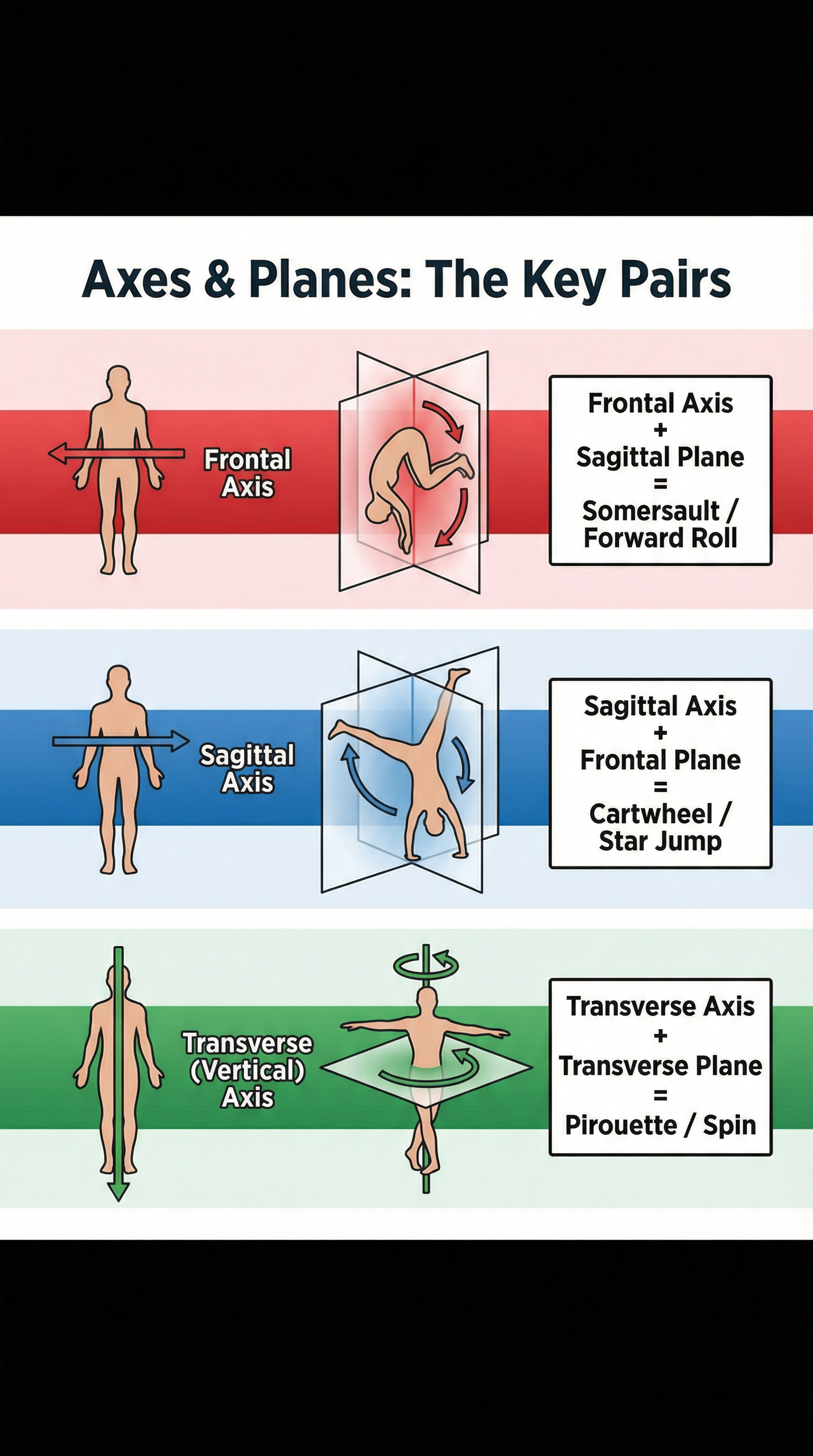
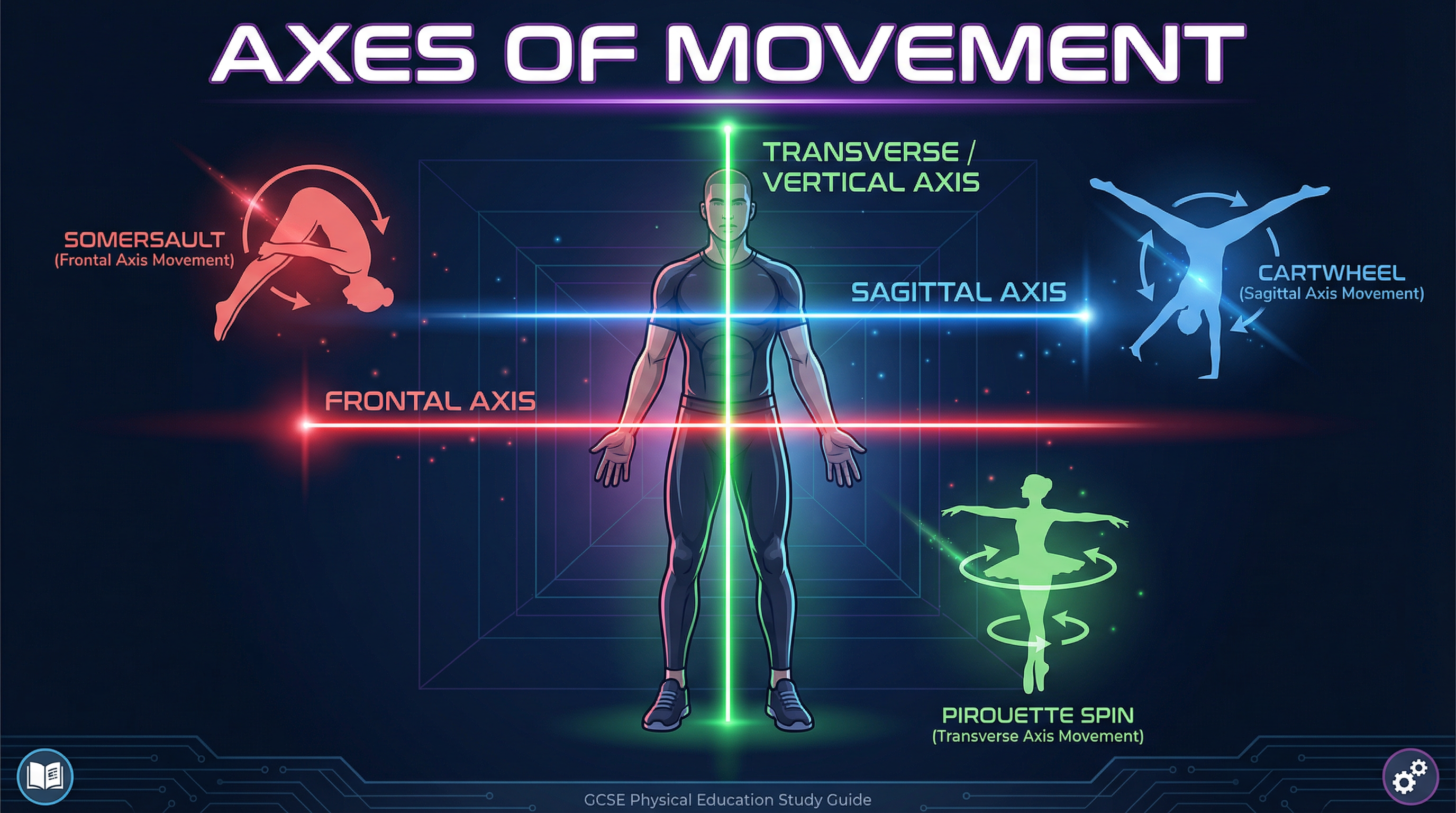
**The Frontal Axis** passes horizontally from one side of the body to the other — left to right through the hips. When the body rotates around the frontal axis, movement occurs in the **Sagittal Plane** (which divides the body into left and right halves). The defining sporting example is the **somersault** or forward roll, where the body tips forward or backward around this side-to-side bar. Other examples include a dive in swimming and the trunk flexion/extension in rowing.
**The Sagittal Axis** passes horizontally from front to back through the body — from the navel through to the spine. When the body rotates around the sagittal axis, movement occurs in the **Frontal Plane** (which divides the body into front and back halves). The defining sporting example is the **cartwheel**, where the body tips sideways. A star jump also involves the sagittal axis, as the arms and legs abduct outward in the frontal plane.
**The Transverse Axis** — also referred to as the **Vertical Axis** — passes vertically from the crown of the head down through the feet. When the body rotates around the transverse axis, movement occurs in the **Transverse Plane** (which divides the body into upper and lower halves). The defining sporting example is the **pirouette** or spin, where the athlete rotates on the spot. Trunk rotation in a tennis serve and the spin of a discus thrower also involve this axis.
### Key Axis–Plane–Movement Pairings
| Axis | Orientation | Paired Plane | Plane Divides Body Into | Classic Example |
|---|---|---|---|---|
| **Frontal Axis** | Side to side (horizontal) | Sagittal Plane | Left and right | Somersault / Forward roll |
| **Sagittal Axis** | Front to back (horizontal) | Frontal Plane | Front and back | Cartwheel / Star jump |
| **Transverse Axis** | Top to bottom (vertical) | Transverse Plane | Upper and lower | Pirouette / Spin / Discus throw |
### Technical Vocabulary
Candidates must use precise anatomical language in their answers. The following terms should appear in written responses where appropriate:
- **Axis of rotation**: the imaginary line around which the body rotates
- **Plane of movement**: the flat surface through which movement occurs
- **Perpendicular**: at right angles — the geometric relationship between an axis and its paired plane
- **Rotation**: movement of the body or a body segment around an axis
- **Abduction**: movement of a limb away from the midline of the body (occurs in the frontal plane, around the sagittal axis)
- **Adduction**: movement of a limb towards the midline of the body
- **Flexion/Extension**: bending and straightening movements (occur in the sagittal plane, around the frontal axis)
---
## Practical Skills
### Techniques & Processes
In the practical component of GCSE PE, candidates demonstrate movement skills across a range of activities. Understanding axes of movement enhances performance analysis and supports the verbal or written commentary candidates may be asked to provide when evaluating their own or others' performance.
When observing a gymnastic sequence, for example, a candidate should be able to identify: (1) which axis is being used in each skill, (2) the corresponding plane of movement, and (3) how the orientation of the axis determines the direction of rotation. This analytical framework applies equally to dance, swimming, athletics, and team sports.
In practical settings, a useful technique is to physically trace the axis through your own body before performing a movement. Before a forward roll, place your hands on your hips and imagine a horizontal bar passing from left to right — that is the frontal axis you will rotate around. Before a cartwheel, place one hand on your navel and one on your lower back — that front-to-back line is the sagittal axis.
### Materials & Equipment
For movement analysis tasks, candidates may use video analysis tools to pause and annotate footage, identifying axes and planes in real sporting actions. In the written exam, candidates are sometimes presented with a photograph or description of a movement and asked to identify the axis. Practising with video clips of gymnastics, dance, and athletics is an effective revision strategy.
---
## Portfolio / Coursework Guidance
### Assessment Criteria
While axes of movement is primarily a written theory topic, it supports the analytical commentary required in the non-examined assessment (NEA) component. When candidates evaluate their own performance, examiners award credit for responses that use anatomical terminology accurately — including correct identification of axes and planes when describing movement patterns.
For example, a candidate analysing their own gymnastics routine might write: *'During my forward roll, my body rotated around the frontal axis in the sagittal plane. To improve the fluency of this movement, I could focus on maintaining a tucked body position to reduce my moment of inertia and increase rotational speed.'* This level of anatomical precision earns marks in both the knowledge and analysis strands.
### Building a Strong Portfolio
Candidates should annotate video recordings of their own performances using axis and plane terminology. Labelling still frames from video with axis lines — as seen in professional coaching software — demonstrates applied understanding and earns credit for linking theory to practice. Written evaluations should always include at least one reference to axes and planes when describing rotational movements.
---
## Exam Component
### Written Exam Knowledge
Axes of movement questions appear in OCR GCSE PE Component 01 (Physical Factors Affecting Performance) and Component 02 (Socio-cultural Issues and Sports Psychology). The topic is assessed at both Foundation and Higher tier.
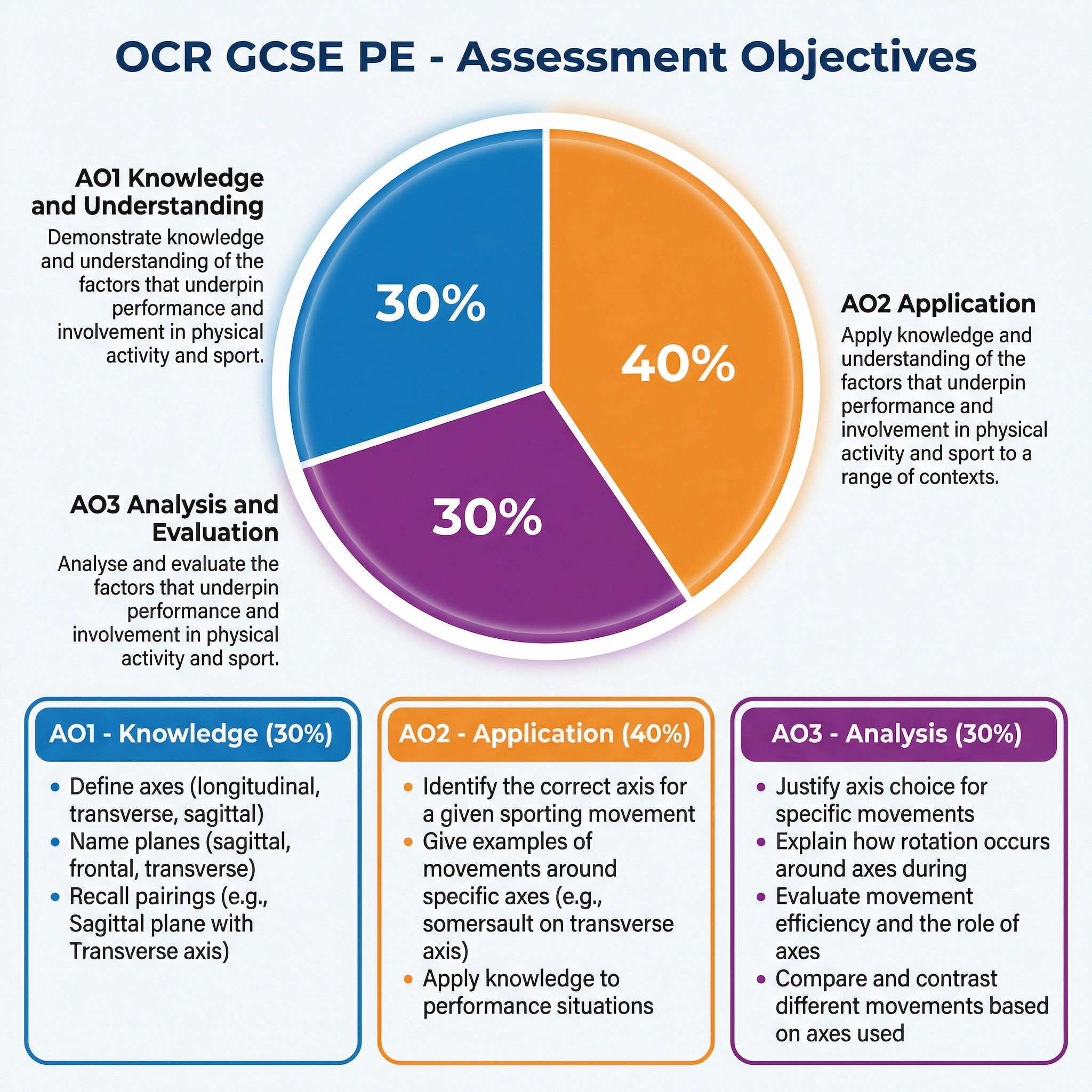
**AO1 (30%)** — Knowledge and Understanding: Candidates are expected to define axes, name planes, and recall the axis–plane pairings accurately. One-mark questions typically ask candidates to 'name the axis of rotation' for a given movement.
**AO2 (40%)** — Application: Candidates must apply their knowledge to specific sporting contexts. Two- to four-mark questions present a movement or sport and ask candidates to identify and describe the axis and plane involved.
**AO3 (30%)** — Analysis and Evaluation: Candidates must justify their axis identification, explain how the rotation occurs, and evaluate the significance of the axis to performance. Extended responses of four to six marks require candidates to use the full Axis + Orientation + Plane + Example structure.
### Practical Exam Preparation
For the practical performance component, candidates should be able to verbalise the axes and planes involved in their chosen activities. Coaches and teachers often ask candidates to explain their movements analytically — practising this out loud, using correct terminology, builds both confidence and accuracy. Recording yourself performing and then analysing the footage using axis terminology is an excellent preparation strategy.