AQA · A-Level · Physics
Turning Points in Physics
This guide explores the pivotal experiments and theories that revolutionised physics, from the null result of the Michelson-Morley experiment to Einstein's theories of special relativity and the quantum nature of light. It's a crucial A-Level topic that bridges classical and modern physics, and mastering it is key to top marks.
- 6 min read
- 3 worked examples
- 5 practice questions
- 6 key terms
Study Notes
Overview
Welcome to Turning Points in Physics, the AQA A-Level topic that chronicles the dramatic shift from the clockwork universe of Newton to the strange and wonderful worlds of quantum mechanics and relativity. This isn't just a history lesson; it's a deep dive into the experimental evidence that forced physicists to abandon centuries of established theory. You'll explore the elegant failure of the Michelson-Morley experiment, the particle nature of light revealed by the photoelectric effect, and the discrete nature of charge shown by Millikan's oil drop experiment. We'll then journey into Einstein's special relativity, grappling with concepts like time dilation and length contraction. Examiners love this topic because it tests your ability to link experimental observation to theoretical conclusion, a core skill of any physicist. Expect long-answer questions asking you to explain why these experiments were so important, and calculation questions that test your application of relativistic formulas.
Key Concepts
Concept 1: The Michelson-Morley Experiment and the Ether
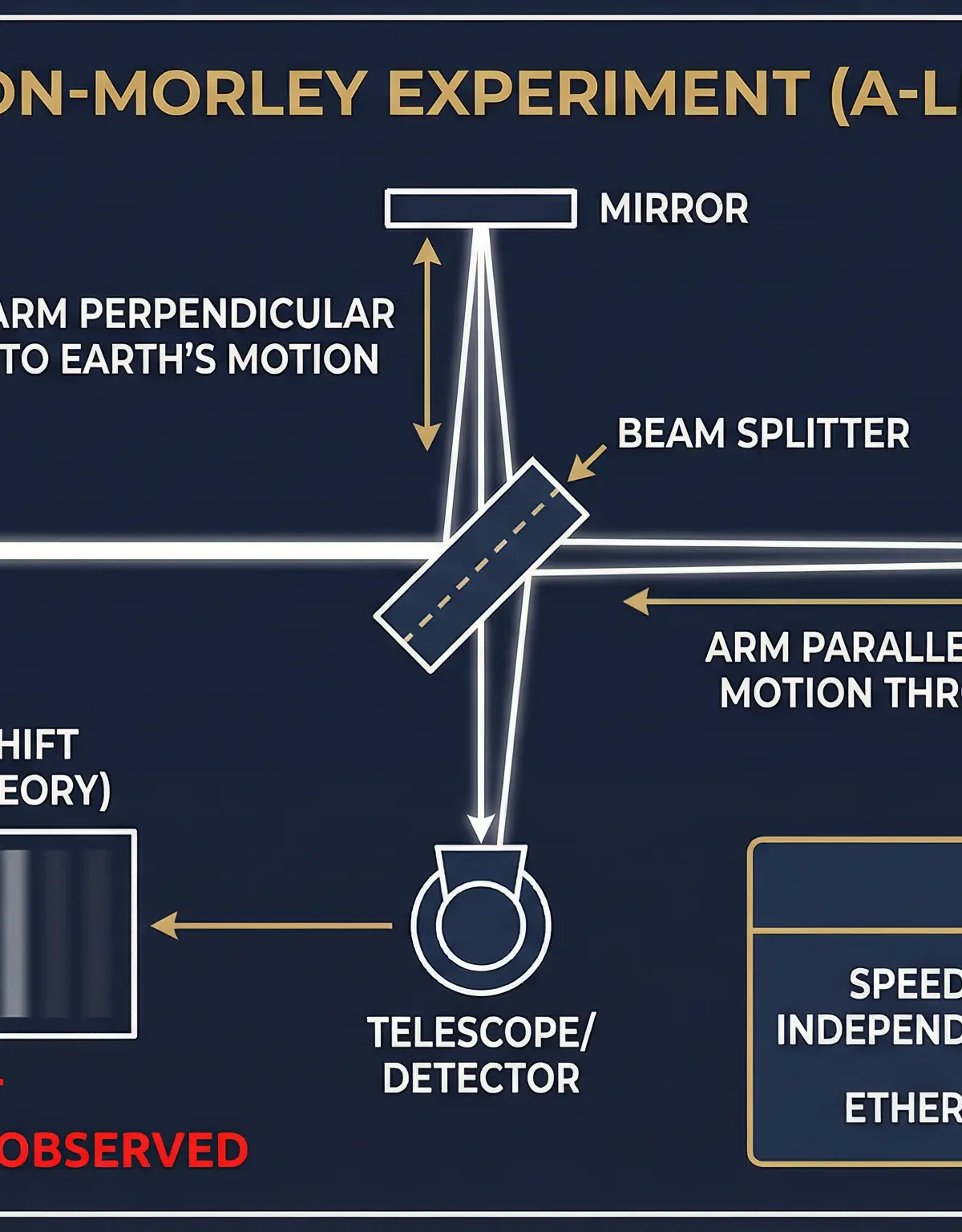
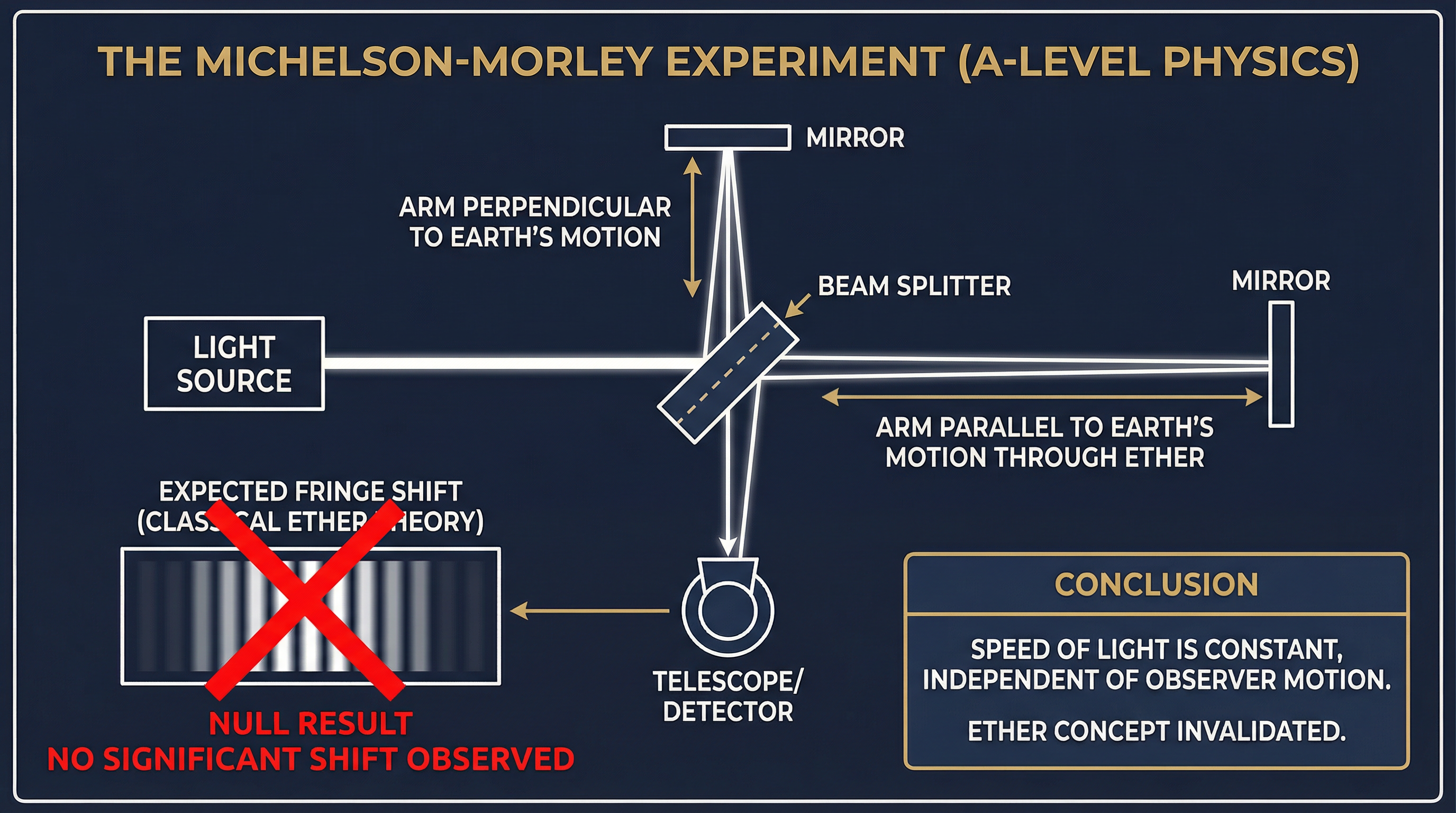
By the late 19th century, physicists were confident that light, as a wave, must travel through a medium called the 'luminiferous ether'. The Michelson-Morley experiment was designed to detect the Earth's motion through this supposed ether. The apparatus, an interferometer, split a beam of light, sent it along two perpendicular paths, and then recombined the beams. If the Earth was moving through the ether, a shift in the interference pattern was expected when the apparatus was rotated. The experiment famously produced a null result: no fringe shift was observed. This was a major turning point. It didn't disprove the ether, but it provided strong evidence against it and suggested a revolutionary new idea: the speed of light in a vacuum is constant for all observers, regardless of their motion. This became a cornerstone of Einstein's special relativity.
Concept 2: The Photoelectric Effect and the Photon Model
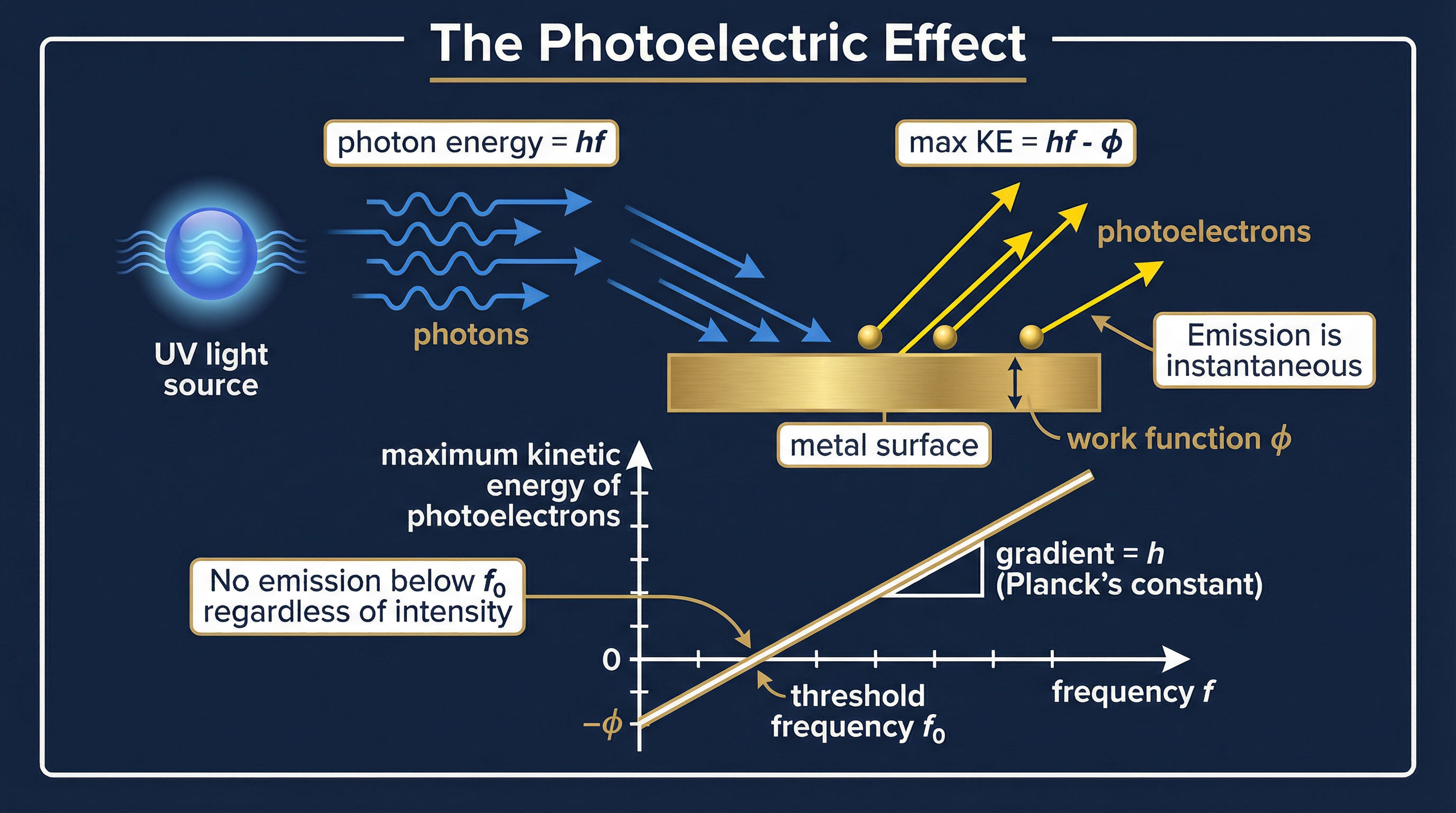
Classical wave theory couldn't explain why, when light is shone on a metal surface, electrons are only emitted if the light is above a certain frequency (the threshold frequency), and why this emission is instantaneous. Albert Einstein proposed that light consists of discrete packets of energy called photons. The energy of a photon is given by E = hf, where h is Planck's constant and f is the frequency. An electron is ejected if it absorbs a single photon with enough energy to overcome the metal's work function (φ), the minimum energy required to escape. Any excess energy becomes the electron's kinetic energy. This explains the threshold frequency and the instantaneous emission, providing powerful evidence for the particle nature of light.

Concept 3: Millikan's Oil Drop Experiment and Quantisation of Charge
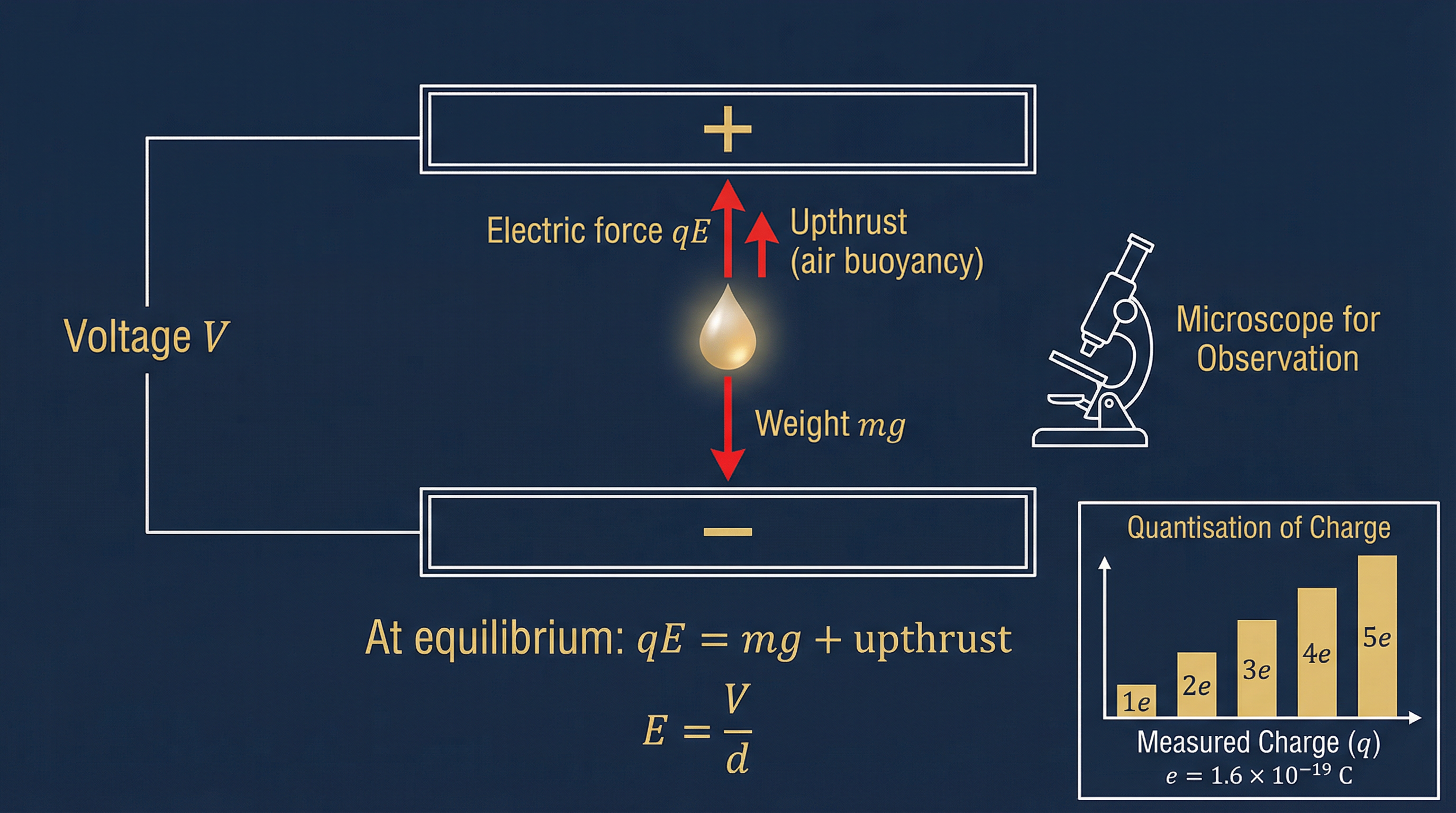
Robert Millikan's experiment provided the first direct measurement of the elementary charge, e. He suspended tiny, charged oil droplets between two parallel metal plates. By adjusting the electric field between the plates, he could balance the electric force on a droplet with the force of gravity. By measuring the voltage required to suspend the droplet and calculating its mass (from its terminal velocity), he could determine the charge on the droplet. He found that the charge on any droplet was always an integer multiple of a fundamental value: 1.60 x 10⁻¹⁹ C. This demonstrated that electric charge is quantised – it exists in discrete units, not continuous amounts.

Concept 4: Special Relativity
Based on the null result of the Michelson-Morley experiment, Einstein built his theory of special relativity on two postulates:
- The laws of physics are the same in all inertial (non-accelerating) frames of reference.
- The speed of light in a vacuum (c) is the same for all inertial observers.
These simple postulates lead to profound consequences:
- Time Dilation: A moving clock runs slower as observed by a stationary observer. The time interval in the moving frame (proper time, t₀) is shorter than the time interval measured by the stationary observer (t). The relationship is t = γt₀, where γ is the Lorentz factor.
- Length Contraction: An object appears shorter in its direction of motion to a stationary observer. The length measured in its own rest frame (proper length, L₀) is longer than the length measured by the observer (L). The relationship is L = L₀/γ.
- Mass-Energy Equivalence: Mass and energy are interchangeable, famously expressed as E = mc². This means a small amount of mass can be converted into a huge amount of energy.
Mathematical/Scientific Relationships
- Photon Energy: E = hf (Must memorise)
- Photoelectric Equation: hf = φ + KE_max (Given on formula sheet)
- Work Function: φ = hf₀ (Must memorise)
- Lorentz Factor (γ): γ = 1 / √(1 - v²/c²) (Given on formula sheet)
- Time Dilation: t = γt₀ (Given on formula sheet)
- Length Contraction: L = L₀/γ (Given on formula sheet)
- Relativistic Mass-Energy: E = γmc² (Given on formula sheet)
Practical Applications
- Photoelectric Effect: Used in light sensors, solar panels, and digital cameras (image sensors like CCDs or CMOS sensors).
- Special Relativity: Essential for the functioning of GPS systems. The clocks on GPS satellites run at different speeds to clocks on Earth due to both special and general relativistic effects, and these must be corrected for accurate positioning.
- Electron Beams: The principles of specific charge determination are fundamental to particle accelerators like the Large Hadron Collider (LHC) and old cathode-ray tube televisions.
Visual Resources
3 diagrams and illustrations
Interactive Diagrams
2 interactive diagrams to visualise key concepts
Conceptual Flow Outline
Flowchart showing the path of light in the Michelson-Morley interferometer and its null result.
Conceptual Flow Outline
Concept map illustrating the energy transfers in the photoelectric effect, from incident photon to electron kinetic energy.
Worked Examples
3 worked examples — open one to explore the question and available guidance.
Practice Questions
Test your understanding — click to reveal model answers
Describe the Michelson-Morley experiment and explain the significance of its null result.
Hint: Think about what the experiment was trying to detect and what the failure to detect it implied.
An electron is accelerated from rest through a potential difference of 5.0 kV. Calculate its specific charge if it is then deflected into a circular path of radius 3.0 cm by a uniform magnetic field of flux density 3.2 mT applied perpendicular to its velocity.
Hint: This is a multi-step problem. First find the velocity of the electron after acceleration, then use the circular motion equation.
A muon is an unstable particle that decays with a half-life of 2.2 μs in its own rest frame. A beam of muons is produced travelling at 0.99c. Calculate the half-life of the muons in the laboratory frame.
Hint: The muon's rest frame measures the proper time. You are calculating the dilated time in the lab frame.
State two features of the photoelectric effect that cannot be explained by the wave theory of light.
Hint: Think about time and energy.
A stationary oil droplet of mass 1.2 x 10⁻¹⁴ kg is held between two parallel plates 1.5 cm apart. The droplet has a charge equivalent to 5 electrons. Calculate the potential difference between the plates. You may ignore the effects of air buoyancy.
Hint: The droplet is stationary, so forces are balanced. What are the two main forces acting on it?
Test your understanding of Turning Points in Physics
Active recall beats re-reading. Take an instant quiz now to test what you’ve learned and lock it into long-term memory.
7 days Premium · Then free forever · No card, no charge