Electricity — AQA GCSE Study Guide
Exam Board: AQA | Level: GCSE
Master the invisible forces that power our world! This topic unlocks the secrets of electric fields, showing how charged objects exert non-contact forces on each other and explaining everyday phenomena like static shocks and lightning.
## Overview
Welcome to the fascinating world of Electric Fields. In this topic, we move beyond simple circuits to understand the fundamental mechanism behind electrical forces. Have you ever wondered how a balloon rubbed on your hair can stick to a wall, or what causes the dramatic flash of a lightning bolt? The answer lies in electric fields.
This topic is crucial because it bridges the gap between static electricity and the forces that govern the universe. Examiners love testing this area because it requires clear, precise language and a solid understanding of abstract concepts. You will be expected to describe how fields are formed, draw accurate field patterns, and explain how the strength of these fields changes with distance.

## Key Concepts
### Concept 1: The Electric Field
An electric field is an invisible region of space around a charged object where another charged object will experience a force. It is a **non-contact force**, meaning the objects do not need to touch for the force to act.
Think of an electric field like the heat radiating from a campfire. You cannot see the heat, but you can certainly feel its effects when you stand near it. Similarly, a charged object creates an 'area of influence' around itself.
**Example**: If you place a positively charged sphere in the middle of a room, it creates an electric field in that room. If you then bring a second, smaller positive charge into the room, it will be repelled by the first sphere without ever touching it.
### Concept 2: Field Strength and Distance
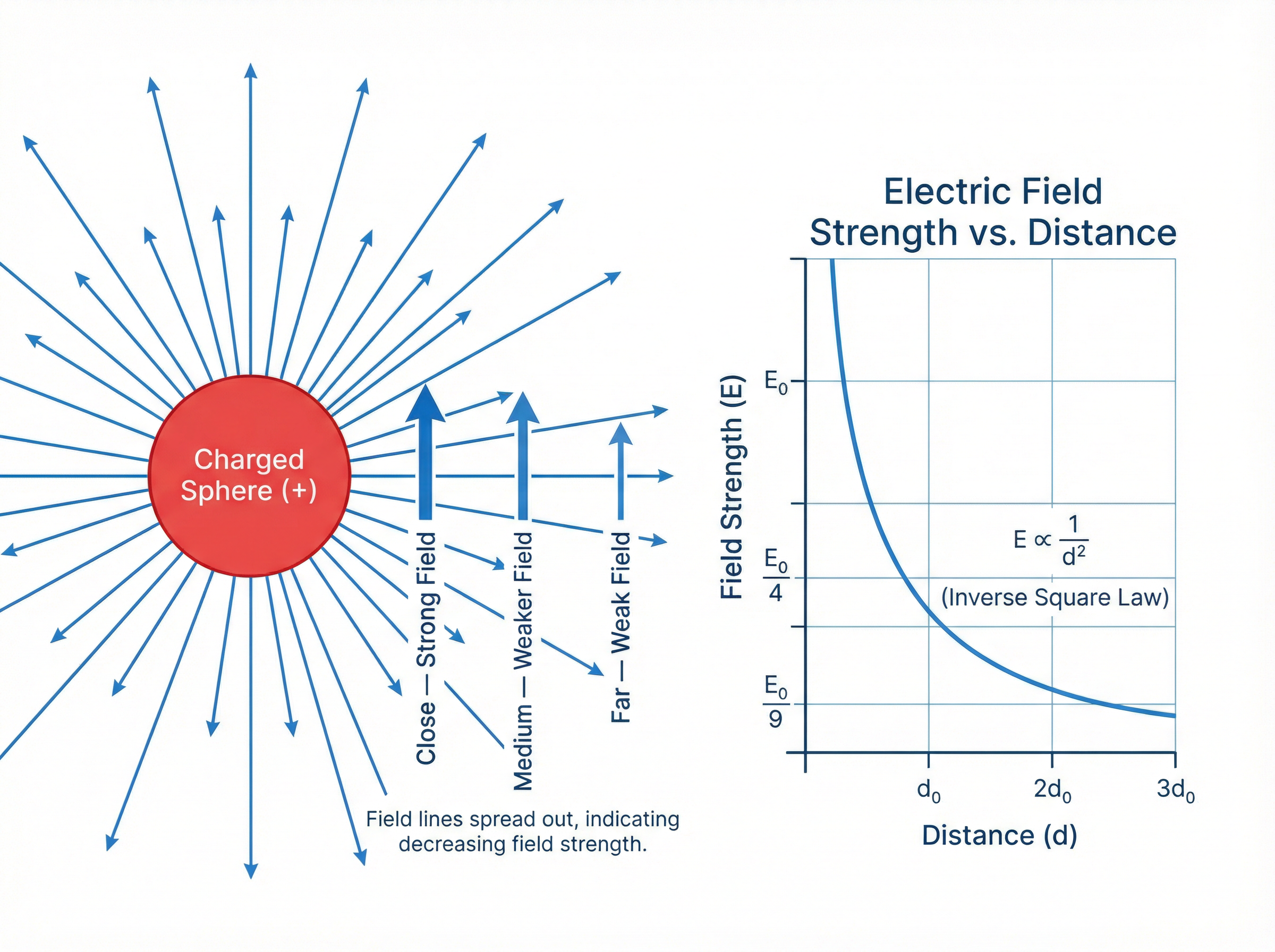
The strength of an electric field is not uniform; it depends critically on the distance from the charged object. The rule is simple but essential for exam success: **Electric field strength is strongest close to the charged object and decreases as distance increases.**
Examiners will often ask you to explain why a force changes when an object is moved. The key is to link distance, field strength, and force. As you move further away, the field weakens, so the force experienced by any charge in that field also weakens.
### Concept 3: Drawing Electric Field Patterns
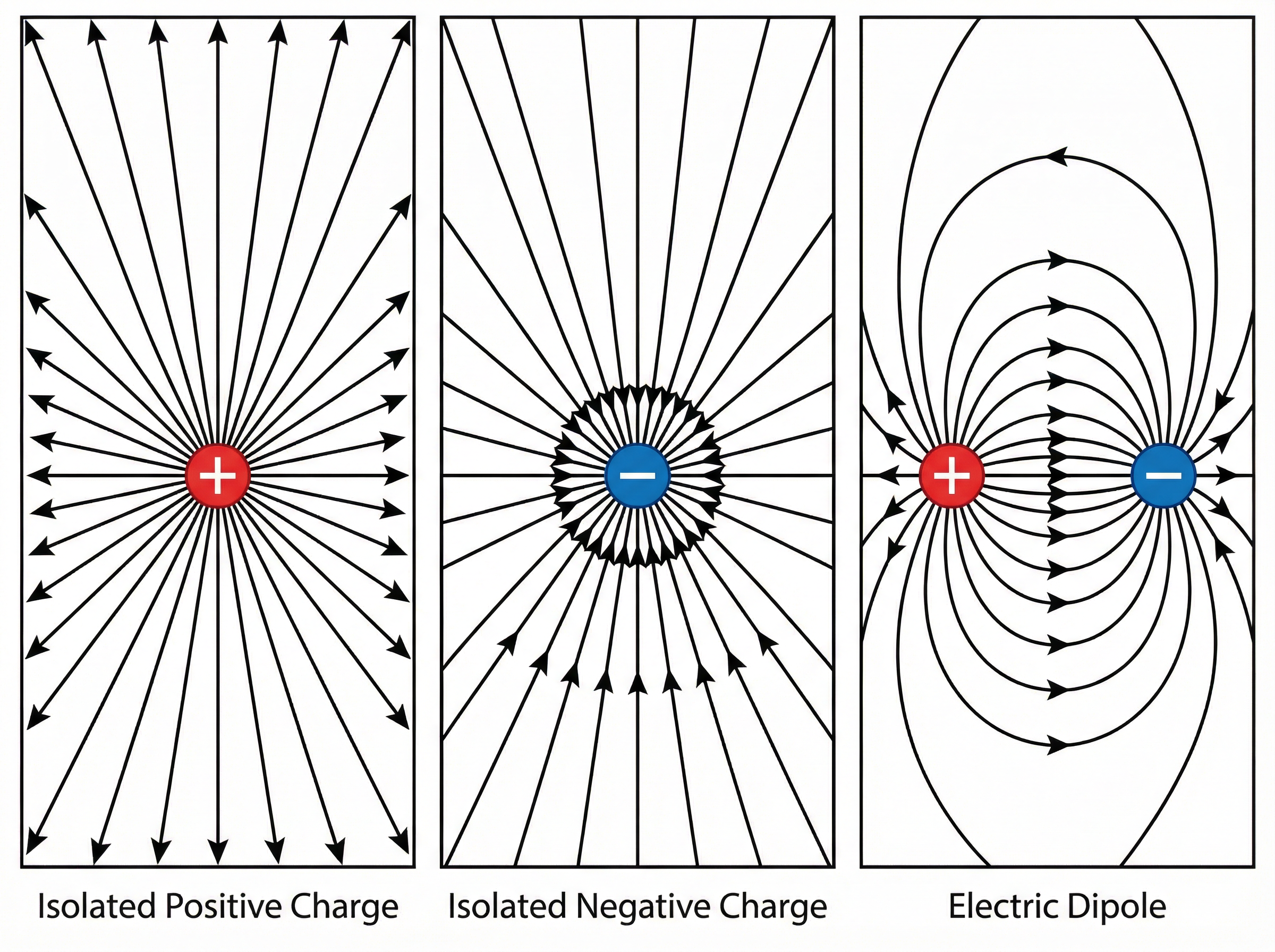
Visualising electric fields is a common exam requirement. We use **field lines** (or lines of force) to represent the field. There are strict rules for drawing these:
1. **Direction**: Field lines always point **away** from positive charges and **towards** negative charges. (Remember: Positive Pushes).
2. **Strength**: The closer the lines are to each other, the stronger the electric field. You must draw them closer together near the charge and spreading out further away.
3. **Shape**: For an isolated charged sphere, the lines must be **radial**. They spread out symmetrically from the centre, like the spokes of a bicycle wheel.
### Concept 4: Sparking and Ionisation
When an electric field becomes incredibly strong, it can cause a spark. This happens because the strong field **ionises** the air between the charged objects. Normally, air is an insulator. However, a strong electric field can strip electrons from air molecules, turning the air into a conductor. This sudden flow of charge is what we see and hear as a spark (or lightning on a larger scale).
## Mathematical/Scientific Relationships
While this specific GCSE topic is often qualitative, understanding the inverse relationship is key:
* **Force $\propto$ 1 / Distance$^2$** (Inverse Square Law - Higher Tier conceptual understanding)
* This means if you double the distance from a point charge, the electric field strength (and therefore the force on a test charge) drops to one-quarter of its original value.
## Practical Applications
* **Photocopiers and Laser Printers**: Use static electricity and carefully controlled electric fields to attract toner (ink) to specific parts of the paper.
* **Electrostatic Paint Spraying**: Paint droplets are given a charge, and the object being painted is given the opposite charge. The electric field ensures an even coat and reduces waste, as the paint is actively attracted to the object.
* **Lightning Conductors**: Provide a safe path for the massive flow of charge during a lightning strike, preventing the strong electric field from causing damage to buildings.