Electricity — AQA GCSE Study Guide
Exam Board: AQA | Level: GCSE
Master the fundamental principles of static electricity, from electron transfer through friction to the non-contact forces of attraction and repulsion. This essential GCSE Physics topic forms the foundation for understanding electric fields and circuit behaviour.
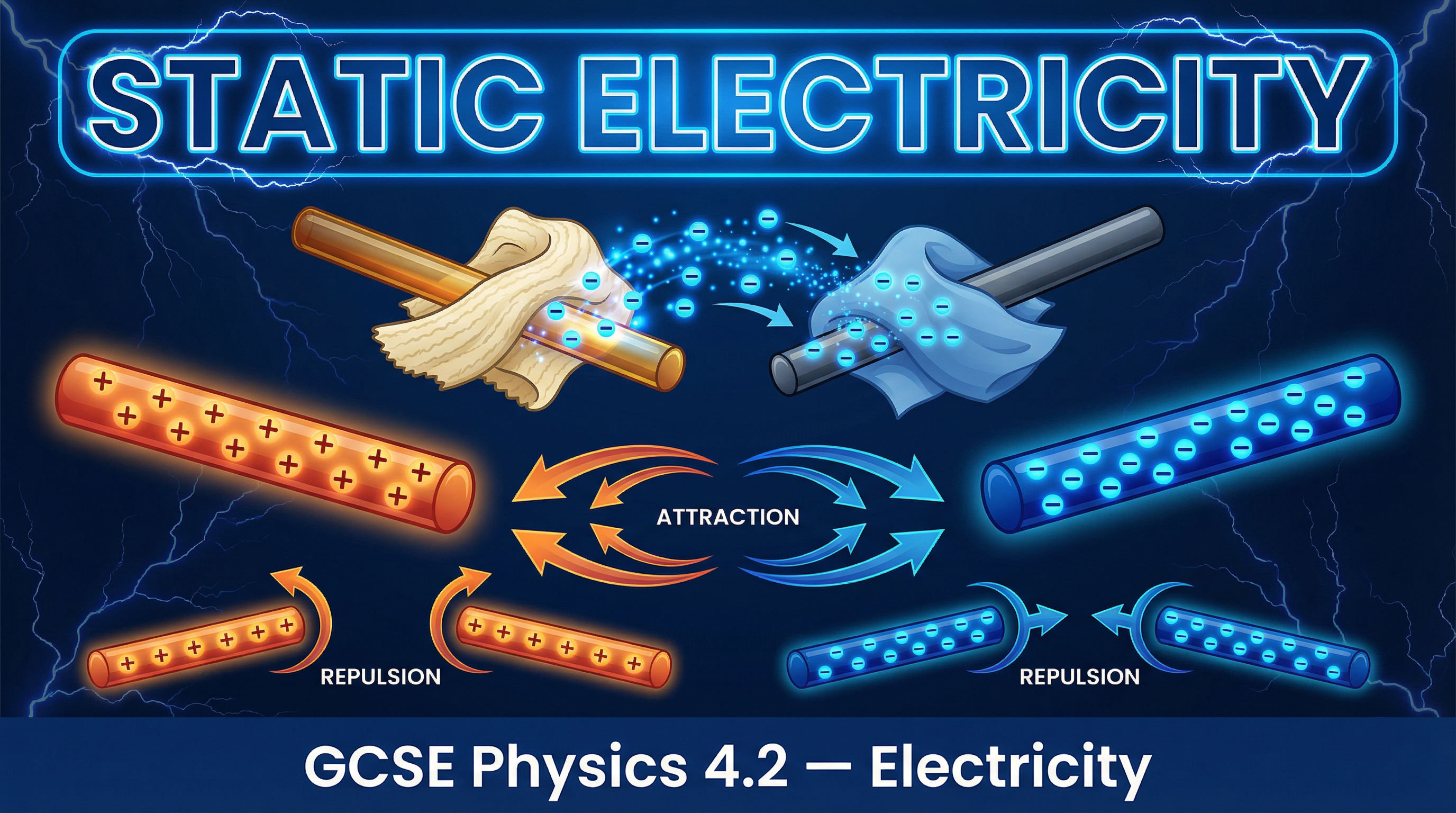
## Overview
Static electricity is a fundamental concept in GCSE Physics that explains how stationary electric charges build up and interact. Unlike current electricity, where electrons flow continuously through a circuit, static electricity deals with charges that remain on the surface of insulating materials. Understanding this topic is crucial because it forms the basis for more advanced concepts like electric fields and potential difference.
Examiners frequently test your understanding of exactly *what* moves when materials are charged (always electrons, never protons) and your ability to describe the forces between charged objects. Questions often require you to apply these principles to real-world scenarios, such as refuelling aircraft or electrostatic painting. By mastering the core rules of electron transfer and charge interaction, you will be well-prepared to tackle both straightforward recall questions and complex application scenarios.
## Key Concepts
### Concept 1: Charging by Friction
When two insulating materials are rubbed together, friction causes the transfer of electrons from one material to the other. It is essential to remember that only electrons move; protons remain fixed within the atomic nucleus. The material that gains electrons becomes negatively charged because it now has an excess of negative charge. Conversely, the material that loses electrons becomes positively charged due to a deficit of negative charge.
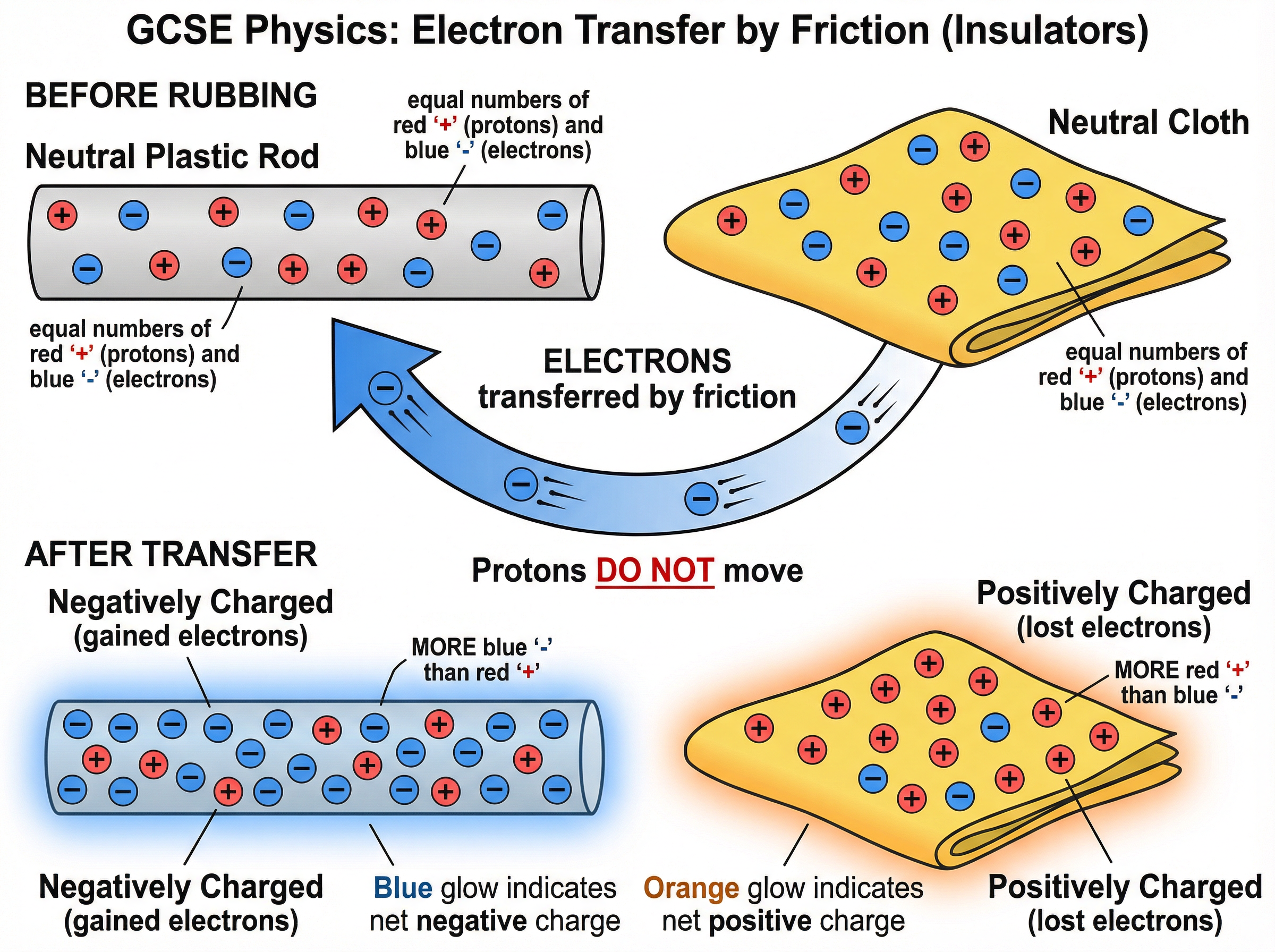
**Example**: If a student rubs a polythene rod with a dry cloth, electrons are transferred from the cloth to the polythene rod. The polythene rod becomes negatively charged, and the cloth becomes equally positively charged.
### Concept 2: Insulators vs. Conductors
Static charge only builds up on electrical insulators. Insulators are materials that do not allow electric charge to flow through them easily. When electrons are transferred to an insulator, they remain on the surface. In contrast, conductors (like metals) allow charge to flow freely. If you tried to charge a metal rod by rubbing it while holding it in your bare hand, the electrons would simply flow through your body to the earth, preventing any static charge from accumulating.
### Concept 3: Interaction Between Charges
Once objects are charged, they exert forces on each other. The fundamental rule is that **like charges repel** and **unlike charges attract**. Two negatively charged objects will push away from each other, as will two positively charged objects. However, a positively charged object and a negatively charged object will pull towards each other.
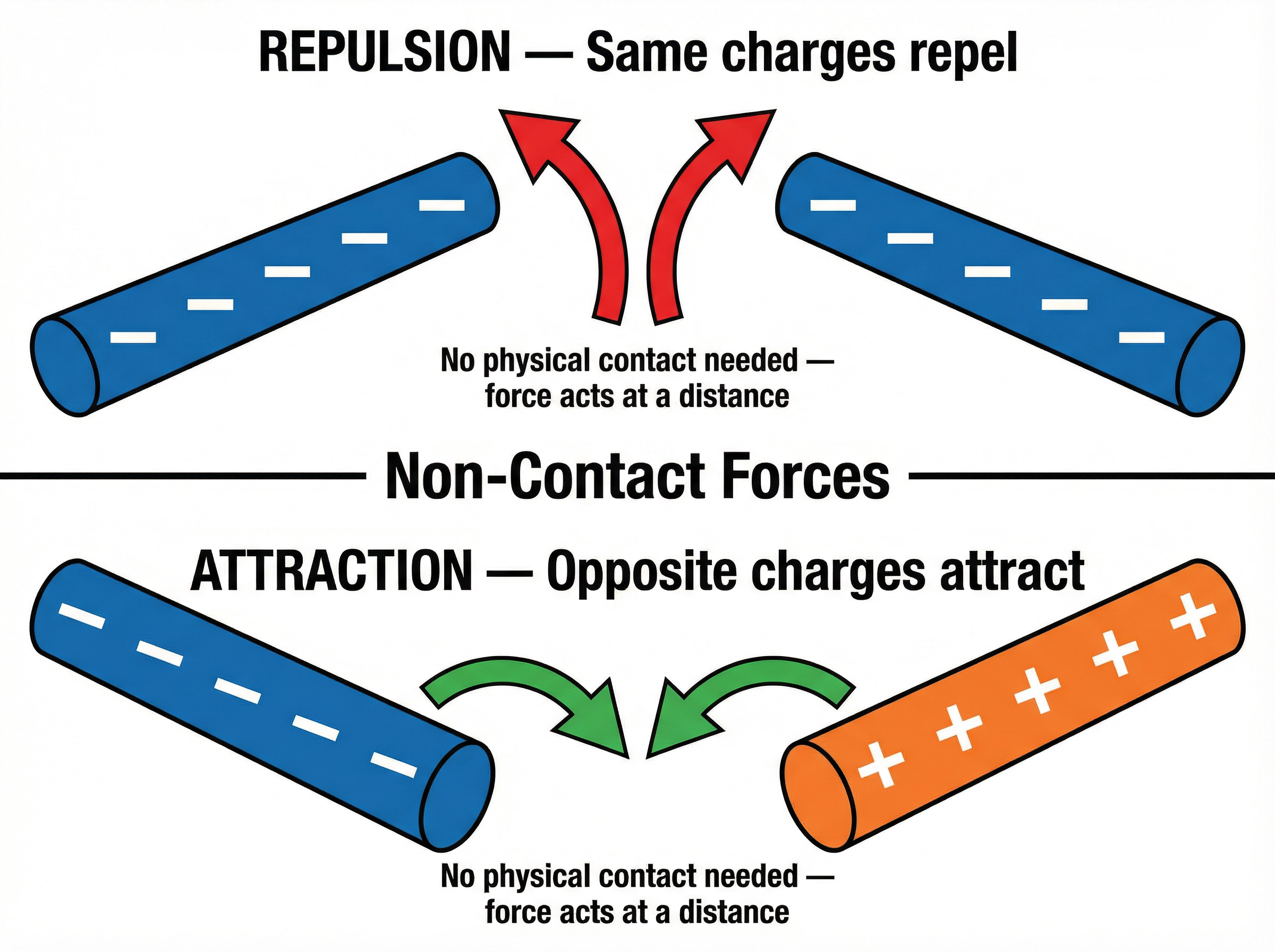
These interactions are **non-contact forces**. The objects do not need to touch for the force to act; the force is exerted through the electric field surrounding the charged objects. Examiners specifically look for the phrase "non-contact force" in your answers.

## Mathematical/Scientific Relationships
While this specific sub-topic does not introduce new formulas, it relies heavily on the fundamental relationship between charge types:
* **Negative + Negative = Repulsion**
* **Positive + Positive = Repulsion**
* **Positive + Negative = Attraction**
The strength of the force depends on the size of the charge on each object and the distance between them (the force gets weaker as the distance increases).
## Practical Applications and Hazards
Static electricity has both useful applications and significant hazards in the real world.
* **Electrostatic Spray Painting**: Paint droplets are given a positive charge as they leave the sprayer. Because all droplets have the same charge, they repel each other, spreading out to form a fine, even mist. The object being painted (e.g., a car body) is given a negative charge, attracting the paint droplets and ensuring an even coat with minimal waste.
* **Refuelling Aircraft**: As fuel flows through pipes, friction can cause a build-up of static charge. If this charge sparks, it could ignite the highly flammable fuel vapour. To prevent this hazard, the aircraft and the refuelling equipment are connected to the ground with a bonding line (earthed) before refuelling begins, allowing any charge to safely flow away.
* **Photocopiers**: Static electricity is used to attract black toner powder to the areas of a drum that correspond to the dark parts of the original document.