Electricity — AQA GCSE Study Guide
Exam Board: AQA | Level: GCSE
Master the fundamentals of electricity: current, charge, and potential difference. This topic forms the foundation of all circuit questions and guarantees you easy calculation marks if you learn the core rules.
## Overview
Electricity is the lifeblood of modern society, and understanding how it works is central to GCSE Physics. Topic 4.2 covers the absolute fundamentals: what electric current actually is, why it flows, and how we measure it. This topic is crucial because it forms the foundation for everything else in electricity — if you don't understand current and potential difference here, you'll struggle with resistance, series and parallel circuits, and mains electricity later on.
Examiners love testing this topic through calculations (especially the $Q = I \times t$ equation) and precise definitions. You will frequently see questions asking you to define current, calculate charge flow, or explain what happens to current in a simple series circuit.

## Key Concepts
### Concept 1: Electric Current
**Electric current is the rate of flow of electrical charge.** This is the exact definition examiners look for. Do not write "the flow of electricity" or "how fast electrons move" — you must use the specific phrase "rate of flow of electrical charge".
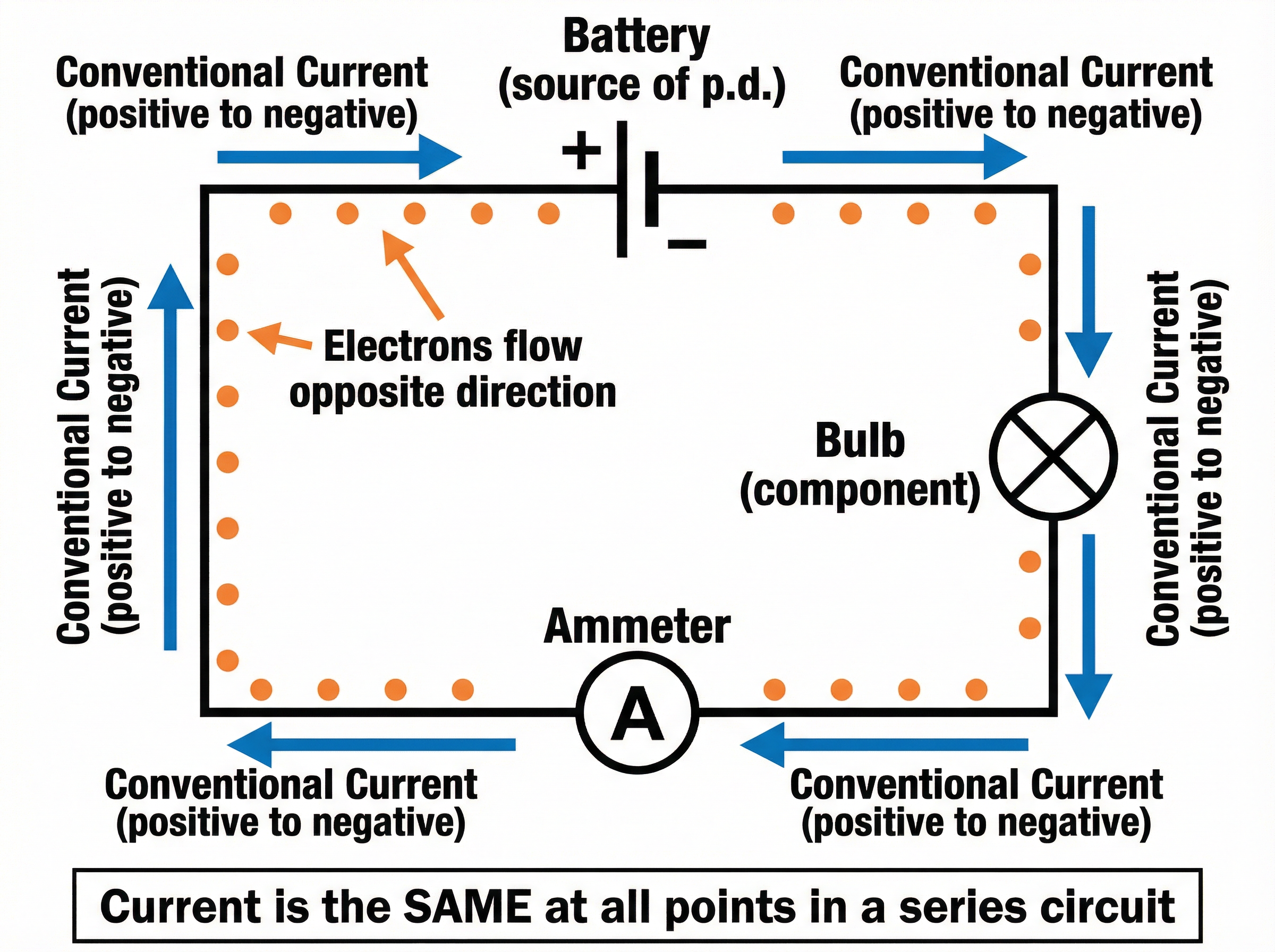
In solid metal conductors (like copper wires), this charge is carried by negatively charged electrons. However, by convention, we draw current flowing from the positive terminal of the battery to the negative terminal. This is called **conventional current**.
Current is measured in **amperes** (often shortened to amps, symbol **A**). We measure it using an **ammeter**, which must always be connected in **series** within the circuit.
**Crucial Rule:** In a single closed loop (a series circuit), the current has the exact same value at any point. The components do not "use up" the current.
### Concept 2: Potential Difference
For electrical charge to flow through a closed circuit, there must be a source of **potential difference** (often called voltage). Think of potential difference as the "push" that drives the charge around the circuit. Without it, the free electrons in the wire will just jiggle about randomly rather than flowing in one direction.
Sources of potential difference include cells, batteries (which are two or more cells connected together), and power supplies.
Potential difference is measured in **volts** (symbol **V**). We measure it using a **voltmeter**, which must always be connected in **parallel** across the component you are investigating.
## Mathematical/Scientific Relationships
### The Charge Flow Equation
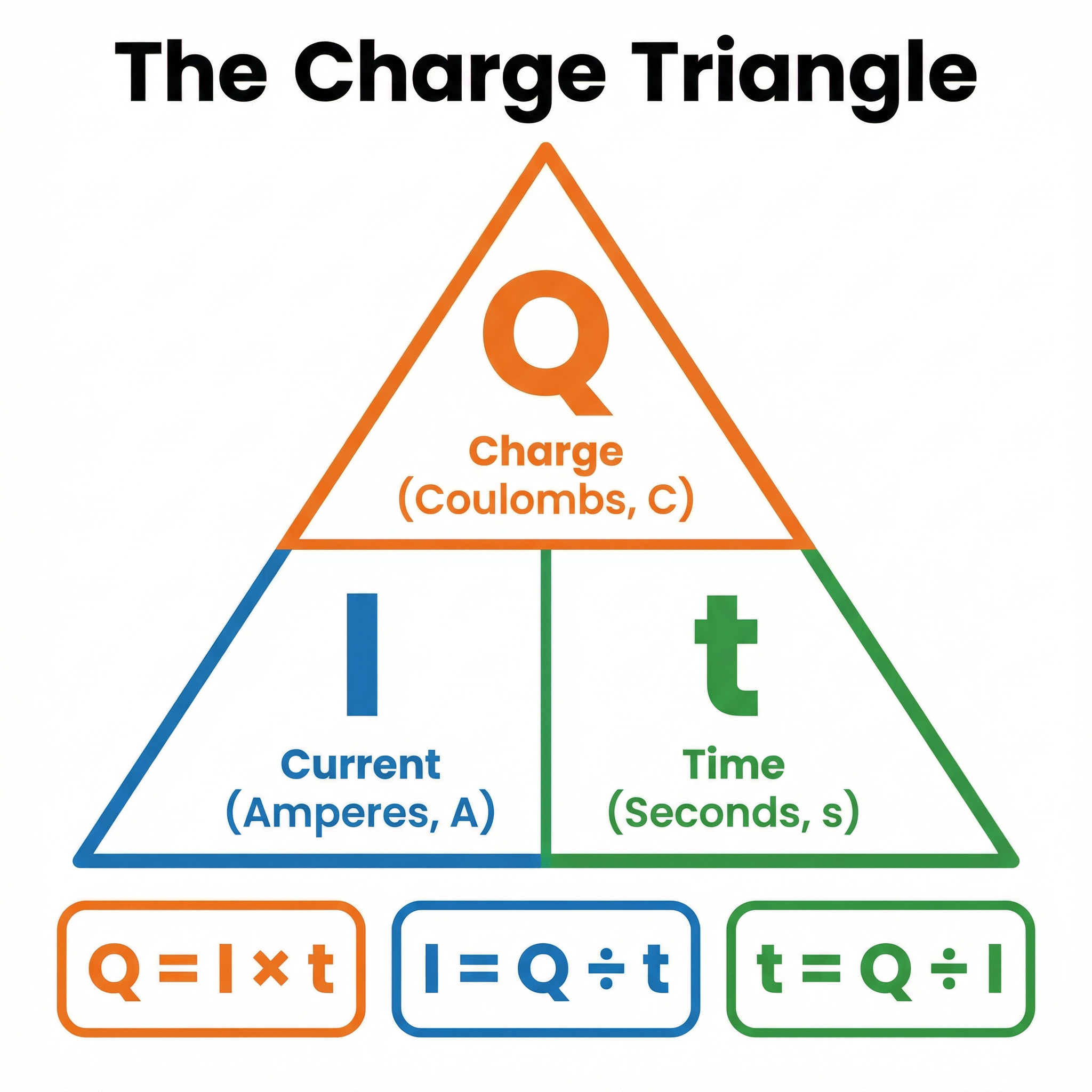
The relationship between charge flow, current, and time is given by the equation:
$$Q = I \times t$$
Where:
* **$Q$** = charge flow in **coulombs (C)**
* **$I$** = current in **amperes (A)**
* **$t$** = time in **seconds (s)**
**Must memorise:** This equation is usually NOT given on the exam formula sheet. You must learn it.
**Examiner Warning:** The most common mistake students make is forgetting to convert time into seconds. If a question says "for 5 minutes", you MUST multiply by 60 to get 300 seconds before doing the calculation.
## Practical Applications
Understanding these concepts is essential for setting up any electrical circuit safely. When electricians wire a house, they need to calculate the expected current to choose the correct thickness of wire — if too much current flows through a thin wire, it can overheat and cause a fire. The concepts of current and charge are also fundamental to understanding how batteries store and deliver energy to our mobile phones and electric vehicles.