Electricity — AQA GCSE Study Guide
Exam Board: AQA | Level: GCSE
Master the fundamental relationships between current, potential difference, and resistance. This topic is the bedrock of electrical physics, testing your ability to apply Ohm's Law and calculate charge flow—skills that are heavily weighted in the exam.
## Overview
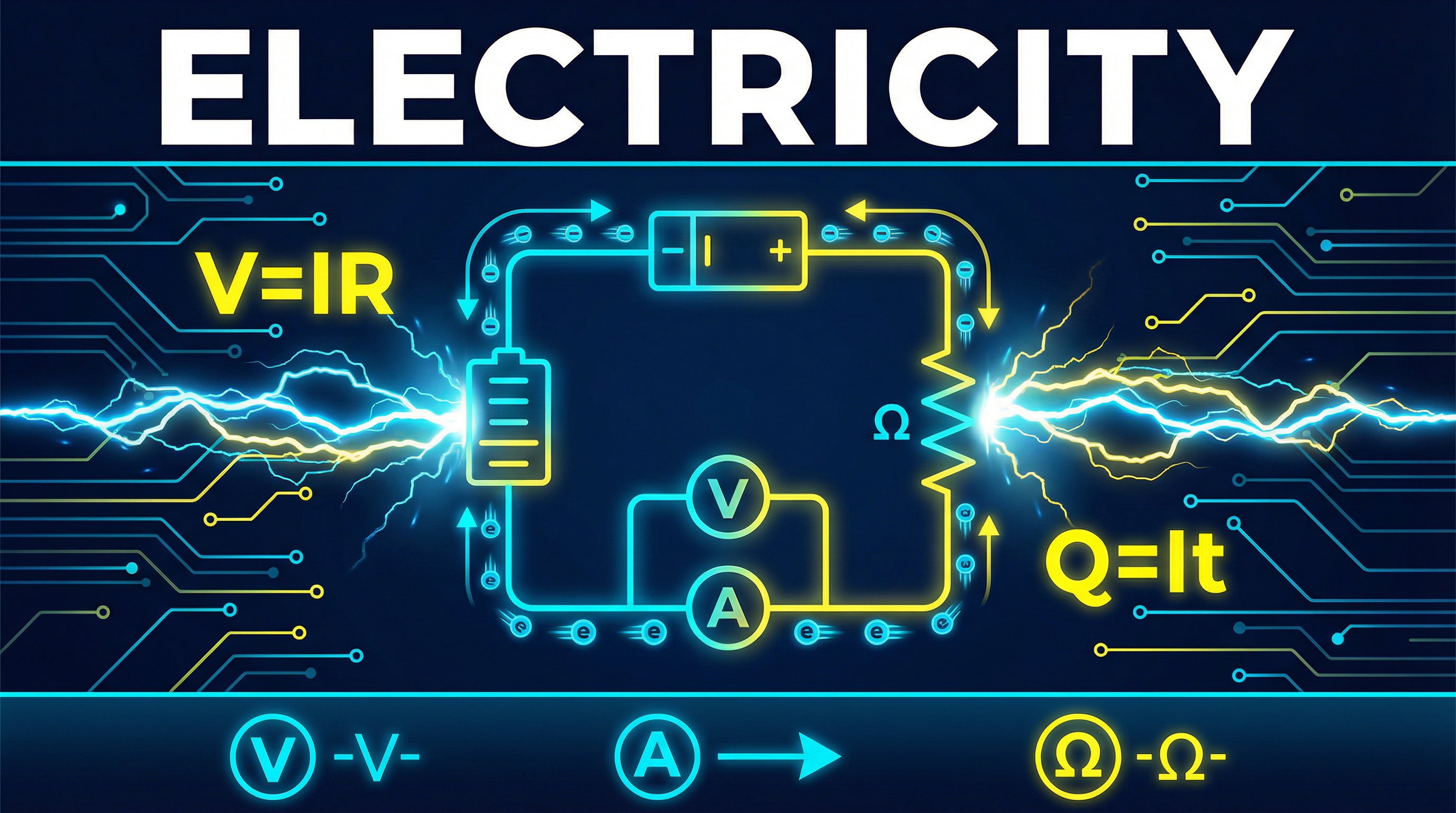
Electricity is the invisible force that powers our modern world. In this crucial topic, you will explore the fundamental relationships that govern electrical circuits. Understanding how electric current, potential difference, and resistance interact is essential, as these concepts form the foundation for all subsequent electrical physics topics. Examiners frequently test this area through multi-step calculation questions and circuit diagram analysis.

This topic connects deeply with energy transfers and electrical power. By mastering the core equations here, you will secure significant marks across both papers. Pay close attention to units and the specific command words used in exam questions, as precision is heavily rewarded.
## Key Concepts
### Concept 1: Electric Current and Charge Flow
Electric current is defined as the rate of flow of electrical charge. In solid metallic conductors, this charge is carried by tiny, negatively charged particles called electrons. When a circuit is closed and a source of potential difference (like a cell or battery) is present, these electrons are pushed around the circuit. The size of the electric current is simply the amount of charge passing a point in the circuit every second.
**Example**: If a current of 2.5 A flows through a lamp for 60 seconds, the total charge flow is calculated using the equation $Q = I \times t$. Therefore, $Q = 2.5 \times 60 = 150\text{ C}$.
### Concept 2: Potential Difference (Voltage)
Potential difference (often referred to as voltage) is the driving force that pushes the charge around the circuit. More formally, it is the work done (or energy transferred) per unit of charge that passes between two points in a circuit. A higher potential difference means more energy is transferred to the components in the circuit.
### Concept 3: Resistance and Ohm's Law
Resistance is the opposition to the flow of current. As electrons move through a conductor, they collide with the metal ions in the lattice. These collisions transfer energy and slow down the flow of charge. For a given potential difference, the higher the resistance of a component, the smaller the current that can flow through it.
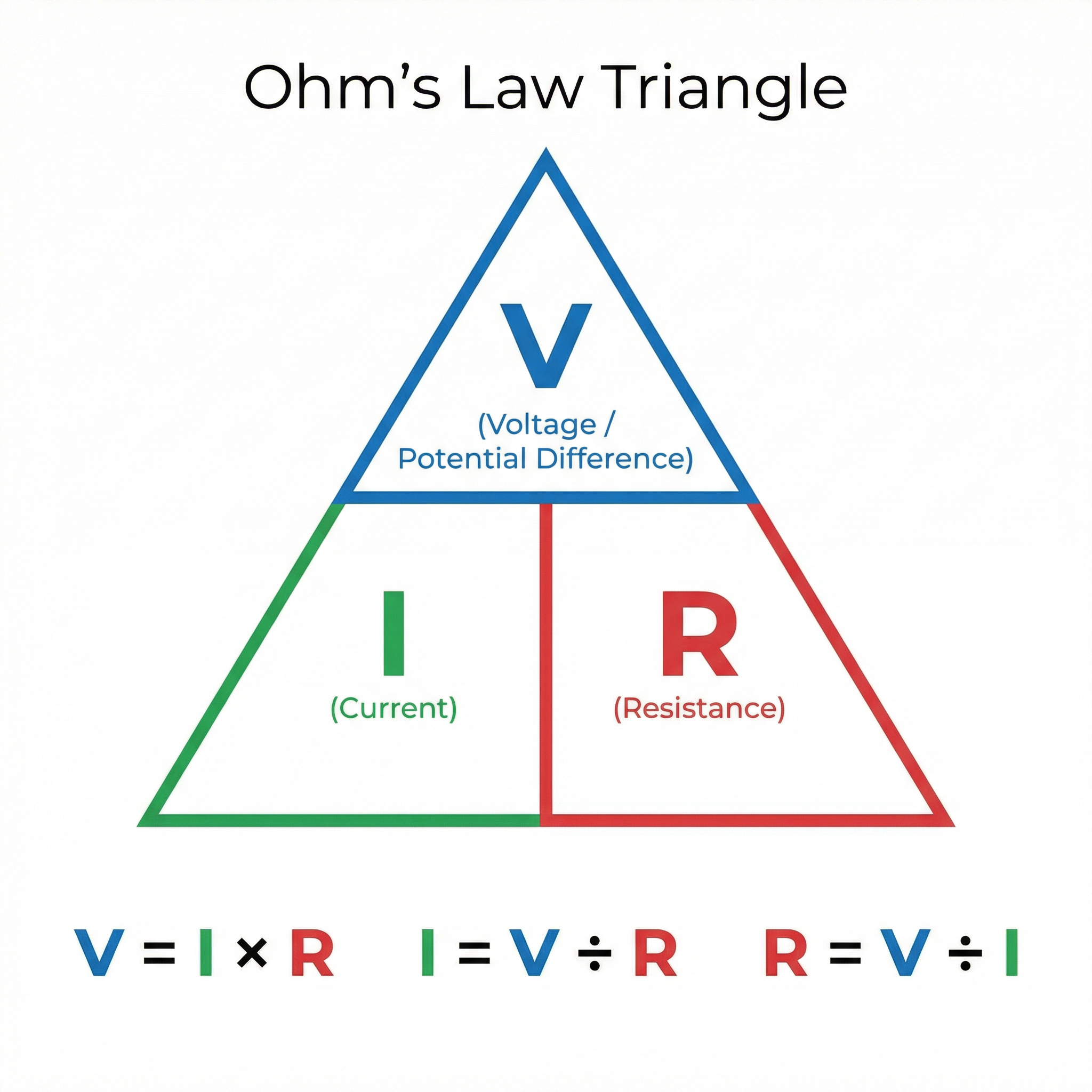
Ohm's Law states that the current flowing through a resistor at a constant temperature is directly proportional to the potential difference across it. This relationship is defined by the equation $V = I \times R$.
### Concept 4: Circuit Symbols and Diagrams
To communicate electrical designs clearly, physicists use standard circuit symbols. You must be able to recognise and draw these accurately.
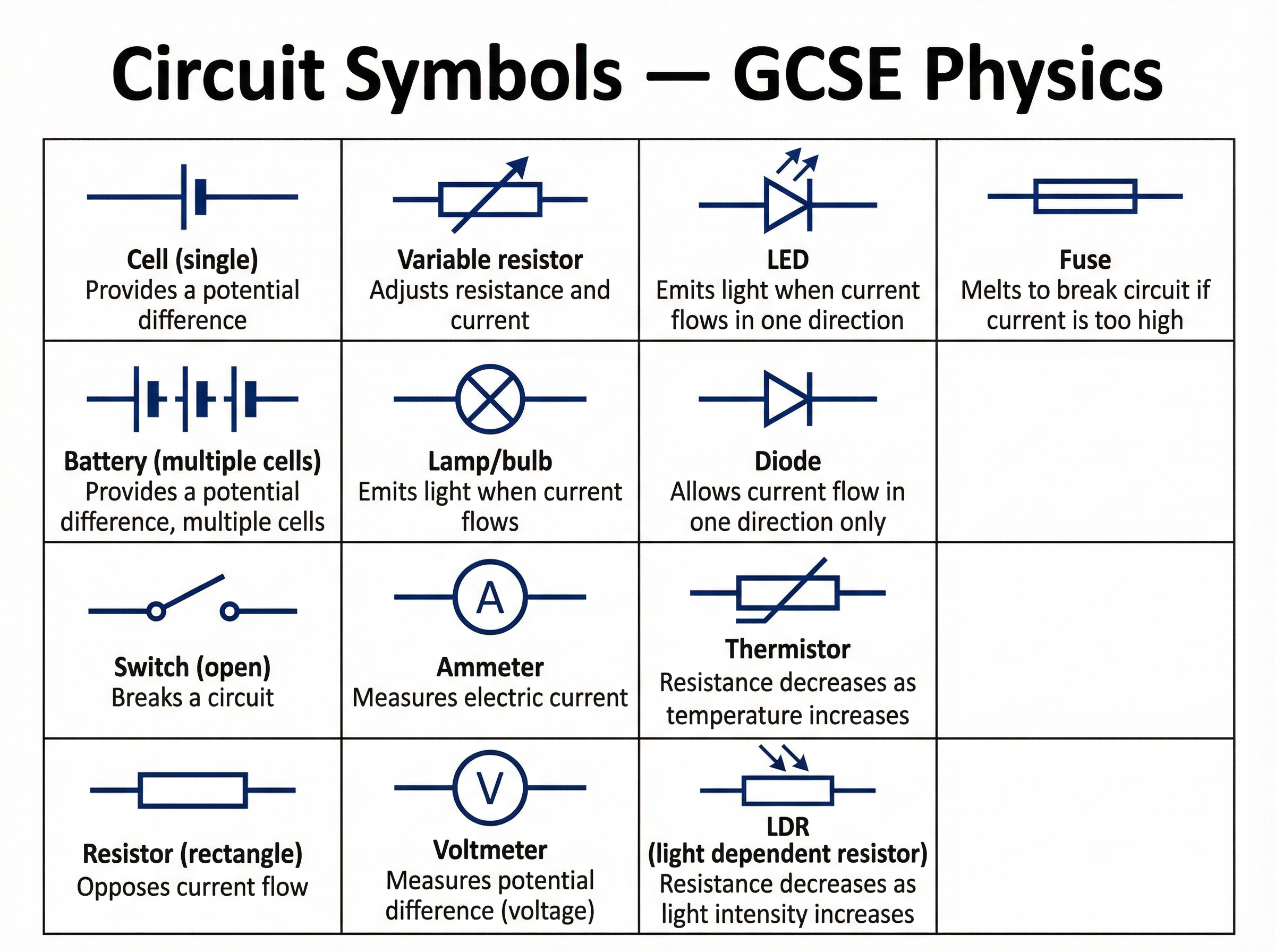
An ammeter is always connected in series to measure the current flowing through a component, while a voltmeter is always connected in parallel across a component to measure the potential difference across it.
## Mathematical/Scientific Relationships
1. **Charge Flow Equation**: $Q = I \times t$
- $Q$ = charge flow in coulombs (C)
- $I$ = current in amperes (A)
- $t$ = time in seconds (s)
- *Note*: This equation must be memorised. Always ensure time is converted to seconds.
2. **Ohm's Law Equation**: $V = I \times R$
- $V$ = potential difference in volts (V)
- $I$ = current in amperes (A)
- $R$ = resistance in ohms ($\Omega$)
- *Note*: This equation must be memorised. Use the VIR triangle to rearrange it easily.
## Practical Applications
Understanding these relationships is crucial for designing safe and efficient electrical appliances. For example, the resistance of a filament lamp increases as it gets hotter, which limits the current and prevents the bulb from burning out immediately. Similarly, variable resistors are used in dimmer switches to control the brightness of lights by adjusting the current flow.