AQA · GCSE · Physics
Energy Transfers
Master AQA GCSE Physics Topic 4.2.4: Energy Transfers. This guide provides everything you need to understand how energy moves between stores, calculate kinetic and potential energy, and analyse efficiency — crucial skills for earning top marks in your exam.
- 7 min read
- 3 worked examples
- 5 practice questions
- 6 key terms
Study Notes
Overview
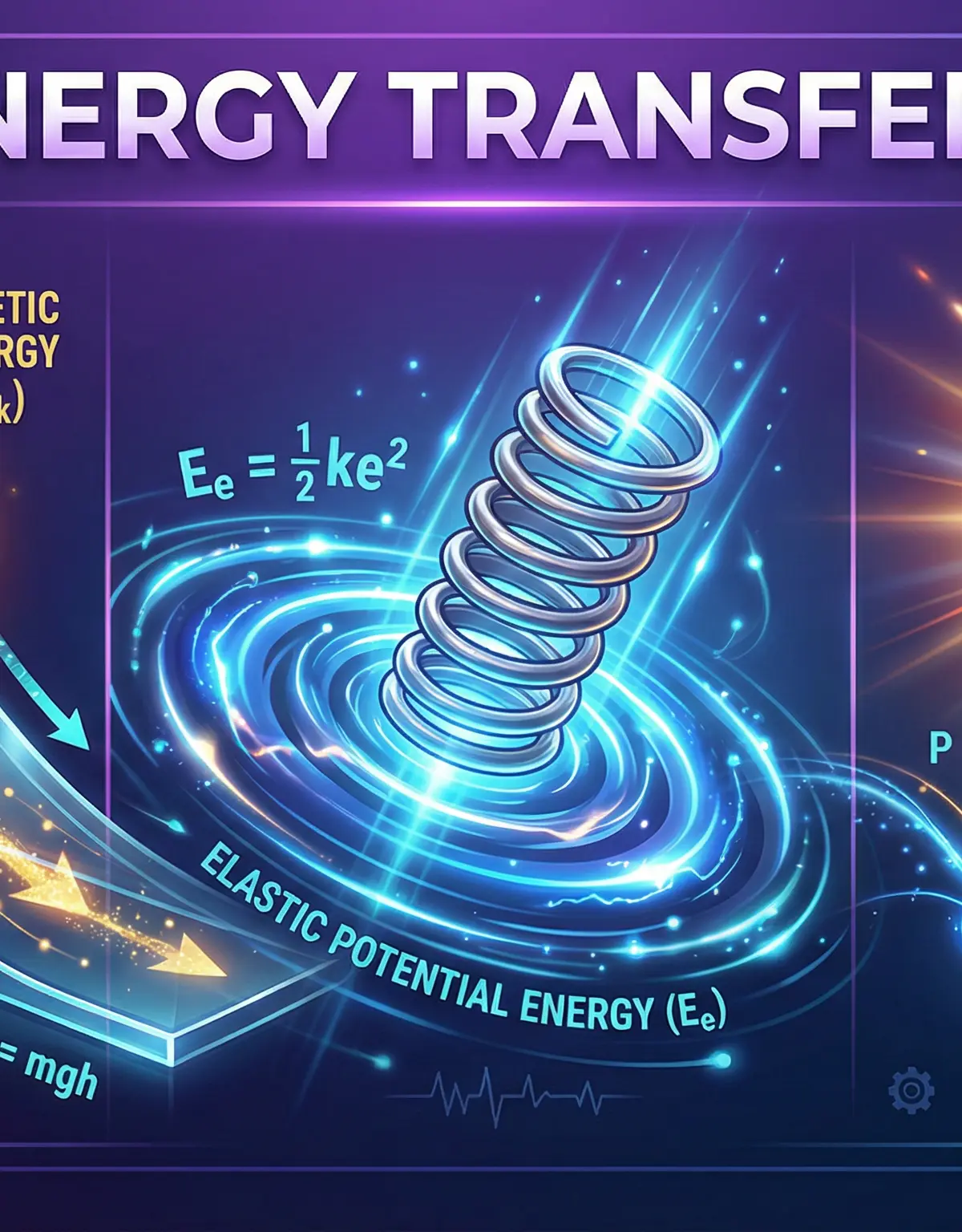
Energy is the currency of the universe, and in this topic, you become an accountant for it. AQA assesses Energy Transfers through both rigorous quantitative analysis (calculations) and qualitative understanding (explanations). You will explore the fundamental Principle of Conservation of Energy, which states that energy cannot be created or destroyed, only transferred between different stores. A mastery of this topic is essential as it forms the foundation for understanding electricity, mechanics, and thermal physics. Candidates are expected to apply formulas for kinetic, gravitational potential, and elastic potential energy, often involving multiple steps and unit conversions. Higher Tier candidates will face more complex rearrangements. Expect to see questions ranging from 1-mark definitions to 6-mark evaluations of energy efficiency in different systems.
Key Concepts
Concept 1: The Principle of Conservation of Energy
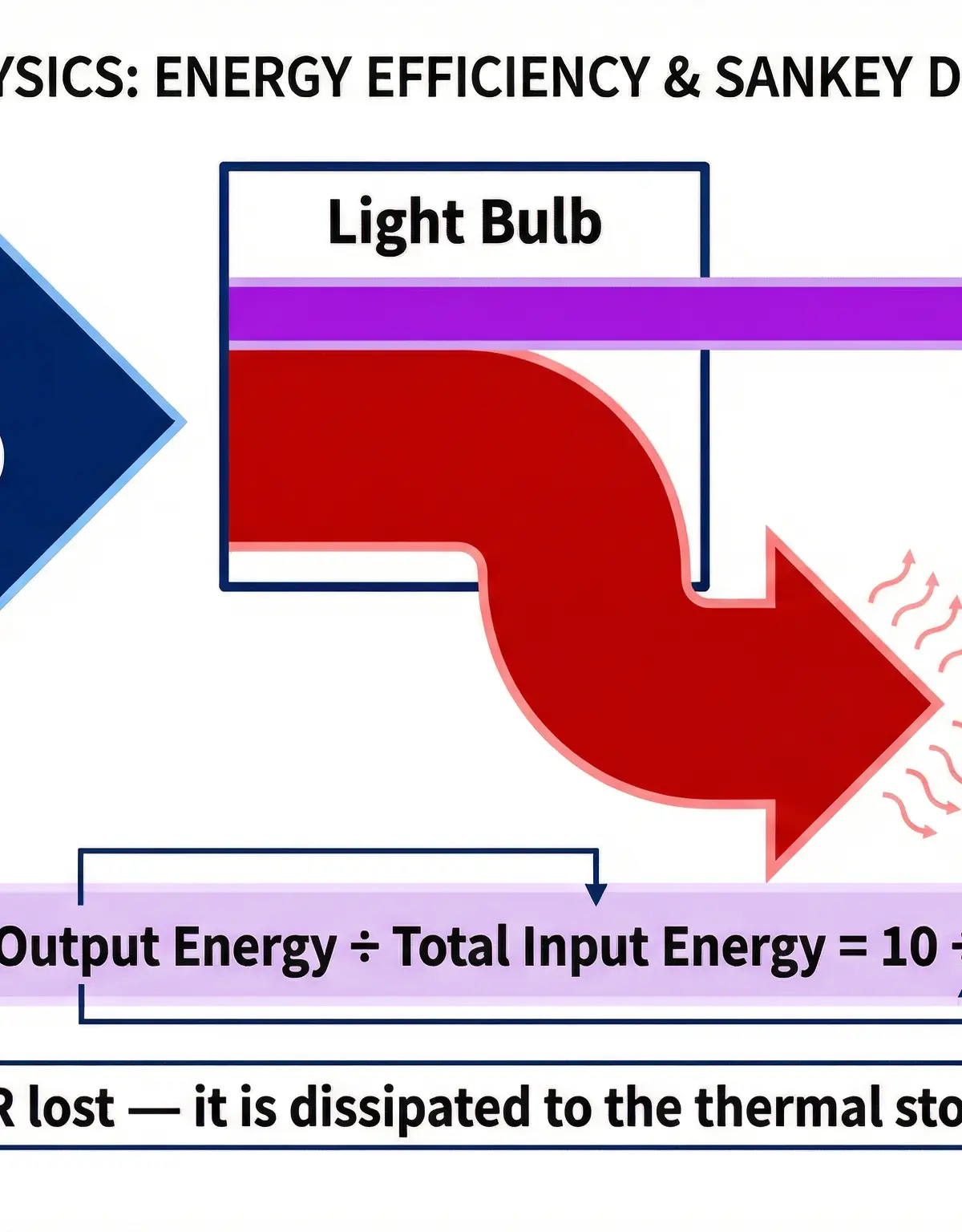
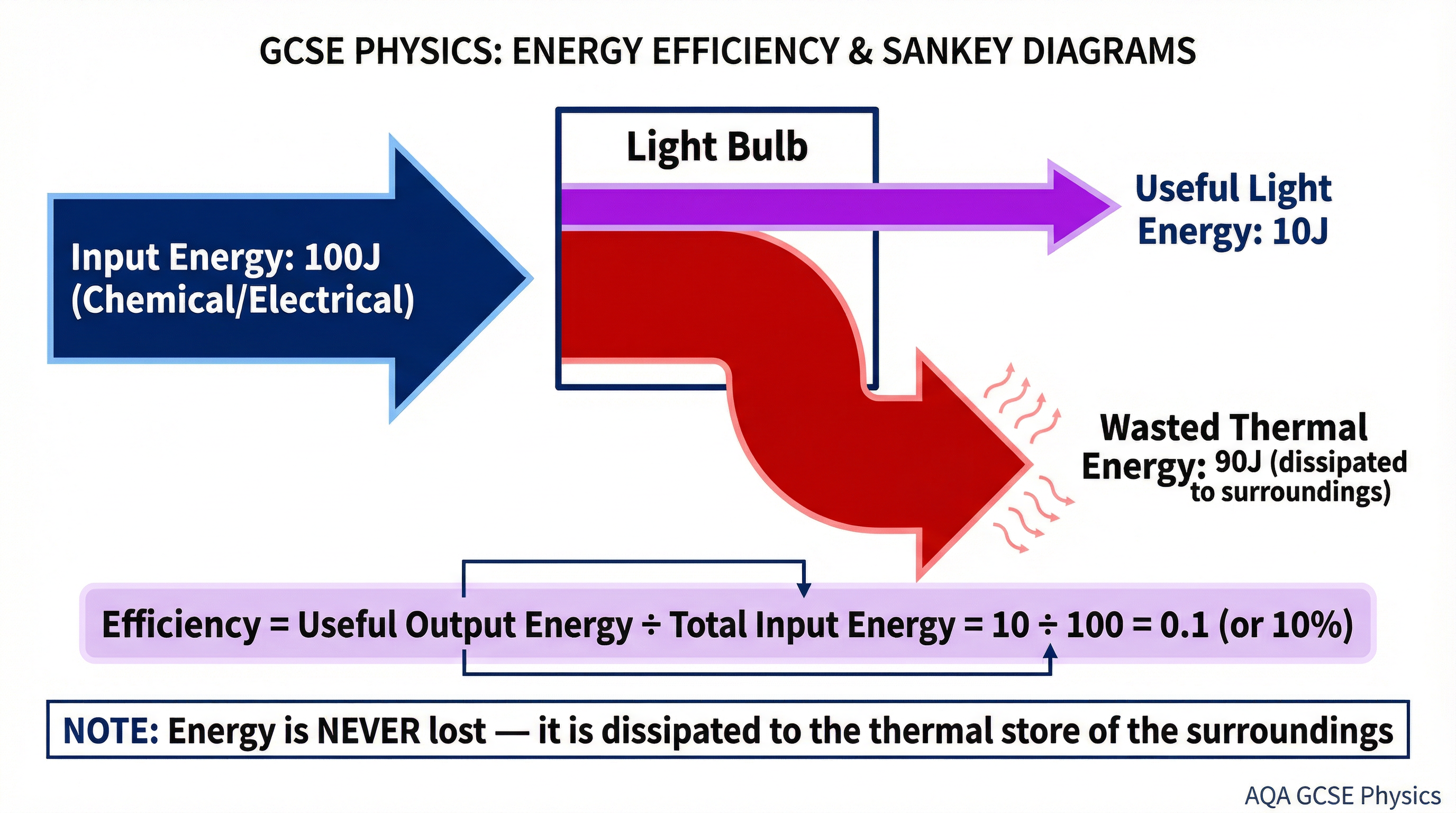
This is the single most important rule in this topic: Energy cannot be created or destroyed, only transferred from one store to another. In a "closed system" (one where no energy can enter or leave), the total amount of energy is constant. Examiners award marks for explicitly stating this principle. When energy seems to disappear, it has actually just been transferred to a less useful store, usually the thermal store of the surroundings. This is called dissipation. Never, ever write that energy is "lost".
Concept 2: Energy Stores
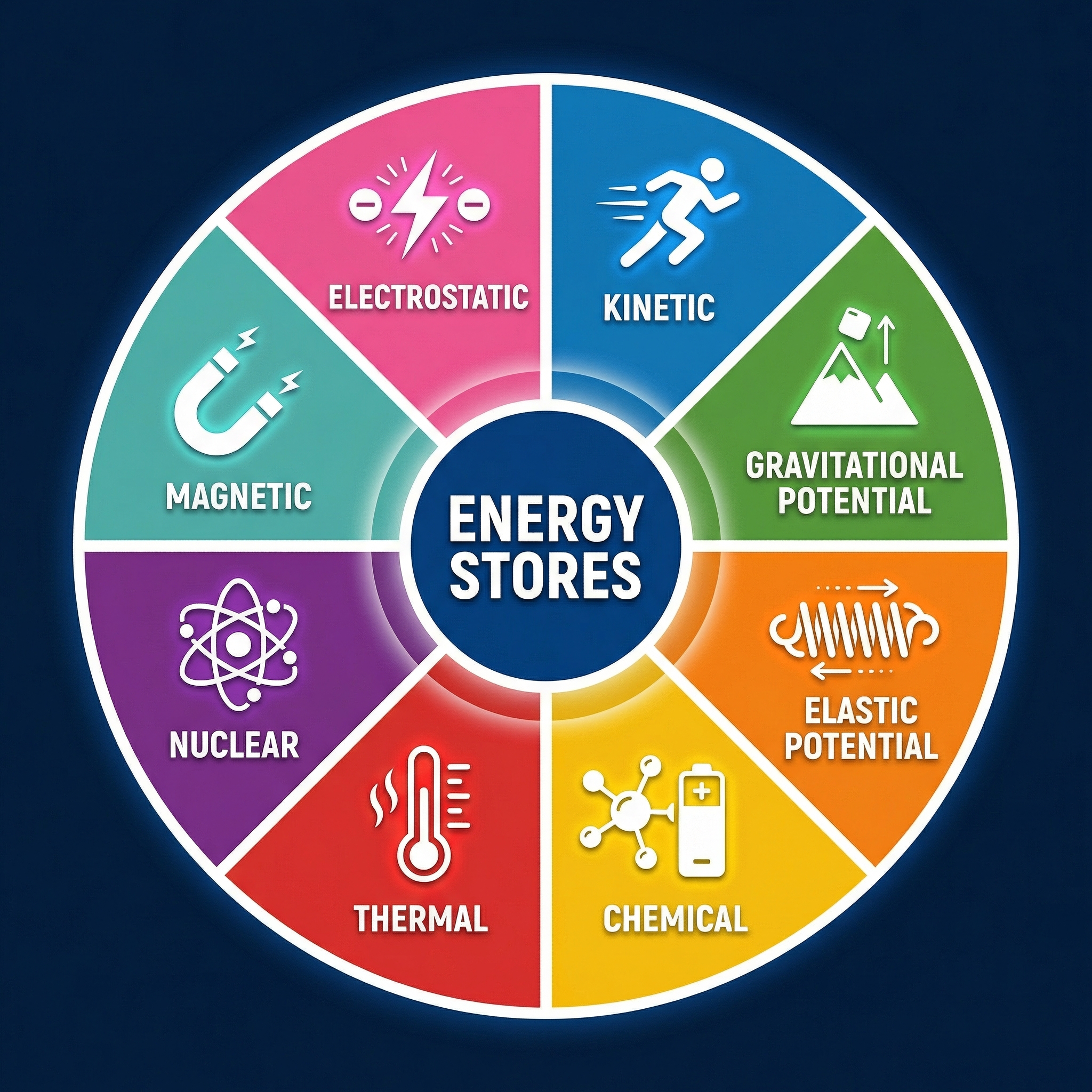
Think of energy stores as different accounts where energy can be held. You need to know eight of them. The main ones for calculations are Kinetic, Gravitational Potential, and Elastic Potential.
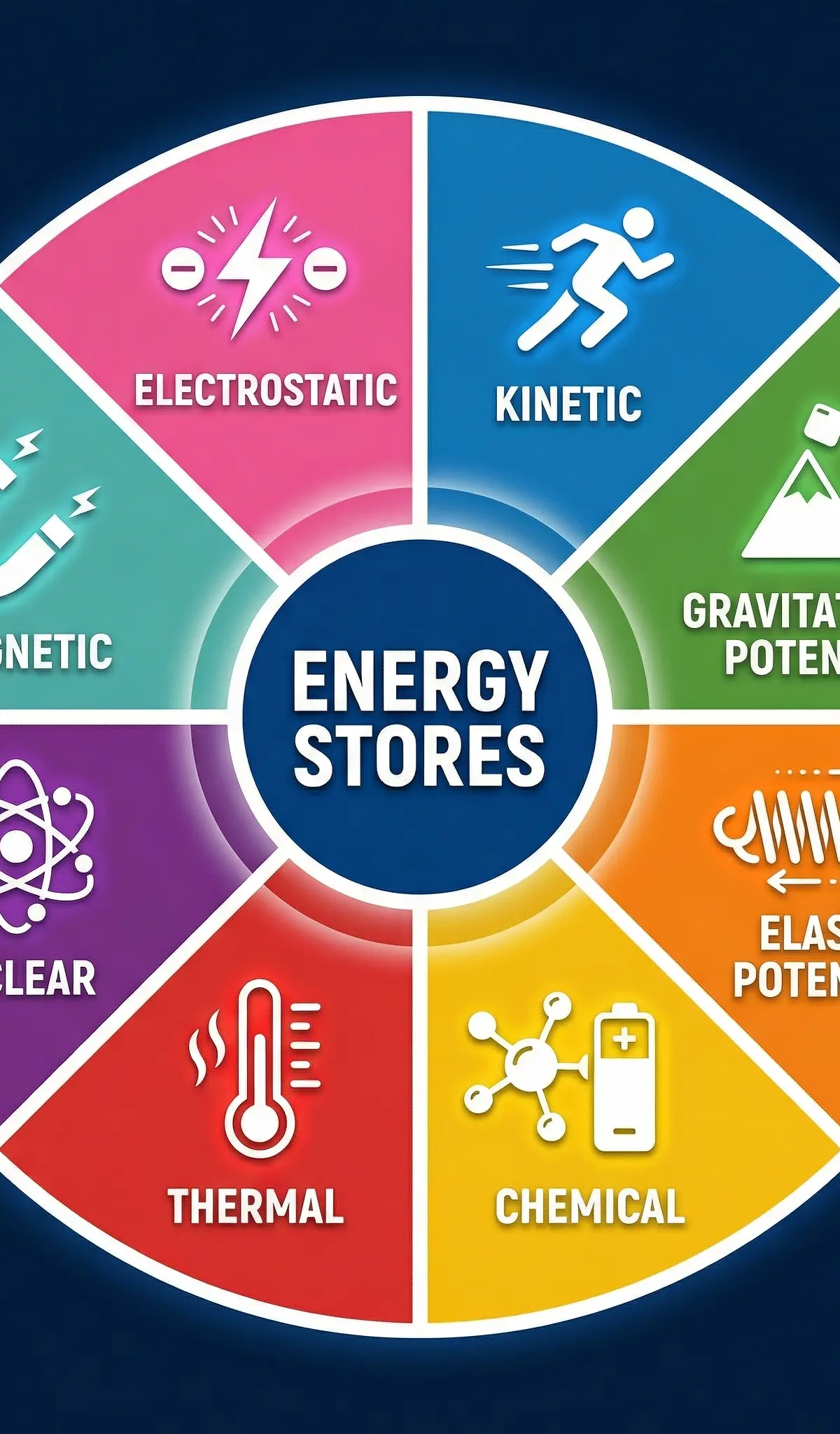
- Kinetic (Ek): The energy of a moving object.
- Gravitational Potential (Ep): Energy stored by an object due to its height in a gravitational field.
- Elastic Potential (Ee): Energy stored when an object is stretched or compressed.
- Thermal: The energy a substance has due to its temperature.
- Chemical: Energy stored in the bonds between atoms (e.g., in food, fuel, batteries).
- Nuclear: Energy stored in the nucleus of an atom.
- Magnetic: Energy stored when repelling poles have been pushed closer or attracting poles pulled further apart.
- Electrostatic: Energy stored when repelling charges have been moved closer or attracting charges pulled further apart.
Concept 3: Energy Transfer Pathways
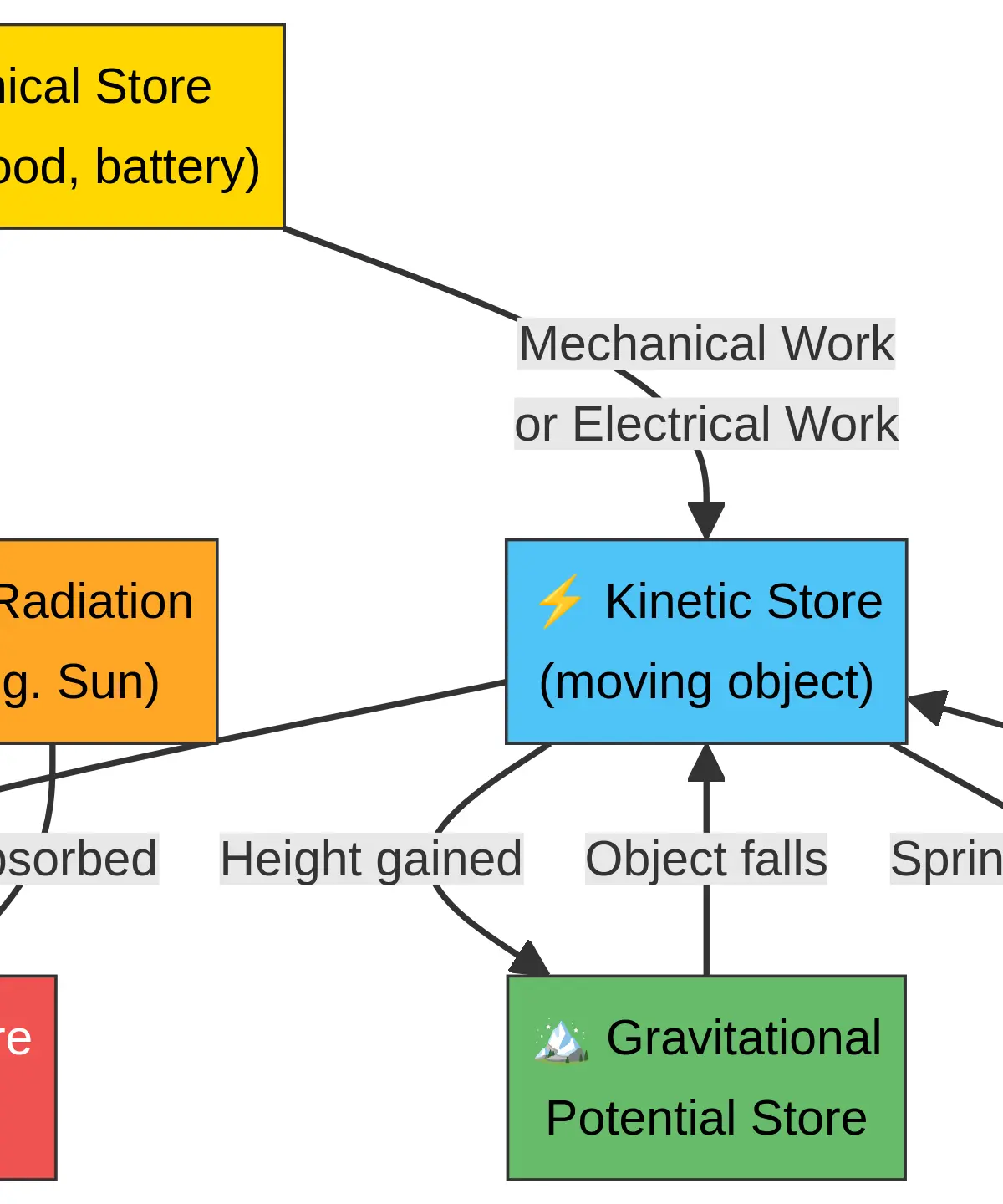
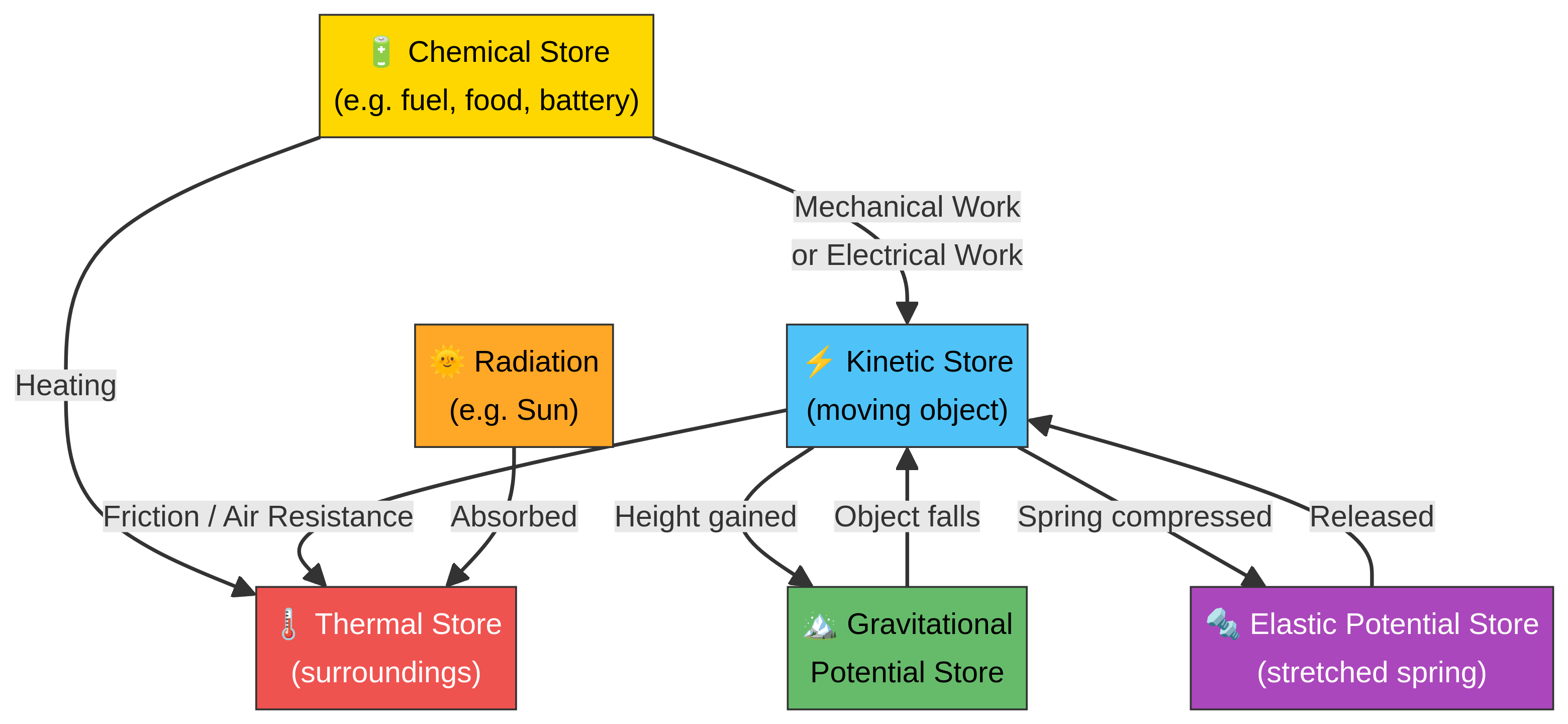
Energy moves from one store to another via four pathways:
- Mechanical Work: A force moving an object (e.g., pushing a box).
- Electrical Work: Charges moving due to a potential difference (e.g., a current in a circuit).
- Heating: Energy transferred from a hotter object to a colder one.
- Radiation: Energy transferred as a wave (e.g., light from the sun, sound waves).
Concept 4: Work Done
Work Done is the energy transferred when a force moves an object. The formula is Work Done (J) = Force (N) x Distance (m). This is a key link between forces and energy. If you push a box with a force of 10 N for 5 metres, you have done 50 J of work, transferring 50 J of energy.
Concept 5: Power
Power is the rate at which energy is transferred, or the rate at which work is done. It is not the same as energy. Power is measured in Watts (W). One Watt is one Joule per second.
- Power (W) = Energy Transferred (J) / Time (s)
- Power (W) = Work Done (J) / Time (s)
Mathematical/Scientific Relationships
| Formula | Meaning | Tier | On Formula Sheet? |
|---|---|---|---|
| Ek = 0.5 x m x v² | Kinetic Energy = 0.5 x mass x (speed)² | Both | Yes |
| Ep = m x g x h | Gravitational Potential Energy = mass x gravitational field strength x height | Both | Yes |
| Ee = 0.5 x k x e² | Elastic Potential Energy = 0.5 x spring constant x (extension)² | Higher | Yes |
| Efficiency = Useful / Total | Efficiency = Useful output energy transfer / Total input energy transfer (or power) | Both | Yes |
| Work Done = F x s | Work Done = Force x distance | Both | Yes |
| Power = E / t | Power = Energy / time | Both | Yes |
Practical Applications
Required Practical: Investigating Specific Heat Capacity
While not directly an energy transfer practical, the principles are identical. You heat a block of material using an electric heater and measure the temperature change. This allows you to calculate how much energy is needed to raise the temperature of 1kg of the material by 1°C.
- Apparatus: 1kg block of material (e.g., copper), thermometer, electric immersion heater, power pack, ammeter, voltmeter, stopwatch, insulation.
- Method: Measure the mass of the block. Wrap it in insulation to reduce unwanted energy transfer to the surroundings. Insert the heater and thermometer. Measure the starting temperature. Turn on the power pack and start the stopwatch. Record the voltage and current. After 10 minutes, record the final temperature and turn off the power. Calculate the energy supplied (Power x time = V x I x t) and the temperature change.
- Common Errors: Forgetting to insulate the block, leading to an overestimation of the specific heat capacity because more energy is needed to achieve the same temperature rise. Not placing the thermometer correctly. Misreading the meters.
- Exam Questions: Examiners will ask you to describe the method, identify sources of error, and suggest improvements (e.g., "Wrap the block in insulating foam to reduce thermal energy transfer to the surroundings").
Reducing Unwanted Energy Transfers
This is a huge area for application questions.
- In the Home: Loft insulation (reduces convection and conduction), cavity wall insulation (traps air, reducing convection), double glazing (traps air, reducing conduction and convection), draught excluders.
- In Machines: Lubrication (e.g., oil in a car engine) reduces friction, which minimises the transfer of kinetic energy to the thermal store of the components.
Visual Resources
4 diagrams and illustrations
Interactive Diagrams
2 interactive diagrams to visualise key concepts
Conceptual Flow Outline
A flowchart showing the main energy stores and the transfer pathways that connect them.
Conceptual Flow Outline
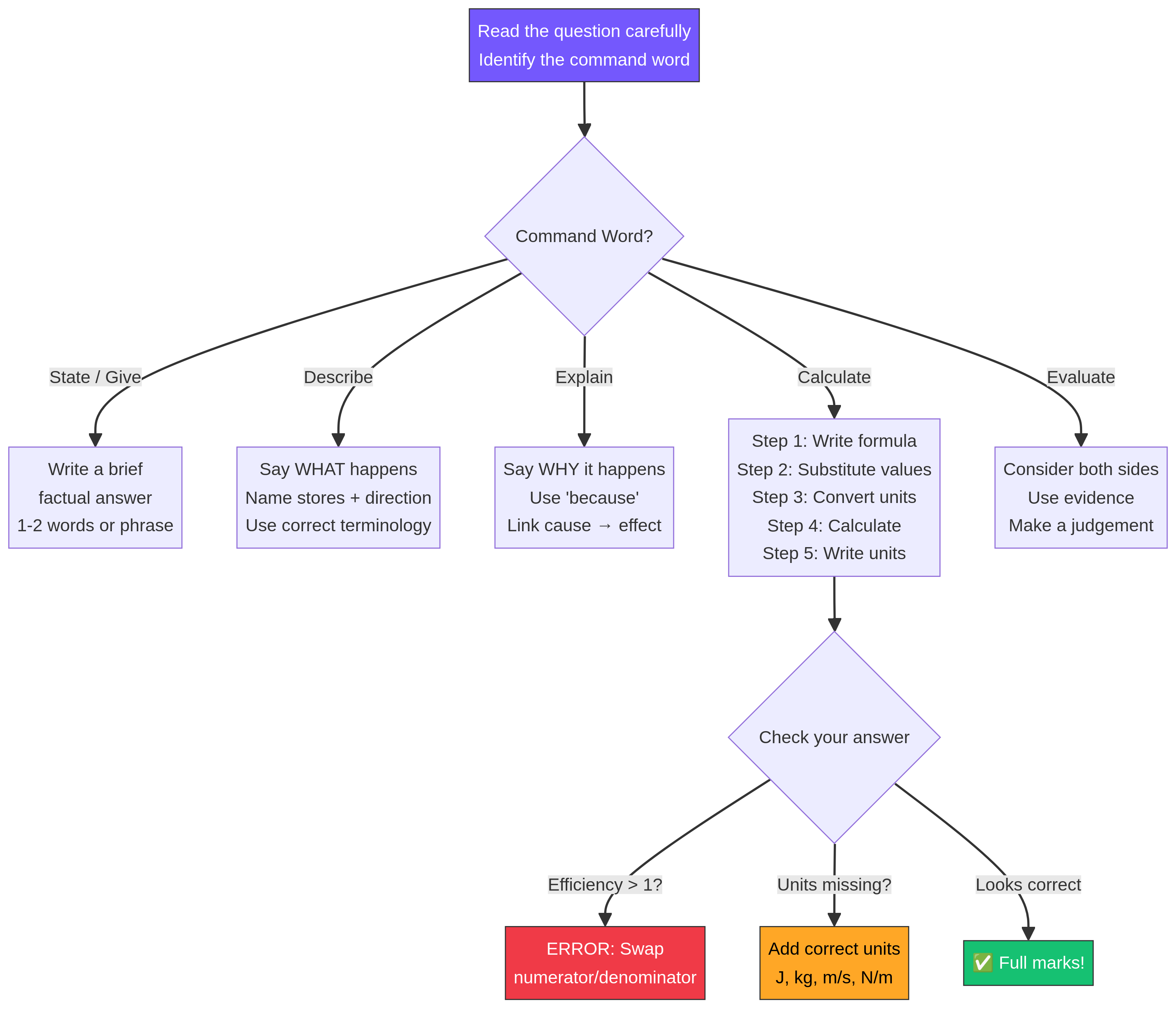
A flowchart detailing a systematic approach to deconstructing and answering exam questions based on the command word.
Worked Examples
3 worked examples — open one to explore the question and available guidance.
Practice Questions
Test your understanding — click to reveal model answers
State the eight stores of energy.
Hint: Think about movement, height, stretching, temperature, food, atoms, and charges.
A 2 kg bowling ball is travelling at a constant speed of 4 m/s. Calculate its kinetic energy.
Hint: Remember the formula Ek = 0.5mv². Don't forget to square the speed!
A toaster has a power rating of 1.1 kW. It is used for 2 minutes. Calculate the total energy transferred by the toaster.
Hint: Power is in kW and time is in minutes. You must convert them to Watts and seconds before calculating.
A motor is used to lift a load. The motor has a total input power of 50 W and a useful output power of 35 W. Describe what happens to the wasted energy and calculate the efficiency of the motor.
Hint: Where does wasted energy in a motor usually go? Use the power values to calculate efficiency.
A bungee jumper of mass 70 kg stands on a platform 80 m above the ground. The unstretched bungee cord is 30 m long and has a spring constant of 60 N/m. The jumper falls to a maximum drop of 75 m. Calculate the energy stored in the bungee cord at this point. (g = 9.8 N/kg)
Hint: This is a synoptic question combining GPE and EPE. Use the conservation of energy. The loss in GPE is equal to the gain in EPE.
Test your understanding of Energy Transfers
Active recall beats re-reading. Take an instant quiz now to test what you’ve learned and lock it into long-term memory.
7 days Premium · Then free forever · No card, no charge