AQA · GCSE · Physics
Energy Transfers and Efficiency
This guide covers AQA GCSE Physics topic 4.1.3, focusing on the core principles of energy conservation, transfers, and efficiency calculations. It provides essential exam techniques, worked examples, and multi-modal resources to help students master how to quantify energy use and reduce waste."
- 9 min read
- 3 worked examples
- 5 practice questions
Study Notes

Overview
Welcome to your guide for AQA GCSE Physics topic 4.1.3: Energy Transfers and Efficiency. This is a cornerstone of your physics course, and mastering it is crucial for exam success. This topic explores the fundamental Principle of Conservation of Energy, which states that energy cannot be created or destroyed, only transferred, stored, or dissipated. We will delve into the different energy stores and the pathways through which energy is transferred. A major focus for AQA is quantifying how effectively energy is used, which brings us to efficiency calculations. You will learn how to calculate efficiency for various systems and, critically, how to represent wasted energy using Sankey diagrams. The examiners are particularly interested in your ability to describe how unwanted energy transfers can be reduced, for example, through lubrication and thermal insulation. This topic frequently appears in exams, often as structured questions requiring both calculations and written explanations, including challenging 6-mark questions.
Key Concepts
Concept 1: The Principle of Conservation of Energy
This is the single most important rule in this topic. It is a fundamental law of physics and is worth a guaranteed mark in an exam if you can state it correctly. The principle states:
Energy cannot be created or destroyed, only transferred, stored, or dissipated.
This means the total amount of energy in a closed system remains constant. When you use an electrical appliance, the energy doesn't just vanish. It is converted from one form (electrical) into other forms. Some of this will be the useful form you want (e.g., light from a bulb), but some will always be transferred into wasted forms, which are not useful for the intended purpose. For AQA, 'wasted' energy is almost always dissipated (spread out) into the thermal store of the surroundings, causing a temperature increase.
Crucial exam language: Avoid using the term 'lost energy'. Marks are awarded for specific phrases like "dissipated to the surroundings" or "transferred to the thermal store of the surroundings".
Concept 2: Energy Stores and Pathways
To understand energy transfers, we need to know where energy is kept (stores) and how it moves (pathways). You need to be familiar with the 8 main energy stores.
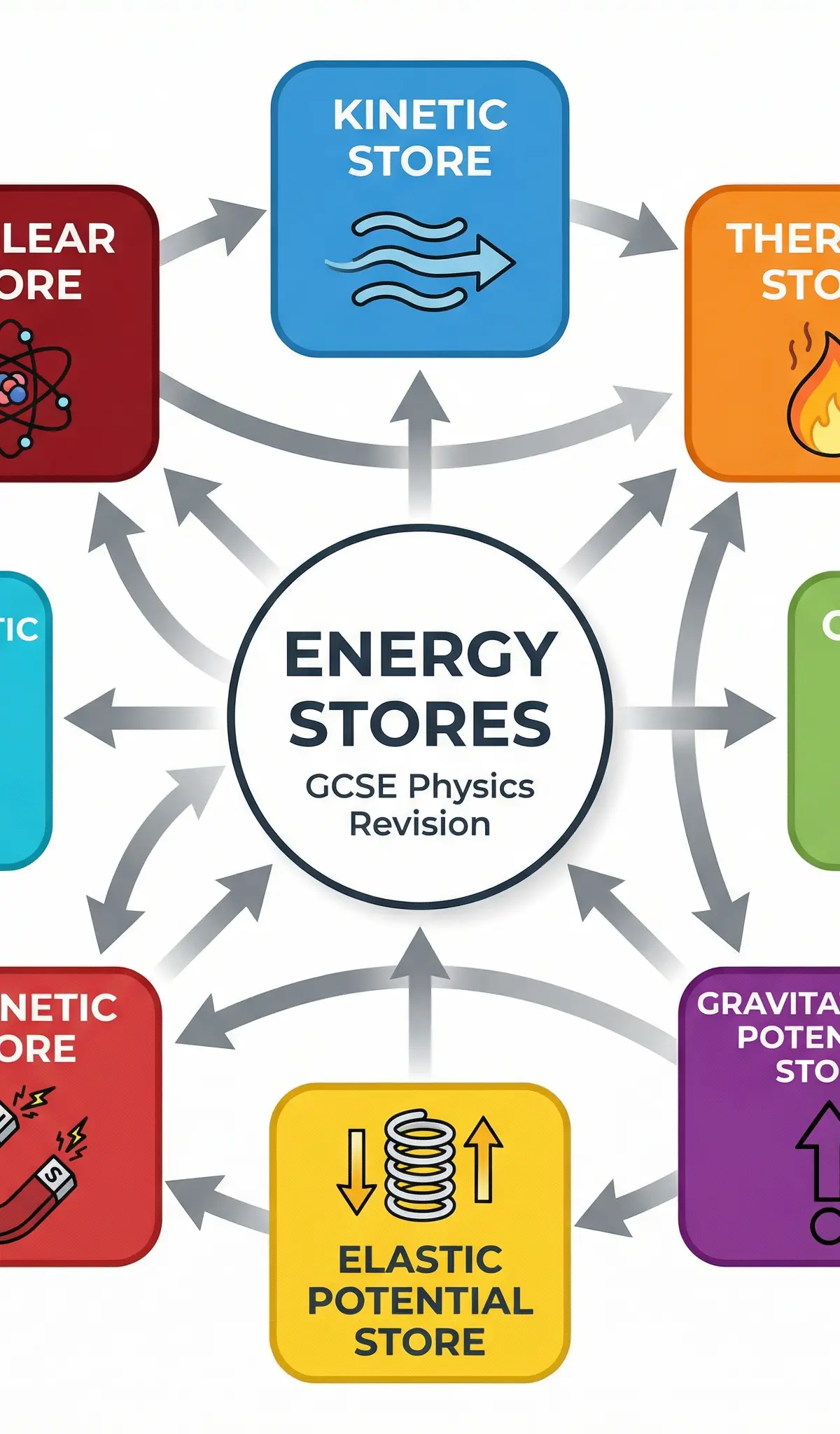
- Kinetic: The energy of a moving object.
- Thermal: The energy a substance has due to its temperature.
- Chemical: Energy stored in the bonds between atoms (e.g., in food, fuel, batteries).
- Gravitational Potential: Energy an object has due to its position in a gravitational field (i.e., its height).
- Elastic Potential: Energy stored when an object is stretched or squashed (e.g., a spring or elastic band).
- Magnetic: Energy stored when repelling poles have been pushed closer together or attracting poles have been pulled further apart.
- Electrostatic: Energy stored when repelling charges have been moved closer together or attracting charges have been pulled further apart.
- Nuclear: Energy stored in the nucleus of an atom.
Energy is transferred between these stores via four main pathways:
- Mechanical Work: A force moving an object through a distance.
- Electrical Work: Charges moving due to a potential difference.
- Heating: Due to a temperature difference.
- Radiation: Energy transferred as a wave (e.g., light, infrared, sound).
Concept 3: Efficiency
Efficiency is a measure of how good a device is at transferring energy into the useful form that is intended. No device is 100% efficient; some energy is always dissipated. Efficiency can be calculated as a decimal or a percentage.
A key point: Efficiency is a ratio and therefore has no units.
If you calculate an efficiency value greater than 1 (or >100%), you have made a mistake. This is a common error where candidates invert the fraction. Always do a quick 'sanity check' on your answer.
Concept 4: Sankey Diagrams
A Sankey diagram is a visual representation of energy transfers in a system. The width of the arrows is proportional to the amount of energy they represent. This makes it easy to see at a glance how much energy is useful and how much is wasted.
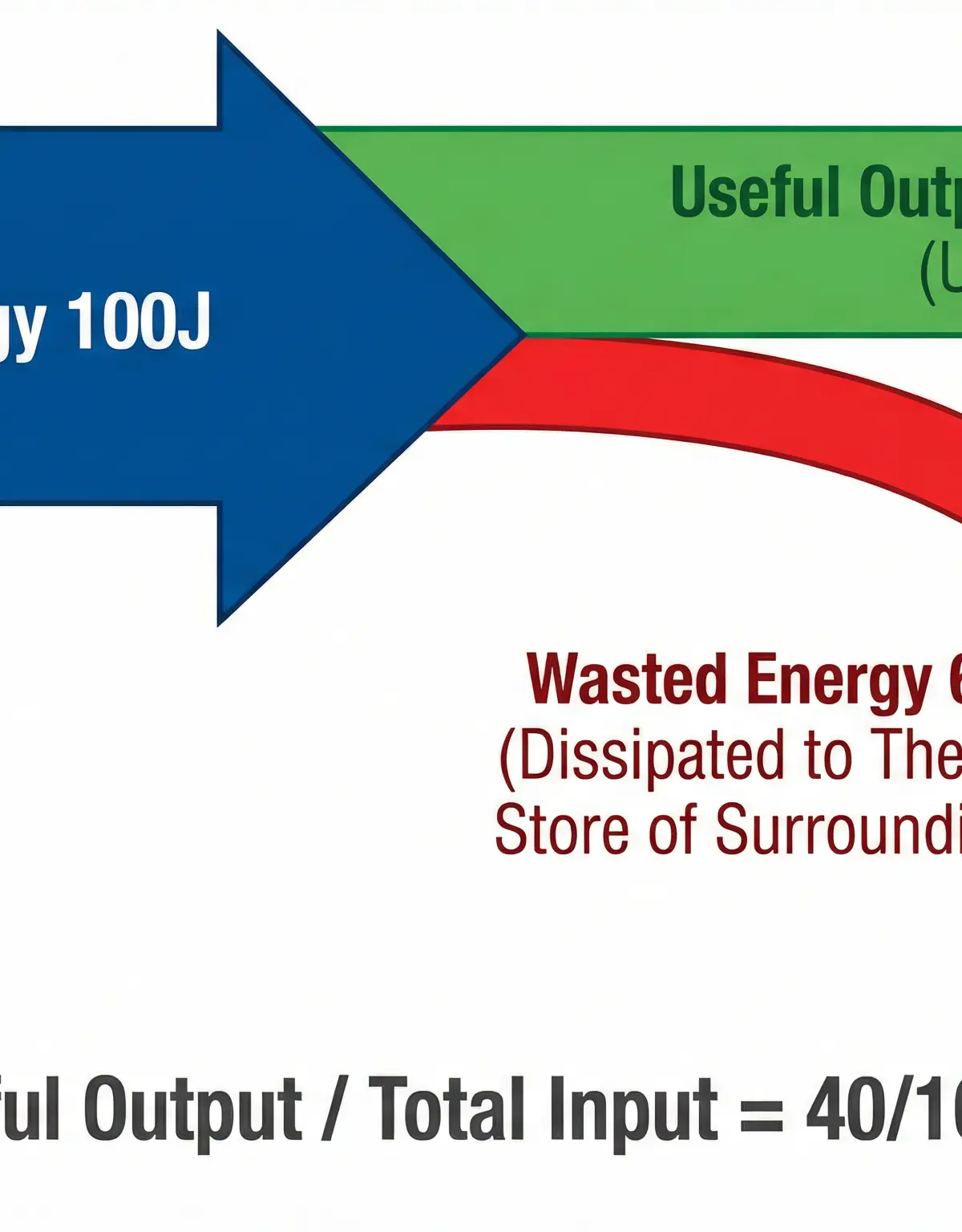
Key features of a Sankey diagram:
- The total input energy is a single arrow entering from the left.
- This arrow splits into two (or more) branches.
- The arrow pointing straight to the right represents the useful output energy.
- The arrow(s) curving away (usually downwards) represent the wasted energy.
- By the Principle of Conservation of Energy, the total width of the output arrows must equal the width of the input arrow.
Concept 5: Reducing Unwanted Energy Transfers
Since wasted energy reduces efficiency and costs money, a lot of engineering is focused on reducing it. For your GCSE, you need to know about reducing energy transfer by heating, and reducing energy transfer due to friction.
Thermal Insulation: To reduce the rate of energy transfer by heating, we use thermal insulators. In a house, this includes:
- Loft insulation: Fibreglass wool traps pockets of air. Air is a poor conductor, and trapping it prevents convection currents from forming, reducing the rate of energy transfer by both conduction and convection.
- Cavity wall insulation: Foam is squirted into the gap between the inner and outer walls of a house. This works in the same way as loft insulation, trapping air to reduce conduction and convection.
- Double glazing: Two panes of glass with a vacuum or a noble gas (like Argon) trapped between them. The vacuum prevents any transfer by conduction or convection. The gas is a poor conductor.
Lubrication: In any mechanical system with moving parts (like a car engine or a bicycle chain), friction acts between the surfaces. This does work, transferring energy from the kinetic store to the thermal store of the components, which then dissipates to the surroundings. To reduce this, a lubricant (like oil or grease) is applied. This creates a thin film between the surfaces, allowing them to slide over each other more easily. This reduces friction, meaning less energy is wasted as heat, and the system is more efficient.
Mathematical/Scientific Relationships
Here are the key formulas you need to know for this topic. Pay close attention to which ones are given on the formula sheet and which you must memorise.
-
Efficiency (using Energy)
Efficiency = Useful output energy transfer / Total input energy transfer- Must memorise
-
Efficiency (using Power)
Efficiency = Useful output power / Total input power- Must memorise
-
Work Done
Work Done (J) = Force (N) x Distance (m)- Given on formula sheet
-
Power
Power (W) = Energy transferred (J) / Time (s)- Given on formula sheet
Unit Conversions: A common trap in exams is using the wrong units. Always check and convert before you calculate!
- 1 kJ (kilojoule) = 1000 J (joules)
- 1 MW (megawatt) = 1,000,000 W (watts)
- Time must be in seconds for power calculations (e.g., 5 minutes = 5 x 60 = 300 s)
Required Practical: Thermal Insulation
This topic is linked to a required practical investigating the effectiveness of different materials as thermal insulators.
Apparatus:
- Kettle
- Several identical beakers (e.g., 250ml glass beakers)
- Lids for the beakers (with a hole for a thermometer)
- Thermometer or temperature probe
- Stopwatch
- Various insulating materials (e.g., bubble wrap, cotton wool, aluminium foil, newspaper)
Method:
- Boil water in a kettle. Safety: Handle boiling water with care.
- Measure a set volume of hot water (e.g., 200ml) and pour it into a beaker. This is your control beaker.
- Wrap a second beaker with one of the insulating materials, ensuring it is a set number of layers thick (e.g., 3 layers).
- Pour the same volume of hot water into this insulated beaker.
- Place the lids on both beakers and insert the thermometers.
- Record the starting temperature of the water in both beakers.
- Start the stopwatch and record the temperature of the water in each beaker every 2 minutes for a total of 20 minutes.
- Repeat the experiment for each different insulating material, always using the same number of layers and the same volume of water.
Expected Results:
You will observe that the temperature of the water in all beakers decreases over time. However, the temperature in the insulated beakers will decrease more slowly than in the control beaker. The beaker that maintains the highest temperature after 20 minutes is the one wrapped in the most effective insulator.
Common Errors & How to Avoid Them:
- Volume of water is not the same: Use a measuring cylinder to ensure the volume is identical in each beaker. This is a key control variable.
- Starting temperature is different: Try to pour the water into the beakers as quickly as possible to ensure a consistent starting temperature.
- Forgetting a lid: A lot of energy is lost by evaporation and convection from the surface. A lid significantly reduces this.
- Inconsistent thickness of insulation: Use a set number of layers for each material to ensure a fair test."
Worked Examples
3 worked examples — open one to explore the question and available guidance.
Practice Questions
Test your understanding — click to reveal model answers
A kettle is used to boil water. The kettle has a power rating of 2.5 kW. It takes 2 minutes to boil the water. The increase in the thermal energy of the water is 240,000 J. Calculate the efficiency of the kettle.
Hint: First, calculate the total energy supplied to the kettle in joules. Remember to convert power to watts and time to seconds.
Describe how a vacuum flask is designed to reduce the rate of energy transfer by heating.
Hint: Think about the different ways heat can be transferred (conduction, convection, radiation) and how the flask's features combat each one.
State the Principle of Conservation of Energy.
Hint: What is the fundamental rule about what can and cannot happen to energy?
A 1000 W microwave is used for 3 minutes. It transfers 150,000 J of energy to the food. Draw a Sankey diagram for the microwave.
Hint: First, calculate the total input energy. Then, calculate the wasted energy. The width of your arrows should be proportional to these values.
Explain why a thick winter coat keeps you warmer than a thin t-shirt.
Hint: Think about insulation and the rate of energy transfer.
Test your understanding of Energy Transfers and Efficiency
Active recall beats re-reading. Take an instant quiz now to test what you’ve learned and lock it into long-term memory.
7 days Premium · Then free forever · No card, no charge